Author: Curry, Shenchao TechFlow
Original title: a16z raised $15 billion, saying it will make America win
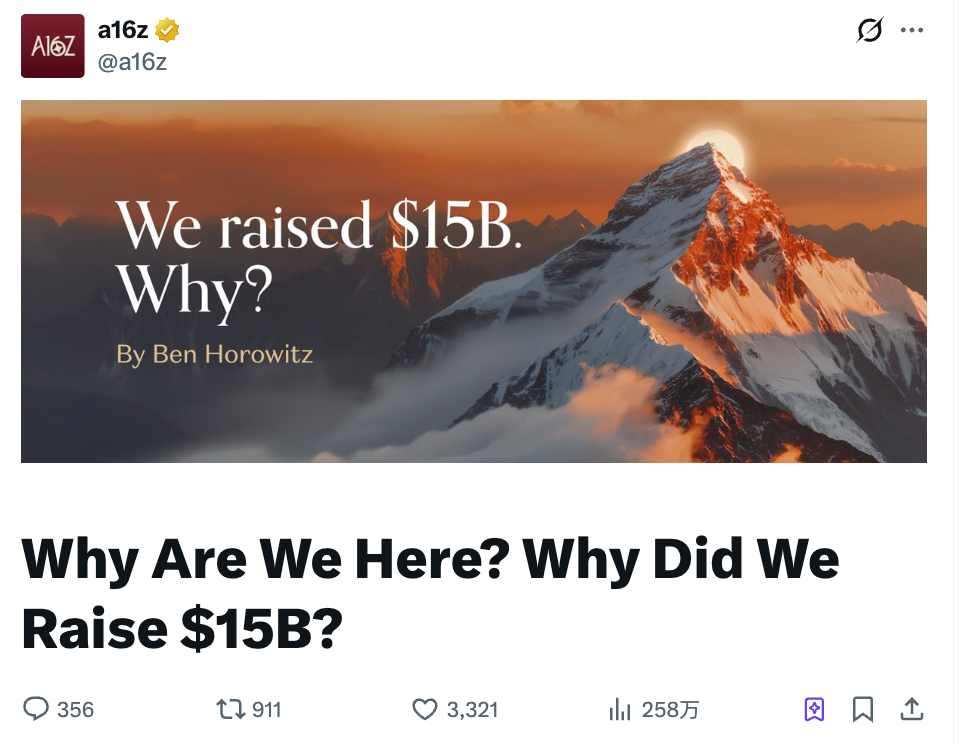
Last Friday, a16z announced the completion of a $15 billion fundraising.
Note: It's fundraising, not investment. It's LPs giving them money to invest in others.
How exaggerated is this number?
In 2025, the entire U.S. VC industry raised $66.1 billion, an 8-year low. a16z alone took nearly 20% of that.
The industry is in winter, they are stockpiling.
But why are LPs willing to give them money in the cold winter?
Probably because they have a record of making money in winter.
Invested in Facebook in 2009, just after the financial crisis, when no one dared to act. Invested in Coinbase in 2013, when most people thought Bitcoin was a geek toy. In May 2022, Bitcoin fell 55%, Coinbase's stock price fell 80%, and a16z raised a $4.5 billion Crypto fund at that time.
The comment section was laughing at them for catching the falling knife.
Last year, The Information reported that this fund's returns surged. The reason is simple: their investment in Solana rose from $8 to $180 at the time.
"Be fearful when others are greedy" is often just a鸡汤 (chicken soup for the soul).
But if you are greedy every time others are fearful, and you bet right every time, it becomes a:
Credit record.
Back to this $15 billion, how will a16z spend it?
$6.75 billion of it will be invested in growth-stage companies, adding fuel to projects that have already proven themselves and are ready to expand further. $1.7 billion for application layer, $1.7 billion for underlying technology, $700 million for biopharma.
And $1.176 billion is invested in a theme called "American Dynamism".
Translated directly, it sounds like a slogan created by a high-end think tank. Look at what they have already invested in under this theme, and you understand the real meaning:
Making America able to build things again.
Build what? Weapons.
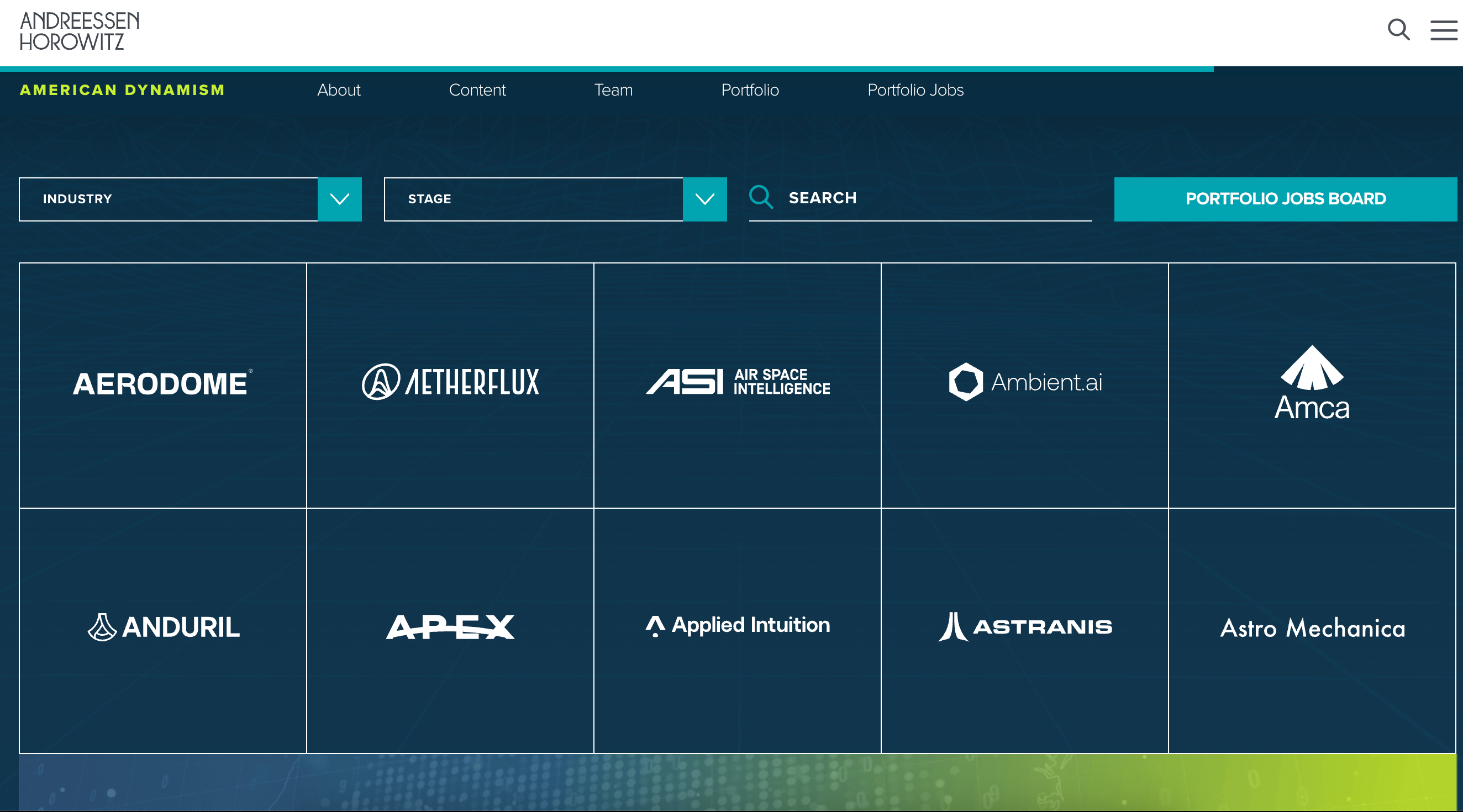
Companies in this part of the portfolio, like Anduril making autonomous weapon systems, Shield AI making military drones, Saronic making unmanned ships, Castelion making hypersonic missiles. These companies have one thing in common: their biggest customer is the Pentagon.
a16z themselves cited a statistic: if a conflict with China breaks out in the Taiwan Strait, the U.S. missile stockpile would be exhausted in 8 days, and it would take 3 years to replenish.
In the eyes of the U.S., this is not alarmism, it's business.
The U.S. military-industrial system is aging, Lockheed Martin and others are too slow and expensive, the Pentagon needs new suppliers. a16z is betting on this gap, using VC money to incubate a batch of "software-defined weapon" companies, waiting for them to grow up and sell to the Department of Defense.
$1.176 billion isn't a huge amount, but it bets on a judgment. America is going to restart manufacturing, and it starts with the military industry.
Betting on the military industry requires more than just money, it requires connections.
a16z doesn't lack this.
At the end of 2024, Marc Andreessen called himself an "unpaid intern" for the DOGE (Department of Government Efficiency), helping this department recruit people, reportedly spending half his time at Mar-a-Lago advising Trump.
The DOGE was dissolved ahead of time last November, but a16z's connections remain. Their employee number one, Scott Kupor, is now the Director of the U.S. Office of Personnel Management.
Trump just said this week that next year's defense budget will be increased to $1.5 trillion.
Many VCs invest in the military industry, but few can invest in companies while simultaneously influencing policy.
This might be one of a16z's real moats—not just investing, but also participating in rule-making. Investing in missile companies while helping the government decide who gets the contracts.
It feels a bit like being both the referee and the player.
You could call it a conflict of interest, or you could call it resource integration. Anyway, LPs don't care, they only care about returns.
Many people know a16z because of Crypto.
In this $15 billion, Crypto is not listed separately; it's tucked into the $3 billion "Other".
Has crypto been abandoned?
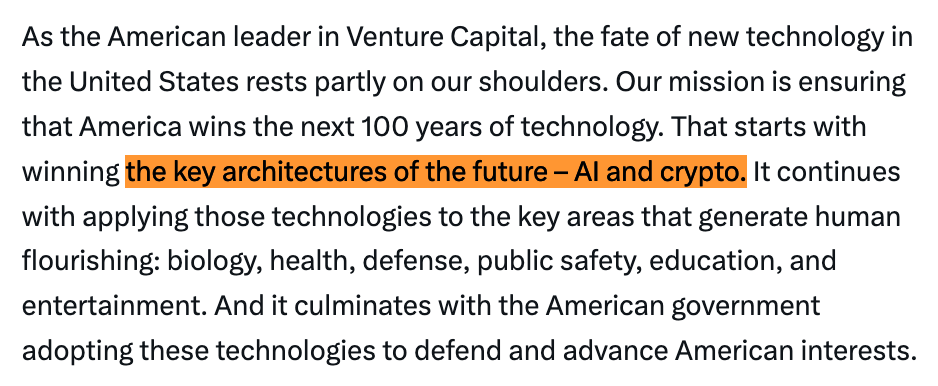
No. Ben Horowitz wrote clearly in the blog, "AI and Crypto are the key architectures of the future."
It's just that for a16z, Crypto no longer needs a separate fund.
Their first Crypto fund in 2018 was $350 million. By 2022 it grew to $4.5 billion. Now? They invest directly from the main fund, putting it in the same pool as AI, military, energy.
What does this mean?
It means Crypto, in their eyes, has transitioned from a "new track" to infrastructure.
Exchanges are infrastructure, public chains are infrastructure, DeFi protocols are infrastructure. Just like AWS, like Nvidia, like missiles, they are all underlying things.
They used to be a Crypto VC, now they are an infrastructure VC.
The vision has expanded.
For the Crypto industry, this is actually good news. Being categorized as "Other" seems like a demotion, but it's more like graduation. It means this thing no longer needs separate explanation, LPs understand it, and Western regulators are beginning to accept it.
Of course, this also means Crypto projects have to compete for money from the same pool as AI and military projects.
The competition is fiercer.
Also, Ben wrote a sentence in the blog that Sequoia might find comfortable:
"As a leader in American venture capital, the fate of new technology rests partly on our shoulders."
Sequoia has been around for 50 years, a16z is only 16 years old. But now both manage around $90 billion, tied for first place globally.
Why?
The VC business essentially sells two things: vision and resources.
Vision is hard to prove. You say you see accurately, you have to wait ten years to know. But resources are different; resources can be accumulated.
What a16z has been doing all these years is building up resources.
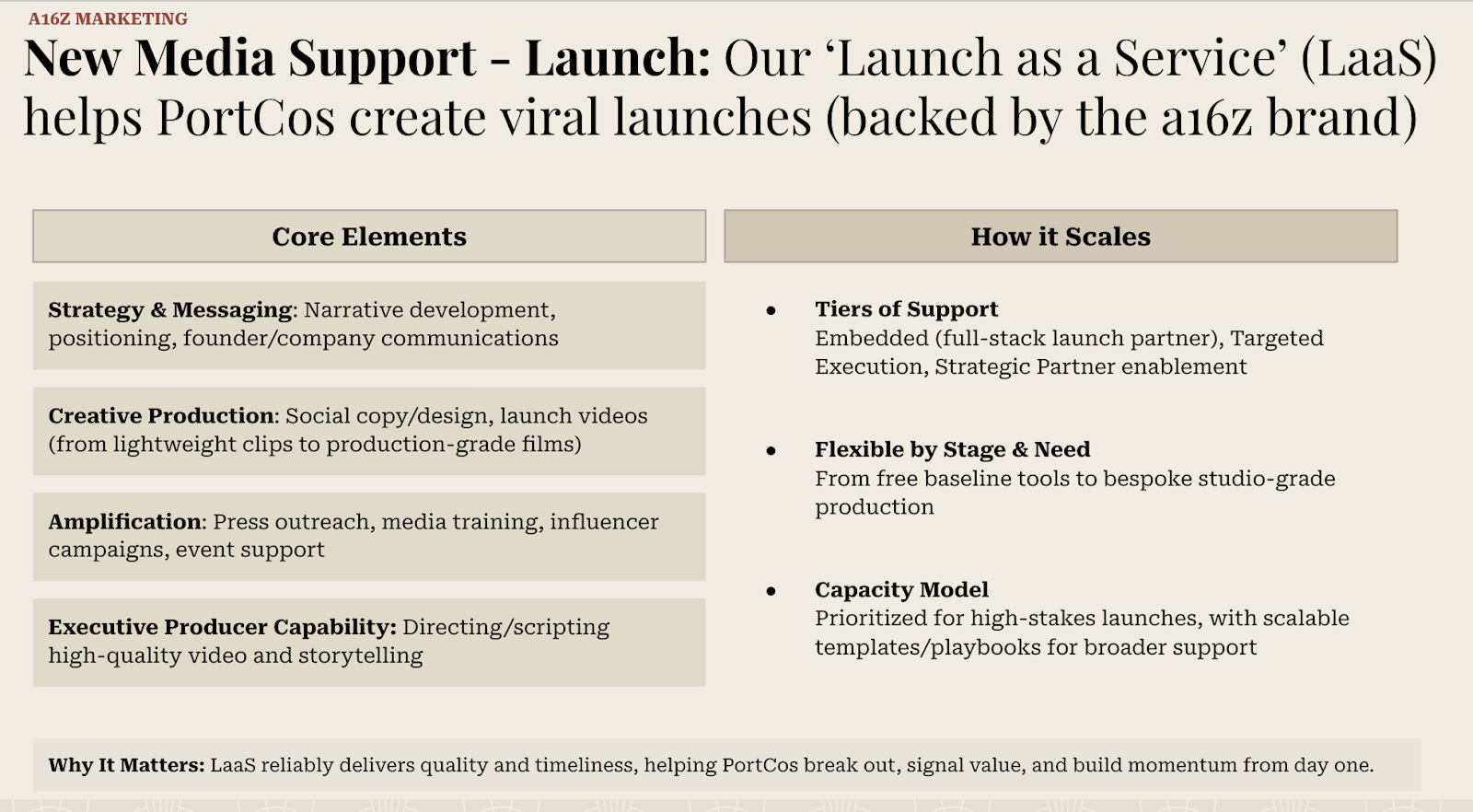
They have the strongest content team in the industry—podcasts, blogs, newsletters—output rivaling a media company. Entrepreneurs get washed over by a16z's worldview before they even get the money.
They have connections in Washington. Not just knowing a few politicians, but directly placing people in the government.
They also have the advantage brought by scale itself. When you manage $90 billion, you can write a $1 billion check to SpaceX, small funds simply don't have that capability.
It's not just about investing accurately, it's about making yourself irreplaceable.
Entrepreneurs come to you not because you have more money, but maybe because you can help them secure government contracts. LPs come to you not because your returns are higher, but because others don't have your policy influence.
This playbook is hard for other VCs to replicate.
Of course, there are risks here.
Part of a16z's current strategy is tied to American national fortune. AI must win, the military industry must rise, American manufacturing must revive. If these judgments are wrong, a large part of that $15 billion will be lost.
a16z is betting not just on the technology cycle, but on the political cycle. This cycle is probably harder to predict than the technology cycle.
But then again, LPs are willing to give them $15 billion, indicating the market believes this judgment.
Or, in an uncertain world, a16z provides a kind of certainty:
We know how to turn money into influence, and then turn influence into returns. Invest when others dare not, bet when others don't understand. Then wait for the cycle to turn, and harvest trust.
Therefore, this $15 billion can be understood as a vote of confidence from LPs to a16z.
Next, let's see how a16z bets on America.
Twitter:https://twitter.com/BitpushNewsCN
Bitpush TG Discussion Group:https://t.me/BitPushCommunity
Bitpush TG Subscription: https://t.me/bitpush