From Airdrop Myth to King of Derivatives: A Look Back at Hyperliquid's 2025 Conquest

marsbitPublished on 2025-12-12Last updated on 2025-12-12

Abstract

Reviewing crypto's growth in 2025, Hyperliquid stands out. It began the year with an epic airdrop and strong price performance, capturing attention. By year's end, it transformed into a top-four revenue-generating platform in crypto, earning over $650M and at one point capturing 70% of all perp trading volume. Its success was no accident. In Q1, it solidified its reputation by being first to list new assets like the TRUMP perp and launched HyperEVM, a smart contract layer. Q2 saw explosive growth: HYPE token surged 4x from April lows, and HyperEVM's TVL grew from $350M to $1.8B. The platform gained mainstream media coverage. In Q3, major wallets like Phantom and MetaMask integrated via Hyperliquid's builder codes, routing $158B in volume and earning partners nearly $50M. A high-profile stablecoin bid war was won by Native Markets, aligning with Hyperliquid's bootstrapped ethos. However, new competitors like Aster and Lighter emerged with aggressive airdrops. Q4 brought permissionless listings via HIP-3, enabling new markets like stock perps and yield-bearing collateral. Yet, HYPE fell nearly 50% from its September peak due to market conditions, a rare ADL event during a crash, and the start of team token unlocks. As perps go mainstream in 2026, Hyperliquid's true test begins. Its success came from building a superior product and ecosystem without shortcuts. Maintaining leadership will require doing it all over again in a crowded field.

Source: Bankless

Author: David Christopher

Original Title: Hyperliquid & The Year Perps Caught Fire

Compiled and Arranged by: BitpushNews

Looking back at the growth of the crypto industry in 2025, Hyperliquid is an unavoidable focal point.

The exchange ended 2024 with an epic airdrop and price performance, attracting a large number of crypto Twitter users to pay attention to the product once again.

By the end of 2025, it had completely transformed—becoming a platform that broke the mold, ranking fourth in revenue across the entire crypto ecosystem with total revenue exceeding $650 million, and at one point capturing 70% of the perpetual futures trading volume.
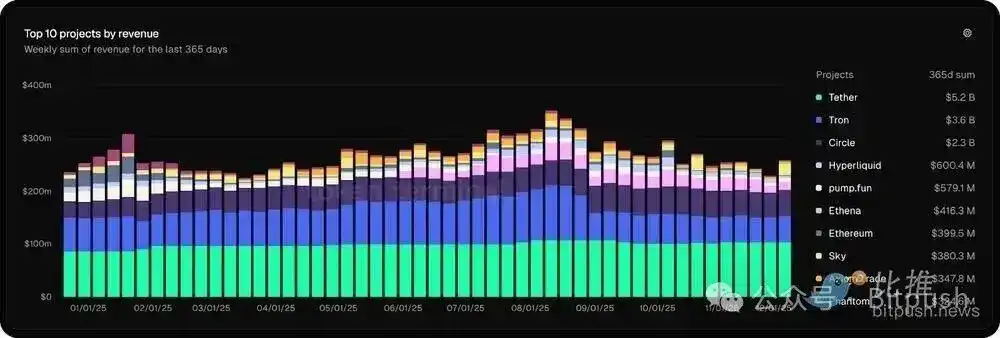
If you haven't been tracking Hyperliquid's every step, this breakthrough success might seem to have come out of nowhere. But its path to conquest was the product of meticulous design, unconventional growth strategies, and well-deserved external recognition.

What follows is a complete review of Hyperliquid's journey in 2025 (and why it will be truly tested in 2026):

Q1 2025: The Crypto-Native Advantage

Hyperliquid's year of rapid growth began with a profound reminder of what it means to be "truly in tune with the industry's pulse."

When the TRUMP token launched in January, Hyperliquid listed perpetual futures for it almost immediately, beating other exchanges to the punch and starting a winning streak as the "go-to venue for pre-launch token trading."

Of course, its ability to act quickly was partly because it wasn't hindered by the "corporate guardrails" that large exchanges use to protect users and the company.

But a crucial factor was its firm "insider knowledge"—its team was so deeply intertwined with on-chain dynamics that it could spot opportunities and recognize the advantage of being first to list these tokens. This solidified Hyperliquid's reputation as the preferred place to trade new assets before the established giants could react.

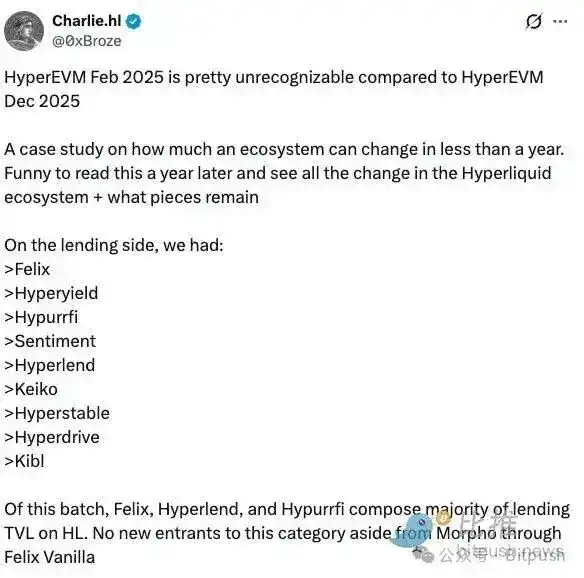
In February, HyperEVM was released—a general-purpose smart contract layer built on top of HyperCore (Hyperliquid's exchange engine). Although it took some time to find its footing, its success came without any top-down incentive programs. This meant that when it gained traction in Q2, it had already built a core user base who stayed not to "farm" rewards, but because they believed in the chain's vision and wanted to leverage its unique features (such as interoperability with HyperCore), rather than just extracting incentives.
Q2 2025: The Breakout

Market attention arrived faster than most expected. Beyond the HYPE token rising nearly 4x from its April lows, by May Hyperliquid captured 70% of all on-chain perpetual futures trading volume—a staggering figure for a platform with zero VC backing and zero token incentives.

The HYPE token's highs, the explosive growth of HyperCore activity, and the development of the HyperEVM ecosystem all spread the Hyperliquid story.

As the market came back to life, Hyperliquid's smooth user experience (UX) and deep liquidity captured a massive amount of order flow, with total trading volume climbing to $1.5 trillion.

As mentioned, HyperEVM also hit its stride simultaneously, with its Total Value Locked (TVL) growing from $350 million in April to $1.8 billion by mid-June, fueled by the launch of projects (like Kinetiq, Felix, and Liminal) and users exploring new earning opportunities—all while continuously burning HYPE tokens in the background.

Amid this rapid growth, Hyperliquid seemed to be everywhere.

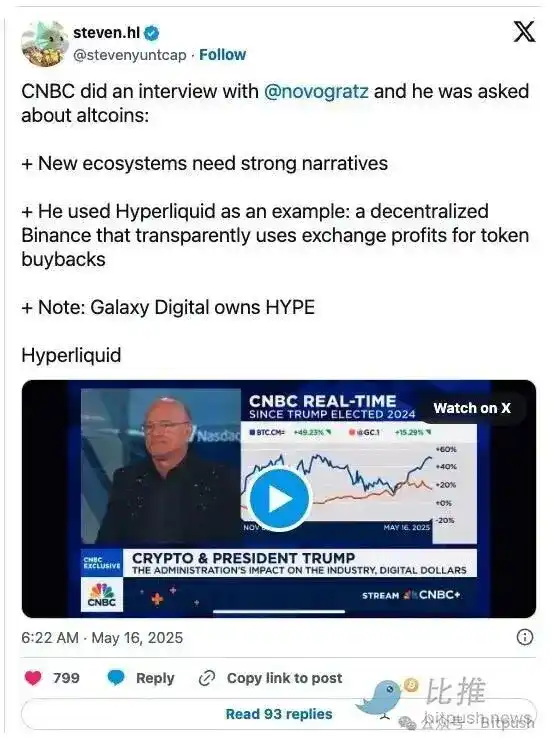
It appeared on national television, was covered by Bloomberg, and became a focal point in CFTC policy discussions. This exchange became impossible to ignore.
Q3 2025: Peak Momentum and the Beginning of Fragmentation

Q3 began with a signal that Hyperliquid's infrastructure was becoming indispensable even outside its own ecosystem.

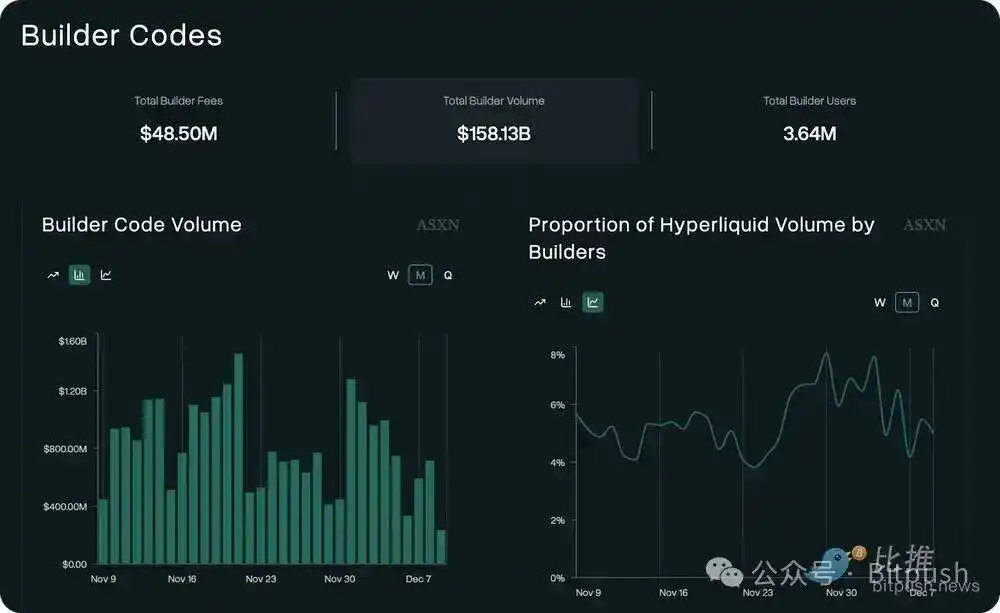
The Phantom wallet bypassed Solana-based perp platforms, choosing instead to integrate Hyperliquid via builder codes. Builder codes are a Hyperliquid mechanism that allows external platforms to earn fees by routing trades to HyperCore.

Rabby followed shortly after. Then MetaMask.

A host of mobile trading apps went live via builder codes.

All told, "partners" have earned nearly $50 million in fees through these integrations, routing $158 billion in trading volume.
Then, in September, the USDH bidding war erupted—which showed just how valuable and prominent Hyperliquid had become.

The problem was simple: Hyperliquid held about 8% of the total Circle USDC supply in its bridge, leaking roughly $100 million in annual yield to a direct competitor (Coinbase), while its own ecosystem couldn't recapture that value. Launching a native stablecoin could solve this, potentially redirecting $200 million in annual revenue back to Hyperliquid.

A proposal to launch a stablecoin was invited, and heavyweight contenders entered the bidding.

Ethena offered a $75 million growth commitment and institutional partnerships. Paxos dangled PayPal and Venmo integration, even getting PayPal to tweet about Hyperliquid.

But in the end, Native Markets won the bid—a team led by highly respected HYPE contributor Max Fiege, former Uniswap Labs COO MC Lader, and Paradigm researcher Anish Agnihotri.

Why did a smaller, less capitalized team beat these giants? Because they were more favored, more aligned with Hyperliquid's ethos: bootstrapped, aligned in goals, and ready to build something truly organic—just as Hyperliquid itself was built.
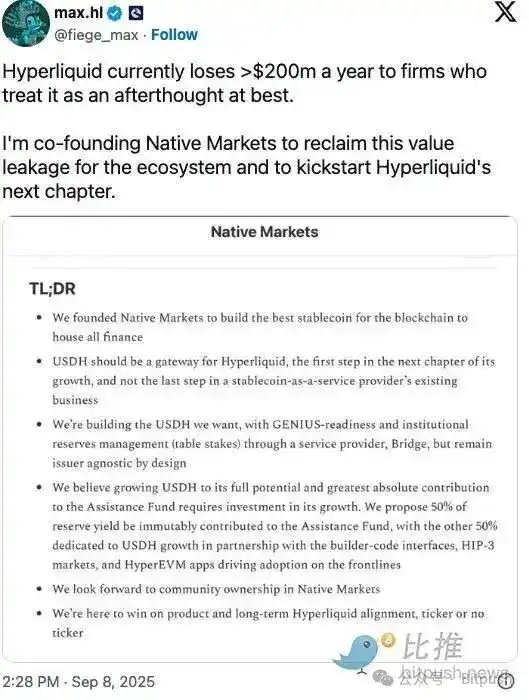
The ripple effects extended beyond Hyperliquid itself. MegaETH announced its own native stablecoin plans shortly after. Sui followed suit in November.

However, USDH also marked the peak of the HYPE token in mid-September—and the moment competition began to show. Aster (a Binance-backed exchange) and Lighter (an Ethereum L2 perp platform) both launched with aggressive airdrop campaigns. Trading volume continued to fragment, Hyperliquid's market share split, and at the time of writing stands at just 17.1%.
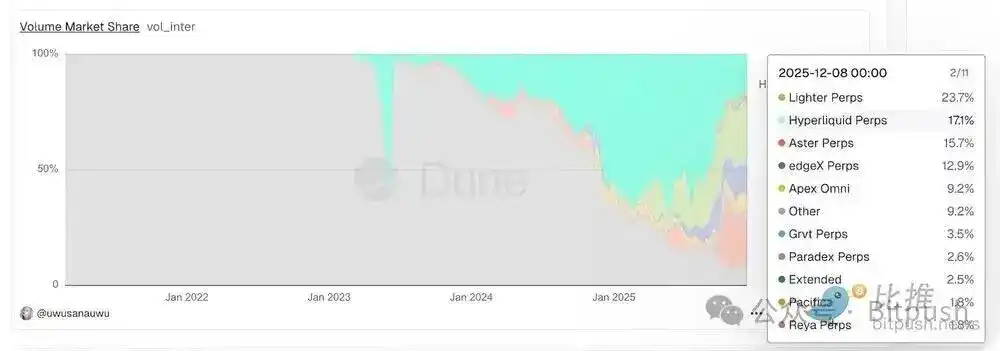
Q4 2025: Maturation and Growing Pains

In October, the long-awaited HIP-3 went live, opening permissionless listings on HyperCore, driving the exchange's expansion and decentralization.

Anyone staking 500,000 HYPE can now deploy custom markets, such as:

  • Equity perps from Unit's Trade.xyz and Felix Protocol
  • Perp markets using yield-bearing collateral (like sUSDE) from protocols like Ethena
  • Markets offering synthetic exposure to private companies like SpaceX or Anthropic through platforms like Ventuals

However, despite the HIP-3 launch, the HYPE token price fell nearly 50% from its September peak.

Why? Beyond market conditions and competition, two things stood out.

First, the quarter saw Hyperliquid experience its first ADL (Auto-Deleveraging) event in over two years. During the market crash on October 10th, over-leveraged positions burned through margin faster than the liquidation engine and HLP (Hyperliquid Liquidity Provider) could absorb. The protocol triggered over 40 auto-deleveragings in 12 minutes, forcibly reducing the most profitable positions to rebalance the books. While some argued the affected positions were still "closed in the green," others contended the mechanism liquidated more than was necessary to cover the bad debt. Yes, the system remained solvent without external capital, but Hyperliquid, like the broader market, might need time to recover from this event.

Second, in November, team token unlocks began. Although the total unlock was lower than some expected, this vesting schedule likely also contributed to HYPE's underperformance. The sell-off volume was small—only 23% went to OTC desks, while 40% was re-staked—but the pace of future unlocks remains unclear. My read is the core team is likely still determining the schedule to balance contributor fairness with ecosystem health. But for a protocol known for transparency and "honesty," this lack of clarity can create market unease.

Hyperliquid's first unlock released 1.75 million HYPE after the lock-up period ended, but the pace of future team unlocks has not been fully disclosed.

The Proving Ground for Perpetuals

Despite the cooldown in markets and trading activity, we shouldn't overlook, when trying to understand Hype's underperformance, that the perp ecosystem has evolved profoundly alongside Hyperliquid's own development.

Lighter and Aster are just two examples of on-chain competition. While their volumes might be inflated by airdrop farming, they do offer real alternatives.

In the off-chain realm, Coinbase's perp product will soon compete with Robinhood's moves in the space. As perps continue going mainstream, more competitors will emerge.

In other words, Hyperliquid is in its proving ground, and it will continue into 2026.

The question isn't whether it had a remarkable 2025—it did. The question is whether, as the space gets crowded, the exchange can prove that its path to growth—through integrations like builder codes and decentralized models like HIP-3—remains an advantage.

What got them here was building a better product and a better ecosystem, without taking shortcuts. What keeps them ahead will be doing it all over again.

Related Questions

QWhat were the key factors behind Hyperliquid's rapid growth and success in 2025?

AHyperliquid's success was driven by its crypto-native agility in quickly listing new assets like TRUMP tokens, the launch of HyperEVM which built an organic user base, superior user experience and deep liquidity capturing significant trading volume, and strategic integrations via builder codes with major wallets like Phantom and MetaMask.

QHow did Hyperliquid's market share in perpetual trading change throughout 2025?

AHyperliquid reached a peak of 70% market share in on-chain perpetual trading volume by May 2025. However, due to increased competition from platforms like Aster and Lighter with aggressive airdrop campaigns, its market share declined to 17.1% by the end of the year.

QWhat was the significance of the USDH bidding war and who won it?

AThe USDH bidding war was significant because issuing a native stablecoin would allow Hyperliquid to recapture an estimated $200 million in annual revenue that was leaking to competitors. Native Markets, a team led by respected HYPE contributors, won the bid over larger players like Ethena and Paxos due to their alignment with Hyperliquid's bootstrap philosophy.

QWhat was HIP-3 and what impact did it have on the Hyperliquid ecosystem?

AHIP-3 was a proposal that enabled permissionless listing on HyperCore, allowing anyone staking 500,000 HYPE to deploy custom markets. This led to the expansion of the exchange with new offerings like stock perps, yield-bearing collateral markets, and synthetic exposure to private companies, furthering its decentralization.

QWhat challenges did Hyperliquid face in Q4 2025 that contributed to the decline in HYPE token price?

AThe HYPE token price declined nearly 50% from its September peak due to a combination of factors: increased competition, a market-wide ADL (Auto-Deleveraging) event that shook confidence, and the beginning of team token unlocks which created uncertainty about future sell pressure, despite the actual initial sell-off being relatively small.

Related Reads

Stuck Polymarket: The Real Test After Riding the Traffic Boom Has Arrived

Polymarket, a leading prediction market platform, is facing significant technical challenges as its growth outpaces its current infrastructure on Polygon. Users are experiencing laggy transactions, unresponsive orders, and delayed confirmations, severely impacting the trading experience. In response, DeFi Engineering VP Josh Stevens outlined a comprehensive engineering overhaul. The plan includes reducing on-chain data delays, fixing order cancellation issues, rebuilding the central limit order book (CLOB), improving website performance, and developing a unified SDK and API. A major revelation was the ongoing "chain migration," indicating a potential move away from Polygon. The core issue is that Polymarket has evolved from a simple prediction market into a high-frequency trading platform, making Polygon's limitations—such as block space, gas fees, and block time—a ceiling for further growth. The migration is not just a simple chain switch but a fundamental rebuild of its trading system to support more complex products like perpetual contracts (Perps). This announcement has sparked competition among chains like Solana, Sui, and Algorand, all vying to host Polymarket. For Polygon, losing this key application, which contributes significantly to its gas fee revenue, would be a major setback. The real test for Polymarket is no longer attracting users but proving it can provide a stable, reliable trading environment that retains them.

Odaily星球日报3m ago

Stuck Polymarket: The Real Test After Riding the Traffic Boom Has Arrived

Odaily星球日报3m ago

Lowering Expectations for BTC's Next Bull Market

The author, Alex Xu, explains his decision to significantly reduce his Bitcoin holdings (from full to ~30% of his portfolio) during the current bull cycle, citing a lowered long-term outlook for BTC's price appreciation in the next cycle. He outlines six key reasons for this reduced expectation: 1. **Diminished Growth Drivers:** The narrative of exponential user adoption has largely played out with institutional ETF adoption. The next major growth phase—adoption by sovereign national reserves or central banks—seems unlikely in the near future. 2. **Personal Opportunity Cost:** More attractive investment opportunities have emerged in other assets, such as undervalued companies. 3. **Industry-Wide Contraction:** The broader crypto industry is struggling, with most Web3 business models (SocialFi, GameFi, DePIN) failing. This overall萧条 (depression) reduces the fundamental demand and consensus for Bitcoin. 4. **Strain on Major Buyer:** MicroStrategy, a major corporate buyer of BTC, faces rising financing expenses for its debt, which could slow its purchasing rate and create significant marginal pressure on the market. 5. **Increased Competition from Gold:** The emergence of "tokenized gold" has closed the functional gap (portability, divisibility) between physical gold and Bitcoin, offering a strong competitor in the non-sovereign store-of-value space. 6. **Security Budget Concerns:** The block reward halving continues to exacerbate the long-standing issue of funding Bitcoin's network security, with new fee source explorations like Ordinals and L2s largely failing. The author's decision to hold a significant (though reduced) position reflects a cautious, not bearish, outlook. He remains open to increasing his exposure if the fundamental reasons for his skepticism change or if new positive catalysts emerge.

marsbit42m ago

Lowering Expectations for BTC's Next Bull Market

marsbit42m ago

Can Iran 'Control' the Strait of Hormuz?

Iran has announced a comprehensive plan to assert control over the strategic Strait of Hormuz, a critical global oil shipping chokepoint. The proposed measures include requiring all vessels to obtain Iranian permission for passage, imposing fees for security, environmental protection, and navigation management—preferably paid in Iranian rials—and absolutely banning Israeli ships. Vessels from countries deemed hostile by Iran’s top security bodies may also be barred. Analysts suggest Iran’s motives are multifaceted: increasing pressure on the U.S. and Israel by leveraging control over oil transit to influence global prices and inflation; creating a new revenue stream, potentially exceeding $7.7 billion annually, to counter Western sanctions and support postwar reconstruction; and using transit permissions as bargaining chips in future negotiations, notably with the U.S. However, the plan faces significant practical and diplomatic challenges. Enforcing comprehensive interception and fee collection in the busy waterway, patrolled by international military forces, would be difficult. The U.S. has already countering with a blockade of Iranian ports and threats to intercept any ship paying fees, potentially strangling Iran’s oil exports and fee revenue. Broad international opposition, led by European and Gulf states, and legal controversies further complicate implementation. The proposal may ultimately serve more as a negotiating tactic than a feasible policy, with its execution remaining highly uncertain.

marsbit1h ago

Can Iran 'Control' the Strait of Hormuz?

marsbit1h ago

Trading

Spot
Futures

Hot Articles

Discussions

Welcome to the HTX Community. Here, you can stay informed about the latest platform developments and gain access to professional market insights. Users' opinions on the price of S (S) are presented below.

活动图片