FRNT, the First State-Backed Stablecoin in the U.S.: Can It Save Wyoming from Energy Decline?

marsbitPublished on 2026-01-09Last updated on 2026-01-09

Abstract

Wyoming, the least populous U.S. state, has launched $FRNT, the first state government-backed dollar stablecoin, issued on Solana and six EVM-compatible chains. This move is a response to a deep fiscal crisis triggered by the decline of its coal industry, which once funded its tax-free status but has seen revenue halve since its peak. Facing an urgent need to diversify, Wyoming is leveraging its history of legislative innovation—like pioneering LLCs in 1977—to become a crypto hub. Previous steps included creating the SPDI banking license for crypto custodians and legalizing DAOs. The $FRNT stablecoin is 102% backed by U.S. Treasuries and cash, managed by Franklin Templeton, with interest funding public education. However, the state suffers from stark inequality. Wealthy enclaves like Jackson Hole contrast with widespread economic hardship, raising questions about who truly benefits from such financial innovations. While aiming to build a digital future from the ashes of coal, Wyoming’s experiment highlights the tension between technological ambition and social reality.

On the map of the United States, Wyoming is often an overlooked "Western asset."

When mentioned, most people's first thought is the erupting Old Faithful in Yellowstone National Park or the perpetual snow atop the Grand Teton peaks.

It is the least populous state in the U.S., with less than 600,000 people living across nearly 260,000 square kilometers—a number even smaller than the population of a distant suburban town in Shanghai.

In literary and cinematic memory, it is the cruel wilderness described by Annie Proulx as "unfixable, only endurable," the mountains that trapped the struggling cowboys in "Brokeback Mountain," and the blood-stained border town besieged by a blizzard in Quentin Tarantino's "The Hateful Eight."

It is contradictory and distinct: deeply conservative, it is the "deepest red" state in the U.S., with the Republican Party monopolizing power for forty years. In the 2024 U.S. election, over 70% of voters cast their ballots for Trump. Yet it has also been at the forefront of progress, becoming the "Equality State" as early as 1869 when it was the first to grant women the right to vote.

But Wyoming is by no means a financial desert. Every summer, the world's "most powerful" people gather here: at the serene Jackson Hole resort in Wyoming, the global central bank annual meeting hosted by the Federal Reserve Bank of Kansas City takes place. From Greenspan (the 13th Chair of the Federal Reserve) to Powell, every key turning point in global monetary policy has been set amidst these snow-capped meadows.

It is this aloof and unique "Western spirit" that once again thrust Wyoming into the spotlight in early 2026.
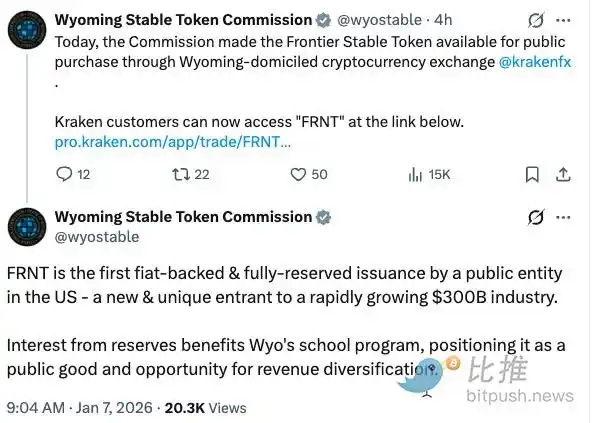
On January 7, local time, the state officially announced the launch of the $FRNT stablecoin, initially released on the Solana blockchain and supporting six EVM-compatible chains. This is the world's first dollar stablecoin backed by "state government credit."

Mining for Light: The Path to Regeneration in Energy Transition

Wyoming's radical move stems from a deep fiscal anxiety: the "underground wealth" that has sustained this land for a century is drying up.

As the energy heartland supplying 40% of the nation's coal, it once created the myth of a "tax-free paradise" through mineral resource taxes: residents pay no personal income tax, and businesses pay no corporate tax.

One key reason is that, thanks to the continuous export of resources from the Powder River Basin, this sparsely populated state generated astonishing wealth: its per capita GDP has long ranked among the top ten in the U.S., rivaling New York and California during peak energy years.

This prosperity once gave Wyoming the confidence to refuse to levy personal income tax, corporate tax, and estate tax. However, this is a fragile prosperity built on heavy industry.
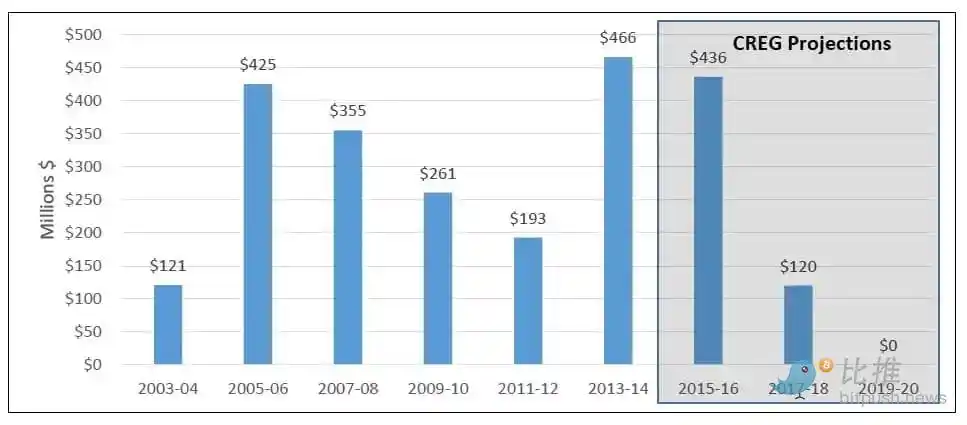
Since 2011, Wyoming's pillar industry began a decade-long "avalanche":

Ruthless market displacement: The rise of low-cost shale gas and renewable energy delivered a crushing blow to coal in terms of power generation costs.

Tightening environmental constraints: The advancement of federal carbon emission regulations (such as the Clean Power Plan) led to the closure of coal-fired power plants across the U.S.

A cliff-like fiscal gap: According to CREG official data cited by Wyoming Public Media, the state's coal resource tax plummeted from $290 million in 2011 to $170 million in 2022. In 2025, the state's coal production is expected to fall to the second-lowest point in history, only half of the peak in 2008. The "coal lease bonuses," once a significant source of school infrastructure funding, have even dropped to zero.
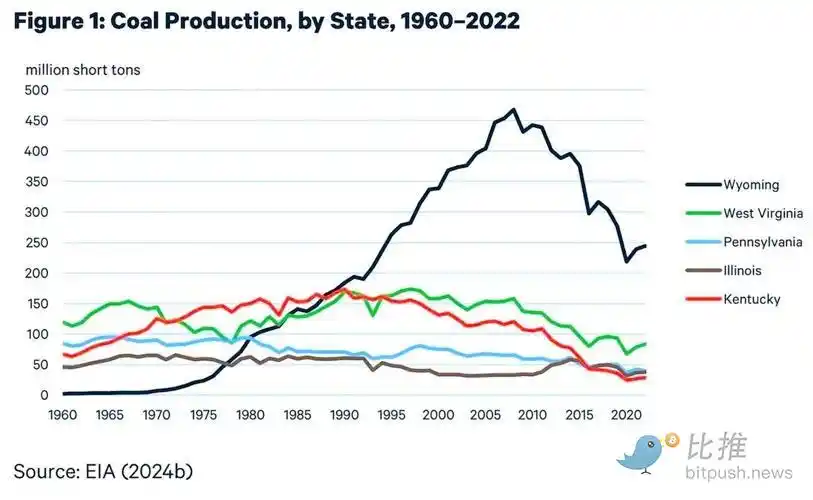
"If we don't shake things up, we'll be the next West Virginia (note: a traditional mining region in the U.S. that became one of the poorest states after the coal industry declined)."—This visceral fear has instilled a sense of urgency even in the most conservative cowboy politicians.

They realized that since they cannot change the trend of energy transition, they must leverage Wyoming's core asset—its extremely liberal business legislation.

In fact, Wyoming's innovative基因 has precedent. In 1977, it pioneered the LLC (Limited Liability Company), now the most popular business entity in the U.S.

Starting in 2018, to save itself, this deeply "red" conservative state was forced to embark on a long journey of institutional innovation in the crypto world.

In 2019, Wyoming passed House Bill 74 (HB 74), creating a new type of financial entity: the SPDI license (Special Purpose Depository Institution). This is not a traditional bank but an institution that "does not engage in lending and only handles custody and settlement."

In September 2020, the crypto exchange Kraken obtained the first SPDI license in the U.S., establishing Kraken Bank. This marked the first time crypto assets received "bank" status under state law.

In 2021, the state率先 passed the DAO Act, allowing code-controlled organizations to register as legal LLC entities.

As for the recently launched $FRNT, according to the Wyoming Stable Token Commission (WST) plan, the $FRNT stablecoin is over-collateralized by 102% in U.S. Treasuries and cash.

Reserve management is handled by the investment giant Franklin Templeton, which manages approximately $1.6 trillion in assets, while custody is provided by its affiliate, Fiduciary Trust Company International. Its core business logic is: the state government absorbs U.S. dollars, buys U.S. Treasuries, and the interest generated is directly allocated to the "School Foundation Fund" to support local public education.

Stablecoins: Who Actually Benefits?

Wyoming's leap actually marks the entry of the stablecoin赛道 into the second half: transitioning from a "credit game" of private companies to a "public good" at the government level.

In the past, discussions about stablecoins focused on the compliance risks of Tether or Circle; but in Wyoming's narrative, stablecoins are回归 to their essence—an extremely efficient, low-cost payment channel (settlement fees are typically below $0.01)—and they are beginning to take on public fiscal attributes.

However, this "digital highway" has encountered invisible barriers in the real world.
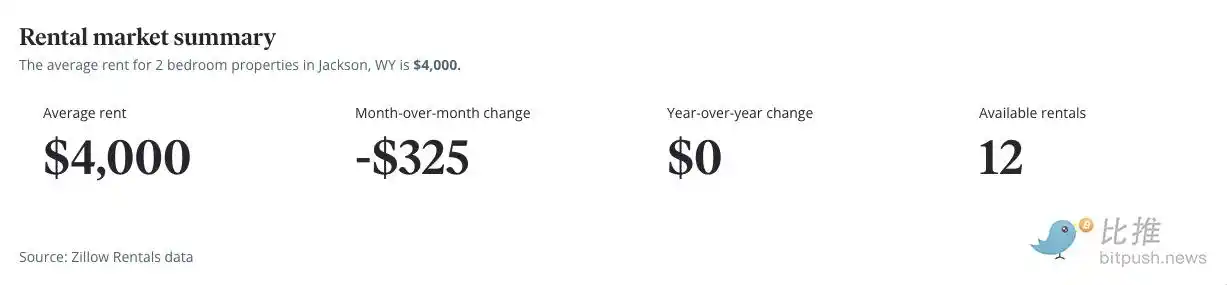
In Wyoming's Jackson Hole resort area, the monthly rent for an ordinary two-bedroom apartment has reached $4,000, 25% higher than in Los Angeles. Although the local per capita GDP ranks among the highest in the U.S., about 10% of residents still face food shortages. For blue-collar workers who catch the morning commute bus and rely on two or three jobs to make ends meet, "stablecoins" seem more like a distant technological concept.

This divide is not accidental but is meticulously designed and maintained. A state finance official admitted to prospect.org that through land acquisition and planning thresholds, the landscape here is shaped to be "poverty invisible."

Writer Annie Proulx once described the harshness of Wyoming's land; today, that harshness is folded by technology and capital into two layers of reality that do not penetrate each other.

On one side is the tax-avoidance utopia created by the wealthy in the mountains; on the other are the ordinary Americans who支撑这一切 but have nowhere to call home—their lives are quietly folded away in both reality and online narratives.

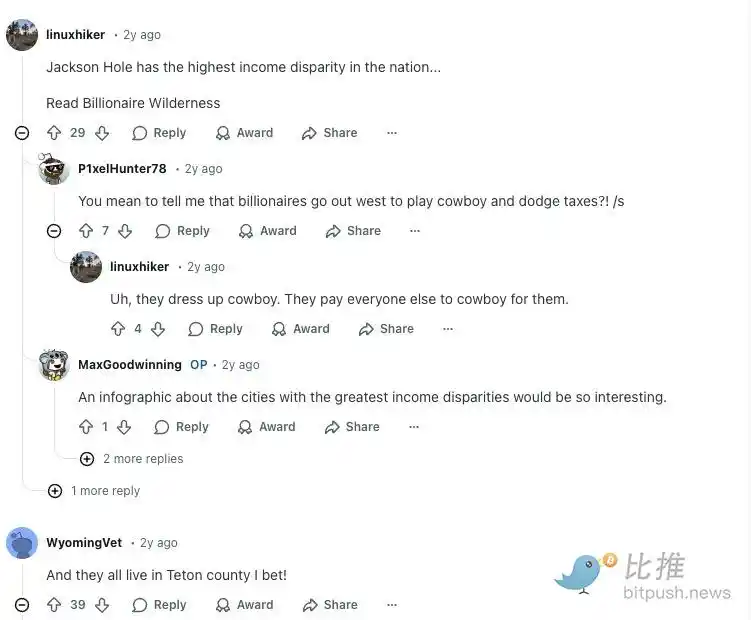
Looking through discussions about Wyoming on Reddit, complaints from locals are everywhere:
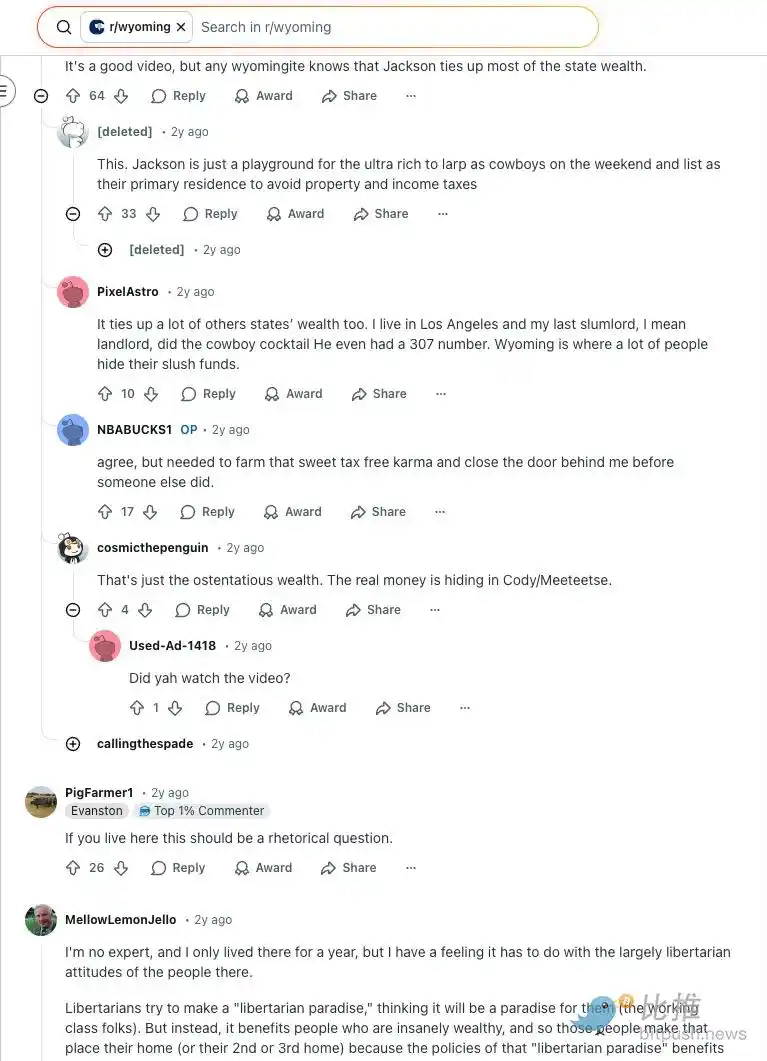
"Jackson is just a playground for super-rich people to play cowboy on weekends. They list it as their primary residence to escape property and income taxes."

"The people here are libertarians trying to create a 'libertarian paradise.' They think it will be a paradise for them (the working class). But in reality, it benefits the filthy rich, who make it their home (or second, third residence) because the policies of the 'libertarian paradise,' such as less regulation, lower taxes, etc., favor them."
Amid such撕裂, the state government is attempting to build digital-era fiscal autonomy on the ruins of the coal mining industry using laws and stablecoins. Data shows that Wyoming has 348 limited liability companies per thousand adults, surpassing Delaware to become the new institutional洼地 in the U.S.

But will this digital revenue flowing to the "Cowboy State" truly缝合 the cracks in this land?

Related Questions

QWhat is the significance of Wyoming's $FRNT stablecoin in the context of U.S. state governments?

A$FRNT is the first U.S. dollar stablecoin to be backed by the full faith and credit of a state government, marking a significant shift from private company-issued stablecoins to a government-level public financial instrument.

QWhat major economic challenge is Wyoming facing that prompted the creation of $FRNT?

AWyoming is experiencing a severe decline in its coal industry, which has been its economic pillar, leading to a dramatic drop in coal severance tax revenue from $290 million in 2011 to $170 million in 2022, creating a pressing fiscal need for new revenue sources.

QHow does the $FRNT stablecoin mechanism generate revenue for the state of Wyoming?

AThe $FRNT stablecoin is over-collateralized by 102% with U.S. Treasuries and cash. The interest income generated from these reserve assets is directed into the state's School Foundation Fund to support public education.

QWhich companies are involved in the management and custody of the reserves for the $FRNT stablecoin?

AThe investment management giant Franklin Templeton, which oversees approximately $1.6 trillion in assets, manages the reserves, and its affiliate, Fiduciary Trust Company International, provides custody services.

QWhat previous legislative innovations has Wyoming pioneered, demonstrating its history of financial and business law experimentation?

AWyoming invented the Limited Liability Company (LLC) in 1977. More recently, it created the SPDI (Special Purpose Depository Institution) banking charter for crypto businesses in 2019 and passed the first DAO法案 (DAO Act) in 2021, allowing decentralized autonomous organizations to register as legal LLCs.

Related Reads

Agents Take Over Traffic Distribution Power: What Are Tencent, ByteDance, and Alibaba Competing For?

In the race to dominate the AI era's entry point, China's tech giants—Tencent, ByteDance, and Alibaba—are aggressively deploying AI Agents to control the future of traffic distribution. Alibaba is pursuing a dual-track "closed loop + openness" strategy. Its Qianwen app is evolving into a super-Agent integrated across its ecosystem (Taobao, Alipay, etc.) to handle complex tasks like travel planning. Concurrently, it is opening its platform to external brands (Luckin Coffee, KFC) and has launched a B2B Agent platform, "Wukong," targeting enterprise automation. Its other flagship, Quark, aims to be an "AI super search box" for information and tasks. ByteDance is executing an omnipresent "sprawl strategy." Its Doubao app boasts over 300 million monthly active users and is evolving into a default AI entry point for daily life, with plans for paid versions and e-commerce integration. Its core weapon is the Kouzi platform, a visual "AI assembly factory" for developers to build custom Agents. ByteDance is also pushing hardware integration, collaborating on AI phones and developing smart glasses to embed Doubao everywhere. Tencent is playing its long-held "ultimate card" by quietly embedding an AI Agent directly into WeChat. This Agent, accessible via a swipe, can understand user commands and automatically execute tasks by calling upon WeChat's millions of mini-programs (e.g., finding and ordering coffee). This leverages WeChat's unparalleled 1.4-billion-user ecosystem to position the app as an AI-powered "service operating system," a move that could dramatically reshape the competitive landscape. The core battleground is shifting from competing for "user screen time" to competing to be the "default execution layer" for user intent. The business model is evolving from an "attention economy" to an "intent economy," where the Agent that can most efficiently fulfill a user's need gains control over service access and token flow. This represents a fundamental change in how users connect with digital services, making the fight for the Agent入口 (entry point) a pivotal moment for redefining industry leadership in the AI age.

marsbit13m ago

Agents Take Over Traffic Distribution Power: What Are Tencent, ByteDance, and Alibaba Competing For?

marsbit13m ago

From Banning Doubao to Embracing Honor: Why Did WeChat Suddenly 'Change Its Face'?

The article explores the sudden shift in WeChat's strategy towards AI assistants from mobile phone manufacturers, transitioning from strict opposition to active collaboration. For over a year, WeChat fiercely resisted attempts by phone AI assistants (like ByteDance's Doubao in late 2025) to control its features via GUI automation ("simulated clicking"), citing security and data control concerns. This stance created a significant barrier for system-level AI integration. Now, Tencent has initiated A2A (Agent-to-Agent) partnerships with major phone brands like Honor, Xiaomi, OPPO, and vivo. This model allows a phone's system AI (e.g., Honor's YOYO) to parse a user's voice command and send a structured request directly to WeChat's own internal AI agent via secure APIs. WeChat then executes the action (e.g., sending a message) and returns the result. The article attributes Tencent's "change of face" to strategic pressure. While leading in social app usage, Tencent trails rivals like ByteDance and Alibaba in standalone AI app popularity. WeChat, with its vast mini-program ecosystem, is Tencent's key asset for an AI comeback. The upcoming WeChat AI agent aims to handle tasks like booking and payments within the app. However, phone system assistants remain the primary AI entry point for most users. The A2A collaboration allows Tencent to extend WeChat's AI reach to this crucial system layer while maintaining control over its core functions and data. For phone manufacturers, embracing A2A is a pragmatic move. The GUI route proved unviable due to WeChat's blocks. A2A offers a compliant path to integrate a vital service, enhancing their AI assistants' usefulness. It allows them to focus on developing their own AI ecosystems for other services while cooperating on WeChat access. The collaboration is framed as a mutual, strategic necessity: Tencent gains a distribution channel, and manufacturers gain a key functionality. The partnership relies on a "dual authorization" mechanism for security, requiring both user and app consent for each action. While questions about long-term data privacy practices remain, experts note A2A is more secure and compliant than GUI automation. Ultimately, this cooperation is seen as a tentative, calculated truce. Tencent's long-term goal is to make WeChat an AI-powered "service OS." Phone manufacturers aim to make their system AI the central user interface. Their paths may converge or clash in the future, but for now, the A2A deal represents the opening chapter in the battle for the AI-era user入口, driven by necessity and strategic calculus on both sides.

marsbit1h ago

From Banning Doubao to Embracing Honor: Why Did WeChat Suddenly 'Change Its Face'?

marsbit1h ago

On-Chain Figures on the Eve of Kickoff: 1.6 Billion Traded Before the World Cup Even Begins

"On-Chain Numbers on the Eve of the World Cup: $1.6 Billion Traded Before Kick-off" Analysis of on-chain markets before the 2026 FIFA World Cup reveals significant crypto integration into football. The most striking figure is the approximately **$1.6 billion** in total trading volume on the single "World Cup Winner" contract on the Polymarket prediction market platform, accumulated before a single match was played. This represents explosive growth for a sector whose annual volume surged from ~$16B in 2024 to ~$64B in 2025. The ecosystem is maturing beyond speculation. Key developments include: 1) **Infrastructure upgrades** like Polymarket's migration to native, regulated USDC stablecoin for settlements; 2) **Reliable data oracles**, such as Chainlink, being used to resolve real-world match outcomes on-chain; and 3) **Official recognition**, with FIFA appointing its first-ever "Prediction Markets" partner. Over 100 contracts now cover everything from the outright winner to individual match results and even non-sporting risks like venue relocation. This evolution marks a fundamental shift. While crypto firms are absent from FIFA's top-tier sponsor list, the technology has deeply penetrated the tournament's financial and predictive infrastructure through regulated stablecoin settlements, decentralized oracles, and new official partnership categories. The regulatory landscape remains complex and varies by jurisdiction, but on-chain markets for the World Cup are already a multi-billion-dollar reality.

marsbit2h ago

On-Chain Figures on the Eve of Kickoff: 1.6 Billion Traded Before the World Cup Even Begins

marsbit2h ago

Trading

Spot
Futures
活动图片