Franklin Templeton brings ETFs on-chain as Ethereum hosts over $13B in tokenized assets

ambcryptoPublished on 2026-03-25Last updated on 2026-03-25

Abstract

Franklin Templeton is launching two ETFs that can be traded directly through crypto wallets 24/7, marking a shift in how traditional financial products are accessed. One fund tracks the S&P 500, while the other focuses on short-term U.S. Treasuries. Both will be issued on Ethereum, enabling peer-to-peer trading without relying on traditional brokers or market hours. The move aligns with the growing tokenized real-world asset market on Ethereum, which has reached approximately $13.6 billion in value, with U.S. Treasury products making up the majority at $11.8 billion. The firm is collaborating with Ondo Finance to support the tokenized distribution of the funds.

Franklin Templeton is launching two exchange-traded funds that can be traded directly through crypto wallets around the clock. It marks a shift in how traditional financial products are accessed and settled.

The move brings equity and bond exposure onto blockchain rails, at a time when tokenized assets on Ethereum alone are approaching $13.6 billion.

The asset manager said the funds — one tracking the S&P 500 and another focused on short-term U.S. Treasuries — will be issued on Ethereum and available for trading 24/7.

Investors will be able to buy, sell, and hold shares using self-custody wallets, removing the need for traditional brokerage accounts and standard market hours.

Franklin Templeton is also working with Ondo Finance to support the tokenized distribution of the funds.

According to Bloomberg, the collaboration will allow the ETFs to trade in crypto wallets continuously, bypassing the brokerage infrastructure that has traditionally defined ETF access.

Franklin Templeton launches ETFs that trade directly in crypto wallets

The two ETFs are designed as fully on-chain products, allowing peer-to-peer trading without relying on centralized intermediaries.

While access through traditional brokers will still be supported, the core functionality shifts toward wallet-based ownership and transfer.

Franklin Templeton said the funds will operate under a hybrid structure, allowing shares to be created or redeemed in both fiat currency and stablecoins. This model is intended to bridge conventional financial systems with blockchain-based settlement.

The firm has already expanded its digital asset footprint in recent years. This includes the launch of an on-chain money market fund and is now extending that approach to broader asset classes.

How the funds work without brokers or market hours

Unlike traditional ETFs, which are limited by exchange trading hours and settlement timelines, the new funds are designed to function continuously. Transactions can occur at any time, with ownership recorded directly on-chain.

This setup reduces reliance on intermediaries and shortens settlement cycles, while giving investors direct control over their holdings through self-custody wallets.

The funds will also be compatible with platforms that support on-chain settlement, allowing participation from both crypto-native users and traditional investors.

Tokenized assets on Ethereum near $13.6B as Treasuries dominate growth

Franklin Templeton’s move comes as tokenized real-world assets continue to expand on Ethereum.

Data shows total on-chain RWA market capitalization on the network has reached approximately $13.6 billion. Also, around $9.86 billion is actively circulating across 36 issuers.
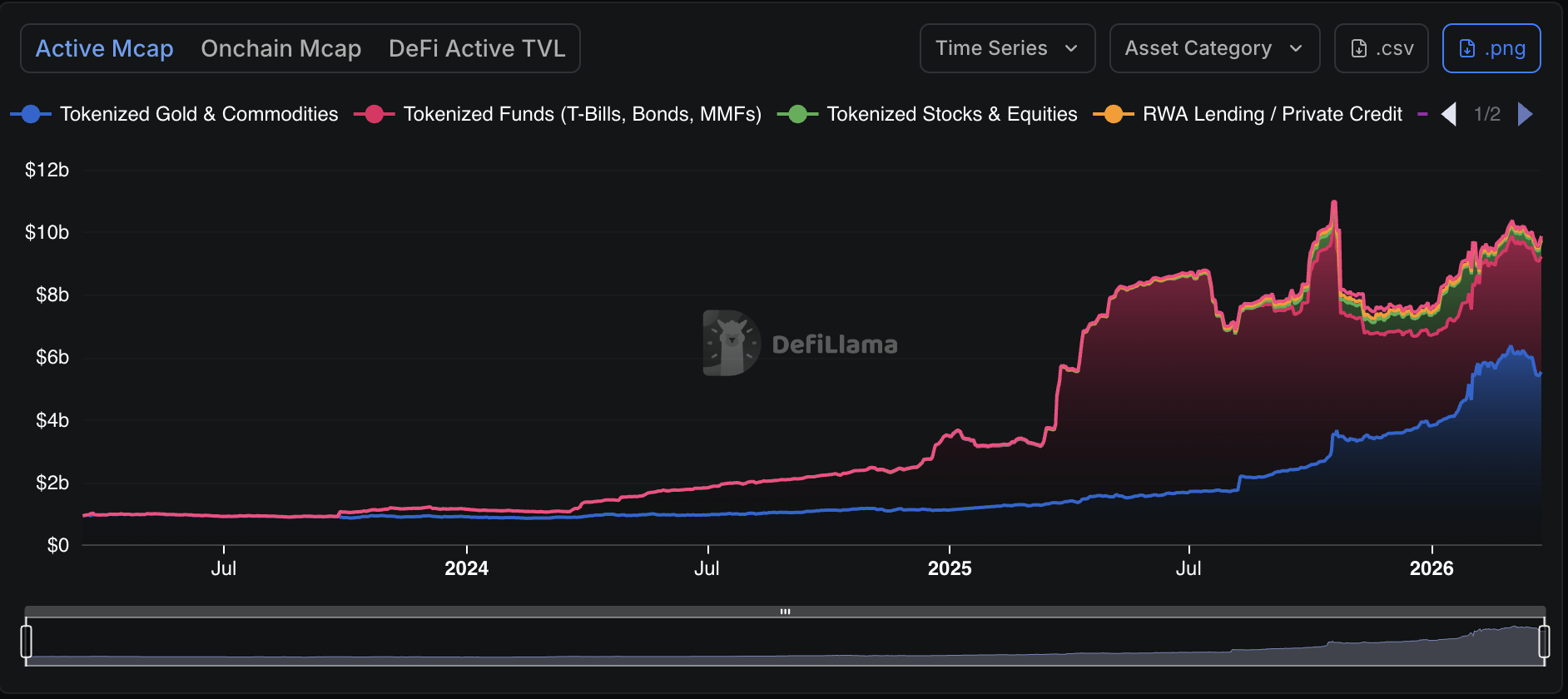
Source: DefiLlama

Within that market, tokenized U.S. Treasury products account for roughly $11.8 billion, making them the largest segment.

This aligns closely with Franklin Templeton’s decision to include a Treasury-focused ETF, suggesting the firm is targeting an already established demand base.

Growth has accelerated since 2024, with tokenized funds and credit products driving most of the expansion. The trend points to increasing institutional participation, as asset managers test blockchain-based distribution and settlement models.

The ETFs are expected to launch in the coming weeks, pending regulatory clearance.


Final Summary

  • Franklin Templeton’s ETFs shift trading from broker-led systems to wallet-based, 24/7 access on Ethereum.
  • The launch aligns with a $13.6B tokenized asset market where Treasuries already dominate demand.

Related Questions

QWhat is Franklin Templeton launching and on which blockchain?

AFranklin Templeton is launching two exchange-traded funds (ETFs) that can be traded directly through crypto wallets, and they are being issued on the Ethereum blockchain.

QHow do these new ETFs differ from traditional ETFs in terms of trading and settlement?

AUnlike traditional ETFs limited by exchange hours and settlement timelines, these new funds can be traded 24/7 with transactions settled directly on-chain, reducing reliance on intermediaries and allowing peer-to-peer trading.

QWhat is the total value of tokenized real-world assets on Ethereum mentioned in the article?

AThe total on-chain real-world asset market capitalization on Ethereum has reached approximately $13.6 billion.

QWhich type of tokenized asset dominates the current on-chain market, and what is its approximate value?

ATokenized U.S. Treasury products dominate the market, accounting for roughly $11.8 billion of the total tokenized assets on Ethereum.

QWho is Franklin Templeton collaborating with to support the tokenized distribution of these funds?

AFranklin Templeton is working with Ondo Finance to support the tokenized distribution of the funds.

Related Reads

Arbitrum Pretends to Be the Hacker, 'Steals' Back the Money Lost by KelpDAO

Title: Arbitrum Poses as Hacker to Recover Stolen Funds from KelpDAO Last week, KelpDAO suffered a hack resulting in nearly $300 million in losses, marking the largest DeFi security incident this year. Approximately 30,765 ETH (worth over $70 million) remained on an Arbitrum address controlled by the attacker. In an unprecedented move, Arbitrum’s Security Council utilized its emergency authority to upgrade the Inbox bridge contract, adding a function that allowed them to impersonate the hacker’s address and initiate a transfer without access to its private key. The council’s action, approved by 9 of its 12 members, moved the stolen ETH to a frozen address in a single transaction before reverting the contract to its original state. The operation was coordinated with law enforcement, which attributed the attack to North Korea’s Lazarus Group. Community reactions are divided: some praise the recovery of funds, while others question the centralization of power, as the council can upgrade core contracts without governance votes. However, such emergency mechanisms are common among major L2s. Despite the partial recovery, over $292 million was stolen in total, with more than $100 million in bad debt on Aave and remaining funds scattered across other chains. The incident highlights escalating security challenges in DeFi, with state-sponsored hackers employing advanced tactics and L2s responding with elevated countermeasures.

marsbit4m ago

Arbitrum Pretends to Be the Hacker, 'Steals' Back the Money Lost by KelpDAO

marsbit4m ago

iQiyi Is Too Impatient

The article "iQiyi Is Too Impatient" discusses the controversy surrounding the Chinese streaming platform IQiyi's recent announcement of an "AI Actor Library" during its 2026 World Conference. IQiyi claimed over 100 actors, including well-known names like Zhang Ruoyun and Yu Hewei, had joined the initiative. CEO Gong Yu suggested AI could enable actors to "star in 14 dramas a year instead of 4" and that "live-action filming might become a world cultural heritage." The announcement quickly sparked backlash. Multiple actors named in the list issued urgent statements denying they had signed any AI-related authorization agreements. This forced IQiyi to clarify that inclusion in the library only indicated a willingness to *consider* AI projects, with separate negotiations required for any specific role. The incident, which trended on social media with hashtags like "IQiyi is crazy," is presented as a sign of the company's growing desperation. Facing intense competition from short-video platforms like Douyin and Kuaishou, as well as Bilibili and Xiaohongshu, IQiyi's financial performance has weakened, with revenues declining for two consecutive years. The author argues that IQiyi is "too impatient" to tell a compelling AI story to reassure the market, especially as it pursues a listing on the Hong Kong stock exchange. The piece concludes by outlining three key "AI questions" IQiyi must answer: defining its role as a tool provider versus a content creator, balancing the "coldness" of AI with the human element audiences desire, and properly managing the interests of platforms, actors, and viewers. The core dilemma is that while AI can reduce costs and increase efficiency, it risks creating homogenized, formulaic content and devaluing human performers.

marsbit57m ago

iQiyi Is Too Impatient

marsbit57m ago

Trading

Spot
Futures

Hot Articles

Discussions

Welcome to the HTX Community. Here, you can stay informed about the latest platform developments and gain access to professional market insights. Users' opinions on the price of ETH (ETH) are presented below.

活动图片