Fortune Investigation: Copying Strategy's Homework Fails, Fund Suffers Huge Losses and Liquidation, Fiancée Dies Mysteriously in Africa

marsbitPublished on 2026-04-18Last updated on 2026-04-18

Abstract

In a dramatic turn of events, Joe McCann, founder of the crypto fund Asymmetric, faces both financial collapse and personal tragedy. After raising funds from prominent investors like Marc Andreessen, Asymmetric's liquidity fund nearly doubled in value during the 2024 crypto market surge. However, by July 2025, the fund suffered massive losses of nearly 80%, leading to investor redemptions and eventual liquidation. McCann attempted to pivot the fund’s strategy to emulate Michael Saylor’s "digital asset treasury" model but failed. Amid this financial turmoil, McCann’s personal life unraveled. His fiancée, influencer Ashly Robinson, died under suspicious circumstances during a vacation in Tanzania in April 2025. Initially ruled a suicide, her death is under investigation, with McCann’s passport seized by local authorities. Robinson’s family has called the events "suspicious." McCann, who had built a flashy personal brand around crypto success and cultural influence, now faces a crisis extending far beyond financial losses, encapsulating the high-risk, "asymmetric" nature of both his investments and his life.

Original Author: Jack Kubinec, Fortune

Compiled by: Peggy, BlockBeats

Editor's Note: In the narrative of the crypto industry, "asymmetric returns" are almost a default belief—using limited downside to potentially capture explosive upside. Joe McCann tried to turn this logic into a business. The Asymmetric he founded simultaneously bets on primary investments and secondary trading, rapidly scaling its size and profile during the 2024 market recovery window: assets doubled, trades worked, personal brand and fund performance reinforced each other. Everything seemed to prove this model worked.

But the other side of the cycle soon emerged. As the market cooled and liquidity contracted, strategies driven by high-volatility assets and narratives began to fail. By 2025, the fund experienced significant drawdowns, followed by internal turmoil, strategic flip-flops, and a loss of investor confidence. "Asymmetric" began to reveal its other meaning—while returns were amplified, risks were also delayed and amplified.

And before all of this was fully resolved, a sudden incident in Tanzania completely interrupted this market narrative. McCann's fiancée, internet celebrity Ashly Robinson, died suddenly while on vacation. The incident is still under investigation but has quickly evolved from a personal tragedy into a public focus—passport confiscation, ongoing investigation, and family质疑 (doubts) have shifted the discussion from fund performance to a more complex reality.

When individuals, capital, and narratives are highly intertwined, a loss of control in any single link can quickly spread, eventually exceeding the boundaries of the market itself.

The following is the original text:

Joe McCann's crypto liquidity fund was once highly successful

After entering the crypto trading space, Joe McCann seemed to have achieved success in just two years. In 2022, his fund Asymmetric raised capital from institutions like Marc Andreessen and Circle; during the crypto market boom accompanying Donald Trump's return to the White House, the fund's value nearly doubled.

But then, things started to spiral out of control.

By July 2025, Asymmetric's liquidity fund had suffered significant losses, prompting McCann to steer investors towards a new project, which ultimately failed to deliver. Then, earlier this month, reports emerged that McCann's fiancée, internet celebrity Ashly Robinson, had died while vacationing with him at a luxury resort in Tanzania. Robinson's death was initially ruled a suicide, but it was reported that local police had confiscated McCann's passport and were questioning him as part of an ongoing investigation.

McCann and a Young Internet Celebrity

Robinson was active on social media under the name Ashlee Jenae. According to one of her Instagram posts, she and McCann started dating in November 2024. At the time, McCann's crypto company was at its peak. McCann did not respond to multiple requests for comment via text message.

McCann was previously married to marketing professional Shea Jackson in 2018, who was ten years his junior. They eventually separated. According to two founders who received investment from Asymmetric's venture fund and spoke to Fortune, some of McCann's shareholdings were transferred to Jackson. Jackson also did not respond to requests for comment.

Additionally, based on McCann's posts on X (formerly Twitter), he has a daughter.
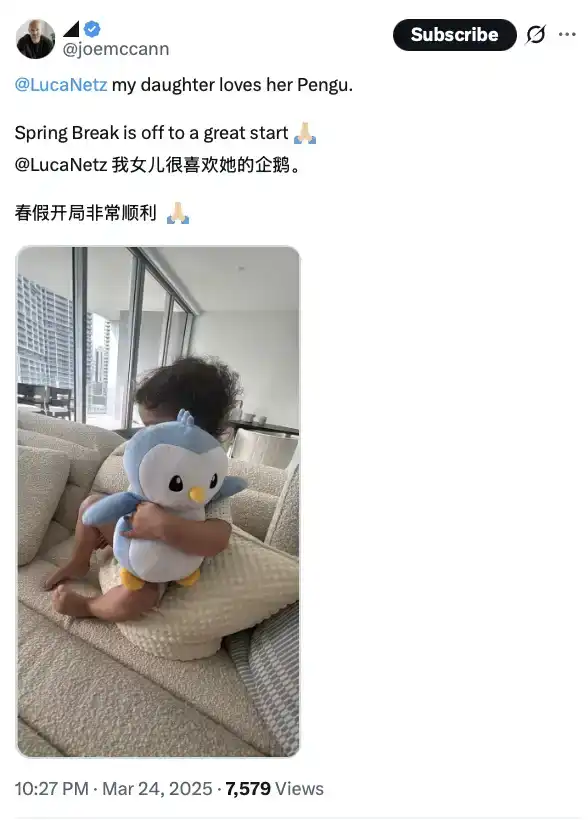
McCann began bringing Robinson, 15 years his junior, to various crypto industry events, and she frequently posted photos of them together on social media. Robinson's social media accounts showed the couple traveling to multiple exotic destinations, and she herself gradually embraced the so-called "soft life" trend (a social media trend emphasizing self-care and an easy lifestyle).

Her final Instagram post read: "Chapter 31, I am right where I'm supposed to be." The accompanying picture showed her feeding a giraffe in Tanzania. Two days prior, the 30-year-old internet celebrity had posted a video: the 45-year-old McCann proposing to her, with a lion slowly approaching in the foreground.

According to the local police report, the couple checked into the luxury hotel Zuri Zanzibar on April 6th. However, after a dispute, hotel staff reportedly moved McCann to a room separate from Robinson's. On April 8th, a housekeeping staff member found Robinson unconscious in her room, and she was rushed to the hospital. Tanzanian police ruled her cause of death as suicide.

The police report also stated that although McCann has not been formally charged with any wrongdoing, his passport has been confiscated by local law enforcement, and he is being questioned. Robinson's family stated in a statement that the circumstances of her death are "suspicious."

The Collapse of the Crypto Venture

Joe McCann has always been known for "doing things his own way."

Born in 1980, he attended Portland State University, majoring in philosophy, with a particular fondness for Nietzsche and Schopenhauer. For the first decade-plus of his career, he moved between the tech and finance industries, eventually becoming the CEO of a software company and facilitating its acquisition in 2019. Afterwards, he worked at Microsoft, then started another venture, founding a crypto fund. In a 2024 podcast, he mentioned that this time he wanted to "do things a little differently."

McCann shaped Asymmetric (which had both venture capital and secondary market investment arms) into an institution that was "financially prudent, culturally edgy." In the podcast, he reflected that before starting the company, he had been a DJ, organized rave parties, run a record label, and co-founded a clothing brand with his brother; he had also served as CTO for a top advertising agency in New York. He saw this long-term exposure to the "creative side of humanity" as his unique advantage in crypto investing.

In multiple interviews, McCann boasted about the staggering returns he made on the short-lived memecoin BONK. He also leveraged his association with rapper Iggy Azalea to enhance his "cultural influence" and promoted her later failed crypto project. Furthermore, he briefly launched a series of Asymmetric-themed merchandise, accompanied by a well-produced, expensive promotional video.

For a time, all of this translated into substantial returns. According to a person familiar with the company's financial situation who spoke to Fortune, in 2024, Asymmetric's liquid investment portfolio grew from approximately $195 million to $395 million. However, this performance still lagged behind Bitcoin's 121% surge that year.

Despite the impressive paper returns, Asymmetric was not calm internally. Informed sources stated that founding member and core trader Chris Cecere chose to leave the company in 2024, even as its performance grew significantly. Cecere did not comment on this.

Entering 2025, as performance began to come under pressure, McCann turned to a new crypto frenzy—"digital asset treasury companies," a model championed by Michael Saylor, whose company Strategy is a representative case. In a July note to investors, McCann stated that due to "changing market conditions," Asymmetric would abandon its active trading strategy and commit its remaining resources to building a Solana asset reserve.

The company originally planned an investor briefing on July 22nd, but on the same day, a dissatisfied limited partner disclosed on X that the fund had lost nearly 80% year-to-date. Soon after, this Solana strategy was also abruptly halted. A former investor told Fortune that during the liquidation of the liquidity fund, the final amount recovered was even less than the initial principal.

Currently, Asymmetric's website only lists two venture funds and a special purpose vehicle (SPV) for investing in Circle equity. The "Team" page has been taken down, and a general partner of the company also did not respond to a request for comment.

Even as the company faced difficulties, McCann himself remained active in the crypto industry, frequently posting on his X account, which has over 100,000 followers. In March of this year, crypto services company MG Stover acquired the data analytics company he founded, Asymmetric Information.

But after that disastrous trip to Tanzania, the problems McCann faces clearly extend beyond investment gains and losses. His fiancée's family is demanding further explanation for her death, and he himself remains stranded locally.

Ironically, during a podcast at the peak of his success in 2024, McCann summarized one risk traders should be most wary of—"risk of going to zero." "Pursuing asymmetric returns, meaning huge upside with limited downside, must be combined with avoiding the risk of total failure," he said.

He knew best what it meant to "not lose everything," but his story ultimately developed in the direction of "losing control."


Related Questions

QWhat was the name of Joe McCann's crypto fund and what were its two main business lines?

AJoe McCann's fund was called Asymmetric, and it operated both a venture capital (VC) arm and a secondary market trading business line.

QWhat event in early April 2025 led to the death of Joe McCann's fiancée and where did it occur?

AJoe McCann's fiancée, Ashly Robinson (also known as Ashlee Jenae), died in early April 2025 while on vacation with him at the Zuri Zanzibar luxury hotel in Tanzania.

QAccording to the article, what was the primary reason for the significant losses in Asymmetric's liquidity fund by July 2025?

AThe significant losses were prompted by a change in market conditions, leading the fund to abandon its active trading strategy. McCann then attempted to pivot the remaining resources into building a Solana asset reserve, a strategy that was also quickly abandoned.

QWhich high-profile meme coin did Joe McCann boast about achieving substantial returns on, and which celebrity did he associate with to boost his 'cultural relevance'?

AJoe McCann boasted about substantial returns on the meme coin BONK. He associated with rapper Iggy Azalea to boost his cultural relevance, even promoting her failed crypto project.

QWhat philosophical thinkers did Joe McCann, a philosophy major, express a particular fondness for during his studies?

ADuring his studies, Joe McCann expressed a particular fondness for the philosophers Nietzsche and Schopenhauer.

Related Reads

WeChat Agent Issues a 'Heroic Summons,' Half of the Internet Responds

WeChat AI Agent is on the horizon. The WeChat Open Platform has issued a guide for developers, offering them ways to integrate into the WeChat AI ecosystem. This will enable mini-programs to be discovered and invoked by the AI. Meituan has already announced its integration, allowing users to access services like food delivery through WeChat AI. Other platforms like Ctrip and Tongcheng have followed suit. Furthermore, WeChat is collaborating with major smartphone manufacturers to enable their native AI assistants to perform actions within WeChat, such as initiating calls or sending messages, through a controlled protocol called Agent-to-Agent (A2A). Reports indicate the WeChat AI Agent will be accessible by swiping right on the main interface. It aims to understand user intent within the rich context of chats, groups, and past interactions, then automatically call upon relevant mini-programs to complete tasks like ordering coffee or booking restaurants. This positions it as a potential "super app" with direct access to WeChat's vast ecosystem of services, social connections, and payment systems. Technically, this is a complex endeavor. It requires advanced natural language understanding, a "world model" to predict interactions within mini-programs (UI-Oceanus), multi-model orchestration for cost efficiency, and careful coordination with millions of third-party service providers. Tencent's development follows a "Co-Design" approach, where product teams and the Hunyuan model team collaborate closely, allowing capabilities honed in other AI products (like Yuanbao for chat, ima for search, WorkBuddy for office tasks) to be transferred to the WeChat Agent. Tencent is strategically opting for the A2A protocol over GUI-based automation (which it has blocked in the past), maintaining control over its ecosystem. To manage the immense scale and cost of serving 1.4 billion monthly active users, Tencent is deepening its ties with DeepSeek, known for its cost-effective training, to secure a low-cost inference backbone. The ultimate goal is to solve practical, everyday problems for users within the WeChat ecosystem, moving beyond technical benchmarks to deliver real utility, which Tencent sees as the key to winning in the long-term AI game.

marsbit4m ago

WeChat Agent Issues a 'Heroic Summons,' Half of the Internet Responds

marsbit4m ago

Humanity Loses $31 Million in Attack, Token Price Plummets 90% Due to a Single Private Key

On June 9th, the digital identity project Humanity Protocol suffered a major security breach resulting in over $31 million in losses. According to on-chain analyst Specter, hundreds of wallets holding the project's H token were drained. The attack was confirmed by founder Terence Kwok to be caused by the compromise of a foundation member's private key. As a precaution, users are advised to avoid interacting with Humanity's cross-chain bridge or liquidity pools. The incident caused the H token price to crash over 90%, from around $0.70 to a low of $0.052, wiping its market cap from $2 billion to approximately $35.7 million. The attacker allegedly minted 100 million new H tokens and is selling them for BNB. This breach adds to existing controversies surrounding Humanity Protocol. Founded in 2024, it aimed to verify human users via palm-print biometrics and zero-knowledge proofs. However, a leaked conversation in 2025 revealed that only about 1 million of its 9 million claimed Human IDs had completed biometric verification, suggesting 88% might be bots. Furthermore, the project has faced allegations of being a repackaged product from a Chinese access control vendor, raising privacy and authenticity concerns. Founder Terence Kwok's previous venture, Tink Labs, a hotel smartphone startup that raised $170 million, failed and entered bankruptcy in 2020 after burning through its funding. The current attack highlights the persistent critical issue of private key management in crypto. Unlike smart contract exploits, a private key compromise bypasses all on-chain security mechanisms. With no user compensation plan announced yet, this $31 million breach may be a final blow to the project's credibility, already weakened by previous controversies and a heavily depreciated token.

marsbit38m ago

Humanity Loses $31 Million in Attack, Token Price Plummets 90% Due to a Single Private Key

marsbit38m ago

MicroStrategy Will Not Die in This Downturn: Reflexivity, STRC Anchoring Back to Par, and the Self-Rescue Logic of "Sell Stock, Not Bitcoin"

This article analyzes the recent sharp decline in Bitcoin and MicroStrategy (MSTR), framing it as a targeted "reflexivity" attack. The trigger was MSTR using its cash reserves to buy back convertible notes, raising market concerns about a liquidity crisis. The playbook follows George Soros's principle: market expectations can shape reality. Fears that MSTR might be forced to sell BTC caused panic selling, lowering BTC's price and worsening MSTR's financial ratios, thus reinforcing the negative narrative. The author argues that MSTR's Structured Convertible (STRC), while falling in price, is a floating-rate security that will eventually return to par value (100). The price drop reflects the market demanding a higher yield due to perceived risk, but as a floating-rate instrument, its coupon can adjust, naturally pulling the price back to par over time. This is crucial for MSTR's continued ability to raise funds. The core thesis is that MSTR's best move to counter the attack is to **issue new equity (sell shares)**, not sell its Bitcoin holdings. While selling BTC would solve the immediate cash crunch, it would destroy the company's core investment thesis and premium. It would dilute the BTC per share, likely erase the market premium over its net asset value (mNAV > 1), and worsen its debt-to-asset ratio. Issuing shares while mNAV is high (e.g., 1.25x) allows MSTR to raise cash for reserves without harming shareholder value or the "perpetual accumulation" narrative. It improves the debt ratio and reassures STRC holders, breaking the negative reflexivity cycle. In conclusion, while MSTR could survive this episode even by selling BTC, doing so would fundamentally alter its investment proposition and weaken it for future cycles. The optimal, value-preserving strategy is to sell equity to rebuild reserves and maintain the long-term growth flywheel.

marsbit39m ago

MicroStrategy Will Not Die in This Downturn: Reflexivity, STRC Anchoring Back to Par, and the Self-Rescue Logic of "Sell Stock, Not Bitcoin"

marsbit39m ago

Humanity Loses $31 Million, a Private Key Causes Token Price to Plunge 90%

On June 9th, the digital identity project Humanity Protocol suffered a major security breach resulting in over $31 million stolen from hundreds of wallets holding its H token. The attack was caused by the compromise of a private key belonging to a foundation member, leading the team to advise users against interacting with its bridge or liquidity pools. Following the incident, the price of the H token plummeted by over 90%, from around $0.70 to a low of $0.052, wiping out a significant portion of its market capitalization. The attacker allegedly minted 100 million new H tokens and began selling them for BNB. Humanity Protocol, founded in 2024, aimed to verify human users through palm-print biometrics and zero-knowledge proofs on Polygon CDK. Despite raising $50 million across two funding rounds and achieving a unicorn valuation, the project faced prior controversies. Shortly after its June 2025 token launch, reports emerged that only about 1 million of its 9 million registered IDs had completed biometric verification, suggesting 88% might be bots. Furthermore, allegations surfaced that the project might be a rebranded "shell" of a Chinese access control company, raising concerns about data privacy and authenticity. The project's founder, Terence Kwok, has a controversial business history. His previous venture, Tink Labs, burned through $170 million in funding before collapsing in 2020. The breach highlights the persistent critical risk of private key management in crypto. With no user compensation plan detailed in the initial response, the incident deals a severe blow to trust in a project already struggling with credibility issues.

Foresight News1h ago

Humanity Loses $31 Million, a Private Key Causes Token Price to Plunge 90%

Foresight News1h ago

Trading

Spot
Futures

Hot Articles

Discussions

Welcome to the HTX Community. Here, you can stay informed about the latest platform developments and gain access to professional market insights. Users' opinions on the price of S (S) are presented below.

活动图片















