For Those Still Obsessed with Altcoins, Just Go All-in on HOOD

marsbitPublished on 2026-06-16Last updated on 2026-06-16

Abstract

Title: "For Those Still Fixated on Altcoins, Just Bet on HOOD" The article argues that Robinhood (HOOD) stock is a compelling alternative for investors still holding onto hopes for altcoin rallies. It highlights HOOD's recent strong performance, briefly touching $100, and expresses continued optimism. The bullish thesis is multi-faceted: HOOD's operational data for May showed record highs in key metrics like total assets and funded customers, though crypto volume was weaker. Positive catalysts include Robinhood launching its own prediction market (Rothera) to capture more revenue, gaining approval to act as an IPO underwriter for major upcoming listings, and being selected to manage the new "Trump Account" government savings program for millions of future US newborns. Insider and institutional buying, along with raised price targets, provide further confidence. The core argument is that HOOD is successfully decoupling from the crypto market's fortunes. While crypto-related revenue was once a major contributor, its share of total revenue has been declining, hitting 13% in Q1 2026. Although HOOD's price historically moved with Bitcoin, a recent divergence is noted. The author posits that Robinhood's growing equity trading, prediction markets, and IPO-related businesses can drive growth independently of a crypto bull market. Thus, HOOD offers asymmetric exposure: it stands to benefit if the crypto market recovers but is no longer wholly dependent on it. For those disillusion...

Original | Odaily Planet Daily (@OdailyChina)

Author | Azuma (@azuma_eth)

The stock price performance of Robinhood (HOOD) has been quite strong recently, even briefly returning above $100 last night, though it unfortunately failed to close at that level. However, I remain personally optimistic about HOOD's future performance.

During this downturn cycle, HOOD has been one of the few targets I have been consistently accumulating (including rebalancing), so I've wanted to write an article about HOOD for a long time. In previous Odaily Tea Chats, I briefly shared my accumulation logic. Today, I want to take advantage of the good stock price movement to discuss it in detail. It must be stated that this is not investment advice, nor does it represent the platform's view; it's just some of my personal thoughts when accumulating HOOD.

Multi-dimensional Analysis of Positive Catalysts

Regarding the reasons for HOOD's recent rise, you can find many bullish explanations across different dimensions.

First, looking at the fundamentals, Robinhood announced its May operational data last week, details as follows.

  • Total Assets: $377 billion, a record high;
  • Funded Customers: 27.7 million, a record high;
  • Margin Book: $19.5 billion, a record high;
  • Event Contracts Volume: 3.9 billion, a record high;
  • Cash & Deposits: $18.6 billion, a record high;
  • Options ADV: 11.6 million contracts, matching the historical record;
  • Equity Volume: $315 billion, the second-highest point historically;
  • Options Contracts Volume: 231 million contracts, the second-highest point historically;
  • The only "underwhelming" data point is Crypto Volume: $12.2 billion, ranking only 16th in historical monthly data......
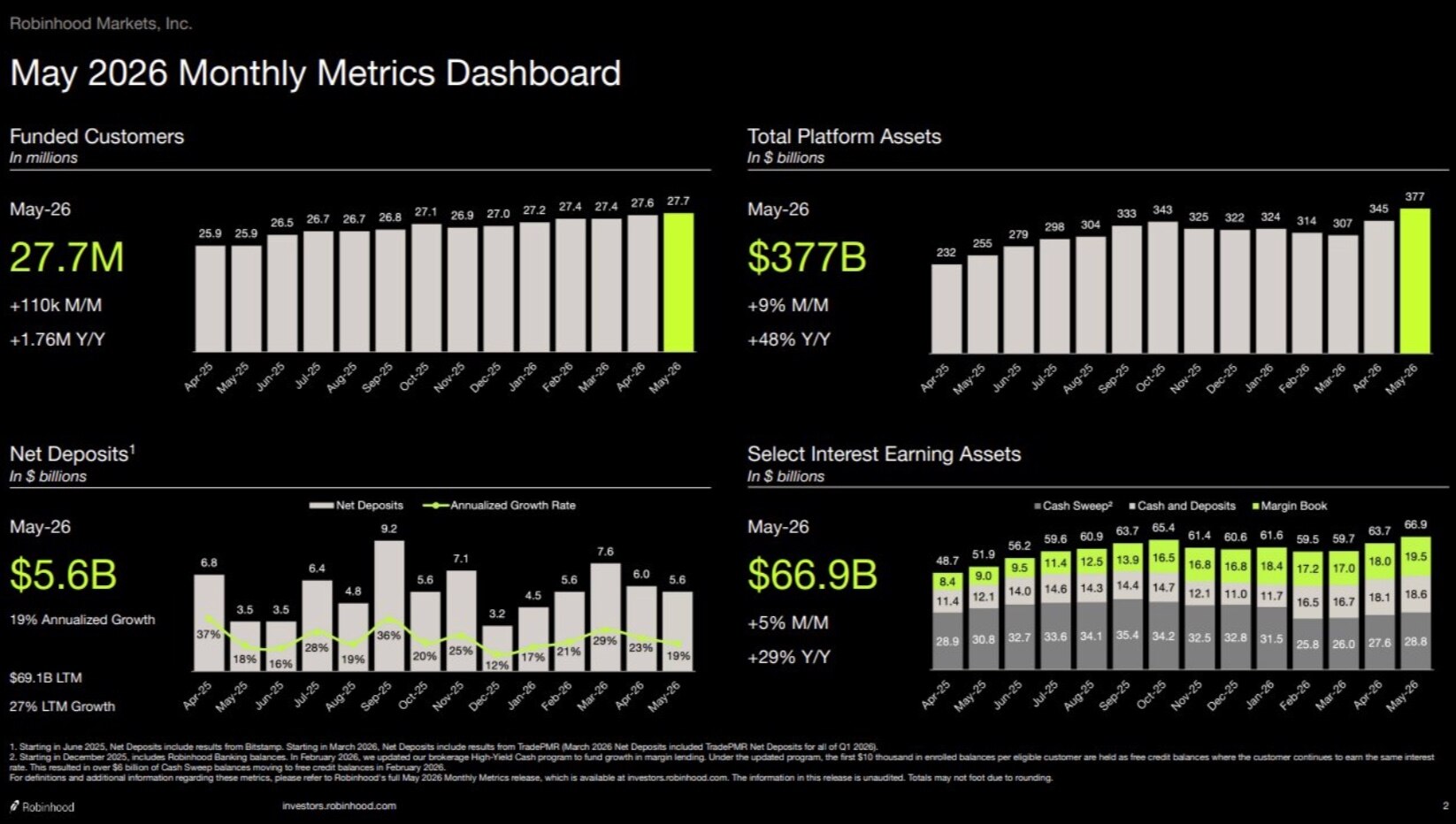
Some positive factors on the news front might be even more stimulating for investor sentiment.

  • First, regarding the fastest-growing prediction market, Robinhood has begun intercepting Kalshi's flow by building its own prediction market, Rothera. Afterwards, related revenue is expected to no longer need to be shared with Kalshi. For details, please refer to the article we published yesterday, "The First Prediction Market Concept Stock Has Emerged!".
  • Second, on the IPO front, SpaceX's historic IPO brought record-level traffic to Robinhood. More critically, Robinhood's brokerage and clearing business unit, Robinhood Securities, was approved last week to act as an IPO underwriter. This means Robinhood is expected to play a more central role in future IPO activities (e.g., Anthropic, OpenAI).
  • Then, Robinhood has been selected by the U.S. Treasury Department to act as the brokerage firm and initial trustee for the "Trump Account." The so-called "Trump Account" is a tax-deferred investment account plan established on June 9, 2025, by U.S. President Trump under the authorization of the "Big and Beautiful" Act. It aims to set up government-funded savings accounts for children of U.S. citizens born between January 1, 2025, and January 1, 2029. This means that in the coming years, tens of millions of newborn Americans will default to using Robinhood as their brokerage platform. Details can be found in "Robinhood Has a New Batch of Stock Investors, the Oldest is 1 Year Old, the Youngest is -3 Years Old".

Regarding market dynamics, there are some more direct signals.

  • Robinhood director Meyer Malka has been continuously increasing his holdings of HOOD recently. Over the past week or two, Malka has accumulated purchases of HOOD worth over $50 million.
  • Institutions have also given HOOD more positive price targets. Goldman Sachs maintains a "Buy" rating and has raised its target price from $105 to $108; Mizuho's target price is $115; Piper Sandler is the most optimistic, giving a target price expectation of $135.

Personally, the initial reason for accumulating HOOD was mainly optimism about its Q2 earnings performance. Firstly, anticipating a massive explosion in stock trading-related revenue this quarter under the epic U.S. stock market trend. Secondly, the potential surge in prediction market trading volume due to the World Cup, coupled with the revenue interception effect of Rothera.

However, the reason for later switching a larger portion of my portfolio (mainly some remaining crypto assets) to HOOD follows another logic, which is the real point this article wants to discuss.

The Alternative to Altcoins

In early May, a friend asked me what I had been buying recently, and I mentioned HOOD. But at that time, HOOD had just fallen from above $90 due to disappointing Q1 earnings (mainly an unexpected $100 million expense related to the "Trump Account"), and the short-term trend looked quite poor.

My friend asked me why, and I briefly explained the above reasons. He thought about it and said, unfortunately, his positions were mostly trapped, and he didn't have much ammunition left. I asked him what he was holding; unsurprisingly, it was mostly altcoins.

I said to him at the time: "Instead of still being obsessed with altcoins, you might as well directly switch to HOOD."

The context for this judgment is that for a long time, cryptocurrency-related revenue has been a significant component of Robinhood's total revenue, and HOOD's stock price movement has had a strong correlation with cryptocurrencies. However, recently, there have been signs that Robinhood is breaking free from its dependence on the cryptocurrency business and is positively shedding this correlation.

First, let's look at Robinhood's cryptocurrency-related revenue over the past five quarters. It's not hard to see that the overall proportion of this revenue stream is showing a downward trend, and the Q1 proportion has dropped to a new low since 2025.

  • 2025 Q1, Total Revenue $927 million, Crypto Revenue $329 million, share 35%;
  • 2025 Q2, Total Revenue $989 million, Crypto Revenue $160 million, share 16%;
  • 2025 Q3, Total Revenue $1.274 billion, Crypto Revenue $268 million, share 21%;
  • 2025 Q4, Total Revenue $1.283 billion, Crypto Revenue $221 million, share 17%;
  • 2026 Q1, Total Revenue $1.067 billion, Crypto Revenue $134 million, share 13%.

Now, look at the intuitive comparison between HOOD and BTC price movements. Since the beginning of the year, HOOD has mostly maintained a trend similar to BTC, but a significant divergence has recently appeared.
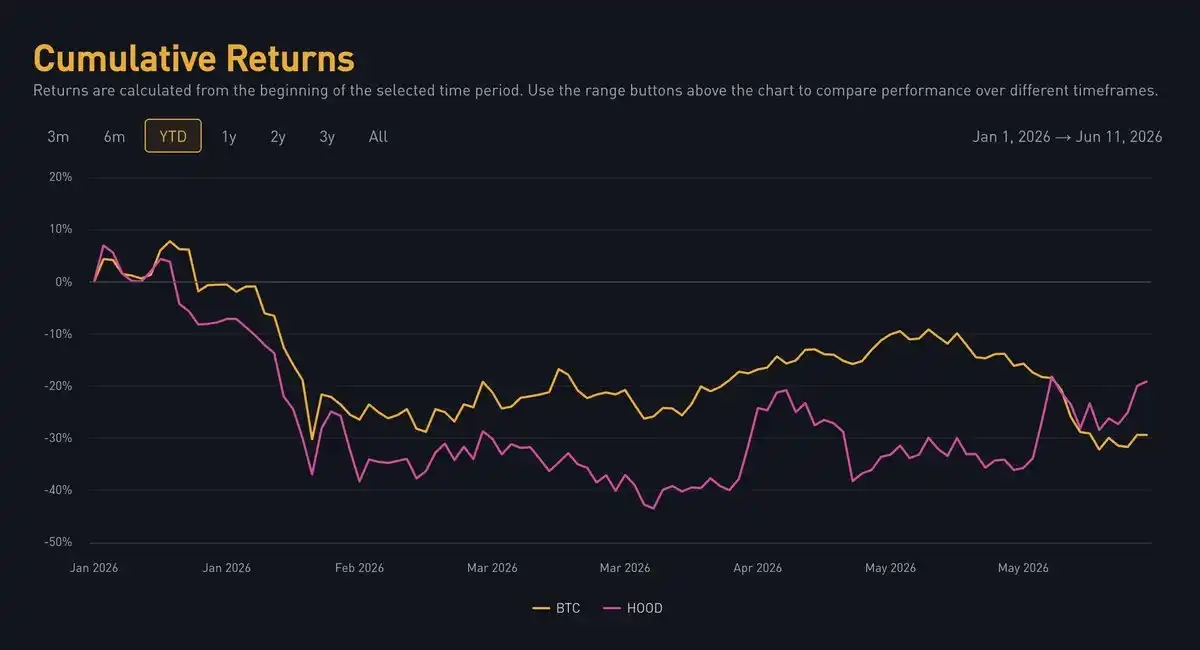
Emphasizing these two points mainly aims to illustrate that the valuation logic surrounding HOOD is beginning to change. In the past, HOOD was often seen as a "shadow stock" of the crypto market, with its business performance showing clear cyclicality alongside the crypto bull and bear markets — when the crypto market soared, retail investors rushed into Robinhood to frantically trade altcoins, commission income surged, and the stock price took off; when the crypto market was sluggish and retail investors exited, Robinhood's revenue would rapidly decline.

But now, Robinhood is no longer as heavily reliant on its cryptocurrency business as before. Even if the crypto market continues to remain in its current half-dead state, its stock trading, prediction markets, Pre-IPO, and newly added underwriting business are still expected to support its earnings growth.

This doesn't mean the cryptocurrency market won't affect HOOD anymore. On the contrary, if the crypto market returns to a bull market in the future, Robinhood's cryptocurrency trading revenue will likely explode simultaneously, and HOOD can still enjoy the dividends brought by industry growth.

Put more bluntly: the crypto circle will still affect HOOD, but HOOD no longer depends on the crypto circle — if the crypto bull market returns, HOOD will still rise with it; if the crypto circle remains half-dead, HOOD doesn't care.

For all those who still hold hope for altcoins but are increasingly worried about liquidity drying up, narrative failure, and value capture problems, instead of continuing to pin hopes on some token that doesn't know when its next narrative will arrive, the current HOOD might be an option with higher safety margins.


Trending Cryptos

Related Questions

QWhat are the main business areas that are expected to support Robinhood (HOOD) growth, especially if the crypto market remains stagnant?

AThe main business areas expected to support Robinhood's growth are stock trading, prediction markets (through their new platform Rothera), Pre-IPO access, and its new role as an IPO underwriter for companies like SpaceX and potentially future ones like Anthropic and OpenAI. These diversified revenue streams reduce its dependence on the volatile cryptocurrency market.

QAccording to the article, what recent legal development could bring millions of new users to Robinhood in the coming years?

ARobinhood was selected by the U.S. Treasury to serve as the broker and initial trustee for the 'Trump Account,' a tax-advantaged investment account plan for children born between 2025 and 2029. This means millions of American newborns will automatically use Robinhood as their brokerage platform.

QHow does the article characterize the recent relationship between the price movements of HOOD and Bitcoin (BTC)?

AThe article states that for most of the year, HOOD's stock price followed a similar trend to Bitcoin (BTC). However, recently there has been a noticeable divergence, with HOOD's performance becoming more independent from crypto market movements.

QWhat was the trend in cryptocurrency-related revenue as a percentage of Robinhood's total revenue over the last five quarters reported?

ACryptocurrency-related revenue as a percentage of total revenue has shown a declining trend over the last five quarters: 35% in Q1 2025, 16% in Q2 2025, 21% in Q3 2025, 17% in Q4 2025, and 13% in Q1 2026 (a new low since 2025).

QWhat is the core argument the author makes for investors with lingering interest in altcoins to consider switching to HOOD instead?

AThe author argues that HOOD offers a safer alternative with higher safety margins. While HOOD can still benefit from a future crypto bull market, it is no longer solely dependent on it. Its diversified business model allows it to grow even if the crypto market remains stagnant, unlike many altcoins which face risks like liquidity drying up and failing narratives.

Related Reads

In Conversation with Ray Dalio: We Are Currently in an AI Bubble, with 1% of My Portfolio in Bitcoin

Ray Dalio, founder of Bridgewater Associates, warns in an interview that the current AI boom shows classic bubble characteristics, which could lead to significant economic downturns as seen in past cycles like 1929 or 2000. He explains that speculative enthusiasm, fueled by debt and overvaluation, often precedes a crash when rising rates or taxation force asset sales, causing widespread losses and recession. Dalio also outlines his "Big Cycle" theory, describing an approximate 80-year pattern where widening wealth gaps, massive government deficits, and shifting geopolitical power (like China's rise) create internal conflict and global instability. He emphasizes that we are in a late-cycle, transitional phase where traditional powers like the US and UK face decline. For personal wealth protection, Dalio advises diversification beyond cash into assets like stocks, bonds, real estate, and particularly gold, which he prefers over Bitcoin. While he holds about 1% of his portfolio in Bitcoin as a non-printable hard asset, he views gold as more secure from technological or governmental threats. Regarding AI's impact, Dalio believes it will disproportionately benefit capital owners, worsening inequality by replacing both physical and cognitive labor. He suggests that human intuition and emotional intelligence, combined with AI, will be key for future workers. On taxation, Dalio argues that wealth taxes are impractical and risk triggering asset sell-offs, reducing productive investment. He points to the UK as a cautionary example of debt, low productivity, and political strife. Geopolitically, Dalio foresees a more regionalized world, with the US showing weakness in prolonged conflicts like with Iran, akin to past imperial declines. The ideal outcome, he suggests, is coexisting powerful blocs (e.g., Americas, China-Asia Pacific) without major war.

marsbit3h ago

In Conversation with Ray Dalio: We Are Currently in an AI Bubble, with 1% of My Portfolio in Bitcoin

marsbit3h ago

Daily 7.2 Trillion KRW: Foreign Capital's Record Net Buying on Friday! Wall Street Says Headwinds for Korean Stock Fund Flows Have Subsided

South Korean stock market sees a dramatic shift in fund flows. On July 31, foreign investors made a record net purchase of approximately KRW 7.2 trillion in KOSPI stocks, marking a fundamental reversal from the persistent large-scale net outflows seen in previous months. This contributed to a significant narrowing of foreign net selling in July to KRW 9.8 trillion, down sharply from KRW 48.4 trillion in June and KRW 44.5 trillion in May. Simultaneously, domestic institutional pressure eased. South Korean pension funds and asset managers turned to a net buying position in July, purchasing KRW 1.0 trillion worth of KOSPI shares, contrasting with net sales in May and June. Market volatility is expected to be dampened by new financial regulations. Effective July 31, the Financial Services Commission tightened access for retail investors to single-stock leveraged ETFs by raising the minimum cash deposit requirement. Trading volumes for these products subsequently dropped to about 50% of their monthly average. Citigroup Research maintains its year-end KOSPI target of 10,000 points. The firm cites several supportive factors: the substantial easing of headwinds from capital outflows, a robust fundamental outlook for the semiconductor sector, historically low market valuations, strong economic fundamentals, and the potential for policy support from financial authorities if needed.

marsbit3h ago

Daily 7.2 Trillion KRW: Foreign Capital's Record Net Buying on Friday! Wall Street Says Headwinds for Korean Stock Fund Flows Have Subsided

marsbit3h ago

Thanks to Dice Rolls, Bitcoin Keys Are Stored Offline, But Not Everyone Will Do It

The article discusses using dice rolls to generate secure Bitcoin wallet seeds, providing entropy independent of potentially flawed hardware random number generators. It explains that each fair dice roll offers about 2.585 bits of entropy, with around 50 rolls needed for a standard 12-word seed phrase and 99+ recommended for higher security. This method gained attention after a vulnerability was revealed in some Coldcard hardware wallets, where a faulty firmware RNG (dating back to 2021) compromised generated keys. The analysis notes that while a dice-generated main seed was safe from this specific flaw, other Coldcard functions (like creating paper wallets, backup keys, or passwords) could still be vulnerable if they used the defective RNG. The piece argues that while dice-based entropy is technically robust, the manual process is error-prone, tedious, and unrealistic for most new users, who might make mistakes in recording or inputting rolls. It concludes that while manual entropy generation should remain an option for advanced users, the long-term goal is to develop reliable, user-friendly hardware and software that securely generates randomness without requiring specialized knowledge. Coldcard users are advised to check their firmware version and replace any secondary secrets (like paper wallet keys) created with vulnerable devices, while also considering multi-signature setups with devices from different manufacturers for added security.

cryptonews.ru8h ago

Thanks to Dice Rolls, Bitcoin Keys Are Stored Offline, But Not Everyone Will Do It

cryptonews.ru8h ago

Trading

Spot

Hot Articles

Discussions

Welcome to the HTX Community. Here, you can stay informed about the latest platform developments and gain access to professional market insights. Users' opinions on the price of S (S) are presented below.

活动图片













