Fidelity Solana ETF Filing Keeps Custody Questions At The Centre Of The SOL Fund Race

bitcoinistPublished on 2026-07-10Last updated on 2026-07-10

Abstract

The race for a spot Solana ETF is shifting focus from speculation to practical operational details, with a new filing highlighting custody as a central and unresolved challenge. As asset managers like VanEck and Bitwise join the competition, the conversation is moving toward the technical and regulatory frameworks required for approval, similar to the path taken for Bitcoin and Ethereum ETFs. Custody credibility—how the underlying SOL tokens are securely held and controlled—is a critical hurdle given Solana's distinct technical and regulatory profile. For investors, key signals to watch will be SEC responses, detailed custody disclosures, and language around staking or market surveillance, rather than headline enthusiasm. This development represents a concrete step in Solana's institutionalization, but its ultimate impact depends on subsequent regulatory and market follow-through.

The Solana ETF race is now far enough along that the market is no longer just asking who files next. It is asking how these products would actually work. Custody, trust structure, creation and redemption mechanics, and exchange listing details are becoming central to the conversation.

That is where the latest Solana ETF filing discussion matters. It moves the narrative away from pure speculation and toward the plumbing that would have to satisfy regulators.

For more details, visit the official SEC platform.

TL;DR

  • A Solana ETF filing has drawn renewed attention to custody and trust mechanics.
  • The race for SOL-based funds is becoming more crowded as issuers test SEC appetite.
  • Custody remains one of the most important practical questions for any spot crypto ETF.

Why Custody Is Central

Spot crypto ETFs live or die on custody credibility. Investors need to know how the underlying asset is held, who controls it, and what safeguards exist around transfers and operational risk.

For Bitcoin and Ethereum, the market has already seen that custody frameworks can be built. Solana introduces a new test because the asset has a different technical profile and a different regulatory history.

The Solana Fund Race

VanEck, Bitwise, and other issuers have helped turn SOL into the next major ETF battleground. That does not mean approval is guaranteed, but it does show that asset managers think there is enough investor demand to justify the work.

Every new filing detail makes the category feel more serious. The more issuers commit resources, the harder it becomes to dismiss Solana ETFs as a fringe idea.

What Investors Should Watch

The next important signals will be SEC responses, amended filings, custody disclosures, and any language around staking or market surveillance. Those details will matter more than headline enthusiasm.

For now, Solana remains firmly in the institutional product conversation. The filing process is where that conversation becomes real or stalls out.

What The Market Can Learn

The useful way to read this story is not as a standalone headline about Fidelity, but as part of the wider pressure building around Solana coverage this week. Markets have been jumping quickly from one catalyst to the next, so the cleaner value for readers is in separating the actual development from the instant reaction around it. In this case, the source material gives us a concrete event to work from, rather than a loose rumour or a recycled social-media talking point.

That distinction matters because crypto readers are being asked to process a lot at once: ETF flows, regulatory actions, exchange listings, protocol upgrades, wallet movements, and political signals. A story like this is most useful when it helps them understand where Solana ETF fits into that broader map. It does not need to be inflated into a guaranteed price call to be worth covering. It simply needs to explain what changed, who is affected, and why the market is paying attention today.

The caveat is also important. Even clean source-backed developments can be overinterpreted when traders are hunting for a fast narrative. A listing does not automatically create lasting demand, a regulatory update does not immediately settle every legal question, and an on-chain movement does not always translate into a finished sale. The better read is to treat the development as a fresh data point and then watch whether follow-up activity confirms the direction of travel.

For Bitcoinist readers, that means keeping the focus on what can actually be verified from the source and avoiding the temptation to turn every update into a sweeping market verdict. The story is strong enough on its own terms: it gives investors and traders another piece of context around Solana, while leaving room for the next filing, dashboard update, wallet movement, governance vote, or exchange notice to decide whether the angle grows into something bigger.

This article is based on information from the SEC filing.

This article was written by the News Desk and edited by Samuel Rae.

This report is based on information from SEC. at SEC

Trending Cryptos

Related Questions

QWhat has become central to the conversation about potential Solana ETFs, beyond just who files next?

AThe conversation has shifted to the practical details of how the products would work, including custody, trust structure, creation and redemption mechanics, and exchange listing details.

QWhy is custody considered a critical issue for spot crypto ETFs like a potential Solana ETF?

ACustody is critical because spot crypto ETFs live or die on custody credibility. Investors need to know how the underlying asset is held, who controls it, and what safeguards exist around transfers and operational risk.

QWhich asset managers are mentioned as helping turn Solana (SOL) into the next major ETF battleground?

AVanEck and Bitwise are mentioned as issuers who have helped turn SOL into the next major ETF battleground.

QAccording to the article, what should investors watch for as the next important signals regarding Solana ETFs?

AInvestors should watch for SEC responses, amended filings, custody disclosures, and any language around staking or market surveillance.

QWhat does the article suggest is the better way for readers to interpret the news of a Solana ETF filing, rather than treating it as a guaranteed price call?

AThe better way is to treat the development as a fresh data point, understand where it fits into the broader map of crypto news, and watch whether follow-up activity confirms the direction of travel, rather than making sweeping market verdicts.

Related Reads

U.S. 'Operation Economic Outcast' Targets Iran's Crypto Sector, Over $100 Million in Oil-Related Payments Allegedly Facilitated via Cryptocurrency

U.S. Treasury Launches "Operation Economic Outcast," Sanctions Iran's Crypto Sector On August 24, the U.S. Treasury Department initiated "Operation Economic Outcast," a government-wide economic campaign against Iran. As part of this, the Office of Foreign Assets Control (OFAC) issued a sectoral sanctions determination targeting digital assets under Executive Order 13902, significantly expanding its authority. The Treasury stated that Iran is increasingly using cryptocurrency as a "tool of choice" to evade sanctions and support transactions linked to the Islamic Revolutionary Guard Corps (IRGC). Concurrently, OFAC sanctioned Ukrainian-Emirati broker Ivan Obukhov and his company, Foscom FZE. The Treasury alleges that since 2023, Obukhov has processed over $100 million in cryptocurrency payments to facilitate oil sales on behalf of the IRGC-Quds Force. Nearly 60 other entities, individuals, and vessels involved in nuclear procurement, cyber operations, and oil revenue networks were also sanctioned. This move marks an escalation from prior actions against specific exchanges, now establishing a broad basis to sanction any foreign entity deemed to operate in or support Iran's digital asset sector. Treasury Secretary Scott Bessent warned that any entity engaging economically with the Iranian regime will face the full reach of U.S. power, calling the operation an "economic D-Day" aimed at isolating Tehran.

marsbit10m ago

U.S. 'Operation Economic Outcast' Targets Iran's Crypto Sector, Over $100 Million in Oil-Related Payments Allegedly Facilitated via Cryptocurrency

marsbit10m ago

Is Your Account Still Blocked? Rosfinmonitoring Gets Direct Access to SBP and 'Mir'

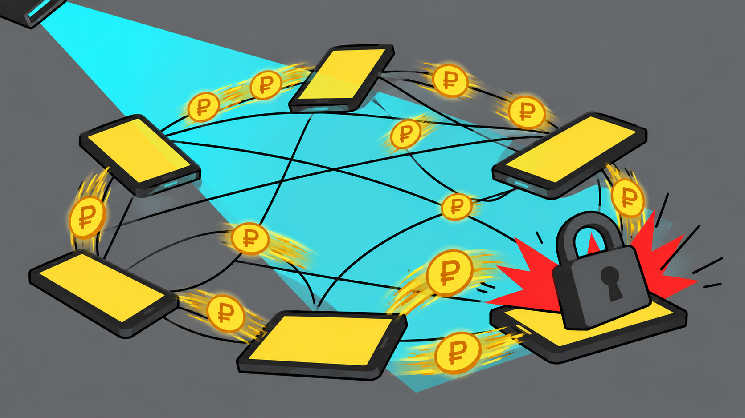
Starting September 1, 2026, Russia's Federal Law No. 461-FZ grants Rosfinmonitoring (the Federal Financial Monitoring Service) direct access to transaction data from the National Payment Card System (NSPK), the operator of the Mir payment card system and the Faster Payments System (SBP). This allows the agency to bypass individual banks when reconstructing transaction trails for anti-money laundering (AML) purposes. The data, provided free of charge and without requiring customer consent or court orders, includes information on operations via SBP, the unified QR-code, and Mir cards, with no minimum transaction threshold. Customers will not be notified when their data is shared. The law does not introduce new taxes, automatic account freezes, or new enforcement powers. If suspicious activity is identified under existing AML laws, existing procedures with banks and law enforcement will apply. The agreement's specific terms between Rosfinmonitoring and NSPK, including the scope and historical depth of accessible data, are not public. The change centralizes access to a vast volume of domestic payments, potentially speeding up financial investigations. However, it also creates a single point of concentration for sensitive data and reduces transparency for cardholders, as customers are not informed about data requests. Observers note a global trend of expanding supervisory powers, with differences in the Russian model being the non-public agreement and the lack of customer notification.

cryptonews.ru13m ago

Is Your Account Still Blocked? Rosfinmonitoring Gets Direct Access to SBP and 'Mir'

cryptonews.ru13m ago

Solana Price Forecast Hits $110 as Bitwise's BSOL Posts Record Trading Volume

Solana (SOL) price is testing a critical resistance zone between $102-$103, having recently risen above $100 and now trading at $101.36. Technical analysis indicates a bullish but cautious trend, with the Parabolic SAR signaling a bullish short-term trend and the MACD gaining momentum. The price is within a rising wedge pattern, suggesting a potential breakout or sharper pullback. Key bullish factors include sustained, record-high network activity, with Solana processing over 1 billion transactions for the fourth consecutive week. Strong institutional demand is also evident, as Bitwise's Solana ETF (BSOL) recorded its highest-ever daily trading volume of over $108 million, contributing to significant daily inflows into SOL ETFs. However, caution is warranted. A major whale unstaked and transferred over 45,000 SOL, realizing a $3.3 million loss. Additionally, long-dated futures are trading at a discount to spot prices, indicating some long-term trader skepticism. **Price Forecast:** * **Bullish Case (Target: $110):** A confirmed daily close above the $102-$103 wedge resistance, supported by strong network usage and ETF inflows, could propel SOL towards $110. * **Bearish Risk (Support: $93-$95):** A rejection at resistance and a breakdown from the rising wedge's support could see the price retreat to the $93-$95 zone, especially if the whale's exit signals broader caution. In conclusion, the outlook is balanced between strong fundamental demand and emerging caution from large holders. The price action around the $102-$103 resistance will be decisive in determining the next significant move.

cryptonews.ru13m ago

Solana Price Forecast Hits $110 as Bitwise's BSOL Posts Record Trading Volume

cryptonews.ru13m ago

Trading

Spot

Hot Articles

Discussions

Welcome to the HTX Community. Here, you can stay informed about the latest platform developments and gain access to professional market insights. Users' opinions on the price of SOL (SOL) are presented below.

活动图片