Father of Claude Code's Latest Assessment: Team Division of Labor Rewritten in the AI Era, These 'Five Types' Are Most in Demand

marsbitPublished on 2026-06-30Last updated on 2026-06-30

Abstract

"In the era of AI reshaping software development, Anthropic's Claude Code team lead, Boris Cherny, proposes a future where traditional job titles dissolve. He identifies five fluid, behavior-based roles emerging in effective, AI-augmented teams: The Prototyper (generates disruptive ideas), The Builder (scales prototypes to production), The Sweeper (streamlines and refactors to combat bloat), The Growth (iterates on launched products for market fit), and The Maintainer (ensures long-term security and reliability). Crucially, these are not fixed positions. Individuals may span multiple roles depending on the project and its lifecycle stage. A designer might be a Prototyper and Sweeper; an engineer could be a Builder and Maintainer. Team composition should shift with product maturity: early-stage products need Prototypers, Builders, and Sweepers, while scaling products require more Builders, Growth roles, and Maintainers. The discussion highlights that role fluidity is key, as professionals often switch roles across different projects or as a single project evolves. While AI tools like Claude increasingly assist with tasks like building and sweeping, human adaptability and focus on goals over rigid job boundaries are seen as essential for future teams."

As Agent Coding goes viral and reshapes the software industry, it seems the field has gradually accepted the undeniable fact that the role of the "engineer" is changing. In reality, however, the change likely extends beyond just the "engineer" position; a more profound transformation is quietly occurring at the foundation of team organizational structures......

Recently, Boris Cherny, head of the Anthropic Claude Code team, shared a very interesting observation on X.

He pointed out that as functions like engineering, product, design, and data science increasingly merge, he has been pondering what these roles will evolve into in the future. Taking the Claude Code team as an example, the traditional "job labels" internally are being completely discarded, replaced by five new types of "unbundled" roles based on behavioral patterns: The Prototyper, The Builder, The Sweeper, The Growth, and The Maintainer.
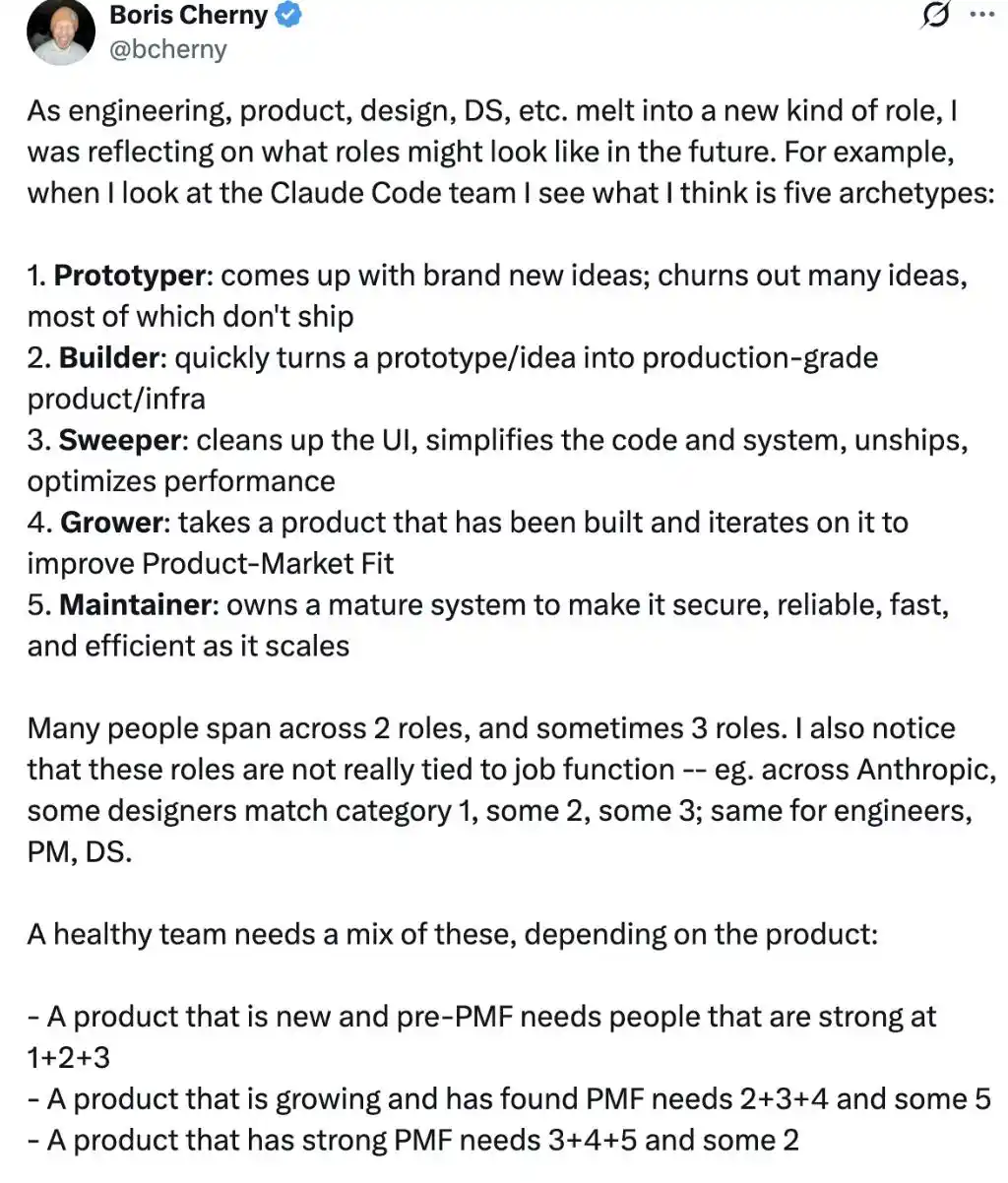
The Prototyper: Primarily responsible for proposing entirely new ideas, continuously generating a large volume of creativity, with most ideas ultimately not being launched. In other words, they pursue the quantity and disruptiveness of ideas, not fixating on whether each one must be implemented.

The Builder: Primarily responsible for quickly turning scattered ideas or rough prototypes into products or highly available infrastructure that can truly be deployed in production environments for massive user bases. In other words, they are responsible for solving the hardcore leap from 0.1 to 1.

The Sweeper: Primarily responsible for "subtraction." The most terrifying side effect of the AI era is the over-expansion of code and features. The Sweeper's duty is to clean up and streamline user interfaces, simplify and refactor messy code and system architectures, and remove unnecessary redundant functionalities to achieve high system performance and maintainability.

The Growth: Takes over a finished, built product. When a product enters the market, The Growth is responsible for continuous, rapid iteration. They must care about: how to bring the product closer to the market? How to make users more willing to stay? How to make a product evolve from "usable" to "needed." However, this role is not equivalent to traditional growth operations; it is more of a combination of product, data, user understanding, and experimentation capabilities.

The Maintainer: Responsible for the long-term operation of a mature system. They may not chase flashy new features but obsess over security, reliability, extreme operational efficiency, and system resilience, ensuring services remain rock-solid under any extreme traffic conditions.

It's important to note, however, that these five roles do not correspond to traditional positions. That is to say, unlike traditional organizational management where a person's role is fixed in a job title.

Boris Cherny believes that many people might span two roles, and sometimes even three.

"I've also noticed these roles aren't truly tied to specific jobs. For example, internally at Anthropic, some designers align more with type 1, some with type 2, and some with type 3; the same goes for engineers, product managers, and data scientists."

This implies that in efficient, AI-empowered teams, many members are no longer 'single-purpose cogs.' A designer can be a Prototyper or a Sweeper; an engineer can be a Builder or a Maintainer; a product manager can take on Growth or become a Prototyper; a data scientist might not only perform analysis but also directly participate in product growth and system optimization......

In other words, the way future teams look at people might change. The past question might have been mainly "What is your job title?" while the future—or the present—is becoming "Which stage of the product lifecycle can you advance?"

Boris Cherny analyzed that the specific combination of these roles needed for a healthy team depends on the product's current stage:

A brand new product that hasn't yet found product-market fit needs people skilled in roles 1, 2, and 3.

A product that is growing and has found product-market fit needs roles 2, 3, and 4, supplemented by some role 5.

A product with strong product-market fit needs roles 3, 4, and 5, while retaining some role 2.

"Perhaps future product roles will look more like this, rather than today's division by specialized fields."

Once this post was published, it immediately sparked lively discussion among netizens, with most expressing agreement.

"This perfectly matches how people actually work. In some projects, I am indeed a 1+3 combo, while in others, I'm almost pure 4. Job titles have never truly captured these."

A data scientist also "stepped forward," saying that as a data scientist, they often find themselves doing Sweeper-type work while also building products with a data science sensibility. "So does that make me a 2+3 type?"

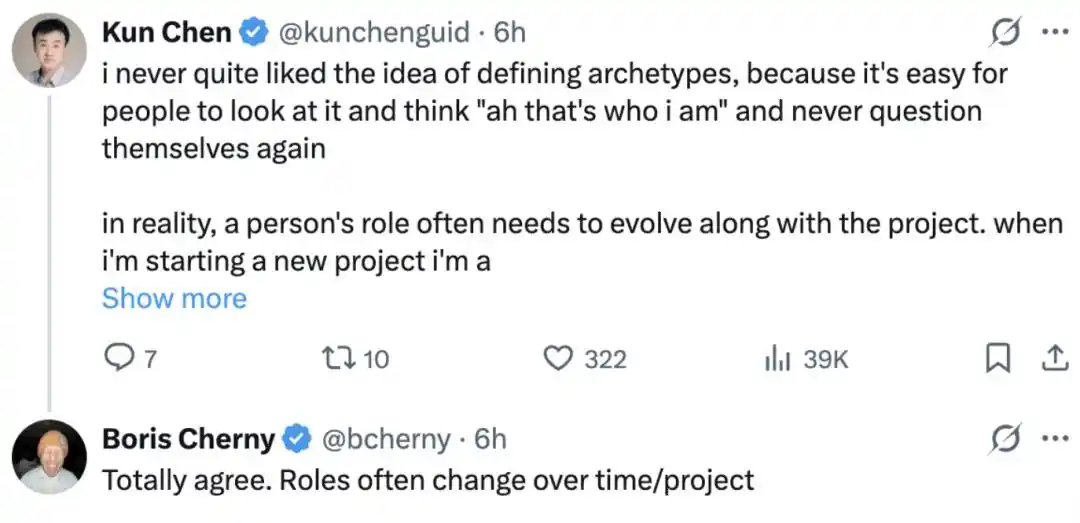
Netizen Kun Chen@kunchenguid expressed strong resonance. He said he never liked defining "role archetypes" because people easily see them and think, "Ah, so this is me," and then stop reflecting. In reality, "a person's role often needs to change along with the project."

He gave an example: when starting a new project, he typically acts as a Prototyper and Builder; but soon, as rough, unfinished parts become bottlenecks, he turns into a Sweeper. As the project matures, he shifts towards Growth and Maintainer... "If I box myself into one specific role, then when the project reaches a certain stage, I'd have to let go."

Another reality is that people now often work on multiple projects simultaneously, requiring them to play different roles in different projects. "Categorizing oneself into a fixed archetype often limits a person's ability to expand their ambitions."

Therefore, his advice is: Stay flexible, focus attention on the most important things needed to achieve the goal, and worry less about role boundaries. Because these boundaries will only continue to blur over time.

Boris Cherny responded, saying this completely captured his own thoughts: "Completely agree. Roles often change over time and project phases."
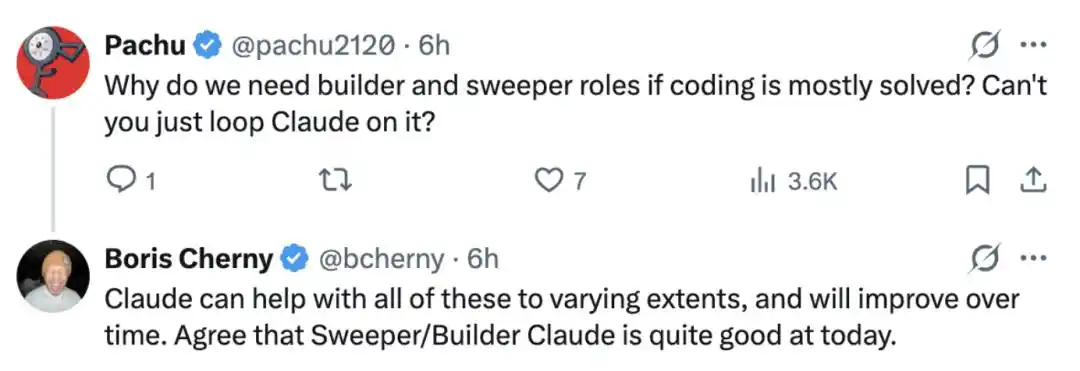
Some netizens expressed skepticism: "Since AI writing code is basically solved, why are roles like Builder and Sweeper still needed? Can't we just let Claude run in a continuous loop?"

In response, Boris Cherny explained that Claude can help with all these things to varying degrees and will continue to become stronger over time. Currently, today's Claude is already quite good at taking on Sweeper and Builder-type work.
What about you? How do you view this change in job roles? Feel free to leave a comment and discuss!

Reference Links:

https://x.com/bcherny/status/2071379474277613732

https://x.com/kunchenguid/status/2071382977628795289

This article is from the WeChat public account "Almost Human" (ID: almosthuman2014), author: Focus on AI


Trending Cryptos

Related Questions

QAccording to Boris Cherny, what are the five new 'unbundled' roles emerging in AI-augmented teams?

AThe five new 'unbundled' roles are: The Prototyper, The Builder, The Sweeper, The Growth, and The Maintainer.

QHow do these five new roles differ from traditional job titles in a company?

AThese roles are not fixed to traditional job titles. They are based on behavioral patterns and how individuals contribute to a product's lifecycle. A person can span multiple roles, and roles can change based on the project or product stage.

QWhich role is responsible for turning rough prototypes into production-ready products?

AThis is the primary responsibility of 'The Builder.' They handle the hard leap from a 0.1 version to a 1.0 version that is ready for the production environment.

QHow should the mix of these five roles in a team change as a product matures?

AFor a new product seeking product-market fit, you need Prototypers, Builders, and Sweepers. For a growing product with established fit, you need Builders, Sweepers, and Growth roles, with some Maintainers. For a mature product with strong fit, you need Sweepers, Growth, and Maintainers, with some Builders retained.

QWhat was Boris Cherny's response to the skepticism about needing human Builders or Sweepers if AI can write code?

ABoris Cherny stated that Claude can already help with these tasks to a significant degree and is getting better. Currently, it is particularly good at assisting with the Sweeper and Builder type of work.

Related Reads

Shanghai's $10 Billion Unicorn Is About to Go Public

Shanghai-based automotive-grade millimeter-wave radar chip unicorn Calterah Microelectronics Technology (Shanghai) Co., Ltd. has filed for an IPO on Shanghai's STAR Market, aiming to raise 3.49 billion yuan. Founded in 2014 by Chen Jiashu, a UC Berkeley PhD graduate, and his professor Ali Niknejad, Calterah pioneered CMOS technology for 77GHz radar chips, breaking the decades-long monopoly of international giants like Texas Instruments. Its low-cost, highly integrated solutions enabled millimeter-wave radar to move from luxury to mass-market vehicles. By 2025, Calterah captured a 31.1% share in China's automotive millimeter-wave radar chip market (second domestically, fourth globally), with cumulative shipments exceeding 30 million units. Its client list includes BYD, Geely, Nio, and Volvo. The company has undergone 11 funding rounds, attracting high-profile investors such as the National Integrated Circuit Industry Investment Fund Phase II, China Capital Management, and GD Capital. Its valuation has reached tens of billions of yuan, with a projected post-IPO valuation of approximately 14 billion yuan. Despite rapid revenue growth—increasing from 206 million yuan in 2023 to 632 million yuan in 2025 with a 75.28% CAGR—Calterah remains unprofitable. It reported net losses of 323 million yuan, 334 million yuan, and 193 million yuan from 2023 to 2025, accumulating over 900 million yuan in losses over three and a half years. These losses are primarily attributed to heavy R&D investment, which totaled over 1.039 billion yuan in the reporting period, often exceeding annual revenue. The company faces significant risks, including high customer concentration (its top five customers accounted for over 99% of revenue from 2023-2025, with BYD alone representing over 50% in 2025) and supply chain concentration. Revenue pressure from key customers and dependencies on overseas suppliers for EDA tools and IP pose challenges to sustainable growth. The IPO is seen as crucial for securing capital to expand production, diversify its customer base, and reduce supply chain dependencies.

marsbit30m ago

Shanghai's $10 Billion Unicorn Is About to Go Public

marsbit30m ago

Ray Dalio's Latest Macro Analysis Full Text: Buy More Gold, Add Some Bitcoin

In his latest macro analysis, Ray Dalio applies his framework from "How Countries Go Broke: The Big Cycle" to the current global debt environment. He highlights recent events like Japan selling U.S. Treasuries and rising U.S. long-term yields as signs of an unsustainable debt dynamic. Dalio explains that excessive government debt leads to either unacceptably high interest rates, severe economic downturns, or significant currency debasement through central bank money printing. He summarizes the U.S. fiscal situation: with $5.5 trillion in revenue, $7.5 trillion in spending, a $2 trillion deficit, and total debt at six times annual revenue, debt servicing costs are immense. Without correction, U.S. debt could reach $55-$60 trillion in a decade. Dalio proposes a "3% Three-Way" solution: reducing the budget deficit to 3% of GDP through balanced spending cuts, tax increases, and interest rate reductions to avoid a traumatic adjustment. In response to FAQs, he argues that the risk of a U.S. debt crisis is high and could materialize within a few years if the current path continues. He dismisses the notion that the dollar's reserve status makes the U.S. immune, citing historical precedents of reserve currency declines. He is also unconvinced by Japan's high-debt stability, noting poor returns for yen-denominated assets. For investors, Dalio recommends diversifying globally, underweighting bonds, and overweighting assets like gold and a small allocation to Bitcoin (around 10-15% to gold) to hedge against currency debasement and poor debt returns.

marsbit1h ago

Ray Dalio's Latest Macro Analysis Full Text: Buy More Gold, Add Some Bitcoin

marsbit1h ago

Stripe’s 16-Year Chronicle: From 7 Lines of Code to a $100 Billion Valuation

Stripe's 16-year journey began with a simple promise: "7 lines of code to accept payments." Founded by Patrick and John Collison, the company started by hiding the complexity of bank integrations and merchant accounts behind a clean API, initially targeting developers at startups. This early focus on user experience and technical simplicity fueled rapid adoption. A key early milestone was establishing vital bank partnerships, a challenge overcome by hiring Billy Alvarado, who brought crucial institutional relationship skills. From this foundation, Stripe systematically expanded its product boundaries. It launched Connect for platform payments, Atlas for company formation, Radar for fraud prevention, and Billing for subscriptions. This transformed Stripe from a payment processor into a broader financial infrastructure suite for internet businesses. The COVID-19 pandemic accelerated growth but also led to over-hiring. A 14% layoff in 2022 marked a period of organizational correction. Subsequently, Stripe shifted its growth strategy towards strategic acquisitions to enter new domains quickly. It acquired Bridge (stablecoin infrastructure), Privy (wallet infrastructure), Metronome (usage-based billing), and agreed to buy OpenRouter (AI model routing). These moves signal Stripe's ambition to build a "programmable money system" for the emerging AI and agent-based economy, managing not just currency flows but also the measurement and pricing of computational resources like AI tokens. Internally, Stripe leverages AI agents (like "Minions") to boost engineering productivity. Despite scaling to nearly 8,000 employees and processing $1.9 trillion in payment volume annually, the company remains private. A recent employee tender offer valued it at $159 billion. The core question for Stripe's future is whether it can successfully integrate its expanding product matrix—spanning payments, crypto, and AI infrastructure—into a cohesive platform, positioning itself as the foundational economic layer for autonomous software agents.

marsbit1h ago

Stripe’s 16-Year Chronicle: From 7 Lines of Code to a $100 Billion Valuation

marsbit1h ago

Treasury Secretary's Move to Suppress Treasury Yields Ignites 'Currency Debasement Trade'! Gold Hits Three-Month High, Bitcoin Surges Over 25% in a Single Week

US Treasury Secretary Besant's efforts to lower long-term Treasury yields by announcing expanded buybacks had only a brief market impact. However, this move fueled a "currency devaluation trade," weakening the US dollar while boosting both gold (to a three-month high) and Bitcoin (up over 25% for the week). Analysts attribute this reaction to deepening market concerns over the massive US fiscal deficit and structural pressures keeping long-term rates elevated, including fierce competition for capital from global government borrowing and massive AI sector financing. Despite the Treasury's actions, fundamental forces like growth, inflation, and capital demand are seen as limiting its ability to sustainably suppress yields. Bitcoin's strong positive correlation with gold has reinforced its narrative as a hedge against devaluation. While equity markets have shown resilience, some strategists warn that Treasury yields nearing 5% increase pressure on the dollar and high-leverage assets. Figures like Ray Dalio have advised reducing bond exposure in favor of gold and some Bitcoin, citing US debt risks. Market opinions are divided on the sustainability of the devaluation trade, with some noting the lack of a near-term catalyst for its next leg higher. The underlying tension between the Treasury's desire for lower borrowing costs and the Federal Reserve's focus on inflation and reducing market intervention remains a key theme. Upcoming events like Nvidia's earnings and the Jackson Hole symposium will test whether AI profits can continue supporting stocks and if the Fed aligns more with Washington's preference for easier financial conditions.

华尔街日报4h ago

Treasury Secretary's Move to Suppress Treasury Yields Ignites 'Currency Debasement Trade'! Gold Hits Three-Month High, Bitcoin Surges Over 25% in a Single Week

华尔街日报4h ago

Trading

Spot

Hot Articles

Discussions

Welcome to the HTX Community. Here, you can stay informed about the latest platform developments and gain access to professional market insights. Users' opinions on the price of S (S) are presented below.

活动图片