Facepalm! A Roundup of "Flipped" Institutional Crypto Predictions for 2025

比推Published on 2025-12-27Last updated on 2025-12-27

Abstract

As 2025 year-end approaches, the cryptocurrency market has failed to deliver the spectacular rallies many institutions had forecasted, instead exposing the inaccuracy of numerous high-profile price predictions. Bitcoin is trading around $87,423 and Ethereum near $2,926, far below the ambitious targets set during the 2023-2024 bull market. Major institutions and analysts, including Michael Saylor (predicting $100,000), Mark Yusko ($150,000), Tom Lee ($250,000), and Tim Draper ($250,000), collectively anticipated Bitcoin reaching six figures, driven by ETF approvals, macro liquidity, and political shifts. Standard Chartered and AllianceBernstein projected $200,000, with the latter even specifying a September 2025 target. However, these forecasts largely underestimated market complexities, such as structural changes from ETFs—which provided a higher floor rather than exponential peaks—and persistent volatility from policy and geopolitical uncertainty. Ethereum predictions also fell short. Deltec Bank expected prices between $9,000-$10,000, while Standard Chartered initially targeted $14,000 before revising down to $7,500. Analysts’ average prediction was $6,105, yet ETH remained below $3,000. The consensus was that upgrades and ETF inflows would propel prices, but the market refused to align with these narratives. The 2025 outcome underscores the declining relevance of historical models, like the four-year cycle thesis, in a new era of institutional involvement and macro pr...

As 2025 draws to a close, the crypto market hasn't produced any miraculous rallies; instead, it has brought the exaggerated price predictions from the past couple of years back down to earth.

First, let's look at the current prices: As of 8:00 AM Beijing Time on December 27th, Bitcoin ≈ $87,423, Ethereum ≈ $2,926.

With the numbers right before our eyes, those earlier predictions of "Bitcoin hitting $200,000" and "Ethereum breaking $10,000" seem a bit awkward now. Market volatility, policy swings, international situations... each one reminds us: predictions are predictions, but the market moves on its own.

Below, let's review those "expert predictions" we once追捧ed (chased after/admired) that have already been "slapped in the face" by reality.

BTC: Mainstream Institutions Bullish En Masse

In 2023–2024, following ETF approvals, a shift in US political winds, and improved macro liquidity, almost all heavyweight institutions and opinion leaders publicly offered specific BTC price targets for 2025.

In hindsight, these targets formed a highly concentrated "prediction cluster."

Michael Saylor (MicroStrategy): Reach Six Figures by 2025, Eventually Reach $1 Million

  • Prediction:

    • BTC $100,000 (2025)

    • Long-term target: $1,000,000

Saylor's judgment wasn't merely a price prediction but an entire long-term narrative of "Bitcoin as a digital capital network." Before 2025, he repeatedly emphasized that BTC would not fall back below sixty thousand.

BTC did indeed maintain a high range for most of 2025, but the $100k mark as a "certain outcome" did not materialize as expected.

Mark Yusko (Morgan Creek CEO): 2025 $150k

  • Prediction: BTC $150,000 (2025)

  • Rationale: Network effects / FOMO driving / New capital inflows
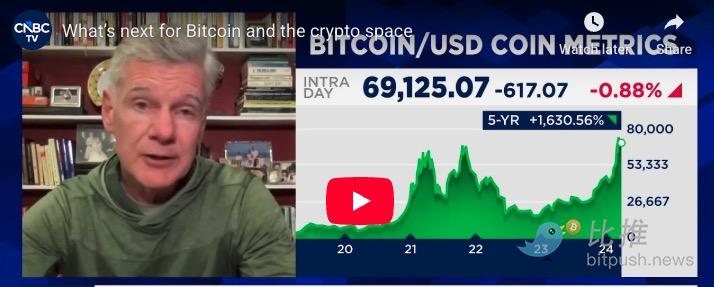
This is a typical "cycle top pricing model", assuming this bull run would completely replicate historical amplitudes.

However, the problem is that ETFs brought about a "structural change," not simply a "leveraged amplification of the cycle."

Tom Lee (Fundstrat Co-founder): $250,000

  • Prediction: BTC $250,000 (2025)

  • Key Catalyst: He believed changes in the US political landscape and potential government Bitcoin holdings were key catalysts. He stated these developments indicate Bitcoin is becoming a legitimate alternative to traditional stores of value like gold.

Tom Lee's prediction was highly influential in 2024 but also heavily reliant on the premise of "policy + sentiment + capital moving in sync."

It's worth noting that Tom Lee revised his prediction downward multiple times in 2025 but still emphasized near-term potential for new highs as the year ended. Just last week, Sean Farrell, Head of Digital Asset Strategy at his firm Fundstrat, predicted in an internal report that BTC could fall to $60,000-65,000 in the first half of 2026 (under a base case). This contrasts with Tom Lee's public optimism, with the company explaining it as a difference in time frames.

Standard Chartered: Close to $200,000

  • Prediction: BTC $200,000 (2025)

  • Rationale/Comparison: Historical price increases following Gold ETF listings. The bank expected significant inflows into Bitcoin spot ETFs to drive this growth, similar to gold's 4x price increase after its first ETF launched.

But unlike gold, Bitcoin did not enter a one-way trend post-ETF; instead, it experienced more frequent pullbacks and repricing.

AllianceBernstein: $200,000

  • Prediction Timeline: September 2025

  • Additional Forecasts:

    • $500k by 2029

    • $1M+ by 2033

This was one of the few institutional predictions offering a specific monthly target. Reality shows: timing targets are the easiest part of any prediction to get wrong.

InvestingHaven: $115,200 (Bull) / $75,000 (Bear)

  • Method: Scenario analysis

This was one of the few models that provided both bull and bear case ranges.

Even so, its bull target was not fully realized in 2025, while the bear case range was validated by the market multiple times.

Tim Draper (VC): $250,000 (Revised)
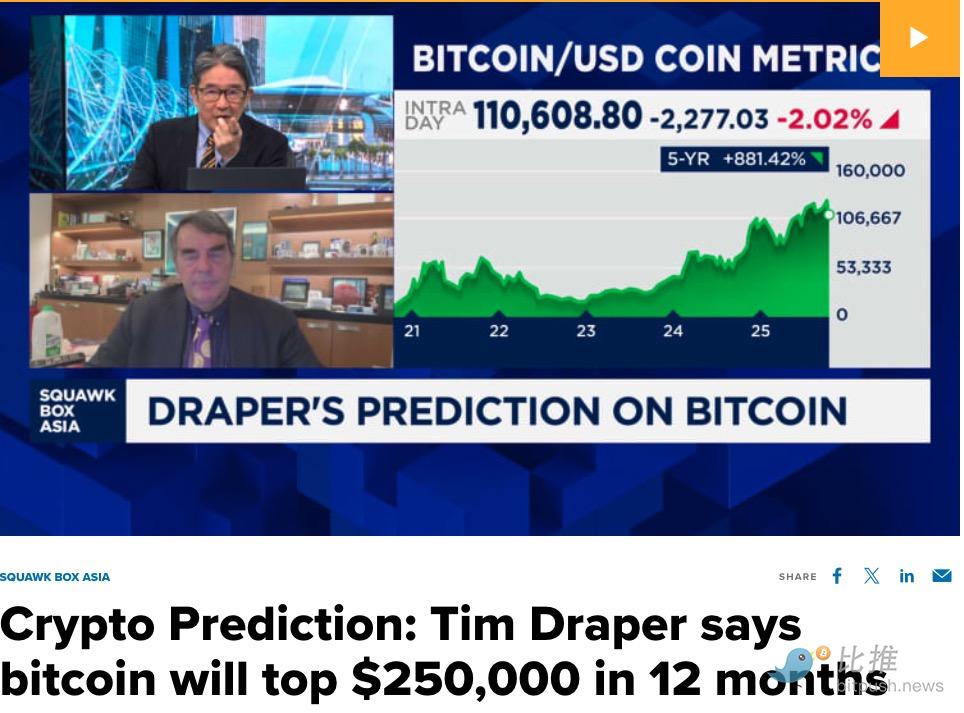
An early investor in Tesla, Skype, Baidu, and Twitch, among others. Draper previously predicted Bitcoin would reach this price in 2022, later revising the timeline to 2025.

Matthew Sigel (VanEck Head of Research): $180,000

  • Prediction: BTC $180,000+ in 2025

  • Rationale:

    • ETF inflows

    • US political cycle changes

But the reality is: ETFs provided more of a floor lift than a ceiling explosion.

Sminston With (Crypto Researcher, PhD): $275,000
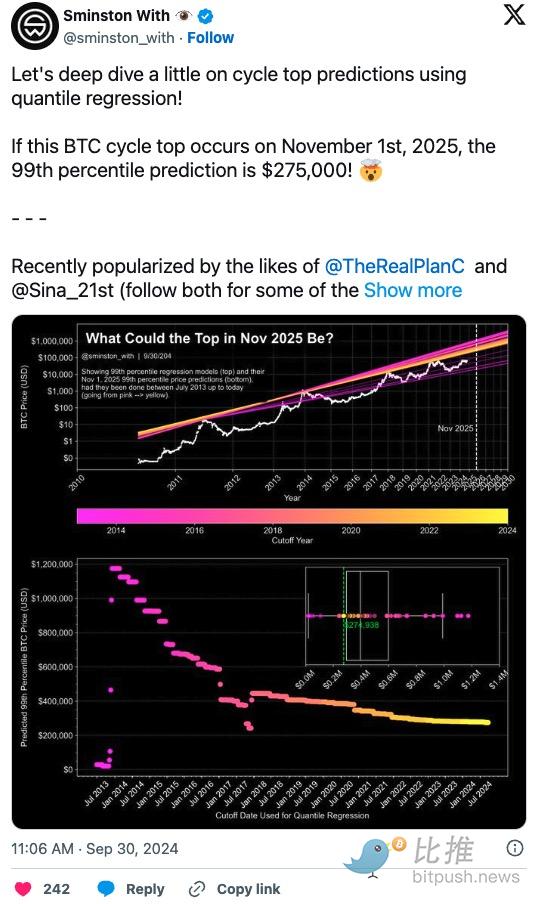
Bitcoin researcher Sminston With used quantile regression to predict the cycle top, estimating it would arrive on November 1, 2025, with Bitcoin reaching $275,000.

By the end of 2025, this prediction was clearly off the mark (had clearly failed).

Cathie Wood (ARK Invest): $1,000,000

  • Prediction:

    • Base case: $650,000 (2030)

    • Optimistic: $1,000,000+

Strictly speaking, this prediction hasn't been "slapped" yet, but it represents the long-term version of the same logic.

ETH: Predictors Bet on "Upgrade Delivery"

In 2025, ETH's fundamental narrative didn't fail, but the price refused to pay for the narrative.

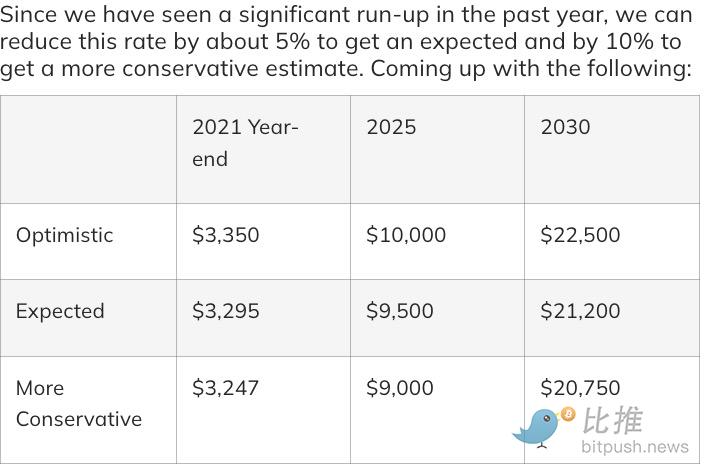
Deltec Bank:

    • 2025: Optimistic $10,000 / Expected $9,500 / Conservative $9,000.
Standard Chartered: The "ETF+Upgrade" Path to $14,000

  • Standard Chartered suggested in 2024 that ETH could reach $14,000 (2025), with ETFs being a core catalyst. But by 2025, Standard Chartered revised its year-end ETH prediction up to $7,500.
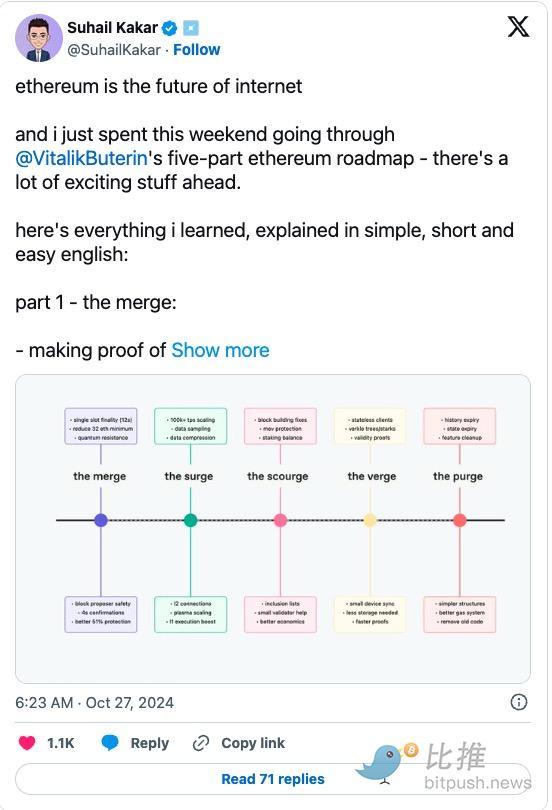
Finder Analysts: In February 2024, the average prediction from 50 analysts was ETH $6,105 (2025).

VanEck predicted Ethereum would reach $11,800 by 2030, citing network growth and adoption.

Bitwise: Predicted end-2024 that Ethereum would reach $7,000 in 2025, alongside new highs for BTC and SOL.

Bankless: Believed that after Ethereum realizes its potential in 2025, the pessimistic price would be $10,000, and the reasonable price would be $15,000.

Summary

The 2025 market cycle has given us pause for reflection – trying to predict the future based solely on past experience is becoming less effective in the crypto market. The once-popular "four-year cycle theory" has lost much of its explanatory power under the impact of massive ETF fund flows and a complex macro environment.

Market predictions are essentially about finding anchors amidst uncertainty. But when the anchors themselves are drifting, who can guarantee accuracy every time? Facing 2026, perhaps what we need is not to rush to find the next "prophet," but to maintain patience and flexibility – the market will always chart its own course, and our job is to prepare to respond, not stubbornly guess.

It should be noted that this article is not meant to negate the value of professional institutional analysis. Rigorous research remains precious in an information-cluttered market. But ultimately, the market always provides the answer, and what we need to do is learn to coexist with predictions while maintaining independent thinking. After all, in this field, there can be many opinions, but the true answer is always only one – the market itself.

Author: Seed.eth


Twitter:https://twitter.com/BitpushNewsCN

Bitpush TG Discussion Group:https://t.me/BitPushCommunity

Bitpush TG Subscription: https://t.me/bitpush

Original link:https://www.bitpush.news/articles/7598563

Trending Cryptos

Related Questions

QWhat was the actual price of Bitcoin and Ethereum at the end of 2025, according to the article?

AAs of 8:00 AM Beijing Time on December 27th, 2025, Bitcoin was approximately $87,423 and Ethereum was approximately $2,926.

QWhich CEO predicted Bitcoin price would reach $150,000 in 2025, and what was their reasoning?

AMark Yusko, CEO of Morgan Creek, predicted Bitcoin would reach $150,000 in 2025. His logical basis was network effects, FOMO (Fear Of Missing Out) driving the market, and new capital entering.

QWhat was the key difference between the actual market effect of Bitcoin ETFs and the predictions, as highlighted in the article?

AThe article states that unlike predictions which expected a massive price surge, ETFs brought about a 'structural change' that resulted in more frequent market retracements and repricing, leading to a 'bottom lift' rather than a 'top explosion' in price.

QWhich institution gave a specific month for its Bitcoin price prediction, and what was that prediction?

AAllianceBernstein predicted that Bitcoin would reach $200,000 by September 2025.

QWhat is the article's overall conclusion about the reliability of price predictions in the crypto market?

AThe article concludes that predicting the future based on past experience is increasingly unreliable in the crypto market. It suggests that instead of seeking the next 'prophet,' investors should maintain patience and flexibility, preparing to respond to the market's actual movements rather than being fixated on predictions.

Related Reads

Misjudged A-Shares: Resilience, Expectations, and Confidence

China's A-share market recently faced selling pressure, especially in tech sectors, initially triggered by a global tech sell-off that began in South Korea. However, the article argues this is a case of "mistaken injury" and highlights the market's underlying resilience. This resilience stems from three main pillars: **1) Tech Sector Fundamentals:** Unlike Korea's market dominated by a few memory chip stocks, China's tech sector is diversified across computing, communications, electronics, and semiconductors, supported by dual narratives of global AI supply chains and domestic substitution. Core areas like optical modules and fiber optics continue to show strong earnings growth. **2) "National Team" Support:** State-backed institutions and large corporations have made significant market purchases and announced buybacks, providing liquidity and signaling confidence. This is seen as a stabilizing policy signal, often associated with market bottoms. **3) Broader Market Pillars:** Other major sectors are showing endogenous recovery momentum. Consumer stocks benefit from stabilizing CPI and signs of sector recovery (e.g., liquor price hikes). Cyclical sectors like aluminum have high earnings, potential price increases due to tight supply, and low valuations. The financial sector offers stable dividends and low valuations. The conclusion is that the sell-off was driven by external contagion, not a collapse in fundamentals. With strong policy support and recovering momentum across key sectors, the A-share market possesses the toughness to regain stability.

marsbit22m ago

Misjudged A-Shares: Resilience, Expectations, and Confidence

marsbit22m ago

The Clarity Act's Journey Through Congress: The Thorny Path of Bipartisan Compromise in the U.S.

The U.S. Congress is struggling to advance the crypto market structure bill known as the Clarity Act, with bipartisan compromise proving difficult. Key hurdles include unresolved disputes over "yield" products and, more critically, the inclusion of strong ethics provisions for elected officials—a non-negotiable demand for many Democrats. While a compromise on yield was reached in May, securing only limited Democratic support in committee, the separate Senate Agriculture Committee version later passed with no Democratic votes due to the ethics impasse. As Republicans push for a full Senate vote in July, demands for ethics rules have expanded, and other contentious issues like developer protections and concerns from law enforcement and large banks further complicate negotiations. Despite consensus on the need for legislation, the path forward is unclear. Recent discussions between senators and White House officials aim to find acceptable ethics language. Some lawmakers question whether a compromise text can garner enough bipartisan support, with one Democrat stating the current proposal lacks the strong ethics provisions required for their vote. Potential short-term goals for the crypto community include symbolic Senate action before the August recess, a longer-term aim for passage by 2026, or establishing a detailed framework that addresses ethics and other compromises. The process remains arduous, relying on the traditional, vote-by-vote effort to build bipartisan support.

marsbit41m ago

The Clarity Act's Journey Through Congress: The Thorny Path of Bipartisan Compromise in the U.S.

marsbit41m ago

Are Kalshi and Polymarket Founders at Odds? This Business Rivalry Is More Brutal Than You Think

"The Rivalry Between Kalshi and Polymarket Founders Turns Bitter and Litigious" The intense feud between Tarek Mansour, CEO of Kalshi, and Shayne Coplan, founder of Polymarket, has escalated far beyond typical business competition into personal animosity and regulatory battles. Both lead billion-dollar prediction market platforms, but their approaches differ sharply. Kalshi positions itself as the compliant operator, securing U.S. regulatory approval before launching. In contrast, Polymarket initially operated offshore, allowing U.S. users to access its platform via VPN, which drew regulatory scrutiny. The conflict reached a peak in November 2024 when FBI agents raided Coplan's New York apartment. While Coplan publicly blamed political motives, his team privately suspected Kalshi was involved. According to sources, Kalshi's lawyers had previously reported Polymarket's operations to federal prosecutors, highlighting its accessibility to U.S. users despite a ban. This incident fueled mutual accusations and underhanded tactics, including social media smear campaigns and attempts to sabotage each other's major business deals. Their rivalry also played out in Washington, influencing regulatory debates. Kalshi actively lobbied against Polymarket's practices, framing them as illegal and unethical. Polymarket, after facing a CFTC fine and investigation, later acquired a licensed U.S. firm to launch a domestic app, regaining a foothold. Despite the hostility, both companies have seen massive growth, with combined trading volumes soaring. However, increased regulatory scrutiny, particularly around insider trading on Polymarket's platform, continues to pose challenges. The founders' deep-seated mutual disdain ensures their battle for market dominance remains as much a personal vendetta as a commercial one.

marsbit50m ago

Are Kalshi and Polymarket Founders at Odds? This Business Rivalry Is More Brutal Than You Think

marsbit50m ago

Trading

Spot

Hot Articles

What Is TradFi

TradFi (Traditional Finance) refers to a centralized financial system dominated by banks, securities exchanges, asset management firms, and regulatory institutions.

39.3k Total ViewsPublished 2026.07.01Updated 2026.07.01

What Is TradFi

HTX Learn: Learn TradFi to Share 1000 USDT in HTX​

To enhance your understanding of TradFi, we are rolling out various rewarding events. Join them now and bring home generous rewards through learning and trading.

40.1k Total ViewsPublished 2026.07.01Updated 2026.07.01

HTX Learn: Learn TradFi to Share 1000 USDT in HTX​

How to Buy DATA

Welcome to HTX.com! We've made purchasing DATA Network (DATA) simple and convenient. Follow our step-by-step guide to embark on your crypto journey.Step 1: Create Your HTX AccountUse your email or phone number to sign up for a free account on HTX. Experience a hassle-free registration journey and unlock all features.Get My AccountStep 2: Go to Buy Crypto and Choose Your Payment MethodCredit/Debit Card: Use your Visa or Mastercard to buy DATA Network (DATA) instantly.Balance: Use funds from your HTX account balance to trade seamlessly.Third Parties: We've added popular payment methods such as Google Pay and Apple Pay to enhance convenience.P2P: Trade directly with other users on HTX.Over-the-Counter (OTC): We offer tailor-made services and competitive exchange rates for traders.Step 3: Store Your DATA Network (DATA)After purchasing your DATA Network (DATA), store it in your HTX account. Alternatively, you can send it elsewhere via blockchain transfer or use it to trade other cryptocurrencies.Step 4: Trade DATA Network (DATA)Easily trade DATA Network (DATA) on HTX's spot market. Simply access your account, select your trading pair, execute your trades, and monitor in real-time. We offer a user-friendly experience for both beginners and seasoned traders.

668 Total ViewsPublished 2026.07.01Updated 2026.07.01

How to Buy DATA

Discussions

Welcome to the HTX Community. Here, you can stay informed about the latest platform developments and gain access to professional market insights. Users' opinions on the price of A (A) are presented below.

活动图片