Ethereum whales are profitable again! Here’s why it’s bullish AND dangerous

ambcryptoPublished on 2026-03-22Last updated on 2026-03-22

Abstract

Ethereum whales holding over 100,000 ETH are profitable again as ETH trades near $2,000, signaling a potential market transition. While this shift improves confidence and supports accumulation, it also raises the risk of distribution near key resistance levels. The aggregate realized price around $2,350–$2,400 remains a critical zone. On-chain data shows exchange outflows and renewed accumulation, but expanding supply and inconsistent retail demand limit upward momentum. With issuance exceeding burns and active address activity fluctuating, Ethereum’s recovery depends heavily on sustained demand to counter rising liquid supply and overhead selling pressure.

Ethereum’s large holders are shifting position as unrealized profit for wallets containing over 100,000 ETH turns positive again.

Earlier, these wallets stayed underwater during declines near $200 and later around $1,000, where the price formed clear cycle lows.

As losses narrowed, accumulation gradually increased. Then, as the ratio crossed above zero, the price began stabilizing and pushing higher. Now, with Ethereum [ETH] trading near $2,000, whales have re-entered profit territory.
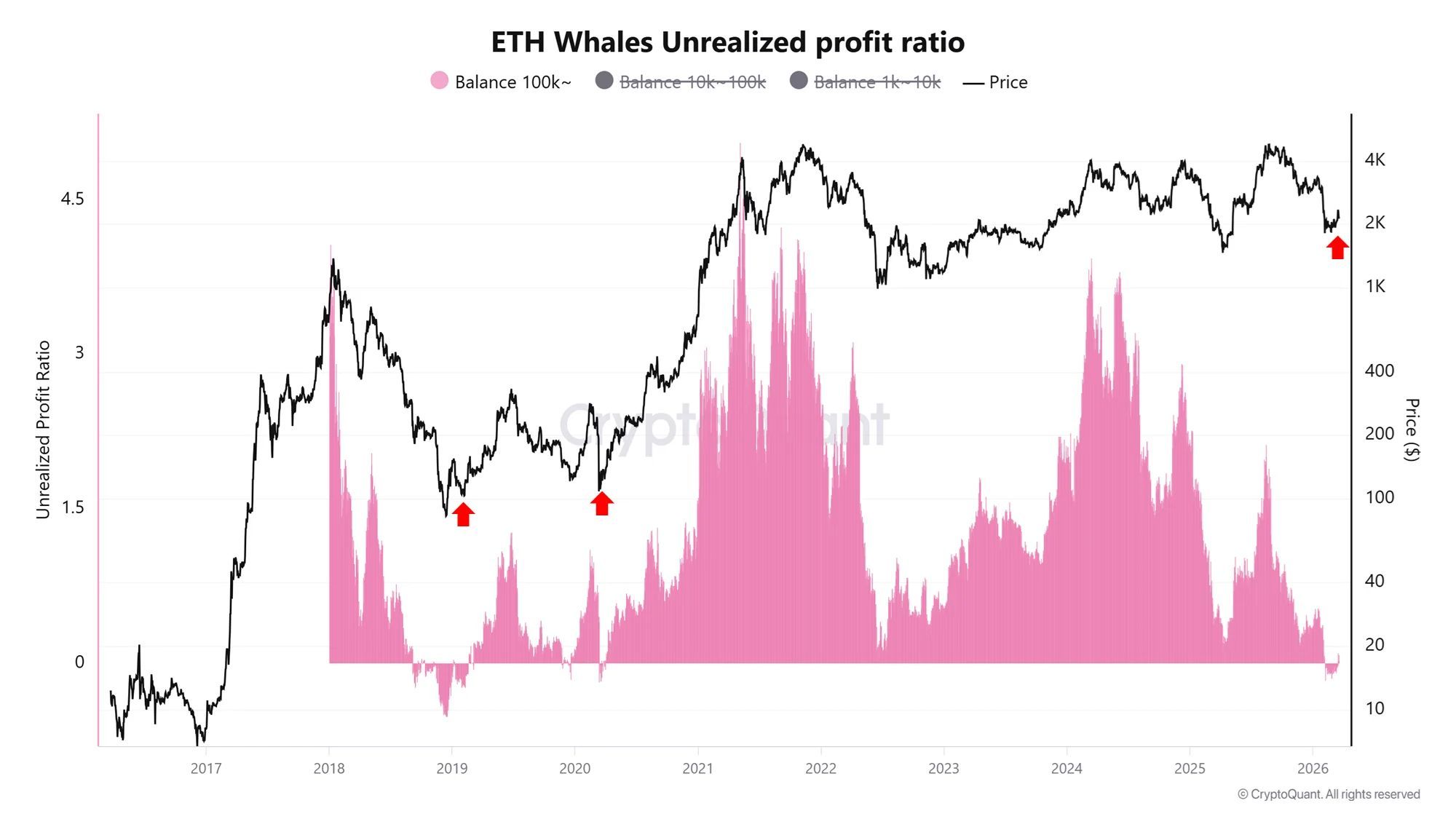
Source: CryptoQuant

This shift often marks a transition point rather than a clear direction.

On one hand, profitable positions support momentum as confidence improves. On the other hand, rising profits can trigger distribution, especially near resistance.

As this balance develops, price action becomes more dependent on demand strength. This implies a potential trend shift forming while also leaving room for volatility if selling pressure emerges.

On-chain accumulation builds as Ethereum faces heavy overhead supply

Ethereum’s structure now reflects a balance between renewed accumulation and heavy overhead supply.

The aggregate Realized Price sat close to $2,353, at press time which serves as a key cost basis. As the price approaches this $2,350–$2,400 zone, market direction becomes more sensitive.
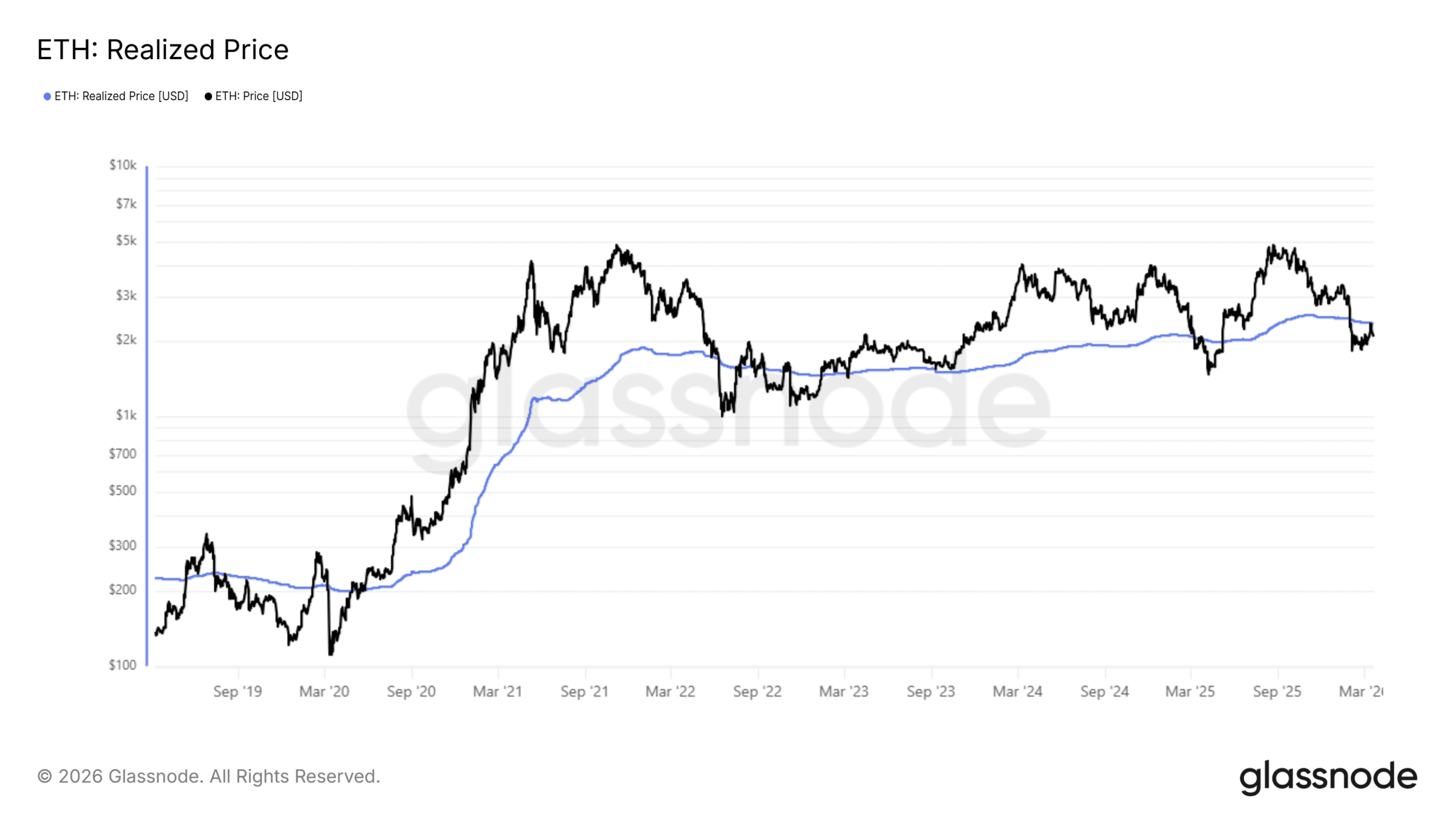
Source: Glassnode

Meanwhile, 100,000+ ETH wallets have flipped back into profit, signaling improved conviction among large holders. Earlier, these cohorts remained defensive while underwater. Now, their positioning supports potential upside.

However, Exchange Outflows exceeded 377,663 ETH, showing capital shifting to long-term holding. This balance implies accumulation is building, while resistance still defines the pace of any recovery.

Expanding supply caps Ethereum’s on-chain momentum

Ethereum’s supply dynamics show expansion rather than tightening, which reshapes the typical accumulation narrative. Circulating supply stands at 121.55 million ETH, with 38.26 million staked, yet issuance still exceeds structural offsets.

Annually, 1 million ETH is issued while only 16,000 ETH is burned, resulting in 0.82% growth.

Over the past week, supply increased by 18,996 ETH, as new tokens outpaced removal mechanisms. This matters because rising liquid supply reduces scarcity, which weakens price pressure during recovery attempts.

Meanwhile, daily active addresses fluctuate between 613,000 and 1.07 million, recently near 842,000, showing unstable participation.

As retail demand lacks consistency and whale flows remain muted, no dominant force drives direction. This balance implies Ethereum lacks strong momentum, leaving the price dependent on sustained demand to absorb the expanding supply.


Final Summary

  • Ethereum [ETH] whale profitability turning positive signals a transition phase, where accumulation supports upside while rising profits increase the risk of distribution near resistance.
  • Ethereum faces expanding supply and uneven demand, which limits momentum and makes price recovery dependent on sustained capital inflows.


Related Questions

QWhat does it mean that Ethereum whales with over 100,000 ETH are profitable again?

AIt means that large Ethereum holders who own more than 100,000 ETH are now in a profitable position after previously being underwater during price declines near $200 and $1,000. This shift often marks a market transition point, supporting potential upside momentum but also increasing the risk of distribution (selling) near resistance levels.

QWhat is the significance of Ethereum's aggregate Realized Price being near $2,353?

AThe aggregate Realized Price of approximately $2,353 represents a key cost basis for Ethereum. As the price approaches the $2,350-$2,400 zone, market direction becomes more sensitive, making this a critical resistance area that could determine whether the price continues upward or faces selling pressure.

QHow are Ethereum's supply dynamics affecting its price momentum?

AEthereum's supply is expanding rather than tightening, with circulating supply at 121.55 million ETH and annual issuance of 1 million ETH exceeding burns of only 16,000 ETH. This 0.82% growth rate increases liquid supply, reduces scarcity, and weakens price pressure during recovery attempts as new tokens outpace removal mechanisms.

QWhat does the recent Exchange Outflow of over 377,663 ETH indicate?

AThe significant exchange outflow of over 377,663 ETH indicates that capital is shifting from exchanges to long-term holding, suggesting accumulation is building among investors who are moving their assets off trading platforms for storage rather than immediate selling.

QWhy does Ethereum currently lack strong momentum according to the article?

AEthereum lacks strong momentum due to expanding supply, unstable retail participation (with daily active addresses fluctuating between 613,000 and 1.07 million), and muted whale flows. With no dominant force driving direction, price recovery depends on sustained demand to absorb the expanding supply.

Related Reads

TechFlow Intelligence Bureau: Chip Stocks Lose Trillions in a Single Day, Bitcoin Falls Below $60,000, US-Iran Conflict Escalates

**Daily Tech & Markets Roundup: AI Advances, Market Turmoil, and Geopolitical Tensions** **AI / LLMs**: Anthropic's internal report on AI self-improvement sparked serious discussions about Recursive Self-Improvement (RSI). Meanwhile, debate continues on AI coding tools after Claude was accused of introducing bugs into the rsync codebase. In positive news, DeepSeek V4 Flash impressed in local deployment tests, and GitHub Copilot now supports custom endpoints for local models. A surprising research turn suggests removing chain-of-thought prompting can sometimes improve LLM performance. **Crypto / Web3**: Bitcoin plunged below $60,000, with its RSI hitting levels last seen during the COVID-19 crash, driven by strong U.S. jobs data reviving interest rate hike fears. Discussions highlight Ethereum DeFi's continued lack of a smooth consumer payment layer. **Chips / Hardware**: Chip stocks suffered a massive sell-off, with the Philadelphia Semiconductor Index posting its worst single-day drop in six years, erasing over a trillion dollars in value. Marvell, Micron, AMD, and Intel were among the biggest losers. **Tech Companies**: A leaked Microsoft document revealing goals to make Copilot "addictive" drew criticism. LinkedIn founder Reid Hoffman left Microsoft's board to focus full-time on his AI agent startup, Manus. Google was revealed to be paying SpaceX $920 million monthly for AI training compute. **Markets & Macro**: A blowout U.S. jobs report (172k vs. 80k expected) crushed hopes for near-term rate cuts, sending Treasury yields soaring and triggering a broad market sell-off. CEOs from Kraft, McDonald's, and Whirlpool simultaneously warned U.S. consumers are exhausting their savings. **Geopolitics**: U.S.-Iran tensions escalated with missile/drone interceptions and U.S. strikes on Iranian radar sites, keeping the critical Strait of Hormuz largely closed since late February and posing ongoing oil supply risks. **The Bottom Line**: The strong jobs data acted as a single trigger for correlated sell-offs across equities, crypto, and chips. Underlying the volatility is a stark contradiction between robust employment data and warnings of consumer weakness, alongside geopolitical risks that could reignite inflation, leaving markets to price in a fraught macro outlook with no clear "soft landing" path.

marsbit6h ago

TechFlow Intelligence Bureau: Chip Stocks Lose Trillions in a Single Day, Bitcoin Falls Below $60,000, US-Iran Conflict Escalates

marsbit6h ago

Trading

Spot
Futures

Hot Articles

Discussions

Welcome to the HTX Community. Here, you can stay informed about the latest platform developments and gain access to professional market insights. Users' opinions on the price of S (S) are presented below.

活动图片