Ethereum TVL Still Quietly Defining ETH’s Long-Term Price Stability And Ecosystem Growth – What To Know

bitcoinistPublished on 2025-12-31Last updated on 2025-12-31

Abstract

Ethereum's price remains below $3,000, but its long-term stability and growth are increasingly supported by a rising Total Value Locked (TVL). Analysts note that ETH's price is now more closely tied to the amount of capital within its ecosystem, indicating a shift from speculative valuation to structural support driven by real usage. Key drivers of TVL growth include stablecoins, Real-World Assets (RWAs), and on-chain asset management, which strengthen liquidity and demand for block space. Despite a significant drop in Ethereum's share of Layer 1 fees—from 90% to 2%—it continues to dominate in TVL and ecosystem value. With ETH trading at a 1.1x premium to its ecosystem's value, analysts suggest that bearish assumptions ignore ongoing growth and liquidity inflows.

Ethereum is showing slight upward momentum once again, but the price still remains below the $3,000 level. Despite the fluctuating price actions in the past few weeks, certain structures and narratives that bolster the leading altcoin’s value are still holding strong, raising the potential for a major upswing.

Rising TVL Reinforces ETH’s Price Foundation

In the dynamic cryptocurrency landscape, Ethereum’s Total Value Locked (TVL) is still emerging as a subtle but powerful anchor for the altcoin’s long-term price stability and the growth of its evolving ecosystem. Over the past few years, this narrative has held strong, bolstering ETH’s price.

While short-term price action still varies with overall market sentiment, ETH’s core value is being reinforced by the consistent concentration of capital throughout the network. Milk Road, a crypto and macro researcher, stated that the price of the altcoin has increasingly tracked the amount of capital that is present on the network.

The development suggests that ETH’s valuation is becoming more structurally supported and less speculative. As a result, the network is maturing to a phase where price floors are primarily determined by utilization rather than hype.
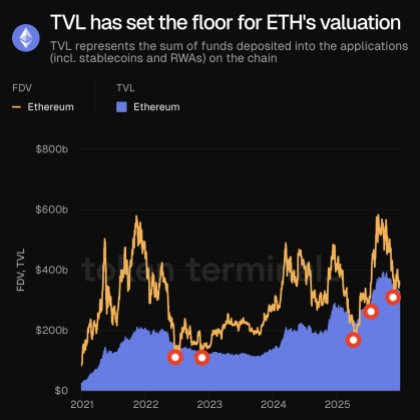
Source: Chart from Milk Road on X

According to the expert, if the TVL expands meaningfully, the network’s economy simultaneously sees noticeable growth. This implies deeper liquidity, stronger collateral base, and more durable demand for block space and the network’s security.

Milk Road highlighted that non-speculative capital, such as stablecoins, treasuries, Real-World Assets (RWAs), and on-chain asset management, are likely the major drivers of the rising TVL. Meanwhile, as the capital flowing from these areas continues to scale, ETH’s floor also rises outside of bull markets.

However, it appears to be more difficult to break into bear markets. It is worth noting that the broader ecosystem’s resilience is strengthened when this occurs, and also improves the long-term valuation anchor.

Why You Shouldn’t Be An ETH Bear

After examining the value of ETH vs. the size of the Ethereum ecosystem chart, Emperor Osmo, a data analyst and researcher, declares that being an ETH bear now is not an ideal choice despite the current bearish state of the market.

Osmo’s bold statement hinges on the major shift in Ethereum network fees. As blockspace becomes commoditized, the expert highlighted that ETH has moved from generating 90% of fees generated by Layer 1s to 2%. Despite this massive shift, the network continues to dominate in TVL and ecosystem growth.

The chart shows that ETH trades are at $353.2 billion while the ecosystem built on top of the network trades at $330 billion, representing a 1.1x premium. According to Osmo, this trend makes the assumption that there is no growth, no value capture, and no liquidity inflows.

At the time of writing, the Ethereum price was trading near the $3,000 mark, after recording a nearly 1% increase over the last 24 hours. Its trading volume is moving in the opposite direction to ETH’s price, dropping by more than 13% in the past day.

ETH trading at $2,976 on the 1D chart | Source: ETHUSDT on Tradingview.com

Related Questions

QWhat is the main factor that is subtly anchoring Ethereum's long-term price stability and ecosystem growth according to the article?

AEthereum's Total Value Locked (TVL) is emerging as a subtle but powerful anchor for the altcoin's long-term price stability and the growth of its evolving ecosystem.

QAccording to Milk Road, what are the major drivers of the rising TVL on the Ethereum network?

AMilk Road highlighted that non-speculative capital, such as stablecoins, treasuries, Real-World Assets (RWAs), and on-chain asset management, are likely the major drivers of the rising TVL.

QWhy does Emperor Osmo declare that being an ETH bear is not an ideal choice despite the current market conditions?

AOsmo's statement hinges on the major shift in Ethereum network fees and the fact that ETH trades at a 1.1x premium compared to the ecosystem built on top of it, making the assumption of no growth, no value capture, and no liquidity inflows unrealistic.

QWhat significant shift in fee generation did Emperor Osmo highlight regarding the Ethereum network?

AOsmo highlighted that ETH has moved from generating 90% of fees generated by Layer 1s to just 2% as blockspace becomes commoditized.

QWhat was the price of Ethereum and its 24-hour trading volume change at the time the article was written?

AAt the time of writing, the Ethereum price was trading near the $3,000 mark after a nearly 1% increase, while its trading volume dropped by more than 13% in the past 24 hours.

Related Reads

Huang Renxun Dramatically 'Saves' South Korean Stock Market

In early June, South Korea's stock market experienced a sharp decline, with the KOSPI index dropping over 5% and triggering a trading halt. Amid this volatility, NVIDIA CEO Jensen Huang's visit to Seoul provided a dramatic boost to market sentiment. During his trip, Huang held a dinner meeting with SK Group Chairman Chey Tae-won and SK Hynix CEO Kwak Noh-Jung. He announced that NVIDIA's new Vera CPU would utilize SK Hynix DRAM and confirmed a multi-year technical collaboration between the two companies. This partnership aims to co-develop next-generation memory for NVIDIA's AI infrastructure roadmap, covering products from data center supercomputers to personal AI devices. Huang also publicly commented that AI company stocks were attractively priced. A key announcement was that NVIDIA's upcoming Vera Rubin AI supercomputer systems will use HBM4 memory, with supply qualifications granted to all three major suppliers: SK Hynix, Samsung Electronics, and Micron Technology. Despite this multi-sourcing strategy, Huang warned that the industry-wide chip shortage, affecting everything from wafers to packaging, is expected to persist for several years due to relentless demand from global AI factory construction. The collaboration extends beyond memory supply. SK Hynix will employ NVIDIA's AI platforms and Omniverse digital twin technology to enhance its own semiconductor design, simulation, and manufacturing processes, aiming for more autonomous factory operations. This visit builds upon a prior October 2025 agreement for SK Group to build a large-scale AI data center using over 50,000 NVIDIA GPUs. Huang's itinerary also included meetings with other Korean giants like Hyundai, LG, and Samsung, indicating NVIDIA's broader strategy to deepen ties with South Korea's tech industry.

链捕手58m ago

Huang Renxun Dramatically 'Saves' South Korean Stock Market

链捕手58m ago

When Inference Becomes a Scarce Resource, Who Captures the Value?

When Inference Becomes the Scarce Resource, Who Captures the Value? The core AI bottleneck has shifted from model training to inference (runtime execution). While concerns persisted about an "AI compute gap"—initially a $200B, now a $600B problem—the market is now recognizing that the solution and value lie in the inference layer. Nvidia's financial restructuring around "serving tokens" and Cerebras's successful IPO highlight this shift. Inference is a recurring, usage-based cost, estimated to be 10-50x larger than the one-time training market, especially with the rise of agentic AI. The inference stack spans six layers: silicon (e.g., Nvidia), bare metal (e.g., CoreWeave), GPU rental/aggregation, deployment/optimization, model APIs, and end applications. Most companies operate in one layer. However, Hyperbolic uniquely spans three layers (GPU rental, deployment, and model APIs) without owning any hardware. It aggregates fragmented GPU supply from multiple cloud providers into a standardized pool, offering developers the cheapest available compute through intelligent routing. Its multi-cloud aggregation creates a data moat and a flywheel: more supply leads to better pricing data and liquidity, attracting more developers and providers. In contrast, applications like Venice operate at the top of the stack, reselling privacy-wrapped inference but remaining dependent on and constrained by the underlying compute costs they purchase. As inference demand explodes, value accrues not just to consumer applications but increasingly to the aggregation and routing layer that captures their cost of revenue. The coming potential GPU oversupply reinforces this dynamic. While hardware owners may suffer from depreciation, asset-light aggregators like Hyperbolic benefit from price arbitrage, routing workloads to the cheapest available capacity. The ultimate winner in the inference economy may not be the entity with the most GPUs, but the one that can most efficiently discover, aggregate, and route the world's fragmented compute.

链捕手1h ago

When Inference Becomes a Scarce Resource, Who Captures the Value?

链捕手1h ago

Trading

Spot
Futures

Hot Articles

Discussions

Welcome to the HTX Community. Here, you can stay informed about the latest platform developments and gain access to professional market insights. Users' opinions on the price of S (S) are presented below.

活动图片
















