Ethereum Repeats A Notable Market Trend As Momentum Wanes – Here’s How Investors Are Positioning

bitcoinistPublished on 2026-06-03Last updated on 2026-06-03

Abstract

Ethereum's price has dipped below $2,000, but analysts spot a potentially bullish short-term pattern. The cryptocurrency has closed below a key multi-year uptrend line for the second time recently, mirroring a setup from early 2026 that could precede a rebound, though momentum appears weak. Experts suggest this may create entry opportunities. They highlight the upcoming CLARITY Act vote as a pivotal event that could trigger a classic "sell the rumor, buy the news" scenario, advocating for positioning in DeFi and accumulating ETH. On-chain data supports this outlook, showing large investors (whales holding 100,000+ ETH) have been accumulating significantly since mid-April 2026, with their collective holdings reaching a 9-week high, indicating strong long-term conviction amidst current market uncertainty.

After a persistent bearish performance, Ethereum’s price is now hovering below the $2,000 mark, raising questions about its stability. ETH may be struggling with volatility, but its short-term outlook appears to be quite bullish as the altcoin mirrors a historical pattern that presents an impending rebound.

ETH’s Price And Investors’ Current Behavior

Ethereum is once again exhibiting a market pattern that emerged at a significant juncture in its price action over the past few months, sparking conjecture that a potential bounce may be imminent. Rekt Capital, a crypto analyst and investor, has found parallels between current price behavior and the past few months that preceded notable changes in momentum, making the trend a crucial area of attention.

As seen in the chart, this trend involves a monthly close below its multi-year upward trend. According to the expert, Ethereum has recently made this key monthly close for the second time in the last 5 months, increasing the likelihood of ETH mirroring its price action of early 2026. Rekt Capital highlighted that the last time the altcoin mostly closed below the trend line of its multi-year uptrend, the price experienced a limited move to the upside. However, it later got rejected, sparking a steady downward trend.
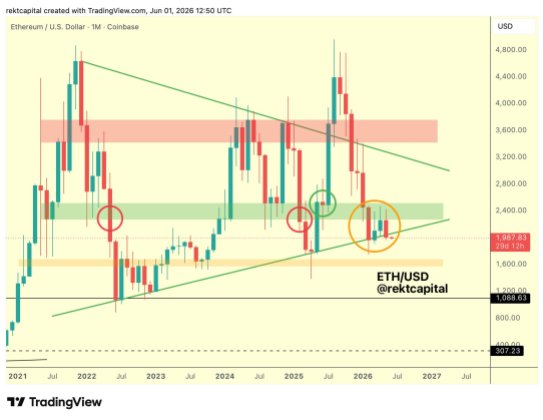
Source: Chart from Rekt Capital on X

Currently, the rallies originating from this trend line are clearly weakening, and the multi-year upward trend is likely faltering. In the meantime, the altcoin needs to at least keep the 2026 lows and/or reclaim the upward trend to avoid deeper downside.

Michael Van De Poppe, the Chief Information Officer (CIO) and founder of MNFund, revealed that ETH is in the area of interest for entry points after a period of sideways price action. This analysis suggests that the ETH market structure is shifting, creating ideal entry opportunities.

However, with the CLARITY Act vote, this month is a decisive one for the altcoin, which the expert believes is providing the ideal “Sell the rumor, Buy the News” type of scenario. Once the bill is passed, Van De Poppe urges immediate positioning in DeFi, as it is highly likely that ETH will experience a lot of upside. Thus, the expert expresses his intention to add more ETH to his portfolio.

Large Investors Are Accumulating More Ethereum

Data shows that investors are already positioning for an upcoming surge as they steadily add more Ethereum to their portfolios. Leon reported that this renewed accumulation is observed among big whales or large investors, particularly wallet addresses holding at least 100,000 ETH, despite ongoing heavy FUD.

Currently, these investors control a total of 17.41 million ETH, marking their highest level in the last 9 weeks. When compared to the ETH total supply, this purchase represents about 22.03%, marking a 10-week high. Since mid-April 2026, their holdings have grown considerably despite strong downward pressure on the price of ETH.

These investors, also considered as smart money, are quietly buying the dip instead of selling, but retail investors are panicking and spreading FUD. This is a classic whale behavior where they see long-term value in ETH way bigger than short-term noise.

ETH trading at $1,983 on the 1D chart | Source: ETHUSDT on Tradingview.com

Trending Cryptos

Related Questions

QAccording to the article, what key market pattern is Ethereum currently repeating, and what historical period does it mirror?

AEthereum is repeating a pattern of a monthly close below its multi-year upward trend line. According to the analyst Rekt Capital, this mirrors the price action that occurred in early 2026, which was followed by a limited upside move and then a steady downward trend.

QWhat are the two potential actions the article states Ethereum needs to take to avoid a deeper downside?

ATo avoid a deeper downside, Ethereum needs to at least hold (keep) the 2026 lows and/or reclaim the upward trend line.

QWhat specific scenario does Michael Van De Poppe associate with the upcoming CLARITY Act vote for Ethereum?

AMichael Van De Poppe believes the upcoming CLARITY Act vote is providing the ideal 'Sell the rumor, Buy the News' type of scenario for Ethereum. He urges immediate positioning in DeFi once the bill is passed, expecting significant upside.

QWhat does the data show about the behavior of large investors (whales) holding at least 100,000 ETH?

AData shows that large investors (whales) holding at least 100,000 ETH are accumulating more Ethereum, increasing their holdings to 17.41 million ETH, which is their highest level in 9 weeks. This represents about 22.03% of the total supply, a 10-week high.

QHow does the article contrast the behavior of large 'smart money' investors with retail investors during the current market phase?

AThe article contrasts that large 'smart money' investors are quietly buying the dip and accumulating Ethereum, seeing long-term value, while retail investors are panicking and spreading FUD (Fear, Uncertainty, and Doubt).

Related Reads

L2 'Recalibration': When L1 Becomes Its Own Rollup, What Is Ethereum's Endgame?

The article discusses the evolving relationship between Ethereum's Layer 1 (L1) and Layer 2 (L2) solutions, moving beyond the initial "L2 for scaling" model. As Ethereum L1 itself scales (increasing Gas Limit, statelessness, zkEVM), the unique value proposition of L2s shifts from merely providing cheap execution to offering differentiated features like application-specific optimization, privacy, and flexible governance. The piece explores three key themes: 1. **L2's New Role:** L2s are transitioning from a pure scaling technology to a spectrum of execution environments with varying degrees of security inheritance from Ethereum L1. 2. **Interoperability as State Trust:** Solving L2 fragmentation is less about cross-chain bridges and more about enabling faster, trust-minimized state verification between environments. This involves initiatives like faster L1 finality, intent-based architectures (Open Intents Framework), and native account abstraction. 3. **Blurring Layers:** With the potential integration of zk-proofs into L1 validation (making L1 akin to its own "Rollup") and the concept of "Native Rollups," the rigid boundary between L1 and L2 may fade. The future could be a unified system with multiple execution domains (for DeFi, gaming, privacy, etc.) sharing a common security, settlement, and state framework. In conclusion, Ethereum's goal is not to abandon L2s or re-centralize everything on L1, but to re-integrate the fragmented user experience—liquidity, accounts, applications—while preserving the scaling benefits of a multi-environment ecosystem. The endgame is a cohesive "one chain" feeling for users, powered by diverse but securely interconnected execution layers.

marsbit30m ago

L2 'Recalibration': When L1 Becomes Its Own Rollup, What Is Ethereum's Endgame?

marsbit30m ago

Trading

Spot

Hot Articles

Discussions

Welcome to the HTX Community. Here, you can stay informed about the latest platform developments and gain access to professional market insights. Users' opinions on the price of ETH (ETH) are presented below.

活动图片