Ethereum Price To $2,000? Here Are The Last Lines Of Defense

bitcoinistPublished on 2025-12-28Last updated on 2025-12-28

Abstract

Ethereum is at risk of falling below $2,000, according to on-chain analyst Joao Wedson. Three critical on-chain support levels are currently holding the price: the MVRV Z-Score, the Market Cap Growth Rate, and the Delta Growth Rate. A break below these supports could trigger a significant downward move, with over a 30% correction possible due to increasing supply pressure and weakening capital inflows. Currently trading around $2,940, ETH is down over 40% from its all-time high. While a long position may appeal to high-risk investors, the overall outlook remains fragile.

The Ethereum price looks set to end 2025 with a double-digit loss, but its start to the new year appears to be the more worrying subject. A prominent on-chain analyst has identified crucial price levels that could decide ETH’s future in the next few months.

3 Critical Support Zones For ETH Price

In a new post on the social media platform X, Alphractal CEO and founder Joao Wedson warned the market of the potential risk of seeing the Ethereum price below the $2,000 mark again. According to the on-chain analytics expert, the price of ETH is currently holding on to three critical on-chain support levels.

Firstly, Wedson highlighted that the MVRV (Market Value to Realized Value) Z-Score, which offers insights into when an asset is overvalued or undervalued, suggests that the Ethereum price is sitting exactly on its final support cushion. According to the crypto founder, a failure of this level could see the price of ETH suffer an aggressive downside move.
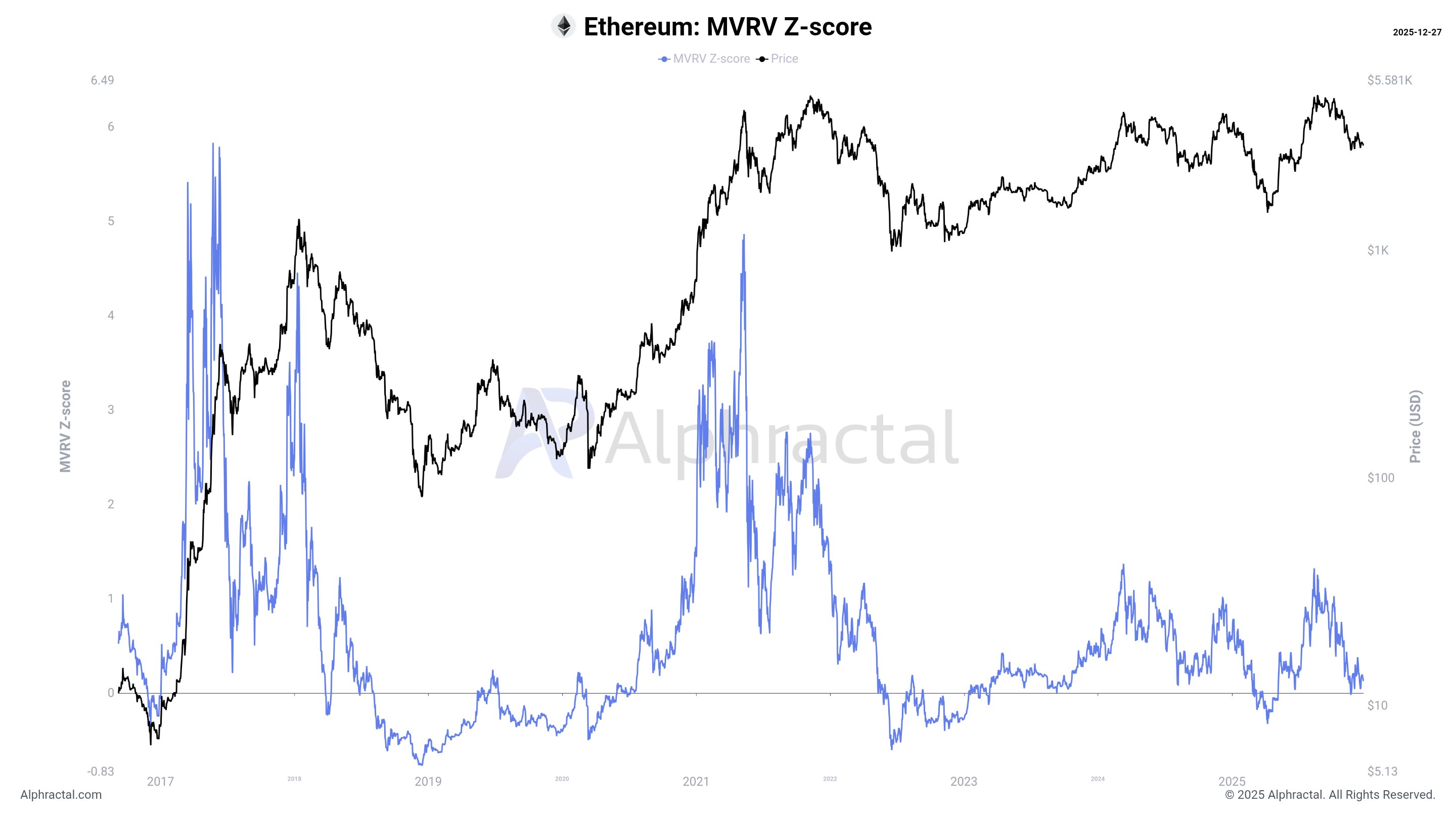
Source: @joao_wedson on X

Wedson also mentioned that the Market Cap Growth Rate, which reflects the real expansion of Ethereum’s market capitalization over time, is testing a critical structural support level. The Alphractal CEO revealed that breaking below this support would suggest weakening capital inflows, signaling the potential imminence of downside pressure.

Additionally, the crypto analyst noted that the Delta Growth Rate, a metric that measures the divergence between Realized Cap growth and Market Cap growth, which generates an on-chain alpha signal, is also at support. “A loss of this level would suggest speculative capital exiting the market, increasing the likelihood of a future capitulation phase,” Wedson added.

According to the crypto pundit, there is a huge likelihood that the Ethereum price falls below the $2,000 mark if these on-chain foundations break. An over 30% correction from the current price point is even more probable as supply pressure increases against declining demand heading into the new year.

The blockchain firm founder didn’t dismiss the idea of taking a long position in the Ethereum market at the current price levels, especially for investors with a higher risk appetite. At the same time, Wedson stated that the Ethereum price remains in a fragile position from a broader outlook.

Ethereum Price Overview

The price of Ethereum is currently down by more than 40% from its all-time high of $4,946. This record reflects the struggles of the second-largest cryptocurrency—and perhaps the broader market—in the final quarter of 2025. As of this writing, ETH is valued at around $2,940, reflecting no significant movement in the past 24 hours.

The price of ETH on the daily timeframe | Source: ETHUSDT chart on TradingView


Related Questions

QWhat are the three critical on-chain support levels that the Ethereum price is currently holding onto, according to Joao Wedson?

AThe three critical on-chain support levels are: 1) The MVRV (Market Value to Realized Value) Z-Score, 2) The Market Cap Growth Rate, and 3) The Delta Growth Rate.

QWhat does the MVRV Z-Score indicate about an asset's valuation?

AThe MVRV Z-Score offers insights into when an asset is overvalued or undervalued.

QWhat would a break below the support level of the Market Cap Growth Rate signal for Ethereum?

ABreaking below this support would suggest weakening capital inflows, signaling the potential imminence of downside pressure.

QWhat is the potential price consequence if these key on-chain support levels fail?

AThere is a huge likelihood that the Ethereum price falls below the $2,000 mark, with an over 30% correction from the current price being even more probable.

QWhat was Ethereum's price and its performance relative to its all-time high at the time of writing?

AAs of the writing of the article, Ethereum was valued at around $2,940, which is down by more than 40% from its all-time high of $4,946.

Related Reads

The Value Distribution of Stablecoins

**Summary: The Value Distribution of Stablecoins** The article argues that stablecoins are evolving from mere trading tools into broader channels for dollar access. It divides the stablecoin ecosystem into four layers to analyze how value is distributed: 1. **Issuance Layer:** Mints stablecoins, holds reserve assets, and captures the spread between reserve yield and user costs (e.g., Tether, Circle). This layer currently earns the largest profit margin. 2. **Infrastructure Layer:** Connects stablecoins to the traditional financial system, handling fiat on/off-ramps, banking integration, compliance (KYC/AML), and asset management (e.g., Bridge, BVNK). This is the "unglamorous" but critical work, building the essential bridges between crypto and real-world finance. 3. **Acquiring/Distribution Layer:** Integrates stablecoins into merchant systems, manages payment flows, and provides enterprise financial software (e.g., Stripe, Coinbase). They act as the access point for businesses. 4. **Application Layer:** The end-users and businesses that ultimately use stablecoins for payments, settlements, or as a store of value. They benefit from convenience but have little pricing power. The core thesis is that while the issuance layer currently dominates profits, the often-overlooked **infrastructure layer holds significant long-term potential**. The real challenge and barrier to mass adoption is not the on-chain transfer of stablecoins (which is simple), but the complex "last mile" integration into existing business workflows, banking systems, and regulatory frameworks across different countries. Companies in this layer are currently in a "land grab" phase, investing heavily to build networks, secure bank partnerships, and establish compliance pathways. While their position is currently pressured by the profitable issuers above and distribution platforms below, the article suggests that if stablecoins become a default financial rail for businesses, the infrastructure providers who have done the hard work of integration will ultimately gain strong pricing power and become entrenched, essential players.

marsbit5h ago

The Value Distribution of Stablecoins

marsbit5h ago

The Value Distribution of Stablecoins

The Value Distribution of Stablecoins The article argues that stablecoins are evolving from a mere trading tool into a broad "dollar channel." It analyzes the industry's value chain through four layers: 1. **Issuance Layer (e.g., Tether, Circle):** The top layer that mints stablecoins, holds reserve assets, and captures the thickest interest rate spread. 2. **Infrastructure Layer (e.g., Bridge, BVNK):** Connects stablecoins to the traditional financial system, handling critical but complex "dirty work" like fiat on/off-ramps, banking integration, compliance (KYC/AML), and cross-border settlement. 3. **Acquiring/Distribution Layer (e.g., Stripe, Coinbase):** Embeds stablecoins into merchant systems, manages payment flows, and integrates with enterprise software. 4. **Application Layer:** End-users and businesses that ultimately use stablecoins for payments, settlement, or storing value. The author posits that while the issuance layer currently captures the most profit, the most overlooked and potentially critical layer is infrastructure. The core challenge for stablecoin adoption isn't the on-chain transfer (which is simple), but bridging the gap between blockchain and the real-world financial system. This involves solving practical problems for businesses: fiat conversion, reconciliation, tax handling, and user onboarding. Infrastructure companies are currently in a difficult "land-grab" phase—building networks, securing banking relationships, and achieving compliance country-by-country. They face pressure from both the profitable issuance layer above and distribution platforms below. However, the author suggests this layer is building a crucial moat. Once stablecoins become a default business rail, the infrastructure players who have done the hard work of integration may gain significant, durable value and pricing power.

链捕手5h ago

The Value Distribution of Stablecoins

链捕手5h ago

Trading

Spot
Futures

Hot Articles

Discussions

Welcome to the HTX Community. Here, you can stay informed about the latest platform developments and gain access to professional market insights. Users' opinions on the price of ETH (ETH) are presented below.

活动图片














