Ethereum Price Falls To $3,000 As Taker Volume Spikes To New High — What’s Happening?

bitcoinistPublished on 2025-12-14Last updated on 2025-12-14

Abstract

Ethereum's price has dropped to around $3,080, a decline of over 4% in 24 hours, following a period of strong performance where it reached $3,400. The correction is attributed to a significant spike in selling pressure. On-chain data reveals a massive surge in Taker Sell Volume for Ethereum perpetual swaps, reaching 124.2 million ETH, indicating aggressive selling activity. Furthermore, 60,000 ETH (worth approximately $200 million) flowed into centralized exchanges, increasing the available supply on the open market. With insufficient demand to absorb this new supply, these factors combined to create strong downward pressure on ETH's price.

Ethereum was one of the best-performing cryptocurrencies in the market over the past week, with its price jumping mid-week to as high as $3,400. Interestingly, the “king of altcoins” is now barely hanging on to the psychological $3,000 price level.

On Friday, December 12, the crypto market felt a wave of bearish pressure, with most large-cap assets witnessing significant price corrections on the day. According to the latest on-chain data, the Ethereum market appears to be experiencing heavy selling pressure.

Ethereum Taker Volume Sees Notable Spike

In a new post on the X platform, crypto analyst Maartunn revealed that the Ethereum price has been a victim of heavy selling pressure in the past day. This observation was based on the Taker Sell Volume metric, which saw a significant increase on Friday.

This on-chain metric estimates the total volume of sell orders filled by takers in perpetual swaps of a particular cryptocurrency (Ethereum, in this case). In crypto trading, a taker refers to a market participant who fills an existing order in an exchange’s order book.
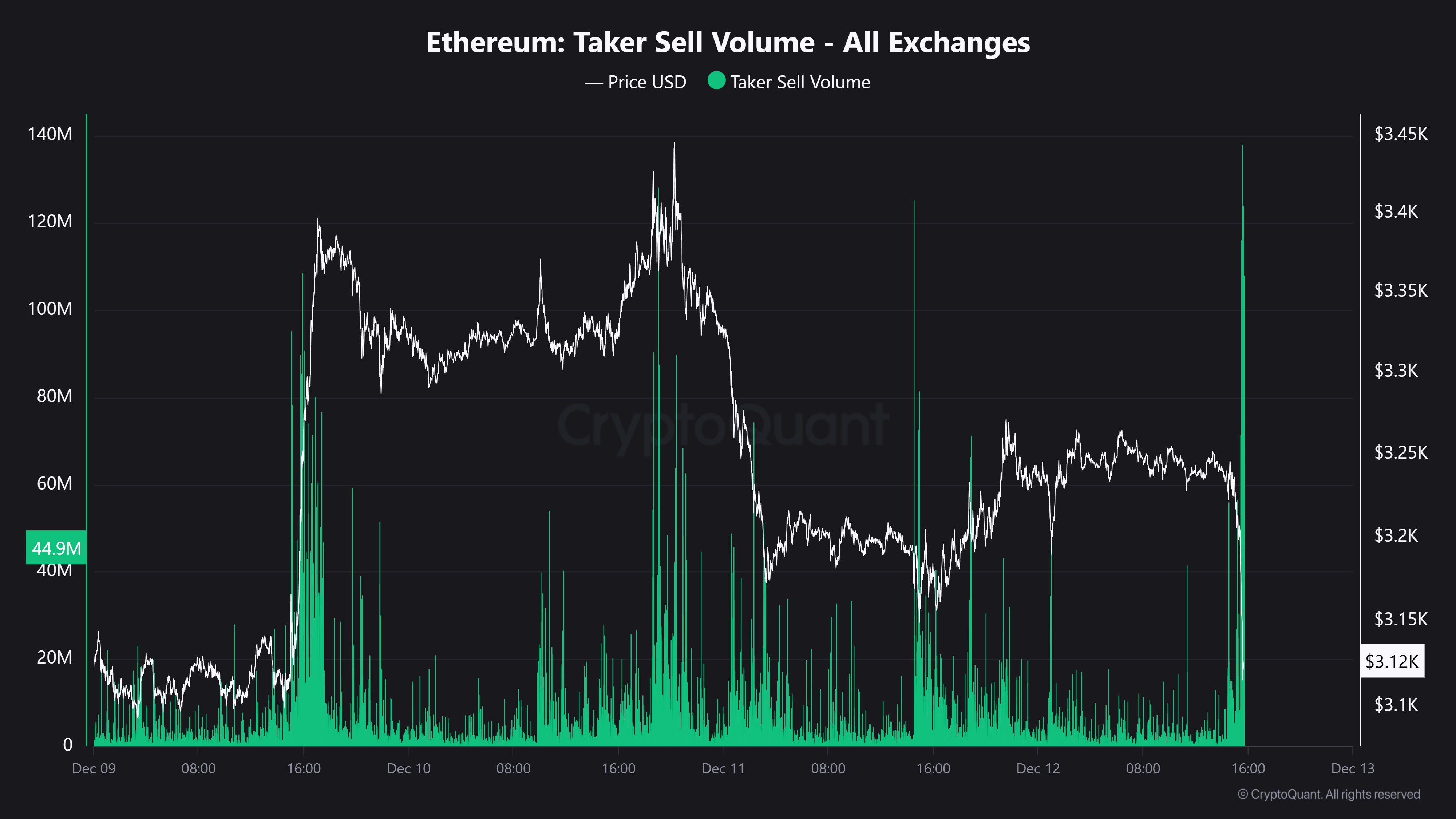
Source: @JA_Maartun on X

Maartunn highlighted that the Taker Sell Volume across all centralized exchanges saw a notable uptick on Friday. Data from CryptoQuant shows that the metric rose to as high as 124.2 million ETH on the day.

According to Maartunn, this significant spike in the Ethereum Taker Sell Volume is a clear sign of aggressive selling in the market. This level of selling activity put bearish pressure on the Ethereum price, explaining the latest correction to $3,000.

60,000 ETH Flows Into Centralized Exchanges

Another on-chain signal that supports the theory of increased selling in the Ethereum market is the exchange inflow metric. According to data shared by Ali Martinez, significant amounts of ETH tokens have found their way onto centralized exchanges in the past day.

Santiment data shows that 60,000 ETH tokens, worth approximately $200 million, flowed onto exchanges on Friday. As expected, this inflow activity led to a spike in the Ethereum supply on exchanges and the open market.

With no adequate demand to mop up this increasing supply, this rising exchange inflow only puts downward pressure on the Ethereum price. As of this writing, ETH is valued at around $3,080, reflecting an over 4% decline in the past 24 hours.

The price of ETH on the daily timeframe | Source: ETHUSDT chart on TradingView


Related Reads

In the AI Era, How to Onboard Without Starting from Scratch

In the AI era, onboarding new employees often resembles a botched relay race baton handoff, where the organization maintains speed while the newcomer starts from zero. The author, after joining Ramp, argues the core problem is a lack of accessible, shared organizational "context"—the collective knowledge from meetings, documents, Slack discussions, and decisions. Instead of relying on slow, manual onboarding or isolated AI tools, the solution is building a continuously updated "company brain." This system acts as a central, AI-native knowledge base that absorbs all company signals. The author describes building a prototype using an Obsidian vault powered by Claude, fed by automated meeting transcripts and notes, and topped with reusable agent "skills." The current enterprise AI approach, deploying specific workflow agents, is likened to the "chatbot era"—useful but disconnected. The real gap is the absence of a shared brain that all agents and employees can access from day one. The future lies in making context layer infrastructure the priority: write context first, then install tools; record every meeting; build the wiki before the dashboard. When new hires, AI agents, and even customers can immediately access this living company brain, the costly "ramp-up" period becomes obsolete. True organizational speed is achieved when maximum velocity and seamless context transfer happen simultaneously.

marsbit1h ago

In the AI Era, How to Onboard Without Starting from Scratch

marsbit1h ago

Trading

Spot
Futures

Hot Articles

Discussions

Welcome to the HTX Community. Here, you can stay informed about the latest platform developments and gain access to professional market insights. Users' opinions on the price of S (S) are presented below.

活动图片