Ethereum Price Falls To $3,000 As Taker Volume Spikes To New High — What’s Happening?

bitcoinistPublished on 2025-12-14Last updated on 2025-12-14

Abstract

Ethereum's price has dropped to around $3,080, a decline of over 4% in 24 hours, following a period of strong performance where it reached $3,400. The correction is attributed to a significant spike in selling pressure. On-chain data reveals a massive surge in Taker Sell Volume for Ethereum perpetual swaps, reaching 124.2 million ETH, indicating aggressive selling activity. Furthermore, 60,000 ETH (worth approximately $200 million) flowed into centralized exchanges, increasing the available supply on the open market. With insufficient demand to absorb this new supply, these factors combined to create strong downward pressure on ETH's price.

Ethereum was one of the best-performing cryptocurrencies in the market over the past week, with its price jumping mid-week to as high as $3,400. Interestingly, the “king of altcoins” is now barely hanging on to the psychological $3,000 price level.

On Friday, December 12, the crypto market felt a wave of bearish pressure, with most large-cap assets witnessing significant price corrections on the day. According to the latest on-chain data, the Ethereum market appears to be experiencing heavy selling pressure.

Ethereum Taker Volume Sees Notable Spike

In a new post on the X platform, crypto analyst Maartunn revealed that the Ethereum price has been a victim of heavy selling pressure in the past day. This observation was based on the Taker Sell Volume metric, which saw a significant increase on Friday.

This on-chain metric estimates the total volume of sell orders filled by takers in perpetual swaps of a particular cryptocurrency (Ethereum, in this case). In crypto trading, a taker refers to a market participant who fills an existing order in an exchange’s order book.
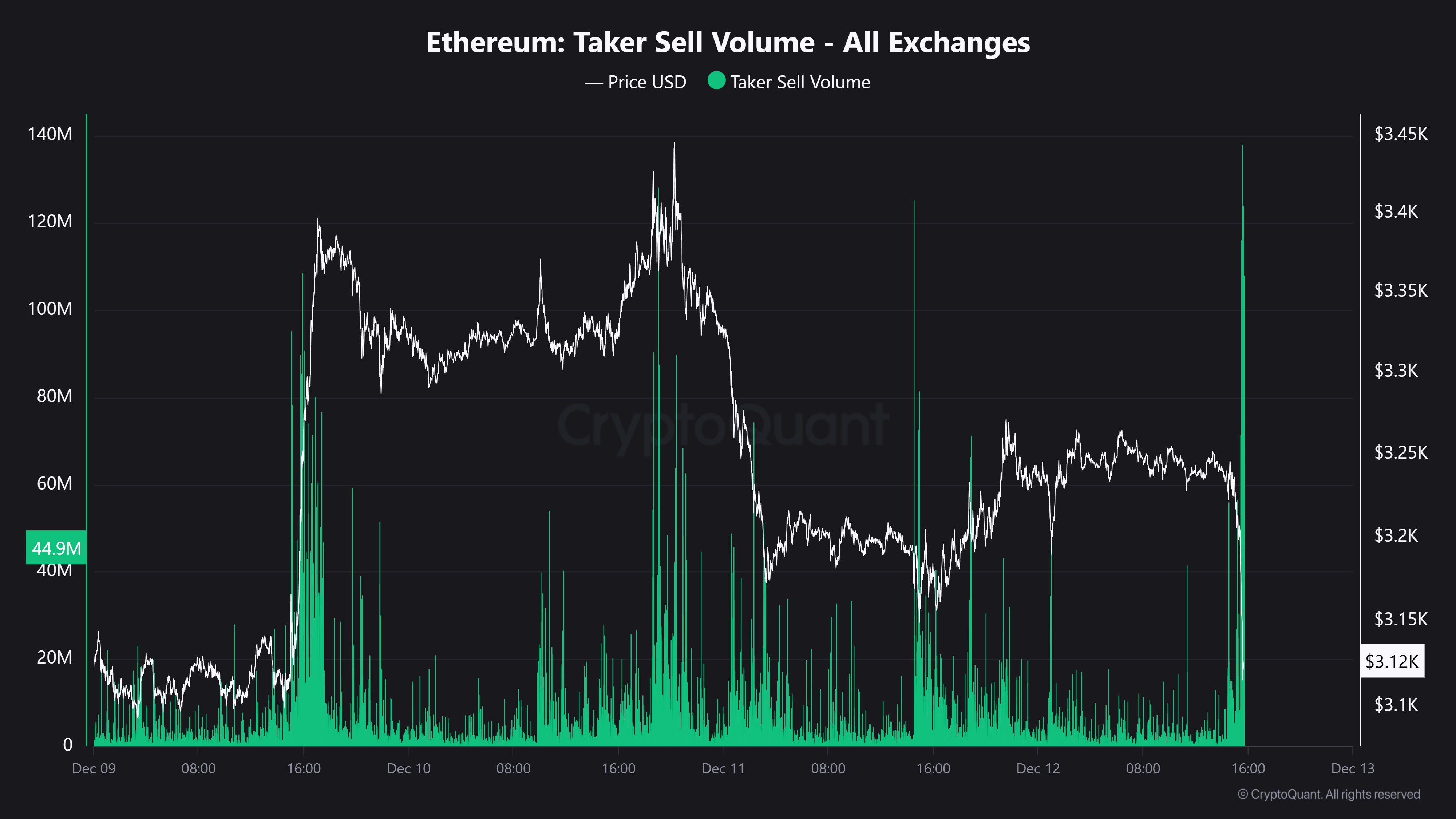
Source: @JA_Maartun on X

Maartunn highlighted that the Taker Sell Volume across all centralized exchanges saw a notable uptick on Friday. Data from CryptoQuant shows that the metric rose to as high as 124.2 million ETH on the day.

According to Maartunn, this significant spike in the Ethereum Taker Sell Volume is a clear sign of aggressive selling in the market. This level of selling activity put bearish pressure on the Ethereum price, explaining the latest correction to $3,000.

60,000 ETH Flows Into Centralized Exchanges

Another on-chain signal that supports the theory of increased selling in the Ethereum market is the exchange inflow metric. According to data shared by Ali Martinez, significant amounts of ETH tokens have found their way onto centralized exchanges in the past day.

Santiment data shows that 60,000 ETH tokens, worth approximately $200 million, flowed onto exchanges on Friday. As expected, this inflow activity led to a spike in the Ethereum supply on exchanges and the open market.

With no adequate demand to mop up this increasing supply, this rising exchange inflow only puts downward pressure on the Ethereum price. As of this writing, ETH is valued at around $3,080, reflecting an over 4% decline in the past 24 hours.

The price of ETH on the daily timeframe | Source: ETHUSDT chart on TradingView


Trending Cryptos

Related Reads

Goldman Sachs Research Report Analysis: Circle and USDC Are Moving Beyond the Crypto World, Cross-Border Payments and AI Agents Become New Battlegrounds

Goldman Sachs published a summary of its meeting with Circle Internet Group (issuer of USDC) on July 5th. The core takeaway is that stablecoins, led by USDC, are evolving from a crypto-native tool into foundational infrastructure for traditional finance and the AI economy. USDC's use cases are rapidly expanding beyond crypto trading into cross-border payments, e-commerce, capital market settlements, and notably, payments for AI agents. Circle's management emphasized that stablecoin growth is now decoupled from crypto market cycles, driven by this diversification. They outlined five key application layers and highlighted USDC's network effects, global liquidity depth, and regulatory compliance as competitive moats. Circle distinguishes USDC from bank-issued tokenized deposits, arguing the former is an open, internet-native system without bank credit risk. Strategically, Circle is building a broader fintech platform with its Arc Layer 1 blockchain, the Circle Payments Network for cross-border transfers, and an "Agentic Stack" to serve AI agent economies, where USDC already dominates. Regarding regulation, Circle views potential U.S. legislation like the CLARITY Act as a catalyst for growth rather than a constraint, expecting it to encourage broader institutional adoption and active usage. Goldman Sachs maintains a Neutral rating on Circle with a $96 price target, noting the company's shift from a pure stablecoin issuer to a financial infrastructure provider. Key risks include competition from USDT and potential earnings pressure from declining interest rates on its reserve assets.

marsbit46m ago

Goldman Sachs Research Report Analysis: Circle and USDC Are Moving Beyond the Crypto World, Cross-Border Payments and AI Agents Become New Battlegrounds

marsbit46m ago

The Robinhood Stock Tokens You Bought Are Just Debts from Jersey Island

The Robinhood stock tokens you buy are essentially debt securities issued by a shell company in Jersey, not real equity. These tokens merely track stock prices like NVIDIA or Apple but grant no shareholder rights like voting or dividends. If the underlying company fails, you have no claim on its assets. Instead, you hold a debt instrument from Robinhood Assets (Jersey) Limited, which promises returns based on stock performance. If this Jersey entity goes bankrupt, you become an unsecured creditor. This complex structure stems from Robinhood's past crisis during the 2021 GameStop short squeeze, where T+2 settlement caused liquidity issues. The blockchain-based tokens enable instant settlement, theoretically preventing such trading halts. The product is classified by the SEC as a "linked security" or structured note, carrying counterparty risk not borne by actual shareholders. It is available globally but excluded from the US, UK, and other major markets, while Robinhood offers a fully compliant, asset-backed token model in Europe under MiFID II. The system relies on oracles for pricing, which poses risks like manipulation and faulty liquidations seen in DeFi exploits. Robinhood profits from spreads and aims to become a full-chain settlement layer. Meanwhile, competitors like Ondo have launched SEC-registered, fully compliant equity tokens in the US with actual voting rights and dividends. Robinhood’s Jersey debt model appears as a transitional, regulatory-arbitrage product, aiming to capture market share ahead of future regulatory clarity.

Foresight News1h ago

The Robinhood Stock Tokens You Bought Are Just Debts from Jersey Island

Foresight News1h ago

Trading

Spot

Hot Articles

Discussions

Welcome to the HTX Community. Here, you can stay informed about the latest platform developments and gain access to professional market insights. Users' opinions on the price of S (S) are presented below.

活动图片