Ethereum Foundation Moves $10M ETH After First-Ever Staking — More Coming?

bitcoinistPublished on 2026-03-17Last updated on 2026-03-17

Abstract

Ethereum has reclaimed the $2,250 level amid a short-term bullish market recovery. The Ethereum Foundation has drawn significant on-chain attention after staking ETH for the first time about three weeks ago, marking a strategic shift from its historical approach of holding or selling assets. This move signals potential confidence in Ethereum’s long-term network economics. Recently, the Foundation transferred $10M worth of ETH to a new wallet, sparking speculation that it may be preparing additional staking operations. If staked, these funds would generate yield and contribute to network security, reinforcing the Foundation’s evolving role in Ethereum’s proof-of-stake ecosystem.

Ethereum has reclaimed the $2,250 level as the broader cryptocurrency market shows signs of a short-term bullish recovery following weeks of volatility and downward pressure. The recent move higher suggests that buyers are gradually regaining control of the market, with traders closely watching whether ETH can maintain momentum above this key technical level.

Beyond the price action, new on-chain developments are also attracting attention across the Ethereum ecosystem. According to data from blockchain analytics platform Arkham, the Ethereum Foundation staked ETH for the first time ever approximately three weeks ago, marking a notable shift in how the organization manages part of its treasury.

Historically, the Ethereum Foundation has primarily held its assets or periodically sold portions of its holdings to fund development and ecosystem initiatives. The decision to begin staking ETH represents a potential strategic adjustment, as it allows the Foundation to generate yield while simultaneously contributing to the network’s proof-of-stake security model.

The move could also carry symbolic significance for market participants. When a central ecosystem entity begins participating directly in staking, it may signal increased confidence in Ethereum’s long-term network economics.

Combined with improving price momentum, the development has added another layer of interest for investors monitoring Ethereum’s evolving market structure.

Ethereum Foundation Moves $10M in ETH, Raising New Staking Speculation

Recent on-chain data highlighted by Arkham shows that the Ethereum Foundation has transferred approximately $10 million worth of ETH to a new wallet address, sparking renewed speculation about the organization’s evolving treasury strategy. The movement follows the Foundation’s first-ever staking activity recorded three weeks ago, suggesting that the latest transfer could potentially be linked to additional staking operations.
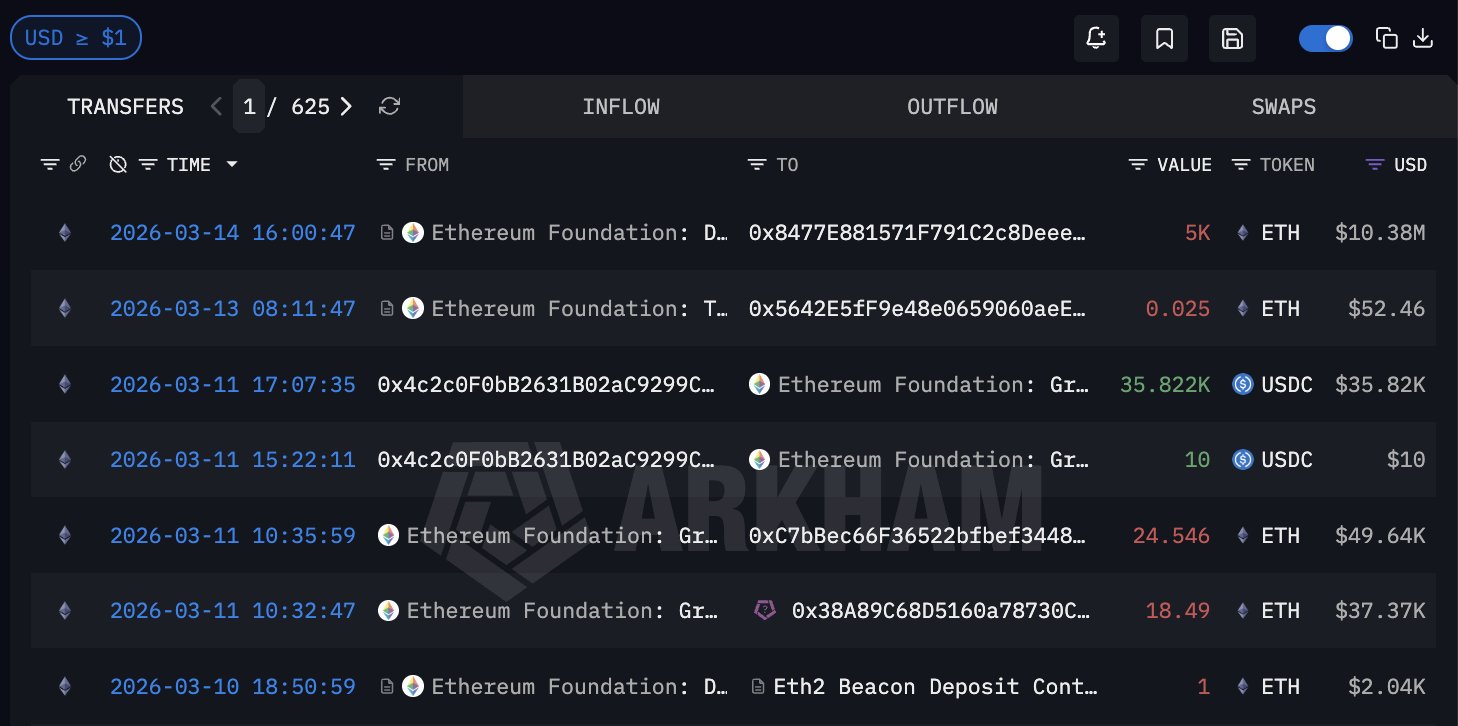
Ethereum Foundation ETH transfers | Source: Arkham

While the destination address has not yet been publicly confirmed as a validator wallet, the transaction has drawn attention across the crypto industry. If the funds are ultimately allocated to staking, it would reinforce the idea that the Ethereum Foundation is gradually shifting toward a more active participation in Ethereum’s proof-of-stake economy.

For the broader ecosystem, such a move carries important implications. The Ethereum Foundation holds a significant amount of ETH, and decisions regarding how those assets are managed can influence both network security and market sentiment.

By staking its holdings, the Foundation would not only generate yield on its treasury but also contribute additional validators to the network, strengthening Ethereum’s decentralized security structure.

At the same time, the market closely monitors these transactions because movements from large ecosystem wallets can affect investor expectations regarding potential sales or long-term holding strategies within the Ethereum ecosystem.


Related Questions

QWhat recent on-chain development involving the Ethereum Foundation has attracted attention in the Ethereum ecosystem?

AAccording to data from blockchain analytics platform Arkham, the Ethereum Foundation staked ETH for the first time ever approximately three weeks ago, marking a notable shift in how the organization manages part of its treasury.

QWhat is the potential strategic significance of the Ethereum Foundation's decision to begin staking its ETH holdings?

AThe decision represents a potential strategic adjustment, as it allows the Foundation to generate yield while simultaneously contributing to the network’s proof-of-stake security model. It may also signal increased confidence in Ethereum’s long-term network economics.

QHow much ETH did the Ethereum Foundation recently transfer, and what has this action sparked speculation about?

AThe Ethereum Foundation transferred approximately $10 million worth of ETH to a new wallet address, sparking renewed speculation about the organization’s evolving treasury strategy and the possibility of additional staking operations.

QWhat are the broader implications for the Ethereum ecosystem if the Foundation stakes its significant ETH holdings?

AIt would not only allow the Foundation to generate yield on its treasury but also contribute additional validators to the network, strengthening Ethereum’s decentralized security structure. It also influences market sentiment regarding long-term holding strategies.

QWhat key technical level are traders closely monitoring for Ethereum's price momentum?

ATraders are closely watching whether ETH can maintain momentum above the $2,250 level, which it has recently.

Related Reads

Anthropic's IPO Launch: Commercial Miracle or Valuation Bubble?

Anthropic has confidentially filed for an IPO, led by Morgan Stanley and Goldman Sachs, potentially going public by October. Following its latest $650 billion funding round, its pre-IPO valuation stands at $965 billion, with projections reaching up to $2 trillion at listing, which would make it the highest-valued private company ever. The article, written by Fu Sheng, addresses skepticism that this represents an AI bubble akin to the 2000 dot-com crash. It argues the current situation differs fundamentally. Unlike the internet bubble era, which relied on speculative narratives with little revenue, Anthropic's valuation is backed by unprecedented, measurable financial performance. Key data points include: * **Revenue Growth:** ARR skyrocketed from $10 billion in early 2025 to $470 billion by May 2026, targeting $100 billion by year-end—a growth curve unmatched in business history. * **Profitability:** It achieved operating profitability in Q2 2026 with an estimated $5.6 billion profit. * **Efficiency:** With ~3,000 employees and ~$470 billion ARR, its revenue per employee exceeds $10 million. Products like Claude Code, launched less than a year ago, already generate $25 billion in annualized revenue. * **Enterprise Adoption:** It boasts a strong enterprise client base, with 8 of the Fortune 10 and over 1,000 large firms spending over $1 million annually on Claude. The valuation is framed using a traditional SaaS model (e.g., a 10x Price-to-Sales multiple on $100 billion revenue). The author contends the core question for analysts has shifted from "How big could this be?" to "How much is it earning and will earn next quarter?" The discussion extends beyond Anthropic to a broader paradigm shift: the transition from a "carbon-based" to a "silicon-based" economy. Companies are increasingly prioritizing investment in compute and AI capabilities over human resources, as these directly scale productivity and competitive advantage. Anthropic's IPO is thus positioned not just as a corporate milestone, but as a price anchor for this new economic era.

链捕手1h ago

Anthropic's IPO Launch: Commercial Miracle or Valuation Bubble?

链捕手1h ago

Near Returns to the AI Stage: Transformation into a Public Chain Due to 'Payroll Difficulties,' Agent and Privacy Emerge as New Growth Narratives

NEAR Returns to AI Origins: From Payroll Struggles to Blockchain, Now Focusing on AI Agents and Privacy NEAR Protocol's journey began not with grand blockchain ambitions, but from a practical hurdle: its AI startup founders, including Transformer paper co-author Illia Polosukhin, couldn't efficiently pay international developers in 2017. This led them to pivot and build a high-performance, scalable blockchain. After years navigating various crypto narratives like sharding and cross-chain interoperability, NEAR is now leveraging its AI roots to re-enter the AI arena. A key driver is its "NEAR Intents" layer, which abstracts complex cross-chain transactions. Users simply state their goal (e.g., swap BTC for ETH), and a solver network finds the optimal route. This system has processed over $20B in cross-chain volume, generating significant fee revenue. A major growth area is private transactions via "Confidential Intents/Swaps," which hide trade details until settlement to protect against MEV and front-running. Remarkably, private swaps recently accounted for over 40% of NEAR's transaction volume, highlighting strong demand but also potential regulatory scrutiny. With its AI-founder pedigree, NEAR is positioning itself at the intersection of blockchain, AI agents, and privacy, aiming to become infrastructure for the emerging agent economy while navigating the challenges of its rapid adoption.

marsbit4h ago

Near Returns to the AI Stage: Transformation into a Public Chain Due to 'Payroll Difficulties,' Agent and Privacy Emerge as New Growth Narratives

marsbit4h ago

Trading

Spot
Futures

Hot Articles

Discussions

Welcome to the HTX Community. Here, you can stay informed about the latest platform developments and gain access to professional market insights. Users' opinions on the price of ETH (ETH) are presented below.

活动图片