Ethereum Exchange Balances Collapse To Levels Not Seen Since 2016 – Here’s What To Know

bitcoinistPublished on 2026-02-11Last updated on 2026-02-11

Abstract

Ethereum exchange balances have plummeted to levels not seen since 2016, signaling a major shift in investor behavior. Despite recent price volatility, ETH has held above $2,000 as large amounts are being withdrawn from exchanges. This indicates investors are moving their holdings into long-term storage, staking, or self-custody rather than keeping them available for immediate sale. The significant reduction in exchange supply suggests decreased selling pressure and a stronger conviction in ETH's long-term prospects compared to Bitcoin. Additionally, institutional accumulation continues, with companies like Bitmine making substantial purchases, buying over $83 million worth of ETH in a single week. If this trend persists and demand returns, the limited available supply could lead to rapid price discovery.

Ethereum’s price has managed to hold above the $2,000 even as heightened volatility persists in the market. During the recent pullback, investors’ sentiment appears to be slowly leaning toward a bullish outlook, which is primarily indicated by the notable ETH withdrawals from crypto exchanges, matching key past levels.

Exchanges Are Seeing Massive Ethereum Withdrawals

Following the sharp pullback in price, Ethereum’s on-chain supply dynamics have now reached a striking milestone. This milestone is taking place on the ETH exchange reserves, which have experienced one of their steepest drop in years.

In a post on the social media platform X, CryptoRus revealed that the ETH supply on crypto exchanges has fallen back to levels last seen in mid-2016. “That’s wild when you think about how much bigger the ecosystem is today,” CryptoRus added.

The significant decline in ETH on centralized platforms indicates that, instead of having their coins easily accessible for sale, more investors are transferring them into long-term storage, staking, or self-custody. Such a development often signals reduced selling pressure and a stronger long-term holder base.

Ethereum investors are showing more notable bullish sentiment towards the altcoin than Bitcoin investors. While Bitcoin has recently returned to crypto exchanges, ETH has been silently disappearing from these platforms. The behavior underscores increasing conviction in the altcoin’s near-term and long-term prospects compared to BTC.
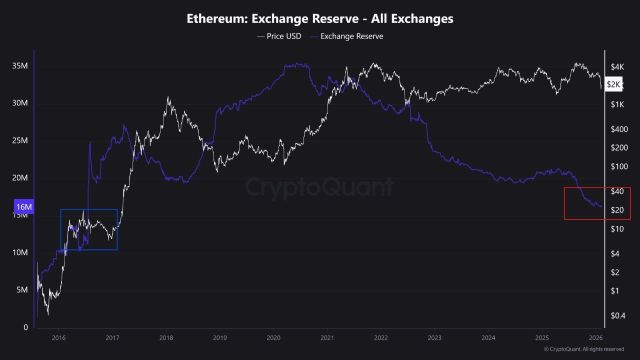
ETH leaving crypto exchanges at a rapid rate | Source: Chart from CryptoRus on X

The majority of this ETH is not lost or abandoned. Rather, it is owned by investors, and they are not sitting on the sidelines. At the same time, Over-The-Counter (OTC) supply has also increased, but it is still far behind in comparison to the total supply of Ethereum.

If OTC liquidity also dries up and ETH exchange balances remain this tight, price discovery will occur quickly rather than smoothly. Nonetheless, when demand returns to the market, there may not be enough ETH available to fill that desire.

Institutions Are Still Buying More ETH In Unfavorable Conditions

Despite the ongoing volatile landscape, Ethereum institutional accumulation has continued, and big firms like Bitmine Immersion are not done buying the dip. The leading public company has recently made another ETH purchase that is making waves in the cryptocurrency community.

On-chain data shared by Ash Crypto, a market expert and investor, shows that Bitmine bought about 20,000 ETH valued at $41.08 million on Monday. This purchase implies that big players are displaying renewed confidence and betting on a potential bounce in the near future.

According to the expert, the company’s total ETH purchase last week alone was valued at $83.45 million. After the purchase, Bitmine’s ETH holdings skyrocketed to $9.19 billion, representing over 3.6% of the total ETH supply. Bitmine’s persistent ETH purchase underscores the firm’s unwavering goal to become the largest Ethereum treasury company in the world.

ETH trading at $2,008 on the 1D chart | Source: ETHUSDT on Tradingview.com

Related Reads

Trade.xyz's Rebase Refusal Sparks Controversy, On-Chain Pre-IPO Market Faces Major Pricing Test

The debate surrounding Trade.xyz's refusal to adjust its SPCX (SpaceX pre-IPO) perpetual contract pricing amid updated share count revelations highlights a key challenge for on-chain pre-IPO markets. While several centralized exchanges (CEXs) paused and repriced their contracts after SpaceX's filing showed a ~10% increase in total shares, Trade.xyz maintained its market-driven pricing logic, which tracks expected per-share price sentiment rather than fundamental valuation metrics like market cap. This discrepancy triggered cross-platform arbitrage and caused leveraged long positions on Trade.xyz to suffer significant losses, as the platform's HIP-3 architecture lacks a native "Rebase" mechanism to neutrally adjust all user positions following such corporate actions. The incident underscores the difficulty for decentralized perpetual exchanges (Perp DEXs) to implement Rebase—a process CEXs handle by centrally pausing markets and adjusting ledger data. On-chain, this requires complex smart contract modifications, increasing gas costs, complexity, and potential attack surfaces. While some DEXs have managed similar adjustments, Trade.xyz's current design does not natively support it, though the team is reportedly exploring solutions for future events like stock splits. Ultimately, the controversy serves as a critical case study for the nascent on-chain pre-IPO sector, raising questions about price discovery reliability, transparent rule disclosure, and the readiness of DeFi infrastructures to handle traditional corporate actions as real-world assets (RWAs) gain traction.

marsbit8m ago

Trade.xyz's Rebase Refusal Sparks Controversy, On-Chain Pre-IPO Market Faces Major Pricing Test

marsbit8m ago

The 'Middle Eastern Prince' Swindles a Wealthy Woman: Renting Planes and Rolls-Royces, Scamming 120 Million Over Three Years

Two brothers who posed as "Middle Eastern princes" have been sentenced in the United States to 24 and 23 years in prison, respectively, and ordered to pay over $21.2 million in restitution and back taxes. Over three years, they fraudulently obtained approximately $21 million, primarily by promoting fictitious investment projects, including a non-existent cryptocurrency mining operation in a former General Electric industrial park in East Cleveland. The brothers, aged 42 and 33, created elaborate personas: one claimed to be a wealthy royal family heir and the city's "International Economic Advisor," while the other posed as a hedge fund manager with expertise from watching the TV show *Billions*. They bolstered their image by renting luxury cars and private jets and cultivating a relationship with a local mayor's chief of staff, who provided official-looking documents and government event access. A significant portion of the victims' funds, about $18 million, came from a single Chinese investor, a woman from Sichuan with experience in Bitcoin mining. The brothers also defrauded several women, including one former girlfriend. Their scheme unraveled when the primary investor discovered her $6 million worth of mining equipment had been sold off. The case highlights a trend of impostors using fabricated "Middle Eastern royal" identities to target wealthy individuals. Similar incidents include a "Dubai prince" who recently promoted a $500 million family office in Hong Kong and a Colombian man who impersonated a Saudi prince for decades in the US before being caught and sentenced in 2019.

marsbit23m ago

The 'Middle Eastern Prince' Swindles a Wealthy Woman: Renting Planes and Rolls-Royces, Scamming 120 Million Over Three Years

marsbit23m ago

a16z Partner: Being in the Flow of Capital Is the True Moat

A16z Partner: Standing in the Cash Flow is the True Moat Historically, many of the strongest companies built their moats by positioning themselves within "cash flows"—facilitating value creation and transfer in a network and taking a cut. The more value flows, the larger they grow. Crypto is the first modern technology natively built for this. With open ledgers, programmable settlement, and stablecoins enabling internet-speed global value transfer, it allows startups to inherit network effects from day one. Well-designed tokens align users, developers, and the protocol towards network growth, distributing value to contributors. This model isn't new (e.g., railroads, Visa, Google, AWS) but Crypto democratizes it. It lets entrepreneurs target areas with high inefficiency and profit extraction—like traditional finance's payments, custody, FX, and settlement—to compress costs, increase speed, and redistribute value by standing in the new flow. The opportunity extends beyond finance to emerging markets like GPU/compute, AI training data, energy, and space, where new, programmable infrastructure can be built without legacy constraints. Key questions for founders: Are you already in the cash flow? Does your revenue scale 10x with network activity? Where is profit extraction highest relative to value created in your market? The strategy is clear: compress the old cost structure, position yourself in the new value stream, and let the network compound.

marsbit50m ago

a16z Partner: Being in the Flow of Capital Is the True Moat

marsbit50m ago

Capturing 15 Top-Tier Zero-Day Vulnerabilities: A Consensus Protocol Debug Agent Framework Built by 0G Lab in Collaboration with Teams from NUS, PKU, and BUPT

"Agents Capture 15 Critical Zero-Day Bugs: 0G Lab's Multi-Agent Framework Automates Debugging in Consensus Protocols" Distributed consensus protocols are notoriously difficult to debug due to complex, intertwined states. A novel framework, Agora, developed by 0G Labs with researchers from NUS, Peking University, and Beijing University of Posts and Telecommunications, tackles this by fusing deep domain expertise with a collaborative multi-agent LLM architecture. Agora moves beyond the limitations of single LLMs and traditional testing like fuzzing. It employs three specialized agents: an Orchestrator for global state, a Strategy agent for generating attack scenarios using distributed systems knowledge, and a TestGen agent that creates executable tests. A core innovation is its efficient "Succinct Memory & Communication" mechanism and a dynamic test harness. This allows the system to translate abstract hypotheses into concrete tests across languages like Go and Rust, run them, capture failures, and refine the approach in a closed loop—all with minimal token overhead. In rigorous evaluations on production-level protocols including Raft, EPaxos, and components from etcd and Sui, Agora discovered 15 previously unknown deep logic bugs (e.g., execution divergence, liveness violations). In stark contrast, powerful standalone LLMs like GPT-5.2 and Claude 4.5 found zero such bugs. Agora achieved this with a high precision of 73.9% and at an average cost of only about $40 per bug found. The framework demonstrates high generalizability. Its decoupled design allows the "Multi-Agent + Hypothesis-Driven Testing" paradigm to be applied to other complex domains like database concurrency control, OS kernels, and Web3 smart contract auditing. By enabling efficient, automated detection of deep logic flaws, Agora points the way for AI-powered security in critical infrastructure, aligning with the growing trends of agentic systems and automated quality control.

marsbit54m ago

Capturing 15 Top-Tier Zero-Day Vulnerabilities: A Consensus Protocol Debug Agent Framework Built by 0G Lab in Collaboration with Teams from NUS, PKU, and BUPT

marsbit54m ago

Trading

Spot
Futures

Hot Articles

Discussions

Welcome to the HTX Community. Here, you can stay informed about the latest platform developments and gain access to professional market insights. Users' opinions on the price of ETH (ETH) are presented below.

活动图片