Ethereum Dominates In On-Chain Finance As Network Sees Record Stablecoin Flows – Here’s How Much

bitcoinistPublished on 2026-01-06Last updated on 2026-01-06

Abstract

Ethereum is solidifying its dominance in on-chain finance as its network experiences record-breaking stablecoin flows. In Q4 2025, over $8 trillion in stablecoin transfers were settled on Ethereum, a volume that surpasses Visa's average quarterly payment volume of $4 trillion. This surge highlights Ethereum's central role as the primary financial layer for stablecoin transactions, trading, and DeFi activity. Despite this massive network usage and adoption, many analysts argue ETH is highly undervalued. It represents only 14% of the total crypto market value while securing 59% of all capital in DeFi, suggesting its price may not yet reflect its true value. At the time of writing, ETH was trading at $3,233.

Just as the price of Ethereum gains upward traction, the network is also experiencing robust adoption and usage, cementing its dominance in the blockchain sector. As the year begins, the Ethereum network reached a major milestone in terms of on-chain finance as stablecoin transfers surge to unprecedented levels.

Stablecoin Liquidity Floods Ethereum Network

Ethereum continues to remain at the forefront of on-chain finance following recent stablecoin flows on the blockchain. Presently, stablecoin activity on the Ethereum network has surged sharply, reaching historical levels, reflecting a significant change in the dynamics of on-chain liquidity.

In the midst of a growing stablecoin market, Joseph Young, a market expert and ETH narrator, revealed that stablecoin transfer volume on the Ethereum network just hit a new all-time high. This rise in stablecoin flows to new heights suggests increasing demand for settlement, trading, and Decentralized Finance (DeFi) activity.
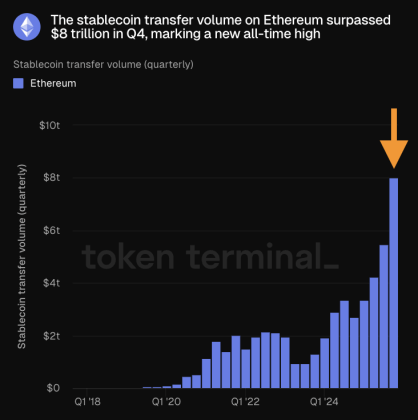
Stablecoin transfer on ETH at its peak | Source: Chart from Joseph Young on X

Data from the chart shared by Young shows that over $8 trillion in stablecoins were settled in the fourth quarter (Q4) of 2025, or in just 3 months. This is actual money being moved, settled, and cleared on the blockchain.

With this growth, Ethereum is reinforcing its central role as the primary financial layer for stablecoin transactions. According to Young, this amount of stablecoin transfers settled on ETH is larger than that of Visa, whose average payment volume is at $4 trillion per quarter.

Stablecoins have subtly emerged as one of the most popular cryptocurrency goods; the key chain for that activity is Ethereum. As a result, Young believes that ETH is becoming the trusted settlement layer of money, and no other chain rivals its financial reach.

ETH Is Highly Undervalued In The Crypto Space

Despite several milestones and remarkable network growth over the years, Ethereum is increasingly viewed through a different lens. Many analysts continue to argue that the ETH network may be the most undervalued blockchain in the entire cryptocurrency landscape today.

In the X post, BMNR Bullz, a financial expert and investor, highlighted that ETH only makes up over 14% of all crypto market value. Meanwhile, the network secures about 59% of all capital in the DeFi sector. This widening gap between usage and price is strengthening the argument that Ethereum’s true value may not yet be completely reflected.

This growth implies that the majority of the real money, applications, and settlements are actively taking place on the leading blockchain. “When price doesn’t reflect where capital actually lives, it’s usually the price that’s wrong,” BMNT Bullz added.

At the time of writing, the price of ETH was trading at $3,233 after experiencing a more than 2% rise in the last 24 hours. At the same time, its trading volume has flipped sharply bullish, increasing by over 42% in the past day.

ETH trading at $3,223 on the 1D chart | Source: ETHUSDT on Tradingview.com

Related Questions

QWhat major milestone did the Ethereum network achieve in Q4 of 2025 according to the article?

AThe Ethereum network reached a record high in stablecoin transfer volume, settling over $8 trillion in stablecoins in just three months.

QHow does Ethereum's stablecoin transfer volume compare to Visa's payment volume as mentioned in the article?

AEthereum's stablecoin transfer volume of over $8 trillion per quarter is larger than Visa's average quarterly payment volume of $4 trillion.

QWhat percentage of the total crypto market value does Ethereum (ETH) represent, and what percentage of DeFi capital does it secure?

AEthereum (ETH) makes up over 14% of the total crypto market value, while its network secures about 59% of all capital in the DeFi sector.

QWhat is the price of ETH and its 24-hour trading volume change at the time of writing?

AAt the time of writing, ETH was trading at $3,233, with a more than 2% price increase and a over 42% surge in trading volume in the last 24 hours.

QAccording to the analyst Joseph Young, what role is Ethereum becoming in the financial ecosystem?

AJoseph Young believes that Ethereum is becoming the trusted settlement layer of money, with no other blockchain rivaling its financial reach.

Related Reads

Dialogue with a Macro Analyst: AI Drains All Liquidity from U.S. Stocks, $40K Bitcoin is the True Bottom

In a recent discussion, macro strategist Luke Groman, founder of FFT LC, presented a sobering analysis of current markets. He argues that while the S&P 500 hits new highs, this is largely driven by just seven AI stocks, which are "sucking all the oxygen and liquidity out of the room." Bitcoin, which he calls the "last working smoke alarm for liquidity," is signaling trouble, having entered a difficult period. Groman explains that the AI boom is fueled by accounting practices that front-load revenue, creating an illusion of high profits while cash is being depleted. He warns this cycle could reverse sharply when construction slows. His base case is that stocks will rise in dollar terms but fall significantly when measured in gold or Bitcoin, highlighting that long-term US Treasury futures have already lost 90% of their value against gold over the past decade. He points to major structural risks, including China's dominance in rare earths—a small commodity market underpinning trillions in tech stock value—and the prolonged closure of the Strait of Hormuz, which he calls a "Suez Moment" for the US. This, combined with a shift towards a "no ticky, no washy" proof-of-work system for settling trade (using gold, not trust), signals deeper systemic distrust. Regarding US debt, Groman notes that historically, all 58 countries that reached a 130% debt-to-GDP ratio defaulted, primarily through inflation. The US crossed this threshold in 2020. He also highlights a contradiction in the AI narrative: if it's as transformative as claimed, it must destroy white-collar jobs, threatening half of US tax revenue—a reality at odds with the "no job loss" messaging from tech leaders. On Bitcoin, Groman sold most of his position near the top and hasn't fully re-entered. Citing technical analysis from Northstar Bad Charts, he suggests a potential bottom around $40,000 could materialize in Q3 or Q4. He concludes that while he may be labeled a doomsayer, his view is simply realistic, grounded in historical precedents and current macro pressures.

marsbit5h ago

Dialogue with a Macro Analyst: AI Drains All Liquidity from U.S. Stocks, $40K Bitcoin is the True Bottom

marsbit5h ago

Trading

Spot
Futures

Hot Articles

Discussions

Welcome to the HTX Community. Here, you can stay informed about the latest platform developments and gain access to professional market insights. Users' opinions on the price of ETH (ETH) are presented below.

活动图片
















