Ethereum Cements RWA Dominance As Amundi Tokenizes $100M SAFO Fund

bitcoinistPublished on 2026-03-20Last updated on 2026-03-20

Abstract

Europe's largest asset manager, Amundi, has launched a tokenized fund, the Spiko Amundi Overnight Swap Fund (SAFO), with $100 million in initial assets. The fund, built on Ethereum and Stellar, is designed for corporate treasury and collateral management, offering low-risk, overnight liquidity and multi-currency support. It uses smart contracts and Chainlink’s oracle network for real-time data and interoperability. This move reinforces Ethereum’s dominance in institutional real-world asset (RWA) tokenization, joining other major players like BlackRock in shifting toward on-chain financial products.

Amundi, Europe’s largest asset manager, is launching the Spiko Amundi Overnight Swap Fund (SAFO), a tokenized fund on Ethereum and Stellar starting with about $100 million in committed assets.

A Traditional Fund With A Tokenized Wrapper

Institutions historically related to TradFi have found a way to not to be left behind on the crypto curve in tokenized assets. In a statement published on Amundi’s website, the investment fund announced its collaboration with Spiko, a French-law regulated specialist tokenization platform, to launch SAFO as a tokenized sub-fund of SPIKO SICAV.

Structurally, SAFO it’s a traditional fund, just with a tokenized wrapper: it’s designed for corporate treasury and collateral management, an “on‐chain cash parking” with low risk and overnight liquidity. The fund invests using fully collateralized total return swaps with top‐tier banks, aiming to deliver stable yields slightly above risk‐free rates while still letting investors get their money back on an overnight basis. It supports multiple currencies (EUR, USD, GBP, CHF) and can be subscribed from as little as 1 unit, which is unusually low for institutional‐grade cash products.

The firm highlighted that the fund enables almost immediate settlement, supports multiple ways to hold assets, provides live visibility into the shareholder register, and allows fund shares to move globally around the clock, with automated access through APIs or smart contracts.

In the statement, Jean-Jacques Barbéris, Head of Institutional and Corporate Clients, and ESG at Amundi, said:

SAFO provides professional investors with a fast and transparent access to cash management solutions. This initiative is part of our ambition to contribute to the rise of tokenized solutions.

Where Ethereum Comes In

The shareholder register and fund shares live on Ethereum and Stellar, with Ethereum chosen for its smart‐contract and DeFi composability, while Stellar supports faster, lower‐cost transfers and 24/7 transferability of fund units. Chainlink’s network of data providers puts SAFO’s fund value directly on the blockchain and acts as the connector between Ethereum, Stellar, and traditional systems. This gives tokenized funds a secure, standardized way to share information, building on tests Chainlink has already run with DTCC and other major institutions.

SAFO is Amundi’s second tokenized fund in a few months. Back in November, the fund rolled out a tokenized share class of a money market fund on Ethereum, working together with CACEIS, one of Europe’s top asset-servicing providers and transfer agents, as reported by Bitcoinist.

Amundi’s new venture adds to a growing universe of tokenized money‐market products from players like BlackRock, the world’s largest asset manager, and Franklin Templeton, and reinforcing Ethereum’s position as the primary settlement layer for institutional RWAs.

A €2.3 trillion incumbent plugging into Ethereum and Chainlink cements the thesis that the next leg of the crypto cycle is driven by tokenized cash, bonds, and funds rather than purely speculative DeFi.
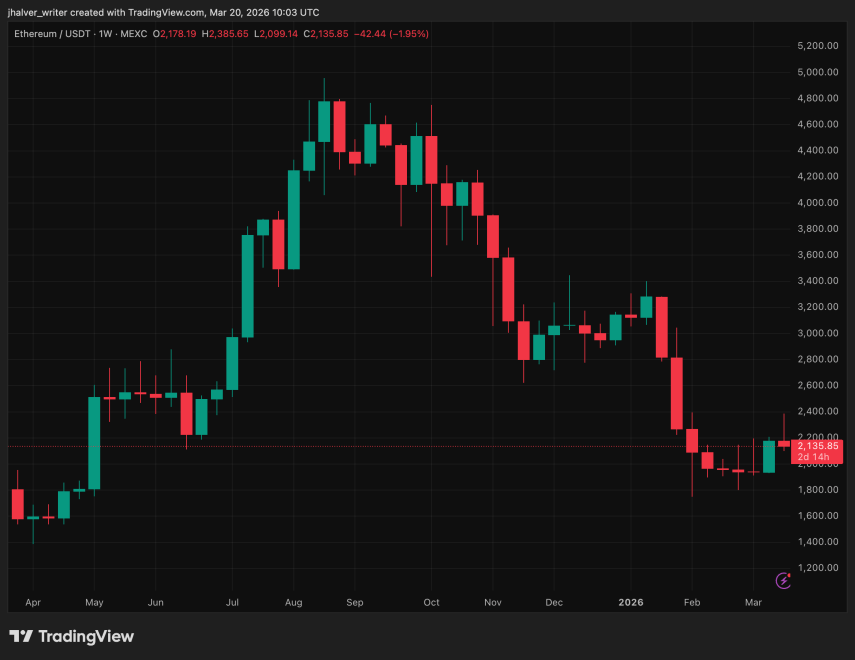
ETH trades for $2k on the daily chart. Source: ETHUSDT on Tradingview

Cover image from Perplexity, ETHUSDT chart from Tradingview

Related Questions

QWhat is the name of the tokenized fund launched by Amundi and Spiko, and on which blockchains is it built?

AThe tokenized fund is called the Spiko Amundi Overnight Swap Fund (SAFO). It is built on the Ethereum and Stellar blockchains.

QWhat is the primary purpose of the SAFO fund, and what type of investor is it target?

AThe SAFO fund is designed for corporate treasury and collateral management, acting as an 'on-chain cash parking' solution with low risk and overnight liquidity. It is targeted at professional investors.

QWhich key infrastructure provider is used to put the fund's value on the blockchain and connect the different systems?

AChainlink's network of data providers is used to put the fund's value on the blockchain and acts as the connector between Ethereum, Stellar, and traditional systems.

QHow does this new fund contribute to Ethereum's position in the market, according to the article?

AThe article states that Amundi's venture reinforces Ethereum's position as the primary settlement layer for institutional Real-World Assets (RWAs).

QWhat was notable about Amundi's previous tokenization effort mentioned in the article?

AIn November, prior to SAFO, Amundi rolled out a tokenized share class of a money market fund on Ethereum in collaboration with CACEIS, a top European asset-servicing provider.

Related Reads

How to Conduct Deep Research Using Claude's Dynamic Workflows

The article "How to Use Claude's Dynamic Workflows for Deep Research" discusses overcoming the pitfalls of technical research, where both humans and AI can get overwhelmed by information, leading to vague conclusions. It introduces Claude Code's new "Dynamic Workflows" feature, which automatically designs and executes task-specific workflows before starting a task, unlike simpler "planning modes." This approach incorporates validation, result convergence, and adversarial verification from the outset. The core of Dynamic Workflows is six predefined scheduling patterns that address how to decompose tasks and synthesize results: 1. **Classify-and-Act (Routing):** An agent classifies the task and routes it to the most suitable specialist agent for execution. It's precise and efficient but struggles with ambiguous tasks. 2. **Fan-out & Merge:** The task is split into parallel, independent subtasks whose results are later merged. It's fast and isolates contexts but is more expensive and challenging to synthesize. 3. **Adversarial Verification:** Multiple "challenger" agents critique a worker agent's conclusion, requiring majority approval. This counters confirmation bias and self-assessment errors but relies on verifiable facts. 4. **Generate & Filter:** Multiple agents generate many candidate solutions, which are then filtered against a rubric to output only the best. It fosters diversity but depends heavily on the filter's quality. 5. **Tournament:** Multiple agents compete on the same task, with pairwise comparisons eliminating contestants over rounds to select the best. This offers stable relative judgment but is complex. 6. **Loop:** An agent iteratively attempts a task, learning from errors and adjusting until a stop condition is met. It handles tasks with unknown scope but risks infinite loops without proper design. The author compares their own custom deep-research system, which involved multi-agent analysis and deduplication but lacked goal-oriented convergence, to Claude's built-in workflow. The official workflow adds critical layers: initial problem decomposition, credibility assessment of sources, cross-agent voting to delete weak conclusions (not just averaging), and output tightly focused on the user's original goals and actionable recommendations. This structurally addresses common AI issues like goal drift, premature stopping, context pollution, and output bias. In summary, Dynamic Workflows represent a shift from smarter single conversations to a structured research process, compressing what used to require many dialogues into 3-4 interactions, albeit at higher token cost. The author notes remaining challenges for their specific domain (blockchain research): the need for fact-based verification over official documentation, depth in truly novel interdisciplinary thinking, the practical validation of proposed solutions, and tailoring information density to the audience.

marsbit6m ago

How to Conduct Deep Research Using Claude's Dynamic Workflows

marsbit6m ago

When LPs Teach Me Investment with Doubao: A Self-Narrative of a Private Equity GP Switching Careers

When LPs Use Doubao to Teach Investing: A Transition Story of a Private Equity GP AI is making life increasingly difficult for small private equity fund managers, as a former GP of an offshore dollar fund reveals. The fund, managing tens of millions in US stocks, outperformed the Nasdaq but struggled with fundraising. Its traditional Cayman SPC/BVI structure failed to attract major Asian LPs, who now prefer Hong Kong LPF or Singapore VCC frameworks. The rise of AI-powered quantitative strategies has further squeezed the space for funds like his, which relied on subjective, discretionary investing. AI tools have leveled the information playing field, empowering LPs—often high-net-worth individuals, entrepreneurs, or family offices—to analyze investments themselves using chatbots like Doubao. This has eroded trust in GPs' expertise, leading to more frequent challenges over investment decisions and even withdrawals, especially during market rallies when retail investors sometimes outperform funds. Friction arises not necessarily from AI's capabilities but from how LPs use it. Many rely on conversational AI for validation rather than rigorous analysis, sometimes receiving misleading or hallucinated advice. While AI democratizes research, effective investing still requires discerning real insight from plausible-sounding output. Ultimately, AI is unlikely to fully replace GPs. Asset management remains a trust-based service. However, the industry must adapt. The future may see "human私募" (private equity) learning from AI and focusing more on providing value beyond pure analysis—perhaps by mastering the emotional intelligence and trust-building that machines cannot replicate.

Odaily星球日报34m ago

When LPs Teach Me Investment with Doubao: A Self-Narrative of a Private Equity GP Switching Careers

Odaily星球日报34m ago

Wang Chuan: After Investing in Storage Stocks and Seeing a Thirty-Fold Return, How to Remain Unanxious (Part 7) - A Quarter-Century Cycle

Wang Chuan: Reflections on Investment Anxiety and Market Cycles After Observing a 30x Gain in a Storage Stock (Part 7) – A Quarter-Century Cycle This article examines the cyclical nature and inherent risks in technology hardware investments, using the storage and semiconductor sectors as examples. It criticizes the misleading practice of "annualized" Net Dollar Retention (NDR) rates, where short-term growth is extrapolated unrealistically. A key concept explored is "reflexivity" – demand driven by panic, exploration, and liquidity during market booms, which can vanish just as quickly when conditions reverse. This reflexivity exists both in product demand and among speculative stock buyers, creating powerful feedback loops that inflate prices during upturns and exacerbate crashes during downturns. The author highlights a major risk for hardware sectors: unlike assets with defined cycles (e.g., Bitcoin's halving), there's no guarantee of a swift recovery post-crash. Companies like Micron, Intel, and Cisco took roughly a quarter-century to surpass their 2000 highs, enduring drawdowns exceeding 80%. This is attributed to the "bullwhip effect" in supply chains, where demand collapses instantly but过剩产能 persists, and a migration of narrative-driven capital. High-valuation stories吸引 speculative funds during growth phases, but these funds quickly depart for the next hot narrative once growth slows, leaving behind stronger companies with much lower valuations. The piece warns of dangerous mental models formed during bull markets: 1) equating current strong demand with perpetual high growth, and 2) believing that making fast, large profits is easy. Citing巴菲特, the author notes that easy money undermines rationality, likening speculators to Cinderella at a ball with a clock that has no hands. The current phase presents an asymmetric risk-reward scenario: potential for further gains exists, but the downside risk is an 80%+ drawdown and a multi-decade wait for breakeven, which reflexive speculators cannot tolerate. The hypothetical investor "老王" (Lao Wang), who achieved a 30x return, is used to illustrate potential pitfalls. Leverage could lead to a wipeout during a sharp correction. Even without leverage, ingrained beliefs in easy money would likely lead him to double down after losses, expecting a quick rebound. Instead, he might face a protracted decline, depleting his resources through frantic trading as the high-growth narrative fades. The conclusion references Schopenhauer, comparing those who have seen multiple market cycles to an audience seeing the same magic trick repeatedly—once the illusion is understood, its power is gone.

marsbit56m ago

Wang Chuan: After Investing in Storage Stocks and Seeing a Thirty-Fold Return, How to Remain Unanxious (Part 7) - A Quarter-Century Cycle

marsbit56m ago

US Stocks Too Expensive? This Top CIO Scoured the Globe and Found 5 Stocks More Attractive Than NVIDIA

Summary: Main Street Research CIO James Demmert maintains his bullish 8,100 target for the S&P 500 but argues that greater opportunities now lie overseas. He identifies five international stocks with superior valuations poised to benefit from the AI revolution, suggesting international markets will outperform the US for years. Key Recommendations: 1. **ASML (Netherlands):** A foundational chip manufacturing technology provider, offering crucial AI exposure and geographic diversification. Demmert's top long-term pick. 2. **HSBC (UK/Asia):** A global bank with a 9x P/E ratio, better growth prospects than US peers like JPMorgan, and strong Asian presence. 3. **Siemens Energy (Germany):** A direct play on global power grid expansion driven by AI, crypto, and EV electricity demand. 4. **BHP Group (Australia):** A "hidden AI play" and "second derivative" of the trend due to massive copper demand for data centers. Trades at a 16x P/E. 5. **AstraZeneca (UK):** An undervalued healthcare stock with a strong pipeline (18x P/E, >20% growth), expected to benefit from AI's impact on medicine. Core Thesis: International outperformance is driven by both attractive valuations and a major policy shift. While the US tightens fiscal policy, Europe and Japan are launching unprecedented stimulus, reigniting growth. Demmert recommends allocating 45% of a portfolio internationally, citing excessive US investor conservatism as a key mistake.

marsbit1h ago

US Stocks Too Expensive? This Top CIO Scoured the Globe and Found 5 Stocks More Attractive Than NVIDIA

marsbit1h ago

Trading

Spot
Futures

Hot Articles

Discussions

Welcome to the HTX Community. Here, you can stay informed about the latest platform developments and gain access to professional market insights. Users' opinions on the price of ETH (ETH) are presented below.

活动图片
















