Ethereum Block Space Futures Market ETHGas Aims to Become a Real-Time Execution Layer?

marsbitPublished on 2026-01-03Last updated on 2026-01-03

Abstract

Ethereum block space futures market ETHGas has raised $12 million in a funding round led by Polychain Capital, with participation from several other investors. The platform aims to address Ethereum's gas fee volatility by allowing users to lock in future gas costs through futures contracts, making expenses predictable for DApps and L2 solutions. A key feature is its Blockspace auction market, where validators and block builders can auction space in upcoming blocks, ensuring transaction inclusion and execution efficiency. ETHGas ultimately envisions a "Real-Time Ethereum" by guaranteeing transaction execution in subsequent blocks. However, challenges include potential increased costs for retail users due to institutional dominance in auctions, and risks of market manipulation through futures trading. The platform plans to mitigate these issues to avoid undermining its core goals.

Author: Eric, Foresight News

On December 17, the block space futures market ETHGas announced the completion of a $12 million funding round, led by Polychain Capital, with participation from Stake Capital, BlueYard Capital, Lafayette Macro Advisors, SIG DT, and Amber Group. Founder Kevin Lepsoe revealed that ETHGas had completed an undisclosed Pre-Seed funding round of approximately $5 million in mid-2024.

Lepsoe also stated that Ethereum validators, block builders, and relay nodes have committed around $800 million to support market and product development, not in cash investments but by providing liquidity to the ETHGas market in the form of Ethereum block space.

Although the project is defined as a block space futures market, its true vision is to achieve "Real-Time Ethereum."

The Order of Blocks

Ethereum co-founder Vitalik Buterin proposed the concept of a Gas futures market earlier this month, aiming to address the issue of Ethereum Gas volatility. Similar to the logic of commodity futures in traditional markets, locking in future Gas costs through futures would make Gas expenses predictable and controllable.

This would allow DApps to lock in Gas costs before events such as users claiming token airdrops and design activities to subsidize users. L2s could also purchase futures when Gas fees are lower to stabilize the cost of bundling and submitting data to L1, making transaction costs on L2s stable and predictable. This would serve businesses that require pre-calculated costs, such as tokenized U.S. stocks.

According to the documentation, ETHGas will also launch a no-code tool called Open Gas specifically for DApps to help them provide Gas subsidy programs. This tool will allow users to claim the Gas fees they consumed on the ETHGas platform after using a DApp.

Developing a Gas futures market is not particularly challenging, as it essentially requires building a sufficiently liquid on-chain futures trading market. ETHGas's "killer feature" is its block space auction market.
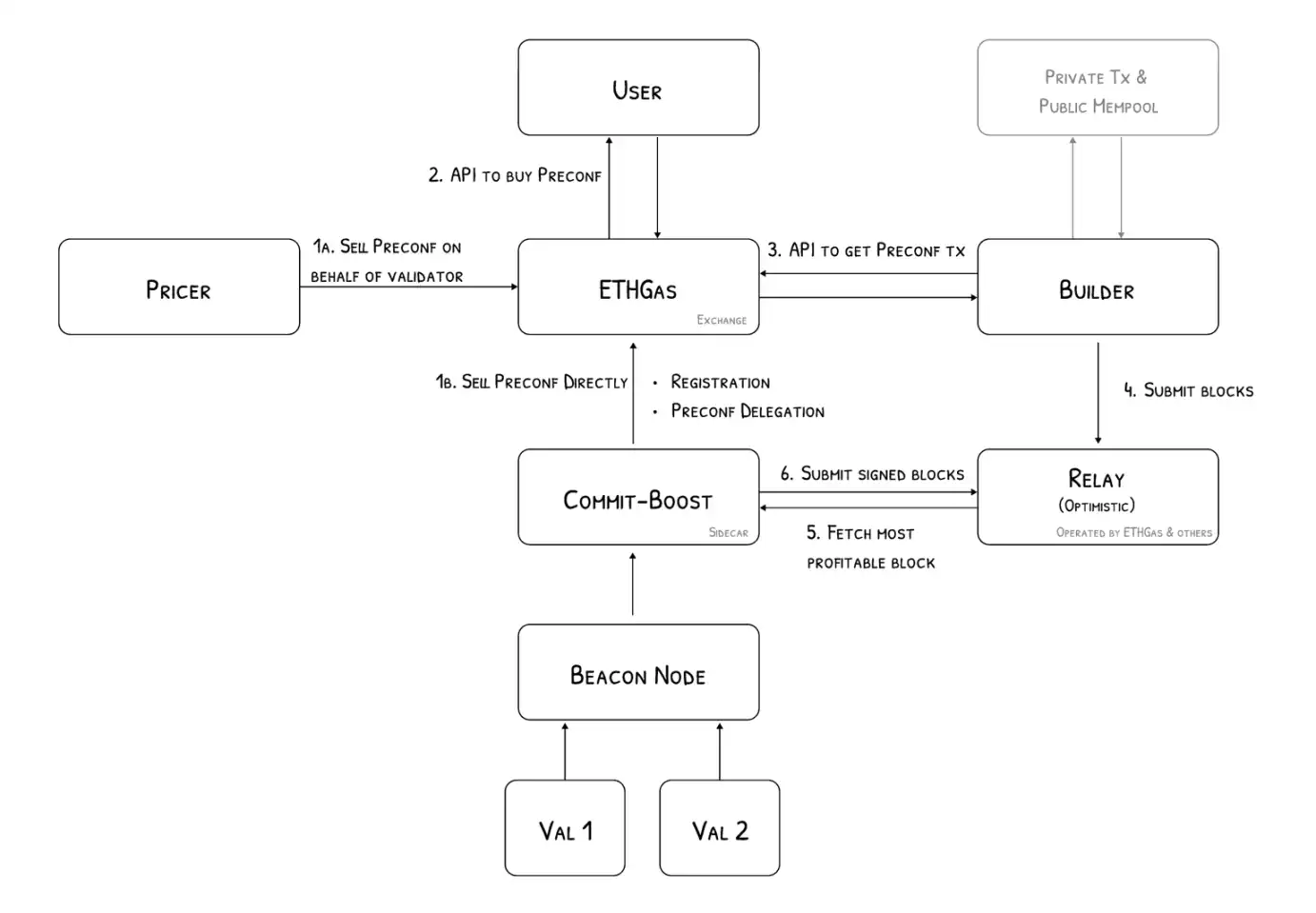
This auction market, named Blockspace, allows Ethereum validators, block builders, and relay nodes to auction space in subsequent blocks, ensuring that bidders' transactions are included in the next block and guaranteeing the execution efficiency of those transactions. Additionally, bidders can even purchase an entire block to include only their own transactions or transactions they provide for others.

Comparing transactions to packages, guaranteeing block inclusion is like ensuring a package is loaded onto a transport plane, while guaranteeing transaction execution is like ensuring the package is delivered to the intended recipient on time. Purchasing an entire block is akin to chartering an entire plane to transport one's packages, but with the option to sublet the extra space to other packages.

ETHGas's ultimate goal is to achieve "real-time transactions" on Ethereum through Blockspace. This "real-time transaction" can only be in quotes because the completion of transactions on the Ethereum mainnet must wait for the block to be finalized. However, if a transaction can be guaranteed to be included in the next block, it can, in a way, be considered "already completed." ETHGas can be understood as an execution layer on top of Ethereum, but how real-time transactions will be reflected on the front end remains to be seen as ETHGas provides answers.

ETHGas aims to create an orderly block space, as opposed to the current system of chaotic bidding for block space with numerous uncontrollable MEV transactions. By offering predictable returns to attract infrastructure operators to join Blockspace and create sufficient liquidity for real-time transactions, the resulting efficiency improvements will attract various DApps. DApps, in turn, will attract users through Open Gas, and users will bring more transaction volume into the ETHGas network, thereby increasing the returns for infrastructure operators and forming a positive cycle.

Challenges Beneath the Ideal Vision

For a DApp about to conduct a token airdrop, it could estimate the number of transactions for claiming the airdrop, pre-book n blocks after a specific time, and provide a Gas subsidy program, thereby achieving a budget-controlled and network-congestion-free token claim event.

Although such visions are ideal, allowing block space to be auctioned may lead to many foreseeable issues.

First, if institutional users can auction block space without restrictions, they might purchase entire blocks in large quantities and resell them to retail users. While this would ensure stable and predictable returns for validators, it could increase transaction costs for retail users. In this scenario, retail users lack the technical capability to compete with institutional users, and even if they could participate in auctions or use futures markets to hedge against rising Gas fees, it would essentially raise their transaction costs.

Additionally, the futures market could become a tool for market manipulation. For example, large players could deliberately create a high volume of on-chain transactions to drive up Gas fees and profit from the futures market, but this could increase transaction costs for other users on the Ethereum mainnet. Moreover, as DApp operators are aware of the specific timing of events that could cause a surge in transactions, they could profit from operations in the futures market in advance, turning the futures market into an arbitrage playground for those with informational advantages and causing unpredictable losses for ordinary users who simply use the market for hedging.

The birth of a new trading market inevitably creates arbitrage opportunities due to information asymmetry, potentially undermining the very problems the market aims to solve. For ETHGas, balancing this issue and preventing a "positive cycle" from turning into a "death spiral" may require some necessary restrictions.


Trending Cryptos

Related Questions

QWhat is the main vision of ETHGas, despite being defined as a block space futures market?

AThe main vision of ETHGas is to achieve 'Real-Time Ethereum' by creating an orderly block space and acting as an execution layer on top of Ethereum.

QWho led the $12 million funding round for ETHGas announced on December 17th?

AThe $12 million funding round was led by Polychain Capital.

QWhat is the purpose of the Blockspace auction market introduced by ETHGas?

AThe Blockspace auction market allows validators, block builders, and relay nodes to auction space in future blocks, guaranteeing that a bidder's transaction will be included in the next block and ensuring its efficiency. It can also be used to auction an entire block.

QWhat potential problem does the article identify with allowing unlimited block space auctions?

AUnlimited auctions could allow institutional users to outbid散户 (retail users) and potentially resell block space to them, ultimately increasing transaction costs for ordinary users and creating an unlevel playing field.

QWhat tool is ETHGas developing specifically for DApps, and what is its function?

AETHGas is developing a zero-code tool called Open Gas, which is designed to help DApps provide gas subsidy programs, allowing users to claim the gas fees they spent after using the DApp on the ETHGas platform.

Related Reads

In Conversation with Ray Dalio: We Are Currently in an AI Bubble, with 1% of My Portfolio in Bitcoin

Ray Dalio, founder of Bridgewater Associates, warns in an interview that the current AI boom shows classic bubble characteristics, which could lead to significant economic downturns as seen in past cycles like 1929 or 2000. He explains that speculative enthusiasm, fueled by debt and overvaluation, often precedes a crash when rising rates or taxation force asset sales, causing widespread losses and recession. Dalio also outlines his "Big Cycle" theory, describing an approximate 80-year pattern where widening wealth gaps, massive government deficits, and shifting geopolitical power (like China's rise) create internal conflict and global instability. He emphasizes that we are in a late-cycle, transitional phase where traditional powers like the US and UK face decline. For personal wealth protection, Dalio advises diversification beyond cash into assets like stocks, bonds, real estate, and particularly gold, which he prefers over Bitcoin. While he holds about 1% of his portfolio in Bitcoin as a non-printable hard asset, he views gold as more secure from technological or governmental threats. Regarding AI's impact, Dalio believes it will disproportionately benefit capital owners, worsening inequality by replacing both physical and cognitive labor. He suggests that human intuition and emotional intelligence, combined with AI, will be key for future workers. On taxation, Dalio argues that wealth taxes are impractical and risk triggering asset sell-offs, reducing productive investment. He points to the UK as a cautionary example of debt, low productivity, and political strife. Geopolitically, Dalio foresees a more regionalized world, with the US showing weakness in prolonged conflicts like with Iran, akin to past imperial declines. The ideal outcome, he suggests, is coexisting powerful blocs (e.g., Americas, China-Asia Pacific) without major war.

marsbit3h ago

In Conversation with Ray Dalio: We Are Currently in an AI Bubble, with 1% of My Portfolio in Bitcoin

marsbit3h ago

Daily 7.2 Trillion KRW: Foreign Capital's Record Net Buying on Friday! Wall Street Says Headwinds for Korean Stock Fund Flows Have Subsided

South Korean stock market sees a dramatic shift in fund flows. On July 31, foreign investors made a record net purchase of approximately KRW 7.2 trillion in KOSPI stocks, marking a fundamental reversal from the persistent large-scale net outflows seen in previous months. This contributed to a significant narrowing of foreign net selling in July to KRW 9.8 trillion, down sharply from KRW 48.4 trillion in June and KRW 44.5 trillion in May. Simultaneously, domestic institutional pressure eased. South Korean pension funds and asset managers turned to a net buying position in July, purchasing KRW 1.0 trillion worth of KOSPI shares, contrasting with net sales in May and June. Market volatility is expected to be dampened by new financial regulations. Effective July 31, the Financial Services Commission tightened access for retail investors to single-stock leveraged ETFs by raising the minimum cash deposit requirement. Trading volumes for these products subsequently dropped to about 50% of their monthly average. Citigroup Research maintains its year-end KOSPI target of 10,000 points. The firm cites several supportive factors: the substantial easing of headwinds from capital outflows, a robust fundamental outlook for the semiconductor sector, historically low market valuations, strong economic fundamentals, and the potential for policy support from financial authorities if needed.

marsbit3h ago

Daily 7.2 Trillion KRW: Foreign Capital's Record Net Buying on Friday! Wall Street Says Headwinds for Korean Stock Fund Flows Have Subsided

marsbit3h ago

Thanks to Dice Rolls, Bitcoin Keys Are Stored Offline, But Not Everyone Will Do It

The article discusses using dice rolls to generate secure Bitcoin wallet seeds, providing entropy independent of potentially flawed hardware random number generators. It explains that each fair dice roll offers about 2.585 bits of entropy, with around 50 rolls needed for a standard 12-word seed phrase and 99+ recommended for higher security. This method gained attention after a vulnerability was revealed in some Coldcard hardware wallets, where a faulty firmware RNG (dating back to 2021) compromised generated keys. The analysis notes that while a dice-generated main seed was safe from this specific flaw, other Coldcard functions (like creating paper wallets, backup keys, or passwords) could still be vulnerable if they used the defective RNG. The piece argues that while dice-based entropy is technically robust, the manual process is error-prone, tedious, and unrealistic for most new users, who might make mistakes in recording or inputting rolls. It concludes that while manual entropy generation should remain an option for advanced users, the long-term goal is to develop reliable, user-friendly hardware and software that securely generates randomness without requiring specialized knowledge. Coldcard users are advised to check their firmware version and replace any secondary secrets (like paper wallet keys) created with vulnerable devices, while also considering multi-signature setups with devices from different manufacturers for added security.

cryptonews.ru8h ago

Thanks to Dice Rolls, Bitcoin Keys Are Stored Offline, But Not Everyone Will Do It

cryptonews.ru8h ago

Trading

Spot

Hot Articles

How to Buy DATA

Welcome to HTX.com! We've made purchasing DATA Network (DATA) simple and convenient. Follow our step-by-step guide to embark on your crypto journey.Step 1: Create Your HTX AccountUse your email or phone number to sign up for a free account on HTX. Experience a hassle-free registration journey and unlock all features.Get My AccountStep 2: Go to Buy Crypto and Choose Your Payment MethodCredit/Debit Card: Use your Visa or Mastercard to buy DATA Network (DATA) instantly.Balance: Use funds from your HTX account balance to trade seamlessly.Third Parties: We've added popular payment methods such as Google Pay and Apple Pay to enhance convenience.P2P: Trade directly with other users on HTX.Over-the-Counter (OTC): We offer tailor-made services and competitive exchange rates for traders.Step 3: Store Your DATA Network (DATA)After purchasing your DATA Network (DATA), store it in your HTX account. Alternatively, you can send it elsewhere via blockchain transfer or use it to trade other cryptocurrencies.Step 4: Trade DATA Network (DATA)Easily trade DATA Network (DATA) on HTX's spot market. Simply access your account, select your trading pair, execute your trades, and monitor in real-time. We offer a user-friendly experience for both beginners and seasoned traders.

1.2k Total ViewsPublished 2026.07.01Updated 2026.07.01

How to Buy DATA

What is ANSEM

I. Project IntroductionThe Black Bull ($ANSEM) is a transparent, community-driven memecoin on Solana built around one creed: charge forward no matter what. The project is frontend-first and fully verifiable — its website reads live on-chain and market data directly from Solana, including price, liquidity, volume, market cap, and holder distribution, so anyone can audit the claims with no login and no user-data collection. Beyond the token, it offers an Ansem-call Radar, non-custodial community liquidity Pods on PumpSwap, and a browser-based meme terminal. $ANSEM is a standard Pump.fun SPL token (6 decimals) trading against SOL and USDC.II. Token InformationToken Symbol: ANSEM(The Black Bull)III. Related LinksWebsite:https://www.blackbullsol.com/X: https://x.com/blknoiz06Contract Address: https://solscan.io/token/9cRCn9rGT8V2imeM2BaKs13yhMEais3ruM3rPvTGpumpNote: The project introduction comes from the materials published or provided by the official project team, which is for reference only and does not constitute investment advice. HTX does not take responsibility for any resulting direct or indirect losses.

3.4k Total ViewsPublished 2026.07.01Updated 2026.07.01

What is ANSEM

How to Buy ANSEM

Welcome to HTX.com! We've made purchasing The Black Bull (ANSEM) simple and convenient. Follow our step-by-step guide to embark on your crypto journey.Step 1: Create Your HTX AccountUse your email or phone number to sign up for a free account on HTX. Experience a hassle-free registration journey and unlock all features.Get My AccountStep 2: Go to Buy Crypto and Choose Your Payment MethodCredit/Debit Card: Use your Visa or Mastercard to buy The Black Bull (ANSEM) instantly.Balance: Use funds from your HTX account balance to trade seamlessly.Third Parties: We've added popular payment methods such as Google Pay and Apple Pay to enhance convenience.P2P: Trade directly with other users on HTX.Over-the-Counter (OTC): We offer tailor-made services and competitive exchange rates for traders.Step 3: Store Your The Black Bull (ANSEM)After purchasing your The Black Bull (ANSEM), store it in your HTX account. Alternatively, you can send it elsewhere via blockchain transfer or use it to trade other cryptocurrencies.Step 4: Trade The Black Bull (ANSEM)Easily trade The Black Bull (ANSEM) on HTX's spot market. Simply access your account, select your trading pair, execute your trades, and monitor in real-time. We offer a user-friendly experience for both beginners and seasoned traders.

1.4k Total ViewsPublished 2026.07.01Updated 2026.07.01

How to Buy ANSEM

Discussions

Welcome to the HTX Community. Here, you can stay informed about the latest platform developments and gain access to professional market insights. Users' opinions on the price of A (A) are presented below.

活动图片













