Ethena’s USDe loses $8.3B since October crash amid ‘loss of confidence’

cointelegraphPublished on 2025-12-23Last updated on 2025-12-23

Abstract

Ethena's synthetic dollar stablecoin, USDe, has experienced approximately $8.3 billion in net outflows since the major market crash on October 10th, driven by a significant loss of confidence. Its market capitalization fell from nearly $14.7 billion to around $6.4 billion in just over two months. The October liquidation event, which erased an estimated $1.3 trillion from the crypto market, marked a turning point, shifting the market into a deleveraging phase. Although USDe briefly lost its peg on Binance due to an internal oracle issue, its minting and redemption mechanisms reportedly functioned normally. Since the crash, broader crypto market activity has weakened, with trading volumes down roughly 50% and significant outflows from U.S. spot Bitcoin ETFs.

Ethena’s synthetic dollar USDe has shed about $8.3 billion in net outflows since the major liquidation event on Oct. 10, as confidence in leveraged and synthetic collateral structures continues to weaken.

According to a report from 10x Research, the October sell-off marked a turning point for the crypto market, flipping the bull phase into a period of deleveraging. The crash erased an estimated $1.3 trillion in crypto market value, nearly 30% of total capitalization at the time.

Ethena USDe (USDe), which relies on synthetic collateral and hedging mechanisms rather than traditional fiat reserves, faced a “sharp loss of confidence” under these conditions, the analysts wrote.

According to data from CoinMarketCap, USDe’s market cap stood at nearly $14.7 billion on Oct. 9. In just over two months, that value dropped to around $6.4 billion.
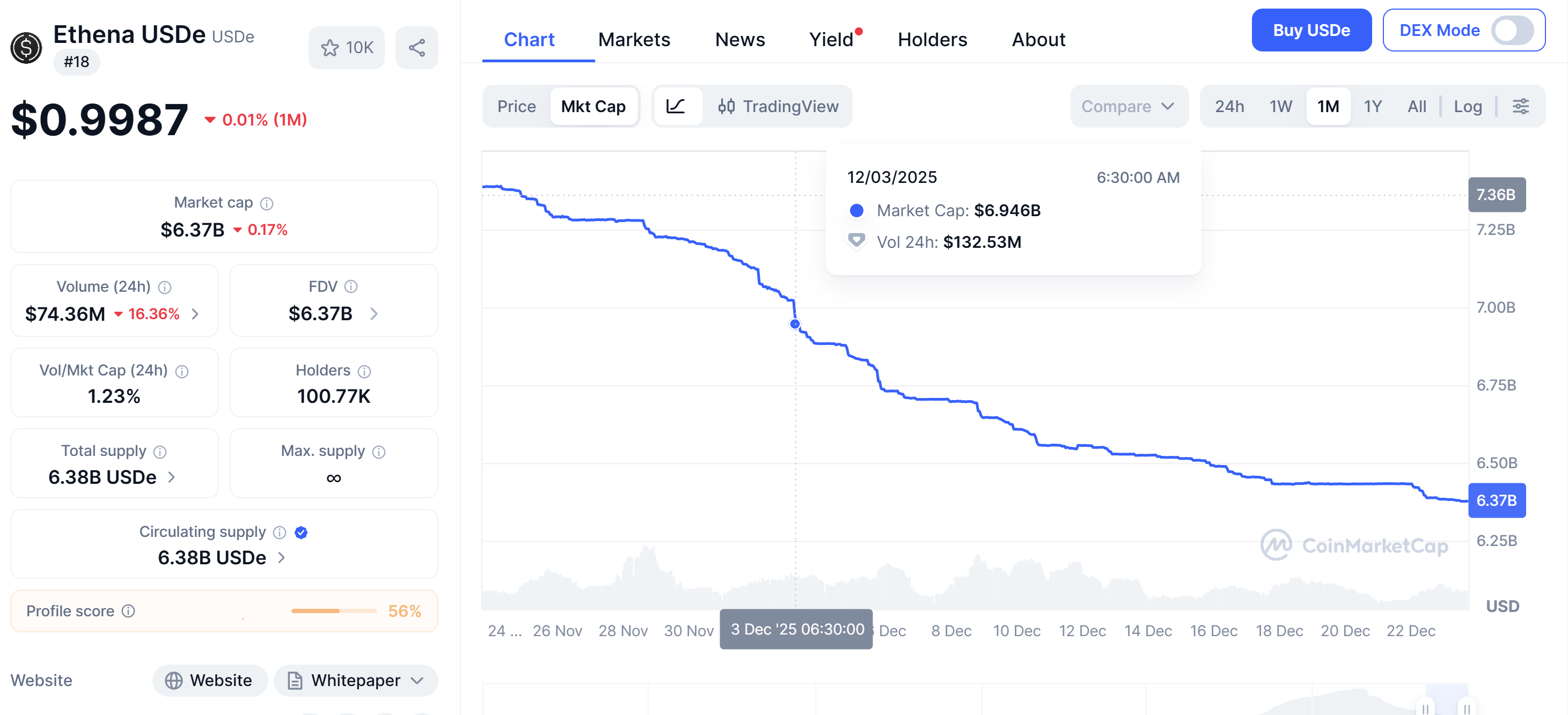
USDe’s market cap declines. Source: CoinMarketCap.

Related: $19B crypto market crash: Was it leverage, China tariffs or both?

USDe’s brief price depeg glitch

Following the Oct. 10 crash, USDe temporarily lost its peg and dropped to about $0.65 on Binance. Ethena Labs founder Guy Young said the brief depeg on the exchange was caused by an internal oracle issue at the exchange, not by problems with the stablecoin’s collateral, protocol or redemption mechanics.

He said USDe minting and redemptions functioned normally during the market crash, with about $2 billion redeemed in 24 hours across major decentralized finance (DeFi) venues and only minor price deviations elsewhere. At the time of writing, USDe is trading at $0.9987, according to data from CoinMarketCap.

The crypto market crash on Oct. 10 was the largest liquidation event in the crypto market’s history. More than $19 billion in crypto positions were liquidated, according to CoinGlass data, leading to a $65 billion decline in open interest.

Related: Crypto.com CEO Urges Probe After $20B Liquidations

Crypto market activity stalls

Since the crash, broader market activity has also thinned. Crypto trading volumes are down roughly 50%, while US-listed spot Bitcoin exchange-traded funds (ETFs) have seen about $5 billion in net outflows since late October.

10x Research said that the current weakness is less about retail capitulation and more about a deliberate pullback by regulated capital. As leverage and liquidity retreat, Bitcoin (BTC) has decoupled from both equities and gold, trading more like an isolated risk asset than a macro hedge.

Magazine: 2026 is the year of pragmatic privacy in crypto — Canton, Zcash and more

Related Questions

QWhat was the total amount of net outflows from Ethena's USDe since the October crash, and what was the primary reason cited for this decline?

AEthena's USDe shed about $8.3 billion in net outflows. The primary reason cited was a 'sharp loss of confidence' in leveraged and synthetic collateral structures following the market crash.

QAccording to the report from 10x Research, what was the estimated value of the crypto market that was erased during the October 10th crash?

AThe October 10th crash erased an estimated $1.3 trillion in crypto market value, which was nearly 30% of the total capitalization at the time.

QWhat did Ethena Labs founder Guy Young identify as the cause of USDe's brief price depeg on Binance?

AGuy Young stated that the brief depeg on Binance was caused by an internal oracle issue at the exchange, not by problems with the stablecoin’s collateral, protocol, or redemption mechanics.

QHow much did the open interest in the crypto market decline by, according to CoinGlass data from the October 10th liquidation event?

AAccording to CoinGlass data, the October 10th liquidation event led to a $65 billion decline in open interest.

QHow have US-listed spot Bitcoin ETFs performed in terms of flows since late October?

AUS-listed spot Bitcoin ETFs have seen about $5 billion in net outflows since late October.

Related Reads

$9.4 Billion: The Largest Robotics Funding This Year Has Emerged

Munich-based humanoid robotics company Neura has completed a $1.4 billion (approximately RMB 94.9 billion) Series C funding round, valuing the company at around $7 billion and positioning it among the global leaders in the sector. The investment round is notable not just for its size—reportedly the largest in robotics this year—but also for its strategic backers, which include tech giants like NVIDIA and Amazon, alongside established industrial players such as German engineering firms Bosch and Schaeffler. This mix of investors signals a significant shift in the industry's focus from technological demonstrations and general-purpose narratives toward practical, industrial deployment and commercialization. Neura's approach centers on developing humanoid robots for defined, high-value industrial tasks rather than pursuing a general-purpose model. Its early validation comes from a partnership with BMW, where its robots are being tested on actual production lines. The involvement of Bosch and Schaeffler, companies deeply embedded in global manufacturing, underscores a growing belief that humanoid robots are transitioning from labs to viable factory-floor solutions. The article highlights two converging trends driving investment: advancements in AI and large language models, which enhance robots' perception and decision-making in unstructured environments, and mounting pressure from labor shortages and rising costs in major manufacturing regions. The funding landscape is now bifurcating between companies like Figure AI, focusing on versatile general-purpose robots, and firms like Neura, targeting specific vertical industrial applications with clearer, shorter paths to ROI. While technical hurdles remain, the core challenges for widespread adoption are increasingly seen as engineering and commercial in nature: managing the high integration and customization costs for different factory environments and establishing robust, localized maintenance and service networks. The record investment in Neura, particularly from industrial capital, indicates the industry's growing confidence in moving from proving feasibility to solving the practical problems of scalability, reliability, and building sustainable business models around humanoid robots in real-world settings like automotive manufacturing and hazardous labor environments.

marsbit10h ago

$9.4 Billion: The Largest Robotics Funding This Year Has Emerged

marsbit10h ago

Trading

Spot
Futures

Hot Articles

Discussions

Welcome to the HTX Community. Here, you can stay informed about the latest platform developments and gain access to professional market insights. Users' opinions on the price of S (S) are presented below.

活动图片















