Drift Protocol halts operations after suspected $285m exploit as funds move across wallets

ambcryptoPublished on 2026-04-01Last updated on 2026-04-01

Abstract

Drift Protocol has halted deposits and withdrawals after confirming an active attack, with initial estimated losses around $285 million. Blockchain security firm PeckShield reported the losses span multiple assets, including $71.4M in USDC and $159.3M in JLP, among others. The attacker has begun moving funds across wallets, likely to obscure transaction trails. Unverified reports suggest the exploit may have involved a compromised administrative key, allowing manipulation of protocol parameters, though this remains unconfirmed. The incident reflects a trend of sophisticated DeFi attacks targeting governance and internal controls. An investigation is ongoing with no timeline for restoring operations.

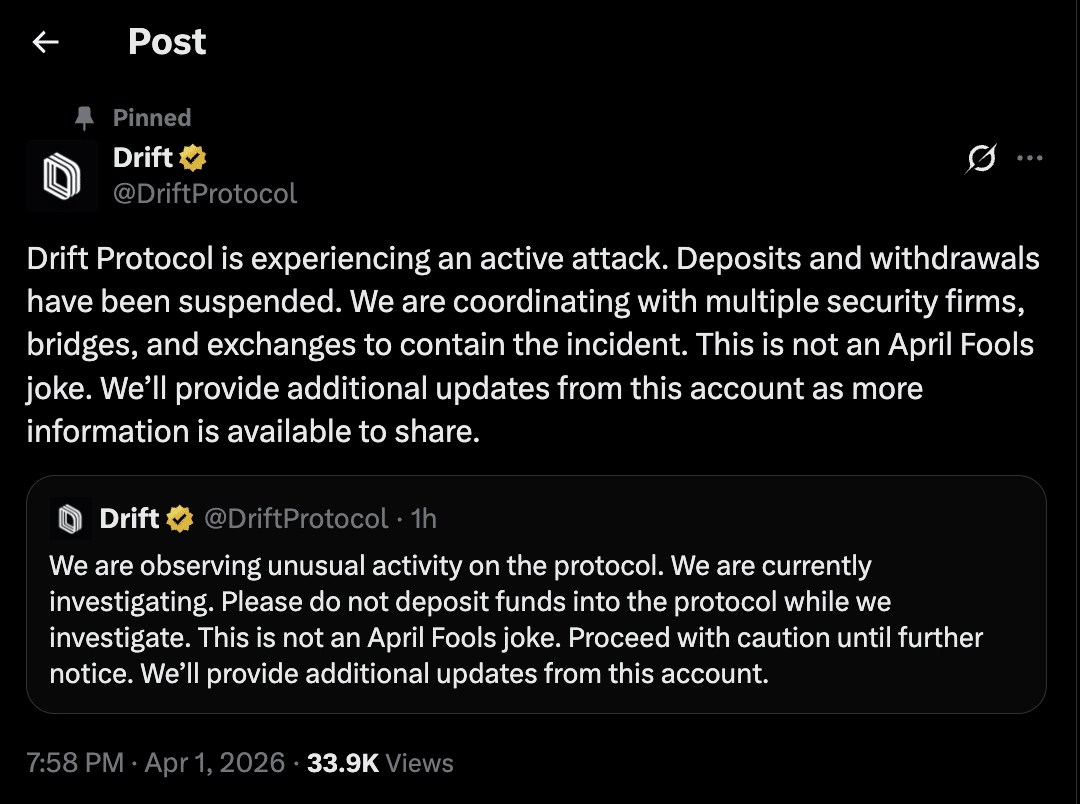
Drift Protocol has halted deposits and withdrawals after confirming it is experiencing an active attack, with early estimates suggesting losses could reach hundreds of millions of dollars.

The protocol disclosed the incident in a public update on 1 April, stating that it is coordinating with security firms, bridges, and exchanges to contain the situation.

“This is not an April Fools joke,” the team said, adding that further updates will follow as the investigation develops.
Source: X

Estimated losses near $285m as breakdown emerges

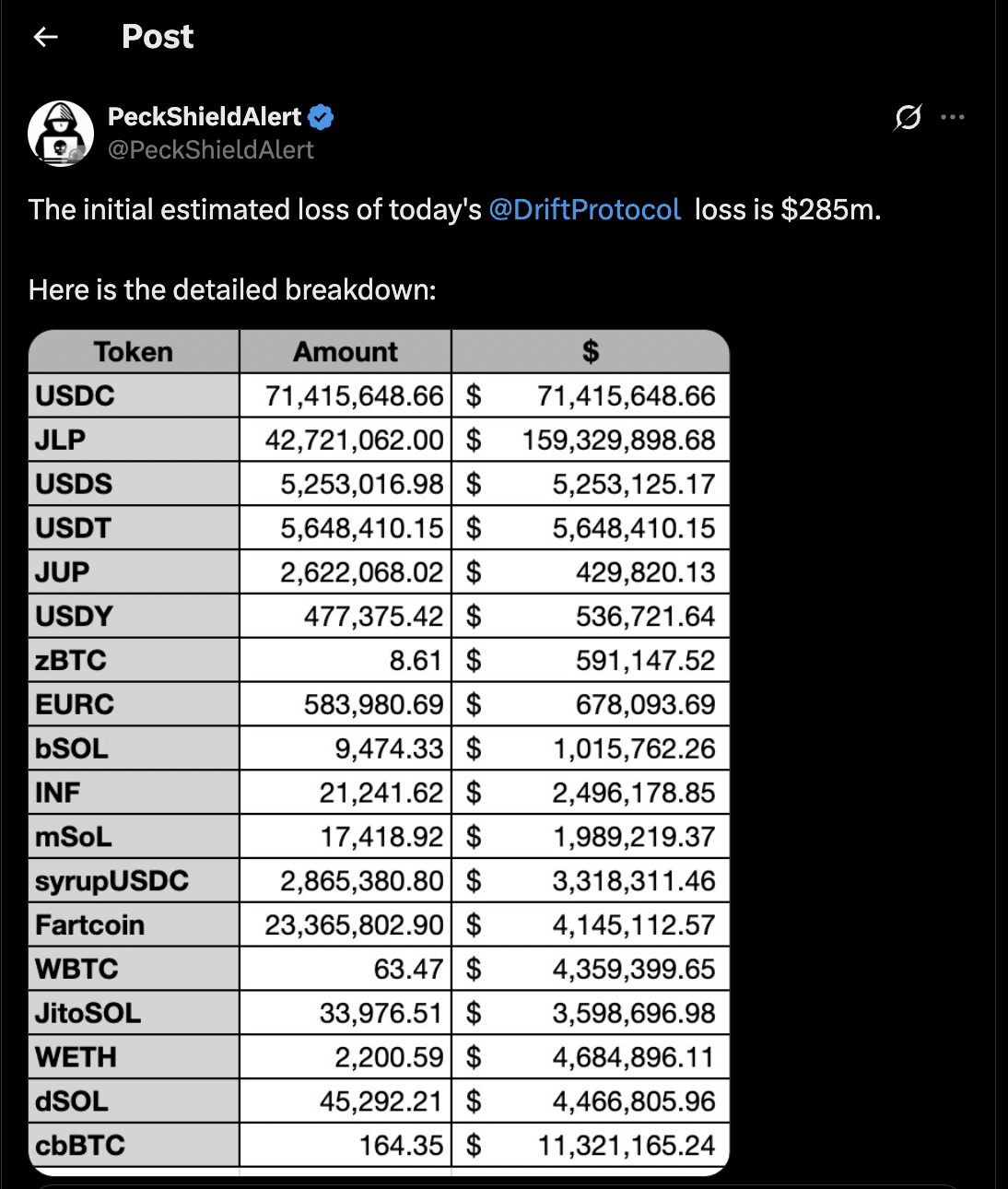
Blockchain security firm PeckShield estimated the initial losses at around $285m, based on early on-chain analysis.

A breakdown shared by the firm suggests the exploit spans multiple assets, including:

  • $71.4m in USDC
  • $159.3m in JLP
  • Smaller amounts across USDT, WETH, wrapped BTC, and Solana-based assets
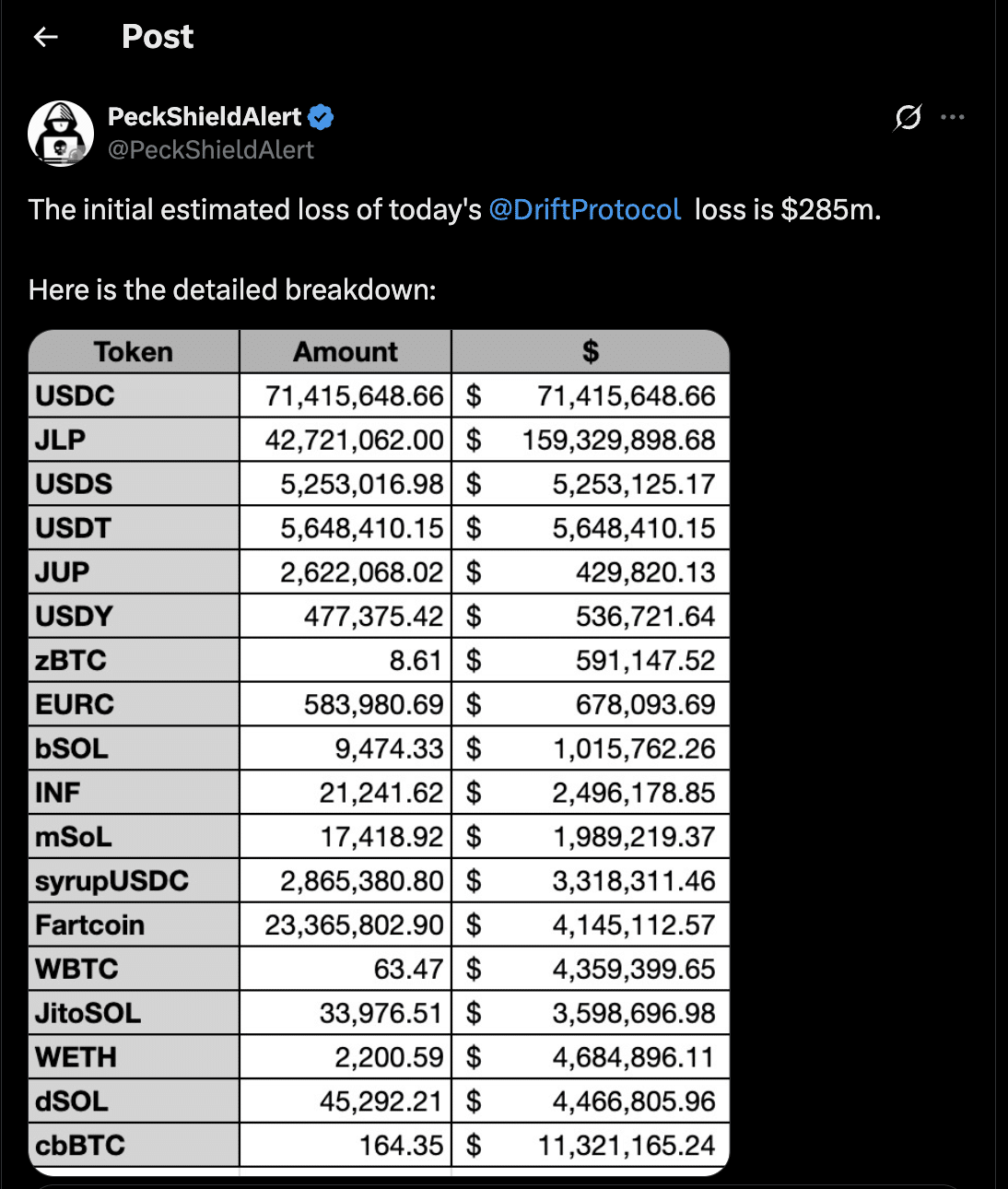
Source: X

While the figures remain preliminary, the scale places the incident among the larger DeFi exploits in recent months.

Funds begin moving across wallets

Separate on-chain tracking indicates that the attacker has already begun moving funds across multiple wallets. This is a pattern typically associated with attempts to obscure transaction trails.

Initial flows suggest assets are being split and transferred through different addresses, with some movements potentially involving cross-chain bridges. This behavior is consistent with past exploits where attackers rapidly redistribute funds to reduce traceability and recovery risk.

At the time of writing, there has been no confirmed recovery of funds.

Unverified reports point to potential exploit mechanism

Unconfirmed reports circulating on social media suggest the attacker may have gained access to a privileged administrative key, allowing them to modify protocol parameters.

According to these accounts, the attacker allegedly manipulated collateral settings, inflated the value of a low-liquidity asset, and used it to borrow higher-value tokens before draining liquidity from the system.

However, these claims remain unverified, and Drift Protocol has not confirmed the attack vector.

A growing pattern of complex DeFi exploits

The incident adds to a broader trend of increasingly sophisticated exploits targeting decentralized finance protocols, where vulnerabilities often extend beyond simple smart contract bugs.

In several recent cases, attackers have exploited governance controls, oracle mechanisms, or internal parameter systems rather than purely external vulnerabilities.

If confirmed, the suspected method in this case would reflect a similar pattern, highlighting how complex protocol design and privileged access controls can introduce new risk surfaces.

Investigation ongoing

Drift Protocol said it is working with multiple partners to investigate the breach and contain further damage. No timeline has been provided for restoring normal operations.

The full scope of the exploit, including the exact attack vector and potential recovery efforts, remains unclear.


Final Summary

  • Drift Protocol has paused operations following an active attack, with early estimates placing losses at around $285m.
  • While funds are already being moved on-chain, the exact exploit method remains unconfirmed as investigations continue.


Related Questions

QWhat is the estimated financial loss from the Drift Protocol exploit according to initial on-chain analysis by PeckShield?

AThe estimated financial loss from the Drift Protocol exploit is approximately $285 million.

QWhat specific action did Drift Protocol take in response to the active attack?

ADrift Protocol halted all deposits and withdrawals in response to the active attack.

QWhat is one of the unverified potential mechanisms for the exploit that was circulating on social media?

AUnverified reports on social media suggested the attacker may have gained access to a privileged administrative key, allowing them to modify protocol parameters, manipulate collateral settings, and drain liquidity.

QWhich two assets made up the largest portions of the stolen funds according to the breakdown?

AAccording to the breakdown, the two largest portions of the stolen funds were $159.3 million in JLP and $71.4 million in USDC.

QWhat broader trend in decentralized finance (DeFi) does this incident contribute to?

AThis incident contributes to the broader trend of increasingly sophisticated exploits targeting DeFi protocols, where vulnerabilities often extend beyond simple smart contract bugs to include governance controls, oracle mechanisms, or internal parameter systems.

Related Reads

North Korean Hackers Loot $500 Million in a Single Month, Becoming the Top Threat to Crypto Security

North Korean hackers, particularly the notorious Lazarus Group and its subgroup TraderTraitor, have stolen over $500 million from cryptocurrency DeFi platforms in less than three weeks, bringing their total theft for the year to over $700 million. Recent major attacks on Drift Protocol and KelpDAO, resulting in losses of approximately $286 million and $290 million respectively, highlight a strategic shift: instead of targeting core smart contracts, attackers are now exploiting vulnerabilities in peripheral infrastructure. For instance, the KelpDAO attack involved compromising downstream RPC infrastructure used by LayerZero's decentralized validation network (DVN), allowing manipulation without breaching core cryptography. This sophisticated approach mirrors advanced corporate cyber-espionage. Additionally, North Korea has systematically infiltrated the global crypto workforce, with an estimated 100 operatives using fake identities to gain employment at blockchain companies, enabling long-term access to sensitive systems and facilitating large-scale thefts. According to Chainalysis, North Korean-linked hackers stole a record $2 billion in 2025, accounting for 60% of all global crypto theft that year. Their total historical crypto theft has reached $6.75 billion. Post-theft, they employ specialized money laundering methods, heavily relying on Chinese OTC brokers and cross-chain mixing services rather than standard decentralized exchanges. Security experts, while acknowledging the increased sophistication, emphasize that many attacks still exploit fundamental weaknesses like poor access controls and centralized operational risks. Strengthening private key management, limiting privileged access, and enhancing coordination among exchanges, analysts, and law enforcement immediately after an attack are critical to improving defense and fund recovery chances. The industry's challenge now extends beyond secure smart contracts to safeguarding operational security at the infrastructure level.

marsbit1h ago

North Korean Hackers Loot $500 Million in a Single Month, Becoming the Top Threat to Crypto Security

marsbit1h ago

Circle CEO's Seoul Visit: No Korean Won Stablecoin Issuance, But Met All Major Korean Banks

Circle CEO Jeremy Allaire's recent activities in Seoul indicate a strategic shift for the company, moving away from issuing a Korean won-backed stablecoin and instead focusing on embedding itself as a key infrastructure provider within Korea’s financial and crypto ecosystem. Despite Korea accounting for nearly 30% of global crypto trading volume—with a market characterized by high retail participation and altcoin dominance—Circle has chosen not to compete for the role of stablecoin issuer. Instead, Allaire met with major Korean banks (including Shinhan, KB, and Woori), financial groups, leading exchanges (Upbit, Bithumb, Coinone), and tech firms like Kakao. This approach reflects a broader industry transition: the core of stablecoin competition is shifting from issuance rights to systemic positioning. With Korean regulators still debating whether banks or tech companies should issue stablecoins, Circle is avoiding regulatory uncertainty by strengthening its role as a service and technology partner. The company is deepening integration with trading platforms, building connections, and promoting stablecoin infrastructure. This positions Circle to benefit regardless of which entity eventually issues a won stablecoin. Allaire also noted the potential for a Chinese yuan stablecoin in the next 3–5 years, underscoring a regional trend of stablecoins becoming more regulated and integrated with traditional finance. Ultimately, Circle’s strategy highlights that future influence in the stablecoin market will belong not necessarily to the issuers, but to the foundational infrastructure layers that enable cross-system transactions.

marsbit1h ago

Circle CEO's Seoul Visit: No Korean Won Stablecoin Issuance, But Met All Major Korean Banks

marsbit1h ago

Trading

Spot
Futures

Hot Articles

How to Buy DRIFT

Welcome to HTX.com! We've made purchasing Drift Protocol (DRIFT) simple and convenient. Follow our step-by-step guide to embark on your crypto journey.Step 1: Create Your HTX AccountUse your email or phone number to sign up for a free account on HTX. Experience a hassle-free registration journey and unlock all features.Get My AccountStep 2: Go to Buy Crypto and Choose Your Payment MethodCredit/Debit Card: Use your Visa or Mastercard to buy Drift Protocol (DRIFT) instantly.Balance: Use funds from your HTX account balance to trade seamlessly.Third Parties: We've added popular payment methods such as Google Pay and Apple Pay to enhance convenience.P2P: Trade directly with other users on HTX.Over-the-Counter (OTC): We offer tailor-made services and competitive exchange rates for traders.Step 3: Store Your Drift Protocol (DRIFT)After purchasing your Drift Protocol (DRIFT), store it in your HTX account. Alternatively, you can send it elsewhere via blockchain transfer or use it to trade other cryptocurrencies.Step 4: Trade Drift Protocol (DRIFT)Easily trade Drift Protocol (DRIFT) on HTX's spot market. Simply access your account, select your trading pair, execute your trades, and monitor in real-time. We offer a user-friendly experience for both beginners and seasoned traders.

4.5k Total ViewsPublished 2024.05.17Updated 2025.03.21

How to Buy DRIFT

Discussions

Welcome to the HTX Community. Here, you can stay informed about the latest platform developments and gain access to professional market insights. Users' opinions on the price of DRIFT (DRIFT) are presented below.

活动图片