Dogecoin Open Interest Crashes To April Levels, Here’s What Happened Last Time

bitcoinistPublished on 2025-12-16Last updated on 2025-12-16

Abstract

Dogecoin's open interest has plummeted to $1.8 billion, a 70% decline from its all-time high of $6.01 billion in September and the lowest level since April 2025. This drop, driven by events like Trump's tariff announcements and subsequent market liquidations, mirrors DOGE's persistent price decline even during Bitcoin rallies. However, historical trends suggest such sharp open interest crashes often precede bullish reversals. Following the April 2025 low, DOGE surged from below $0.20 to $0.25, and a similar pattern occurred in July 2025 with a rally to $0.29. If history repeats, DOGE could see a 20%+ bounce above $0.15, though broader crypto market conditions remain a key factor.

Dogecoin’s open interest has seen a significant decline over the past few months, and the latest push lower has sent the meme coin scraping April 2025 levels. The current trend mirrors the Dogecoin price decline that has persisted even during the Bitcoin price uptrend. Looking at the historical performance of Dogecoin over time, when the open interest has seen a significant crash, it is possible that the meme coin could see a quick bounce at current levels.

Where The Dogecoin Open Interest Is Sitting

Coinglass data points out how much the Dogecoin open interest has declined in recent times, after hitting new all-time highs back in the fourth quarter. The all-time high open interest for the cryptocurrency sits firmly at the $6.01 billion that was recorded back on September 13, showing the stark difference between where it was and where it’s sitting at right now.

The data aggregation website shows that the Dogecoin open interest is currently sitting at $1.8 billion, which shows a 70% decline over the last three months. The last time that the open interest was this low was back in April 2025, following Donald Trump’s tariff wars.

Crypto analyst KrissPas also highlights the Dogecoin open interest performance over this time, showing times where it has spiked this year. So far, the DOGE open interest has crossed the $5 billion mark a total of three times, but each time has ended up in a major crash.

KrissPax explains that the crash in open interest triggered by massive liquidations was a result of different developments. The first of these was the Donald Trump tariff announcements that triggered a major market crash. Next were exchanges and market makers, who inevitably triggered the second and third liquidations before the legendary October 10, 2025, crash.
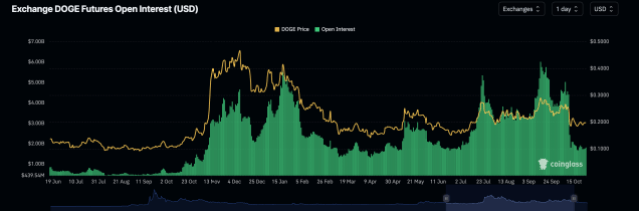
Source: Coinglass

There Is Still Hope

While the current trend points toward further decline in the Dogecoin price, historical performance suggests that it could bounce quickly. Looking back at the times when the Dogecoin open interest had trended this low, the resultant move has always been more of a bullish run.

This was the case following the April 2025 low, leading into another recovery that saw the price move from below $0.2 to $0.25 before the momentum weakened. Then again, a similar trend was recorded following the July 2025 low, with the Dogecoin price eventually rallying from below $0.2 to reach $0.29 before momentum ran out.

Going by the previous trend of at least a 20% increase in price following the open interest hitting a low, it could mean that the Dogecoin price could see another foray above $0.15. However, this also depends on the bitcoin market performance and how the broader crypto market responds.

DOGE price struggles with market uncertainty | Source: DOGEUSDT on Tradingview.com

Related Reads

The Tao (τ) Law Makes EDA Go Viral

In May 2026, Huawei's semiconductor division introduced the "Tao (τ) Law" at IEEE ISCAS, shifting the industry focus from Moore's Law's geometric scaling to "time scaling." Unlike traditional approaches relying on transistor miniaturization, τ Law optimizes the time constant (τ) across device, circuit, chip, and system levels to improve information processing speed and efficiency. Huawei has already applied this principle, mass-producing 381 chips across various applications, with a target to achieve performance equivalent to 1.4nm technology by 2031. The implementation of τ Law, involving techniques like Chiplet, 3DIC, and Logic Folding, places new demands on EDA tools, highlighting gaps in current offerings. Traditional 2D or pseudo-3D EDA flows lack native support for true 3D design, cross-layer co-optimization (STCO), and coupled multi-physics analysis (thermal, power, stress), which are crucial for advanced integration. Chinese EDA companies, such as Empyrean Software, Primarius Technologies, and Xpeedic, are evolving from point-tool specialists to providing full-flow, system-level solutions. For instance, Peking University has developed a prototype "true 3D" EDA tool showing significant improvements in wirelength and timing. Empyrean Software has also launched a comprehensive 3DIC design and verification platform. The τ Law framework presents an opportunity for the domestic EDA industry to transition from achieving basic functionality to developing robust, integrated toolsets essential for next-generation chip design.

marsbit2h ago

The Tao (τ) Law Makes EDA Go Viral

marsbit2h ago

It's Not Jensen Huang Who Wants to Change the PC, But the PC That's Revolting Against Itself

The 40-year-old PC industry is undergoing a fundamental transformation, driven by the rise of AI PCs. At the GTC Taipei 2026 event, NVIDIA, backed by Microsoft and major PC OEMs, announced the RTX Spark super chip for Windows PCs, marking its official entry into the PC core processor market. This move aims to redefine the AI PC by shifting its core from the CPU to an AI-focused SoC (System on Chip). NVIDIA envisions the PC evolving from a personal computer to a "personal AI"—a platform where local AI Agents can autonomously perform tasks. While Intel pioneered the AI PC concept earlier in 2026, NVIDIA's aggressive push, leveraging its vast CUDA developer ecosystem of 6 million, positions it to potentially reshape the industry's long-standing Wintel (Windows-Intel) power structure. NVIDIA's strategy extends beyond hardware; it's about embedding its CUDA, RTX, and AI software stack into the PC platform itself. The article identifies key shifts: 1) The move from a CPU-centric to an AI SoC-centric architecture, similar to Apple's approach with its M-series chips. 2) The PC's evolution from a human-operated tool to a platform for human-Agent collaboration. 3) The extension of NVIDIA's data center-centric CUDA ecosystem to personal devices via RTX Spark. Ultimately, the change is driven by the broader trend of AI moving to personal devices. Companies like Intel, AMD, Qualcomm, and Apple are all participating in this shift. NVIDIA's entry accelerates the competition, but the core driver is the technology itself finding its optimal expression in the PC. The industry is reinventing itself, with the outcome hinging on execution, ecosystem development, and the creation of compelling local AI applications.

marsbit4h ago

It's Not Jensen Huang Who Wants to Change the PC, But the PC That's Revolting Against Itself

marsbit4h ago

Trading

Spot
Futures

Hot Articles

Discussions

Welcome to the HTX Community. Here, you can stay informed about the latest platform developments and gain access to professional market insights. Users' opinions on the price of S (S) are presented below.

活动图片















