
Dogecoin Futures Trading Volume Surges 530 Times! $0.128 Becomes the Make-or-Break Line, Can DOGE Rebound by Year-End?

金色财经Published on 2025-12-23Last updated on 2025-12-23

Abstract

As the end of 2025 approaches, Dogecoin (DOGE) is experiencing a volatile phase, marked by a dramatic surge in futures trading volume and cautious price action around a key support level. According to CoinGlass data, DOGE futures trading volume on BitMEX skyrocketed by 53,255% in a single day, reaching $260.34 million. This surge occurred amid a broader market downturn and declining liquidity, highlighting heightened speculative interest. Meanwhile, DOGE's spot price has been consolidating between $0.128 and $0.134, with $0.128 acting as a critical support level. Analysts, including Crypto Tony, emphasize that holding above this level is crucial for any short-term bullish momentum. A break below could lead to further declines. DOGE has fallen 58.5% year-to-date, and with only nine trading days left in the year, time is running out for a significant recovery. Traders are advised to monitor the $0.128 support closely, consider small long positions if it holds (targeting $0.135), and avoid aggressive bets due to expected year-end liquidity constraints and elevated volatility.

As the end of 2025 approaches, undercurrents are swirling in the cryptocurrency market, and the recent performance of the "ultimate meme coin" Dogecoin (DOGE) can be described as a "tale of two extremes." On one side, there's the frenzied anomaly of single-day futures trading volume skyrocketing over 50,000%; on the other, a cautious stance as the spot price hovers around a key support level. For holders and short-term traders, the next 9 trading days could determine DOGE's final trajectory for the year.

Single-Day Surge of 53,255%! DOGE Futures Volume Sparks a Frenzy

Just as overall cryptocurrency market liquidity is weakening and investors are busy adjusting their year-end portfolios, DOGE futures experienced an "explosive surge in trading volume."

According to data from CoinGlass, the trading volume for Dogecoin futures on the BitMEX exchange became the biggest highlight: it skyrocketed 53,255% in a single day, finally settling at $260.34 million! This is not only the largest single-day increase in DOGE futures volume this year but also stands out starkly during the market's off-season.
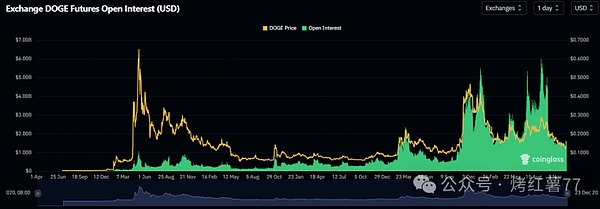
It's important to note that the current market is showing clear "risk-off sentiment." Analysis from 10x Research points out that the year-end liquidity decline isn't solely due to holiday effects; both institutions and retail investors are simultaneously reducing their risk exposure: futures positions are becoming more conservative, ETF flows are cautious, and there's rising demand for hedging volatility in the options market. Against this backdrop, the "counter-trend surge" in DOGE futures could be traders gambling on short-term opportunities within the range-bound oscillation, but it also reflects intensified market divergence regarding its key price levels.

Spot Price Oscillates in a Battle, $0.128 Becomes the "Lifeline"

In contrast to the frenzy in the futures market, the DOGE spot price is still struggling within a narrow range. Last Friday, DOGE briefly touched a local high of $0.1334 but quickly pulled back into consolidation. The price is currently seesawing repeatedly between $0.128 and $0.134. At the time of writing, DOGE is trading at $0.1343, up a modest 3.8% in 24 hours, barely holding onto short-term rebound momentum.
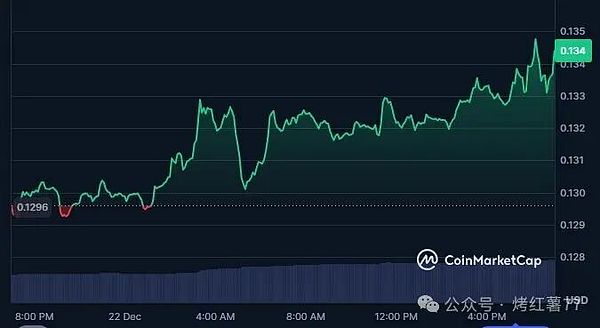
However, looking at a longer cycle, DOGE's situation is not optimistic: the fourth quarter can be described as a "continuous decline," falling for three consecutive months since October, with an annual drop of 58.5%. With only 9 trading days left until the end of 2025, time is extremely tight for the bulls to reverse the year's downtrend.

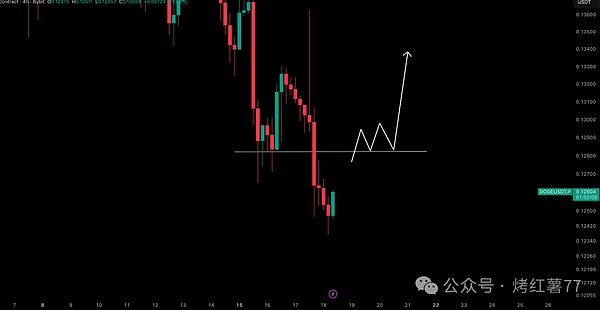
Right now, the key support level of $0.128 has become the "lifeline" determining DOGE's short-term direction. Analyst Crypto Tony clearly stated that this price level is a crucial prerequisite for going long. Only by holding steadily above $0.128 will DOGE's stabilization signal become clearer, making long strategies more cost-effective.

From a technical perspective, DOGE has recently shown brief signs of stabilization above $0.128. Charts suggest it might complete a sideways consolidation within the $0.128-$0.130 range before attempting an upward breakout. If it can successfully hold firm, the next bullish target would be $0.135, representing a potential gain of about 2.2% from the current price. However, if the $0.128 support is lost, it could face further downward pressure.
The Year-End Finale Begins, Do DOGE Bulls Still Have a Chance?

For DOGE holders and short-term traders, the core strategy for the upcoming period is undoubtedly "watch the support level closely + monitor liquidity changes":

  1. If the $0.128 support holds firm and futures market volume continues to cooperate, consider a small position to bet on a short-term rebound, targeting $0.135, with a stop-loss set below $0.128;

  2. If it breaks below the key $0.128 support, be wary of correction risks; avoid buying the dip blindly and wait for new stabilization signals to appear;

  3. Year-end market liquidity may tighten further, potentially increasing volatility; it is advised to control position sizes and avoid heavy betting.

As the "traffic champion" of the cryptocurrency market, every anomaly in DOGE captures investors' attention. Does this surge in futures trading volume预示 the start of a new market trend? Can the $0.128 support hold? In the final 9 trading days of 2025, can DOGE bring a surprise for the bulls? Feel free to leave your views in the comments section!


Trending Cryptos

Related Questions

QWhat was the percentage increase in Dogecoin futures trading volume on BitMEX, as mentioned in the article?

AThe Dogecoin futures trading volume on BitMEX surged by 53,255%.

QWhat is the critical support level identified for DOGE's price action?

AThe critical support level for DOGE is $0.128.

QWhat is the suggested bullish price target for DOGE if it holds above the $0.128 support?

AThe suggested bullish price target is $0.135.

QWhat is Dogecoin's year-to-date (YTD) price decline as of the article?

ADogecoin's year-to-date decline is 58.5%.

QHow many trading days were left in 2025 when the article was written?

AThere were 9 trading days left in 2025.

Related Reads

Anthropic Creates an AI Jailbreak 'Penal Code': Your Requests, Four Ways to Die

Anthropic has publicly detailed its security measures and a new "Cyber Jailbreak Severity" (CJS) framework following the controversial takedown of its Fable 5 model. The incident, triggered by simple user requests like counting letters or stating a profession, highlighted overzealous safety filters. Anthropic classifies cybersecurity-related prompts into four tiers: malicious activities (blocked), high-risk dual-use (like pentesting, with strict limits), low-risk dual-use (often blocked by "safety margin" errors), and harmless tasks (theoretically allowed but still frequently flagged). The company admits its classifiers are tuned for high sensitivity, leading to many false positives. The newly proposed CJS framework aims to objectively score the severity of AI "jailbreaks" (prompts that bypass safety rules) on a 0-10 scale across four dimensions: Capability Gain (does it grant new attack abilities?), Breadth (does it work across multiple attack types?), Weaponization Ease (how hard is it to turn into a real attack?), and Discoverability (how easy is it to find?). The score determines the response, from no action (CJS-0) to a potential model takedown (CJS-4). The score is context-dependent; for example, discovering a major unknown vulnerability today scores high, while asking about a well-known one scores low. The article raises concerns about Anthropic's dual role: it is both creating powerful models (like the restricted Mythos 5) and defining the rules (CJS) for judging their misuse, potentially giving it disproportionate influence. This is set against the backdrop of U.S. export controls, which for the first time directly restricted API access to a model (Fable 5), creating a "tiered" system where public models are heavily filtered and advanced ones are limited to vetted partners. The CJS framework is portrayed as potentially providing regulators with a metric to justify future API shutdowns. For users, the advice is to carefully phrase prompts, watch for signs of being downgraded to a weaker model, and wait indefinitely for promised filter improvements.

marsbit16m ago

Anthropic Creates an AI Jailbreak 'Penal Code': Your Requests, Four Ways to Die

marsbit16m ago

$100M Annual Revenue, Two Berkeley Roommates in Their 20s Build the Most Profitable AI Business

Arena, the AI model ranking platform, has become a $100 million annual revenue business just eight months after launching its commercial service. Originally a UC Berkeley open-source research project called Chatbot Arena, it created a "battle arena" where users blind-test and vote on anonymous AI model responses. This has generated a highly trusted, community-driven leaderboard based on over 10 million user evaluations and 82 million votes. Major AI companies like OpenAI, Google, and Anthropic submit their flagship models to be ranked. The core monetization strategy is its AI Evaluations service, where model developers and large enterprises pay for in-depth performance analysis from Arena's massive user community. This provides real-world feedback on model strengths, weaknesses, and hallucinations—a critical service as models become more complex. The company, spun out from Berkeley in early 2025, quickly raised $100 million in seed funding at a $600 million valuation and later secured a $150 million Series A at a $1.7 billion valuation. The founding team includes CEO Anastasios Angelopoulos, a mathematician focused on rigorous model evaluation; CTO Wei-Lin Chiang, creator of the popular Vicuna chatbot; and co-founder Ion Stoica, a renowned Berkeley professor. Arena is now expanding beyond chat benchmarks into "Agent Mode," evaluating AI agents on complex, multi-step tasks like coding and research. The company's success illustrates the growing value and cost of independent, real-world AI model evaluation as the industry intensifies.

marsbit21m ago

$100M Annual Revenue, Two Berkeley Roommates in Their 20s Build the Most Profitable AI Business

marsbit21m ago

Racking Up 24,000 Stars: With One Command, AI Can Now Find Its Own Skills

Vercel, known for its developer tools like Next.js, has launched 'skills', a package manager for AI coding agents, garnering 24,000 GitHub stars. It allows developers to add specialized capabilities, such as React best practices, to AI assistants like Claude Code or Cursor with a single command: `npx skills add <package>`. Skills are shareable, reusable modules that define an AI agent's behavior for specific tasks, moving beyond one-off prompt engineering towards standardized 'capability engineering'. A key innovation is the 'find-skills' skill, which acts as an internal search engine, allowing an agent to autonomously find and install the right skill for a user's request. This lowers the barrier for non-developers to leverage advanced AI coding assistance. However, this 'npm moment' for AI brings significant security risks. Security audits of thousands of skills on platforms like skills.sh and ClawHub found over 30% contained security flaws, with about 13% classified as severe. Threats include malicious scripts that can access local files and credentials, and prompt injection hidden within skill documentation. Unlike traditional code packages, skills blend instructions, code, and system access, posing a direct risk to user machines and data. Experts advise treating skills like code—reviewing them carefully before installation, especially their scripts, and being wary of excessive permissions. Ultimately, Vercel's initiative represents a major shift towards modular, reusable AI capabilities, but its rapid adoption requires developers to bring the same caution used in managing traditional software dependencies.

marsbit22m ago

Racking Up 24,000 Stars: With One Command, AI Can Now Find Its Own Skills

marsbit22m ago

Claude Engineer Finally Unveils Fable 5's Ultimate Strategy, Teaching You How to Bridge the Information Gap with AI Models

This article, titled "Claude Engineer Finally Releases Fable 5 'Skill-Burning' Guide, Teaching How to Bridge the Information Gap with Models," details a blog post by Claude Code engineer Thariq Shihipar. The core concept is the "information gap" or "unknowns"—the disconnect between a user's instructions (the "map") and the actual task requirements (the "territory"). The article argues that with powerful models like Claude Fable 5, work quality depends on the user's ability to identify and clarify these unknowns. Shihipar categorizes unknowns into four types: Known Knowns (explicit instructions), Known Unknowns (awareness of gaps), Unknown Knowns (implicit, unstated knowledge), and Unknown Unknowns (unforeseen issues). The blog provides a framework for addressing these gaps throughout the workflow: * **Before Implementation:** Techniques include "Blindspot Scanning" to uncover Unknown Unknowns, brainstorming/prototyping for visual or complex tasks, having Claude ask clarifying questions, using reference code/examples, and creating implementation plans. * **During Implementation:** Maintaining an "implementation notes" file for Claude to document deviations and decisions made due to encountered edge cases. * **After Implementation:** Creating summary documents for review and having Claude generate quizzes to ensure the user fully understands the completed changes. The article concludes that as models become more capable, the key to success is systematically discovering and defining these unknowns through low-cost methods like prototyping and planning, allowing for more effective collaboration.

marsbit26m ago

Claude Engineer Finally Unveils Fable 5's Ultimate Strategy, Teaching You How to Bridge the Information Gap with AI Models

marsbit26m ago

Trading

Spot

Hot Articles

What is DOGE M

Doge Matrix ($doge m): The New Breed of Community-Driven Cryptocurrency Introduction In the ever-evolving landscape of cryptocurrency, new projects constantly emerge, each aiming to capture the interest of investors and enthusiasts alike. One of the latest entrants to this domain is Doge Matrix, represented by the ticker symbol $doge m. This project has attracted attention thanks to its roots in the popular meme culture surrounding Dogecoin, establishing its place within the web3 space. This article aims to provide a comprehensive analysis of Doge Matrix, covering its overview, creator, investors, functionality, timeline, and notable aspects. What is Doge Matrix ($doge m)? Doge Matrix is a community-driven cryptocurrency project that seemingly builds upon the widespread appeal of Dogecoin, a digital currency known for its Shiba Inu mascot and its meme origins. While the overarching objectives of Doge Matrix are not extensively defined, it is characterized by a commitment to harnessing community involvement and support. Unlike traditional cryptocurrencies that often emphasize utility or intrinsic value through underlying technologies, Doge Matrix positions itself within a space that embraces the cultural phenomenon of cryptocurrencies, particularly appealing to those who resonate with the ethos of meme-based assets. Drawing on the strengths of the Dogecoin community, Doge Matrix operates as part of a broader ecosystem, inviting participation and engagement from users who share an interest in cryptocurrency and the digital landscape. Who is the Creator of Doge Matrix ($doge m)? The identity of the creator of Doge Matrix remains unknown. This lack of transparency is not an uncommon occurrence in the cryptocurrency space, where some projects are launched without revealing the identities of their founders. The absence of information regarding the founding team can raise questions among potential investors about the project’s accountability and direction. Who are the Investors of Doge Matrix ($doge m)? As it stands, there is no publicly available information detailing the investors or investment foundations that back Doge Matrix. The project appears to rely primarily on community support rather than institutional investment. This model aligns with the community-driven nature of the initiative, fostering an environment where the direction of the project is shaped by its participants rather than being dictated by a select few financial backers. How Does Doge Matrix ($doge m) Work? The specifics regarding the operational mechanisms of Doge Matrix are somewhat vague, reflecting a broader trend of projects in the meme coin space where innovative functionalities are not always clearly articulated. Nonetheless, Doge Matrix seems designed to tap into the existing cryptocurrency ecosystem by encouraging user participation while tapping into the familiar cultural references associated with Dogecoin. Its potentially unique characteristics derive from community interactions rather than technological advancements, emphasizing shared experiences and collaboration among token holders. While the exact innovations have not been explicitly outlined, the project appears to create a space where community members can engage, share ideas, and propel the project's potential forward. Timeline of Doge Matrix ($doge m) Reflecting on the project’s timeline reveals notable events that have defined its journey thus far: November 25, 2024: Doge Matrix reached its all-time high value, marking a significant milestone in its early history. January 1, 2025: Conversely, Doge Matrix hit its all-time low value, illustrating the volatility often associated with cryptocurrencies, especially in the early stages of a project's lifecycle. Ongoing: The project continues to be actively traded and supported by its community, although specific future milestones or objectives have yet to be disclosed. Key Points About Doge Matrix ($doge m) Community Focus At the heart of Doge Matrix is a commitment to community engagement. The project thrives on the premise of collaboration and shared objectives among its members, emphasizing the importance of collective effort. Unlike centralized projects that often have a defined leadership structure, Doge Matrix at present showcases a more fluid approach to governance, where every community member's voice matters. Volatility The cryptocurrency market is notorious for its volatility, and Doge Matrix is no exception. Its price history reflects significant fluctuations between high and low values, which is typical of many new cryptocurrencies but underscores the risks associated with investment in emerging tokens. Lack of Detailed Information One of the most striking features about Doge Matrix is the scarcity of detailed information regarding its technological underpinnings and operational mechanisms. This ambiguity necessitates that potential investors conduct thorough due diligence before engaging with the project. Conclusion In summary, Doge Matrix ($doge m) illustrates a new wave of cryptocurrency projects that lean heavily on community engagement and cultural relevance. While lacking in certain specifics—such as clear leadership, defined objectives, and detailed functionality—the project has managed to generate interest within the crypto community, leveraging the established appeal of meme culture. As with any investment in the cryptocurrency space, understanding the inherent risks and conducting comprehensive research is essential for potential participants. Doge Matrix stands as a reminder of the dynamic, sometimes unpredictable nature of the crypto industry, marked by constant evolution and enthusiasm for community-driven initiatives.

3.9k Total ViewsPublished 2025.02.03Updated 2025.02.03

What is DOGE M

Discussions

Welcome to the HTX Community. Here, you can stay informed about the latest platform developments and gain access to professional market insights. Users' opinions on the price of DOGE (DOGE) are presented below.

活动图片