Do Stablecoins Really Count as Cash? After the Genius Act, Accounting Standards for Stablecoins May Be Adjusted

marsbitPublished on 2026-01-05Last updated on 2026-01-05

Abstract

The U.S. Financial Accounting Standards Board (FASB) has added two crypto-related projects to its 2026 agenda: whether certain stablecoins can be classified as cash equivalents, and how to account for transfers of crypto assets. This follows the passage of the Genius Act, a regulatory framework for stablecoins, and reflects ongoing political support for the crypto industry from the Trump administration. FASB’s move aims to address accounting grey areas, such as when to derecognize crypto assets and how to treat wrapped tokens. These issues impact financial transparency, risk disclosure, and comparability for investors. Although FASB introduced fair-value accounting rules for crypto in 2023, significant gaps remain, particularly around the definition and treatment of stablecoins. Some critics argue the agenda is politically motivated rather than driven by widespread corporate adoption. However, as the Genius Act takes effect in 2027, stablecoin usage is expected to grow, increasing the urgency for clearer accounting guidance. FASB Chair Rich Jones emphasized the importance of defining what does—and does not—qualify as a cash equivalent. The SEC has also acknowledged the difficulty of applying existing accounting frameworks to crypto assets.

Editor's Note: The Financial Accounting Standards Board (FASB) has included "whether stablecoins can be considered cash equivalents" and "how to account for transfers of crypto assets" as key priorities for 2026. While these are technical accounting issues, they reflect a tug-of-war among regulation, politics, and capital markets over the legitimization of crypto assets: on one hand, the "Genius Act" is pushing stablecoins into the mainstream through institutionalization; on the other, Generally Accepted Accounting Principles (GAAP) still have many gray areas—especially regarding when assets are "derecognized" and how cross-chain and wrapped tokens are defined—leading to inconsistencies in how companies report these in their financial statements.

For investors, the real significance of this discussion is not just "whether they can be considered cash," but also risk disclosure, transparency, and comparability: as stablecoins become more like cash and more like financial products, financial statements must provide clearer boundaries.

Below is the original content:

The Financial Accounting Standards Board (FASB) has stated that it will study two crypto-related issues in 2026: whether some crypto assets can be classified as "cash equivalents," and how to account for transfers of crypto assets. These topics will be discussed against the backdrop of the Trump administration's increased support for such investments.

Over the past few months, FASB added these two crypto projects to its agenda based on public feedback. These issues are among the first of more than 70 topics that FASB will consider adding to its agenda; some of these may eventually develop into new accounting standards.

FASB expects to decide on the取舍 (selection) of these more than 70 potential topics by the end of this summer. These topics originated from an "agenda consultation," where businesses, investors, and others could submit letters indicating which issues they want FASB to prioritize.

"Many people have invested significant time and effort to help us set our agenda," said Chairman Rich Jones. "I see 2026 as the year to turn these inputs into action and deliver on our commitments."

In October of last year, FASB added the "cash equivalents" issue to its agenda, focusing particularly on certain stablecoins—assets typically pegged to a fiat currency.

This move came three months after President Trump signed a stablecoin regulatory bill into law. The bill established a regulatory framework for stablecoins, further integrating these assets into the mainstream financial system. Jones noted that the so-called "Genius Act" did not resolve the accounting question of "what can be considered a cash equivalent." He emphasized: "Telling people what does not qualify as a cash equivalent is as important as telling them what does."

President Trump himself and his family have interests in World Liberty Financial, a crypto company; he has introduced a series of policies supporting the crypto industry and halted previous regulatory crackdowns on the sector.

In November last year, FASB voted to study how businesses account for transfers of crypto assets, including "wrapped tokens"—tokens that allow crypto assets from one blockchain to be represented and used on another chain in a "mapped" form.

This project will build on requirements FASB proposed in 2023: that businesses measure Bitcoin and other crypto assets at fair value. That rule filled a gap in U.S. Generally Accepted Accounting Principles (GAAP) but did not cover non-fungible tokens (NFTs) or certain stablecoins.

Despite the crypto-related accounting requirements proposed in 2023, some believe the specific details remain unclear.

"I still think there is a huge gap in GAAP right now on a key issue: under what circumstances should we remove crypto assets from the balance sheet, i.e., derecognize them; and under what circumstances should we not?" said Scott Ehrlich, Managing Director of accounting training and consulting firm Mind the GAAP.

Both projects follow recommendations from a working group established by President Trump to support the crypto industry, while also responding to public feedback. Jones said these recommendations echo views already held by some of FASB's stakeholders.

Jones stated that he was not under pressure to adopt the working group's recommendations.

"I'm certainly happy that they believe the way to address accounting issues is to suggest these topics for FASB to evaluate," Jones said. "They did not recommend pushing legislation to handle accounting issues, nor did they suggest having the SEC speak out to set accounting treatment."

The SEC is responsible for enforcing the accounting standards set by FASB for public companies.

The securities regulator will also closely monitor any adjustments made by FASB. "The crypto space has a host of issues," said SEC Chief Accountant Kurt Hohl at a conference earlier this month. "The difficulty is that they don't fit neatly into the existing accounting standards framework."

Lawmakers and investors have occasionally expressed concerns about FASB's standard-setting approach. Recently, the agency came under scrutiny from U.S. House Republicans: they proposed freezing its funding if FASB did not withdraw upcoming tax disclosure requirements. Under the new requirements, public companies are preparing to disclose more details about taxes paid to government departments in their 2025 annual reports.

Some observers question whether the holding of crypto assets is widespread enough to warrant a place on FASB's agenda. Only a few companies, such as Tesla, Block, and MicroStrategy, include Bitcoin on their balance sheets.

"These new crypto projects don't seem to be driven by pervasiveness or other established FASB criteria for adding projects, but more by current political priorities," said Sandy Peters, head of the financial reporting policy team at the CFA Institute, which represents investment professionals.

However, as the "Genius Act" takes effect in 2027, the newly established regulatory guardrails are expected to reduce the volatility of stablecoins, and market interest in stablecoins is anticipated to heat up. Peters noted that without more adequate risk disclosures, investors are unlikely to accept stablecoins as cash equivalents.

FASB Chairman Jones also faces a "countdown." His seven-year term is expected to end in June 2027, and the search for his successor will begin in early 2026.

Jones said that in the roughly 18 months remaining, he hopes the board can initiate and complete an accounting standard on how to distinguish between "liabilities" and "equity." This determination is highly complex for certain instruments like warrants, and both businesses and auditors find it challenging.

Jones stated that this project has not yet been formally added to the agenda but could still be completed within that timeframe, as the board could opt for "targeted improvements" rather than building a completely new model. "I very much hope to get it done before I step down," he said.

Related Questions

QWhat are the two main crypto-related topics that the Financial Accounting Standards Board (FASB) plans to study in 2026?

AThe FASB plans to study whether certain crypto assets, particularly some stablecoins, can be classified as 'cash equivalents' and how to account for transfers of crypto assets.

QWhat significant legislation, signed by President Trump, helped bring stablecoins further into the mainstream financial system and preceded the FASB's agenda decision?

AThe significant legislation is the 'Genius Act', which established a regulatory framework for stablecoins and was signed into law by President Trump.

QAccording to the article, what is a key accounting problem that GAAP still has a major gap in, as stated by Scott Ehrlich of Mind the GAAP?

AThe key accounting problem is determining when to derecognize a crypto asset (remove it from the balance sheet) and when not to, particularly in the context of transfers and wrapped tokens.

QWhy do some observers, like Sandy Peters from the CFA Institute, question the motivation behind FASB's new crypto projects?

AThey question the motivation because the projects do not appear to be driven by the prevalence of crypto assets on corporate balance sheets, but rather by current political priorities set by the Trump administration.

QWhat is a major concern for investors regarding the treatment of stablecoins as cash equivalents, even after the Genius Act establishes regulatory guardrails?

AThe major concern is that without more robust and sufficient risk disclosures in financial statements, investors are unlikely to accept stablecoins as cash equivalents.

Related Reads

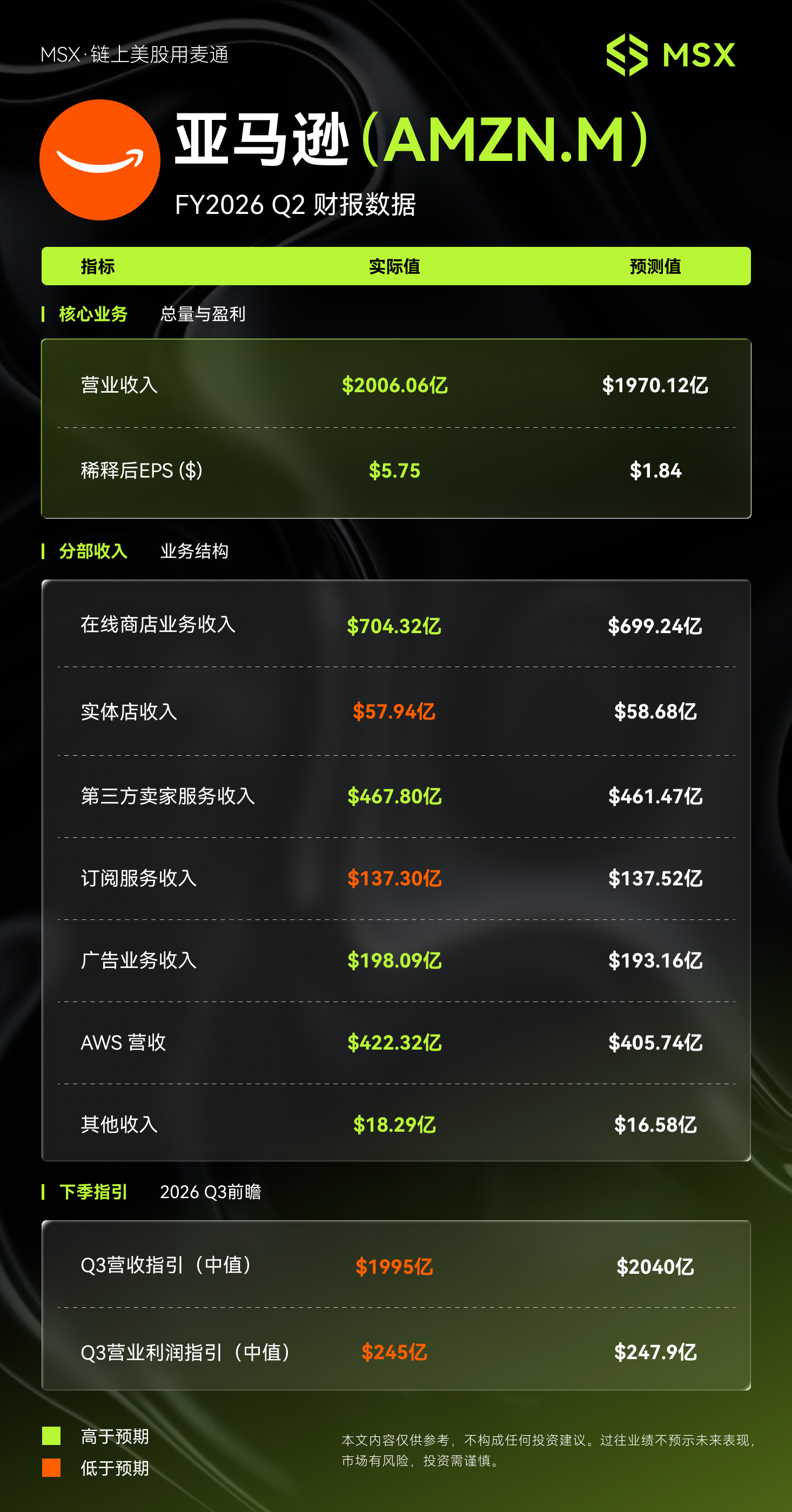
MSX US Stock Daily Insight: Amazon 2026 Q2 Earnings: AWS Records Fastest Growth in Five Years

**MSX Daily US Stock Observation: Amazon's Q2 2026 Earnings: AWS Achieves Fastest Growth in Five Years** Amazon's latest quarterly results exceeded expectations, driven by a strong performance from its cloud computing unit. The company reported revenue of $200.66 billion, surpassing estimates of approximately $197 billion. The key highlight was Amazon Web Services (AWS), which generated $42.232 billion in revenue, surging 37% year-over-year. This marked the segment's fastest growth pace in 18 quarters, indicating robust demand for cloud services. Reported Earnings Per Share (EPS) of $5.75 significantly exceeded the $1.84 forecast. However, this figure included a substantial one-time, non-operating gain of $53.4 billion, primarily from the revaluation of Amazon's investment in AI company Anthropic. Excluding this item, core operating profit was $27.461 billion, a strong increase of 43% compared to the same period last year. Despite the positive results, Amazon provided guidance for the upcoming third quarter that fell short of market expectations. The company's revenue guidance midpoint is $199.5 billion, below the consensus estimate of around $204 billion. Operating profit guidance of $24.5 billion also slightly missed expectations of approximately $247.9 billion. Furthermore, Amazon raised its forecast for full-year capital expenditures to $220 billion, citing rising memory chip costs, which weighed on investor sentiment regarding future profitability. In summary, Amazon's quarter showcased accelerating momentum in its core AWS business. The underlying operational profit growth remains solid. However, cautious forward guidance and increased investment spending present key areas for monitoring in the coming quarters, as the market assesses whether the current growth phase will translate into sustained profit margin expansion.

Odaily星球日报2m ago

MSX US Stock Daily Insight: Amazon 2026 Q2 Earnings: AWS Records Fastest Growth in Five Years

Odaily星球日报2m ago

Cyclical Stock or Growth Stock? Coinbase's Q2 Earnings Report Reveals 'Valuation Disagreement'

Coinbase's Q2 2026 financial results revealed a mixed performance, reigniting debate over whether the company should be valued as a cyclical stock tied to crypto markets or a growth stock with future potential. Total revenue missed expectations at $1.22 billion, down 19% year-over-year. Transaction revenue fell to $599 million, with retail crypto spot trading revenue dropping 30% to $452 million, back to 2023 levels. The company reported a net loss of $359 million, marking its third consecutive quarterly loss. Despite CEO Brian Armstrong's positive commentary on metrics like a 10.3% overall crypto trading market share and 106% growth in prediction markets, the market reacted negatively, with shares dropping over 5% after-hours. A key issue is the decline in core retail trading. While Coinbase touted record market share, this figure includes derivatives and new products. Its traditional crypto spot trading share is likely shrinking. New ventures like prediction markets, while growing, contributed less than $30 million, insufficient to offset the core revenue decline. The valuation debate hinges on perspective. As a cyclical stock, Coinbase remains deeply tied to the crypto bear market, with user attrition and competitive pressures justifying a lower valuation. The company's strategy appears focused on surviving until the next bull cycle. Viewed as a growth stock, however, Coinbase shows promising diversification. Subscription and service revenue reached $555 million, nearly matching transaction revenue. Stablecoin revenue, its second-largest source at $292 million, remains strong through its partnership with Circle. Critically, Coinbase is positioning itself as a leader in the emerging on-chain "agent economy." Over 90% of agent-based stablecoin transactions occur on its Base network, which it believes could handle trillions in future agent transactions. The recent acquisition of Deribit also aims to boost its international derivatives offering. In summary, Coinbase's present struggles are clear, but its future hinges on whether its investments in revenue diversification, stablecoins, and the agent economy can ultimately transform its business model and justify a growth premium.

Odaily星球日报22m ago

Cyclical Stock or Growth Stock? Coinbase's Q2 Earnings Report Reveals 'Valuation Disagreement'

Odaily星球日报22m ago

Global Market Share Survey: Japanese Firms Lead in Semiconductor Materials

Global Market Share Survey: Japanese Firms Lead in Semiconductor Materials According to the 2025 "Major Goods and Services Market Share Survey" by Nikkei, Japanese companies maintain strong positions in semiconductor-related materials. In silicon wafers, Shin-Etsu Chemical ranks first with a 26.3% share, followed by SUMCO at 17.8%. Together, they hold 44.1% of the market, widening their lead over competitors from Taiwan, Germany, and South Korea. In photoresists, Tokyo Ohka Kogyo, JSR, and Shin-Etsu Chemical occupy the top three spots, with a combined share of 60.5%. Despite their strength in materials, Japanese firms have a weaker presence in core semiconductor segments like DRAM and NAND flash memory, where South Korean and U.S. companies dominate. For instance, SK Hynix and Samsung lead in DRAM, while China’s CXMT doubled its share to 6% in 2025. The semiconductor market is projected to grow rapidly, with WSTS forecasting a 90% increase to $1.5112 trillion by 2026. Major players like Samsung, SK Hynix, and Micron are making massive investments to expand capacity. To maintain their edge in materials, Japanese companies must similarly commit to large-scale, risk-taking investments. In contrast, Japan’s automotive sector shows stagnation. Toyota remains the global leader but with only a slight share increase to 12.3%, while Japanese brands are absent from the top five in the EV market. In shipbuilding, Imabari Shipbuilding rose to third place globally with a 7.2% share, benefiting from large container ship deliveries. However, Chinese and South Korean firms dominate the sector, holding the top two positions. Japan aims to revitalize its shipbuilding industry through government and corporate efforts, targeting a near doubling of output by 2035. Addressing labor shortages and adopting advanced technologies like physical AI will be critical for competitiveness.

marsbit47m ago

Global Market Share Survey: Japanese Firms Lead in Semiconductor Materials

marsbit47m ago

Trading

Spot
活动图片