Original Author: Todd Wenning
Original Compilation: Deep Tide TechFlow
Guide: Academic finance theory categorizes risk into systematic risk and idiosyncratic risk. Similarly, stock drawdowns can also be divided into two types: market-driven systematic drawdowns (such as the 2008 financial crisis) and company-specific idiosyncratic drawdowns (such as the current software stock crash driven by AI concerns).
Using FactSet as an example, Todd Wenning points out: during a systematic drawdown, you can leverage a behavioral advantage (patiently waiting for the market to recover); but during an idiosyncratic drawdown, you need an analytical advantage—having a more accurate vision of what the company will look like in ten years than the market does.
Amid the current AI impact on software stocks, investors must distinguish: is this a temporary market panic, or is the moat truly crumbling?
class="ql-align-justify">Do not use a blunt behavioral solution to solve a problem that requires nuanced analysis.Full Text Below:
Academic finance theory posits two types of risk: systematic and idiosyncratic.
- Systematic risk is unavoidable market risk. It cannot be eliminated through diversification, and it is the only type of risk for which you are compensated.
- On the other hand, idiosyncratic risk is company-specific risk. Because you can cheaply purchase a diversified portfolio of uncorrelated businesses, you are not compensated for taking on this risk.
We can debate Modern Portfolio Theory another day, but the systematic-idiosyncratic framework is helpful for understanding different types of drawdowns (the percentage decline from peak to trough of an investment) and how we, as investors, should evaluate opportunities.
From the moment we picked up our first value investing book, we were taught to take advantage of a despondent Mr. Market when stocks are sold off. If we remain calm while he loses his senses, we will prove ourselves to be stoic value investors.
But not all drawdowns are the same. Some are market-driven (systematic), while others are company-specific (idiosyncratic). Before you make a move, you need to know which type you're looking at.

Generated by Gemini
The recent sell-off in software stocks due to AI concerns illustrates this point. Let's look at the 20-year history of drawdowns between FactSet (FDS, blue) and the S&P 500 (measured via the SPY ETF, orange).
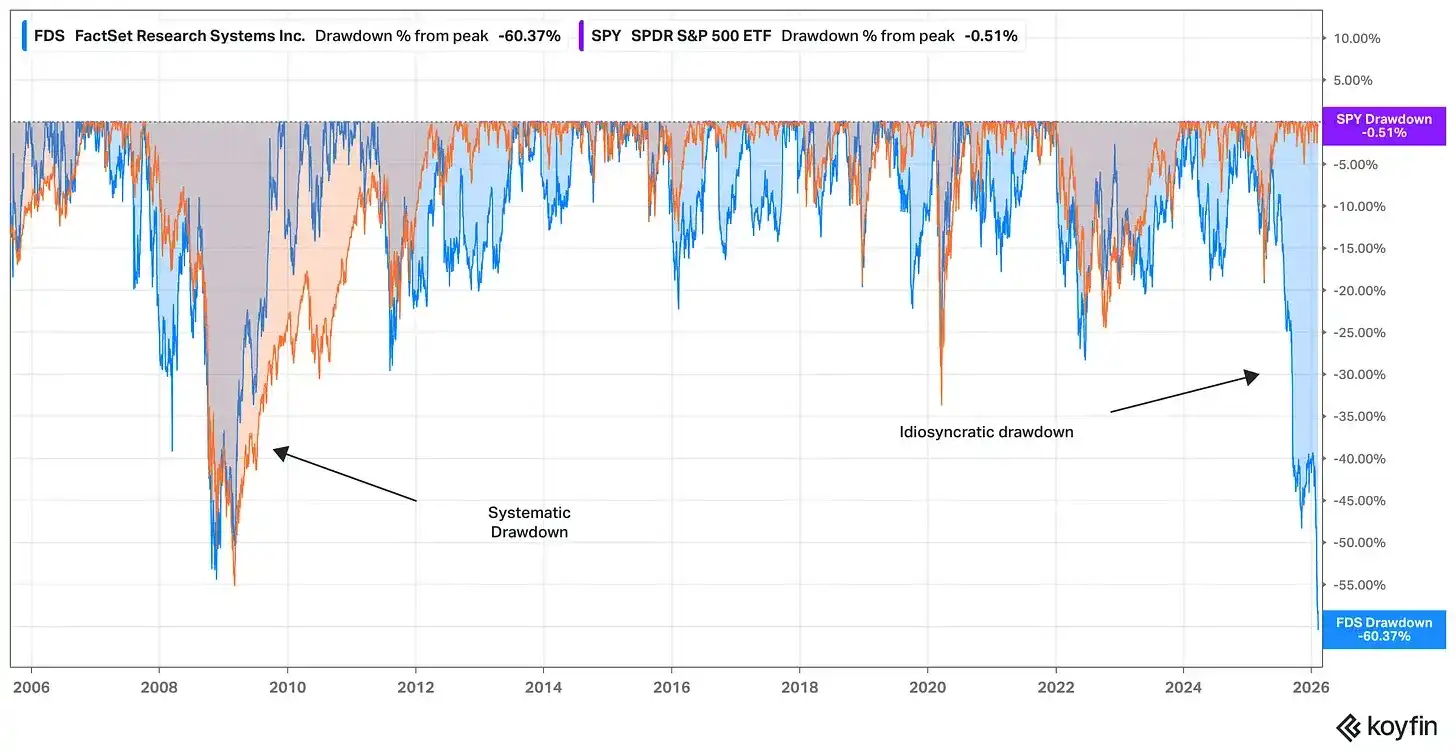
Source: Koyfin, as of February 12, 2026
FactSet's drawdown during the financial crisis was primarily systematic. In 2008/09, the entire market was worried about the durability of the financial system, and FactSet could not be immune to these concerns, especially since it sells products to financial professionals.
At that time, the stock's drawdown had less to do with FactSet's economic moat and more about whether FactSet's moat would matter if the financial system collapsed.
The 2025/26 FactSet drawdown is the opposite case. Here, the concerns are almost entirely focused on FactSet's moat and growth runway, alongside broader fears about accelerating AI capabilities disrupting pricing power in the software industry.
In a systematic drawdown, you can more reasonably make a time arbitrage bet. History shows that markets tend to rebound, and companies with intact moats may emerge even stronger than before, so if you are willing and able to remain patient while others panic, you can leverage a strong stomach to exploit a behavioral advantage.

Photo by Walker Fenton on Unsplash
However, in an idiosyncratic drawdown, the market is telling you that something is wrong with the business itself. Specifically, it suggests increasing uncertainty about the business's terminal value.
Therefore, if you hope to take advantage of an idiosyncratic drawdown, you need to possess an analytical advantage in addition to a behavioral one.
To succeed, you need to have a more accurate vision of what the company will look like in ten years than the current market price implies.
Even if you know a company well, this is not easy to do. Stocks don't typically fall 50% relative to the market for no reason. A lot of once-steadfast holders—even investors you might respect for their deep research—had to capitulate for this to happen.
If you are going to step in as a buyer during an idiosyncratic drawdown, you need to have an answer for why these otherwise informed and thoughtful investors were wrong to sell and why your vision is correct.
There's a fine line between conviction and arrogance.
Whether you are holding a stock in a drawdown or looking to initiate a new position in one, it's important that you understand what type of bet you are making.
Idiosyncratic drawdowns can tempt value investors to start looking for opportunities. Before you take the plunge, make sure you aren't using a blunt behavioral solution to solve a problem that requires nuanced analysis.
Stay patient, stay focused.
Todd