Dialogue with KK, Founder of Hash Global: Do VCs Still Invest in Blockchain Games Now? What Kind of Projects Can Still Get Funding?

marsbitPublished on 2026-06-22Last updated on 2026-06-22

Abstract

**Title: Dialogue with KK, Founder of Hash Global: Do VCs Still Invest in Blockchain Games? What Kind of Projects Can Still Get Funding?** **Summary:** KK, partner at Hash Global, discussed the evolving landscape of Web3 investment and blockchain games in a recent interview. He noted that the industry has moved past its initial hype phase into a more sober "second half," where VCs now prioritize core questions: Is the game actually fun? Does it have real users? Can it generate revenue? Key insights include: * **Web3 Investment Evolution:** The sector is increasingly adopting traditional investment logic, focusing on business models, value capture, and tangible worth over pure narrative. * **Blockchain Game Fundamentals:** The paramount criterion for any game is being genuinely fun and engaging. Web3 elements (like asset issuance and value distribution) should enhance an already solid product, not be a substitute for poor gameplay. Play-to-Earn is seen as a potential final stage, not a starting point. * **Current Investment Thesis:** Hash Global remains active in gaming, favoring projects with low barriers to entry, strong social/competitive elements, and the ability to generate real revenue (e.g., through ads, skins) like traditional Web2 games before scaling. Essential criteria are: 1) A fun core loop understandable without Web3 knowledge, 2) Web3 mechanisms that genuinely improve asset distribution and community participation, and 3) A capable, long-term-focused te...

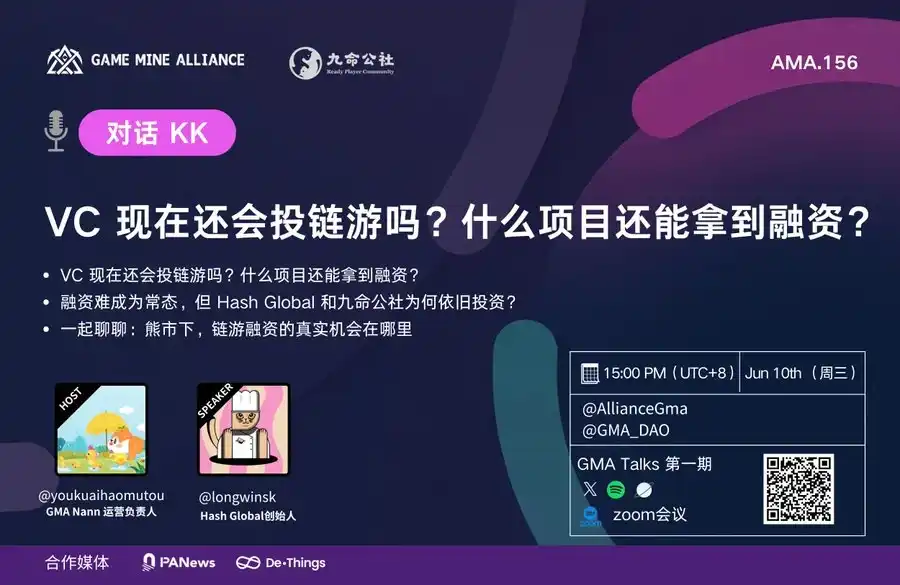
Host: GMA Nann

Guest: KK, Partner at Hash Global

Interview Time: June 10 (Wednesday), 3:00 PM

Partners: Hash Global rpcnftclub

Web3 gaming has passed through the most heated bubble phase and entered the second half of the industry, which is more real and more brutal.

In the past, project parties talked about narratives, economic models, and token launch expectations; now, VCs care more about a simple but crucial question: Is this game actually fun? Does it have real users? Can it generate revenue?
GMA Talk Q&A

Q1: You worked in traditional finance for a long time. Why did you later decide to enter Web3?

KK: I have always worked in the traditional finance industry. Our team entered Web3 mainly because we were looking for a track where we could cultivate long-term and continuously accumulate knowledge. We also studied AI, but AI requires very high expertise in technical judgment. In comparison, Web3 is more finance-oriented and relies more on an understanding of economic models, business models, and value distribution mechanisms.

Q2: What is the biggest difference between traditional investment and Web3 investment?

KK: Early Web3 investment was indeed very different from traditional investment. Back then, there were only a few core assets. People invested, and it was easy to make money. Looking back, it was more about capturing beta; sometimes money was made inexplicably, and money was lost due to one's own lack of understanding. But after 2024, it's clearly felt that Web3 investment is rapidly aligning with traditional investment logic. Whether in primary or secondary markets, the judgments about business models, value capture, and resource capabilities used in traditional investment are increasingly being applied to Web3 investment. In the past, Web3 had many narratives that sounded logical, but whether these narratives could hold up often lacked many key links. Now, I pay more attention to whether the thing itself has value: How much money can it really make? How much value can it capture? In the future, Web3 will gradually put down the narratives and return to a more realistic dimension of value.

Q3: What is your view on Web3 games? What are the most important criteria for judging a gaming project?

KK: A game must first and foremost be fun. People making Web3 games might often forget this point, focusing instead on how to launch tokens or how to design economic systems. But now there should be a growing consensus: whether the game itself is fun is the most important thing. Users don't need to understand Web3 from the start, nor do they need to first understand whether equipment can be transferred from the game server to a chain address. The core question is still: Is this game actually fun? Are users willing to play it? This is prioritizing user value.

Q4: Is Play to Earn still a viable direction?

KK: I used to think Play to Earn might be relatively easy to achieve, but after observing in recent years, I now think Play to Earn might be the most difficult thing, and it should be the final step for a Web3 game. If a game truly aims to achieve Play to Earn, it must first go through a long initial phase: proving that it is fun, and proving that it can attract enough gamers even without Web3. Only after crossing this stage first, then discussing value distribution, asset issuance, and how players and KOLs participate in the ecosystem would be healthier. In other words, Web3 mechanisms are not meant to replace the game itself, but to enhance value distribution and ecological collaboration after the product is already established.

Q5: Does Hash Global still invest in games now?

KK: We are still investing. I am relatively optimistic about gaming formats like competitive/social games and low-barrier-to-entry games. It doesn't necessarily have to be a very heavy AAA blockbuster from the start, but it should allow users to get started easily and also utilize the technical characteristics of Web3, such as asset issuance, value distribution, fan participation, and emotional value. What we hope to see more is that a game can make money without relying on token launches or airdrop expectations, and can have real revenue like Web2 games, such as through tickets, ads, skins, and commercial functions, which should be gradually completed. After these basic commercial elements are proven, then expand traffic and build a larger ecosystem.

Q6: What specific standards do you look at when choosing to invest in a gaming project?

KK: First is the people and the team. We pay special attention to the quality of the team itself. Ideally, this team was already a very successful, product-savvy, and experienced team in their original Web2 track. They aren't just talking about a concept, but truly believe that new technologies like Web3 or AI can enable new business models in their original track, increasing revenue and reducing costs. Specifically for games, I look at three points: First, are users willing to play without needing to understand Web3? Second, can the mechanism improve asset issuance, user contribution, fan participation, and community distribution? Third, does the team have the ability for continuous operations, customer service, and iteration. I value whether the team truly loves games and genuinely wants to make a good product, rather than just wanting to quickly launch a token and make a quick profit. We are more willing to spend time with truly long-termist teams and invest more resources and effort post-investment.

Q7: Why has Hash Global always been relatively focused on Chinese teams?

KK: This is our sober awareness of our own capabilities and boundaries. I received my education in the US and worked at a US asset management company, but we don't think we have the ability to compete with US VCs for European and American startup projects. We are more familiar with Chinese entrepreneurs. We have more accumulated understanding regarding language background, cultural environment, resource structure, and judgment of people. Of course, this doesn't mean all Chinese teams are the best. We have made many mistakes and are constantly learning lessons. But from the beginning, we were clear: focus on investing in Chinese teams, strive to invest well in Chinese teams, and at the same time, try our best to help Chinese teams grow.

Q8: Which directions might Web3 applications truly achieve large-scale adoption first?

KK: We have been thinking about this question constantly. In the past, we also hoped Web3 applications could develop as fast as AI, but now it seems we may have to accept a reality: Web3 applications might need a boost from AI. One angle is: look at which areas are most likely to be boosted by the productivity improvements of AI and also particularly need Web3 technology empowerment. Another angle is to look at which areas have extreme pain points in distribution mechanisms, such as the creator economy. Distribution in many creator industries is not fair, but existing platforms are highly efficient, making it hard for a new product to directly surpass them. So you must find a strong enough pain point, or find a scenario that AI can drive. I don't necessarily think it's inevitable that one specific sub-sector of Web3 will run ahead of another. The key is still whether specific projects can grasp the fundamental product aspects, first achieve from 0 to 1, then do 1 to 100.

Q9: What do you think about the adoption pace of RWA?

KK: Compared to discussing Web3 applications broadly, we have more specific thoughts on the development path of RWA. I believe the assets that might emerge first must themselves be good assets, but for some reason in the traditional financial world, they are not particularly easy for global investors to invest in. Such assets might rank first. Additionally, we have also defined a direction called "non-financial RWA" or, more specifically, "cultural and entertainment RWA." Cultural and entertainment RWA, because it doesn't involve financial products—as long as you don't draw price charts—are essentially "commodities," facing less resistance, and thus might develop faster.

Q10: How does Jiuming Commune view NFT membership benefits and community governance?

KK: I have always been optimistic about using NFTs for private community management and using Web3 technology and NFT technology for community operations and fan management. NFTs are superior to traditional membership cards or spreadsheets because they are on-chain addresses, can be airdropped, data is portable, and assets can be traded worldwide. But we also encountered many problems during our own work on Jiuming Commune. We are not particularly skilled at product development or community operations, so we are appropriately lowering our short-term expectations and development pace. We created Jiuming Commune because we highly value Web3 entrepreneurs. If future Web3 Wang Xings, Liu Qiangdongs, Jack Mas, or Pony Mas emerge from this community, how could this community not have value? We want to use a less utilitarian way to build a platform, create connections, and bring together like-minded entrepreneurs and practitioners.

Q11: What kind of community do you hope Jiuming Commune will become in the future?

KK: Of course, initially we also thought, the West has monkeys, can the East have cats? But we are different from some mature NFT communities. We did not raise funds for this project itself, nor are we skilled at developing games or products ourselves. We hope more that some cultural and entertainment projects within Hash Global's investment ecosystem can gradually grow. When these ecosystems are ready, they can in turn provide Jiuming Commune with more concrete content and spiritual value. So you could also say we are waiting for some things; we are not in a hurry. I certainly hope that one day Jiuming Commune's NFTs will be very valuable, but we are not in a hurry. We hope its value comes from the real sense of belonging, identification, and value exchange among community members, not from short-term speculation.

Q12: What kind of Web3 gaming projects can still get funding now?

KK: I think serious investors can understand good Web3 games. There are roughly a few points: First, it really has to be fun. Second, it needs to have real consumption points or external economic inputs, such as top-ups, ads, equipment, skins, or other revenue sources. Third, the Web3 mechanism should bring something difficult to achieve in Web2, such as asset issuance, value distribution, and community participation. Fourth, the team must be capable of continuous operation and iteration, not just doing a one-time token offering and ending it. If a project has these elements, I think it makes sense and has a chance to secure funding.

Q13: In the current relatively bearish market, what advice would you give to institutional investors newly entering Web3?

KK: If someone is still willing to come look at Web3 at this time, I think such investors have already done very deep research and understanding. Because now it's not just "not so good"; it's already very bearish. For such investors, I have more respect than advice. Being willing to seriously look at Web3 at this stage itself shows they are not attracted by short-term hype.

Q14: Why is Hash Global optimistic about the BNB ecosystem?

KK: We started researching BNB in April 2019. Because we come from traditional finance, when we saw a token like BNB that has both value and functionality, we were very interested and conducted serious research and reports. We were also among the first on-chain nodes in the BNB ecosystem. Over the years, we have watched the BNB ecosystem iterate step by step. There were certainly uncertainties brought by regulatory and legal pressures, but overall, especially after some lawsuits in the US were settled, we have strong confidence in the BNB ecosystem. I believe the BNB ecosystem is significantly undervalued. BNB is not just a token; behind it is a very real Web3 financial ecosystem with real users and global capital connectivity. We hope to enable traditional institutional investors to understand and participate in the BNB ecosystem in a more compliant, convenient, and lower-cost way.

Q15: How do you usually acquire information and accumulate knowledge?

KK: Extensive reading is a must. I read a wide variety, as long as it's high-quality, classic content. Good people recommend good books, and good books lead to another good book; you can't actually finish reading all the good books. But information sources must be controlled. I deliberately filter; for example, I select only a limited number of sources per channel. For Xiaoyuzhou (Chinese podcast platform), YouTube, and media platforms, I don't subscribe to too many. First, control the information sources well, then use AI tools, and then use note-taking software like Obsidian to record what needs to be recorded. Professor Zeng Ming mentioned a term called "intelligent compound interest," which resonated with me. Those who embrace new knowledge will master more and more new knowledge and tools. For our team to do this well, we must also let our own intelligence compound.

Q16: What is your biggest reflection from doing Web3 investment over the years?

KK: There are too many things to reflect on. If I have to name one, I think it's pace. Being a VC naturally tends toward optimism, but the Web3 industry is still very early, so often, the more conservative people survive longer. The pace cannot be too fast; you must see reality clearly. If the pace is too fast and setbacks are too heavy, you might not even persist to the end. We have also paid a lot of tuition and learned many lessons. But I feel that starting from the second half of 2024, we are gradually finding our rhythm again. Web3 investment requires optimism, but also restraint. The ability to survive longer and stay at the table is itself very important.

Related Questions

QAccording to KK, what is the most critical question that VCs now ask when evaluating a Web3 game project?

AThe most critical question VCs now ask is whether the game is genuinely fun, has real users, and can generate real revenue. The focus has shifted from narratives and tokenomics to the fundamental user value and commercial viability of the game itself.

QHow does KK view the concept of 'Play to Earn' in the current Web3 gaming landscape?

AKK now believes 'Play to Earn' is the hardest aspect to achieve and should be the final step for a Web3 game. A game must first prove it is fun and can attract a large player base without relying on Web3 mechanisms. Only after establishing this solid foundation should it focus on value distribution, asset issuance, and community participation.

QWhat specific criteria does Hash Global consider when choosing a game project to invest in?

AHash Global focuses on three main criteria: 1) The game must be enjoyable for users without requiring them to understand Web3. 2) The Web3 mechanism should genuinely improve asset issuance, user contribution, fan participation, and community value distribution. 3) The team must possess the ability for continuous operation, customer service, and product iteration.

QBased on the interview, what type of RWA (Real World Asset) does KK believe will likely emerge first?

AKK believes the first RWA to emerge will likely be high-quality assets that are traditionally difficult for global investors to access. Additionally, 'Non-Financial RWA' or 'Cultural & Entertainment RWA' is promising because it faces less regulatory resistance as a 'commodity' rather than a financial instrument.

QWhat is KK's perspective on the necessary relationship between Web3 applications and AI for achieving mass adoption?

AKK suggests that Web3 applications might need a boost from AI to achieve mass adoption. Key areas for emergence are those where AI can significantly enhance productivity and where Web3 can address major pain points in distribution mechanisms (like the creator economy). He doesn't believe any specific Web3 sub-sector will inevitably lead; success depends on individual projects first achieving product-market fit.

Related Reads

Report Interpretation: J.P. Morgan Details Micron's Pre-Earnings Sentiment, Current Hardware Sector Dynamics

Morgan Stanley analyst Joshua Meyers' report (June 21, 2026) highlights key trends in the hardware and semiconductor sector ahead of Micron's earnings. The core takeaways are: 1. **Micron & Memory:** Memory remains a high-conviction long theme, driven by strong AI demand and rising ASPs. However, investor focus is shifting to the sustainability of Micron's >80% gross margins and the specifics of potential new long-term supply agreements (SCAs). 2. **Hardware Supply Chain:** AI-related demand for servers, networking, and storage remains robust, but company performance is diverging. Celestica (CLS) shows improved margin confidence, Western Digital and Seagate benefit from pricing, Fabrinet (FN) sees predictable AI optics growth, and Teradyne (TER) anticipates a new Google customer. 3. **AI Capex & WFE Forecasts:** JPMorgan increased its Wafer Fab Equipment (WFE) market growth forecasts to 28% in 2026 and 29% in 2027. AI infrastructure financing is evolving, with higher project-level debt reducing constraints on capex expansion. The report signals that while the AI-driven hardware cycle is strong, the market is entering a phase focused on execution verification (e.g., Micron's SCA details, Fabrinet's ramp with Amazon) and valuation sustainability. Key near-term signals include Micron's guidance, Arista Networks' outlook, and the pace of demand normalization post potential tariff-related pull-ins.

marsbitJust now

Report Interpretation: J.P. Morgan Details Micron's Pre-Earnings Sentiment, Current Hardware Sector Dynamics

marsbitJust now

Research Report Analysis: The Fed's New Chair's Debut – New Leader, But Same Script?

Report Analysis: Federal Reserve's New Chair Debut – A New Captain, But the Same Script? Morgan Stanley's chief global economist Seth B. Carpenter analyzes the first FOMC meeting under new Fed Chair Kevin Warsh in a June 21 report. Warsh deliberately avoided providing forward guidance on interest rates, aligning with his philosophy. However, market expectations for a rate hike this year were reinforced. Key signals lie elsewhere: inflation may fall more than expected, and quantitative tightening (QT) could be more aggressive than anticipated. The FOMC's "dot plot" suggests only one rate hike in 2026. Carpenter argues that if inflation undershoots forecasts, the logic for even a single hike weakens, especially as projections indicate potential rate cuts in 2027. On QT, Warsh's stance is clear. Carpenter notes that measures like halving the Treasury's account balance could shrink the Fed's balance sheet by around $500 billion with minimal market impact. Combined with adjustments to reserve interest and liquidity rules, the ultimate QT scale may exceed expectations, though its market effect might be less disruptive unless the Fed actively sells Mortgage-Backed Securities (MBS). While Warsh initiated a review of the Fed's policy framework, the 2% inflation target remains intact for now. The report concludes that the market may be overestimating the significance of reduced forward guidance and the near-term rate hike risk, while potentially underestimating the scope and manageable nature of the coming balance sheet reduction. The key debates will hinge on upcoming core PCE data, the specifics of the QT path, and the framework review's findings.

marsbit12m ago

Research Report Analysis: The Fed's New Chair's Debut – New Leader, But Same Script?

marsbit12m ago

Critical Game Week: BTC Retracement Confirmation vs. HYPE Support Battle | Guest Analysis

This weekly analysis outlines a critical juncture for BTC and HYPE markets, focusing on key price level confirmations. **BTC Analysis:** BTC is at a pivotal point after a five-wave rally from the June 5th low of $59,100. The price has broken below a short-term rising channel's lower boundary, with the current move seen as a pullback to test this breakdown. Failure to reclaim this level could lead to a retest of the $59,000-$60,000 support zone. The core scenario hinges on this channel retest outcome. * **Key Levels:** Resistance at $64,500-$65,000 (channel boundary) and $69,500-$70,500. Support at $59,000-$60,000 and $55,000. * **Strategy:** A core bearish stance is maintained (20% short from last week), with short-term plans for tactical trades. Three detailed contingency plans (A/B/C) are provided for short positions on resistance tests or breakdowns, emphasizing strict stop-loss discipline. **HYPE Analysis:** HYPE shows strong momentum but is currently in a corrective phase after hitting a new high of $76.94. The price is retesting the crucial $64-$66 support area. * **Key Levels:** Resistance near $77 and $80-$82. Support at $64-$66 and $52-$54. * **Strategy:** The short-term approach is "buy on dips, avoid chasing rallies." A long position is considered only if clear stabilization signals appear at the $64-$66 or deeper $52-$54 support zones, with tight risk controls. **General Risk Management:** A standardized trailing stop-loss protocol is emphasized: set initial stop, breakeven at +1% profit, then trail stops upward to lock in gains. *Disclaimer: All analysis is presented as a personal trading framework, not investment advice. Market conditions are complex and require dynamic adjustment.*

marsbit25m ago

Critical Game Week: BTC Retracement Confirmation vs. HYPE Support Battle | Guest Analysis

marsbit25m ago

Research Report Interpretation: Citi Attends AWS Summit, Bullish on Cloud Business Acceleration but Data Governance Remains Key Variable

Citi analyst Tyler Radke's team attended the AWS New York Summit (June 17-18), engaging with over 10 clients and partners. In a June 19 report, they highlighted the summit's focus on scaling agent AI for enterprise deployment. Citi maintains a "Buy" rating on Amazon, forecasting AWS revenue growth to accelerate to 37% in FY27 from 30% in FY26, noting this estimate may be conservative. Key takeaways: 1. **AWS Strategy Shift:** AWS is moving from proof-of-concepts to scalable deployment. New offerings like AWS Context (building enterprise knowledge graphs), Amazon Quick (cross-application AI assistant), and security tool Continuum address core enterprise pain points for AI adoption. 2. **Data Infrastructure Beneficiaries:** Data infrastructure companies like Snowflake, Elastic, Oracle, and ClickHouse are seen as direct beneficiaries of scaling AI workloads, as evidenced by strong growth and use cases presented. 3. **Critical Role of Data Governance:** As AI agents scale from hundreds to thousands, effective data governance becomes the key variable for deploying AI in core business processes. AWS Context represents AWS's strategic extension from providing compute/models to offering a data governance infrastructure layer. The report emphasizes that without solving data governance, AI will remain confined to pilot projects. The investment thesis focuses on AWS revenue acceleration and data infrastructure vendors' growth, while monitoring signals like AWS's quarterly revenue growth, Bedrock AgentCore task volume, and pricing impacts on companies like Elastic.

marsbit31m ago

Research Report Interpretation: Citi Attends AWS Summit, Bullish on Cloud Business Acceleration but Data Governance Remains Key Variable

marsbit31m ago

Crucial Week of Contention: BTC Tests Support and HYPE's Key Level Battle | Special Analysis

**Market Enters Critical Week: Bitcoin Pullback Test and HYPE Support Battle** The market enters a crucial phase of contention this week. The marginal shifts in Federal Reserve policy expectations continue to dictate the pricing rhythm for risk assets. Meanwhile, in the crypto market, following a period of sideways consolidation, the divergence between bulls and bears is becoming concentrated at key price levels. **Bitcoin (BTC) Analysis & Strategy** * **Technical View:** The 4-hour chart suggests BTC is in a five-wave structure since the June 5th low near $59,100. Price action shows a short-term rising channel. The recent drop below this channel's lower boundary is now being followed by a pullback attempt (wave 40-41). The outcome of this retest is critical. * **This Week's Outlook:** The core focus is whether BTC can reclaim and hold above the channel's lower boundary. * **Bullish Scenario:** A successful hold could lead to a continued rebound, potentially challenging the $69,500 - $70,500 resistance zone. * **Bearish Scenario:** Failure to hold may trigger a renewed test of the $59,000 - $60,000 core support area, with $55,000 as a deeper support level. * **Operational Strategy:** The author maintains a 20% mid-term short position initiated last week near $64,500, based on a model signaling a shift to a bearish structure. Short-term tactics involve using 30% capital for potential "spread" trades, with three contingency plans (A, B, C) outlined for reacting to resistance tests, breakouts, or support breakdowns. **HYPE Analysis & Strategy** * **Technical View:** On the 4-hour chart, HYPE shows strong momentum, having recently broken to a new high since January. The current pullback presents a clear three-wave correction structure, bringing the price back to the critical $64 - $66 support zone. * **This Week's Outlook:** The focus is on the battle for the $64 - $66 support area. * **Bullish Scenario:** Holding this support could signal a continuation of the uptrend from the June 10th low, leading to new highs. * **Bearish Scenario:** A breakdown could extend the correction, potentially testing the deeper $52 - $54 support band. * **Operational Strategy:** The recommended short-term approach is "buy on dips, avoid chasing rallies." A light long position (under 30% capital) could be considered if HYPE shows stabilization signals at the $64-$66 or $52-$54 support zones, confirmed by model signals. Strict stop-loss discipline is emphasized. **General Risk Management:** A strict trailing stop-loss protocol is advised: set an initial stop; move to breakeven at +1% profit; lock in profits progressively thereafter. *Disclaimer: All analysis is presented as the author's personal technical perspective and trading log, not as investment advice. Markets are complex and dynamic; risk control is paramount.*

Odaily星球日报32m ago

Crucial Week of Contention: BTC Tests Support and HYPE's Key Level Battle | Special Analysis

Odaily星球日报32m ago

Trading

Spot
Futures
活动图片