DEXE’s 130% surge enters consolidation zone – Breakout or exhaustion?

ambcryptoPublished on 2026-03-30Last updated on 2026-03-30

Abstract

DEXE's price surged 13.36% in a single day, opening near $7.165 and closing around $8.119, signaling a return of demand after a prolonged period of weakness. The rally, which began with a base formed above $1.744 in early February, saw the price move above key EMAs (100 EMA at $4.525 and 200 EMA near $5.261), indicating a shift to a stronger upward trend. This was supported by increased volume and improving market confidence. The RSI remains high at 76.24, and the CMF at 0.21 indicates steady capital inflows. However, the price is now testing a critical zone between $8.1 and $8.3, where further gains depend on sustained buying pressure. Open Interest in derivatives surged from $6.94 million to $19.92 million over the past month, reflecting growing trader conviction and leveraged positions that support the uptrend. Currently, DEXE is consolidating between $7.30 and $7.80, as buyers pause and early positions take profits. Holding the $7.33 level (23.6% Fibonacci retracement) is crucial for maintaining the bullish structure. A break above $8.36 could extend the rally, while a loss of support may lead to a pullback toward $6.17. The trend remains strong but faces increased volatility risk if momentum weakens.

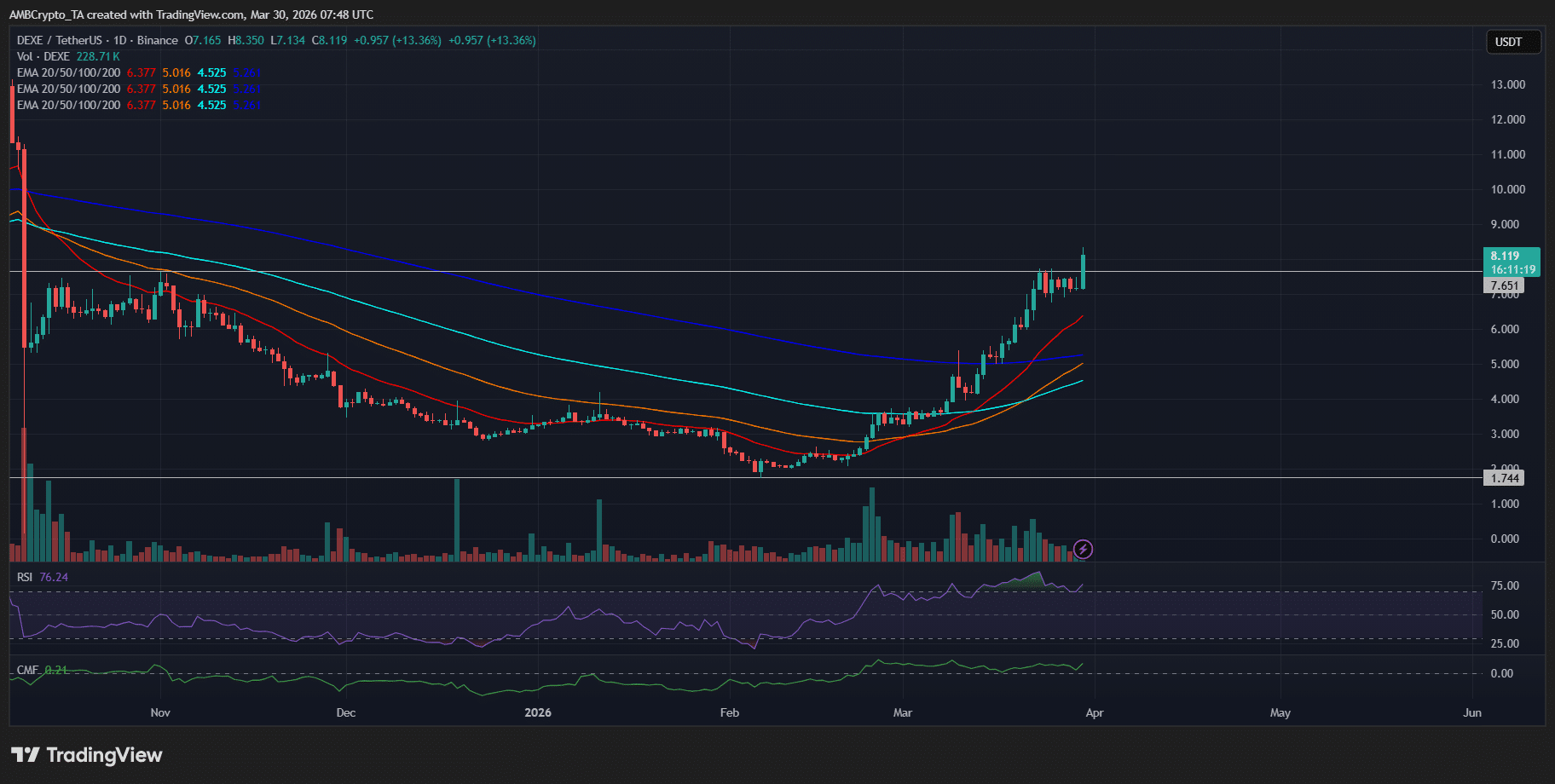
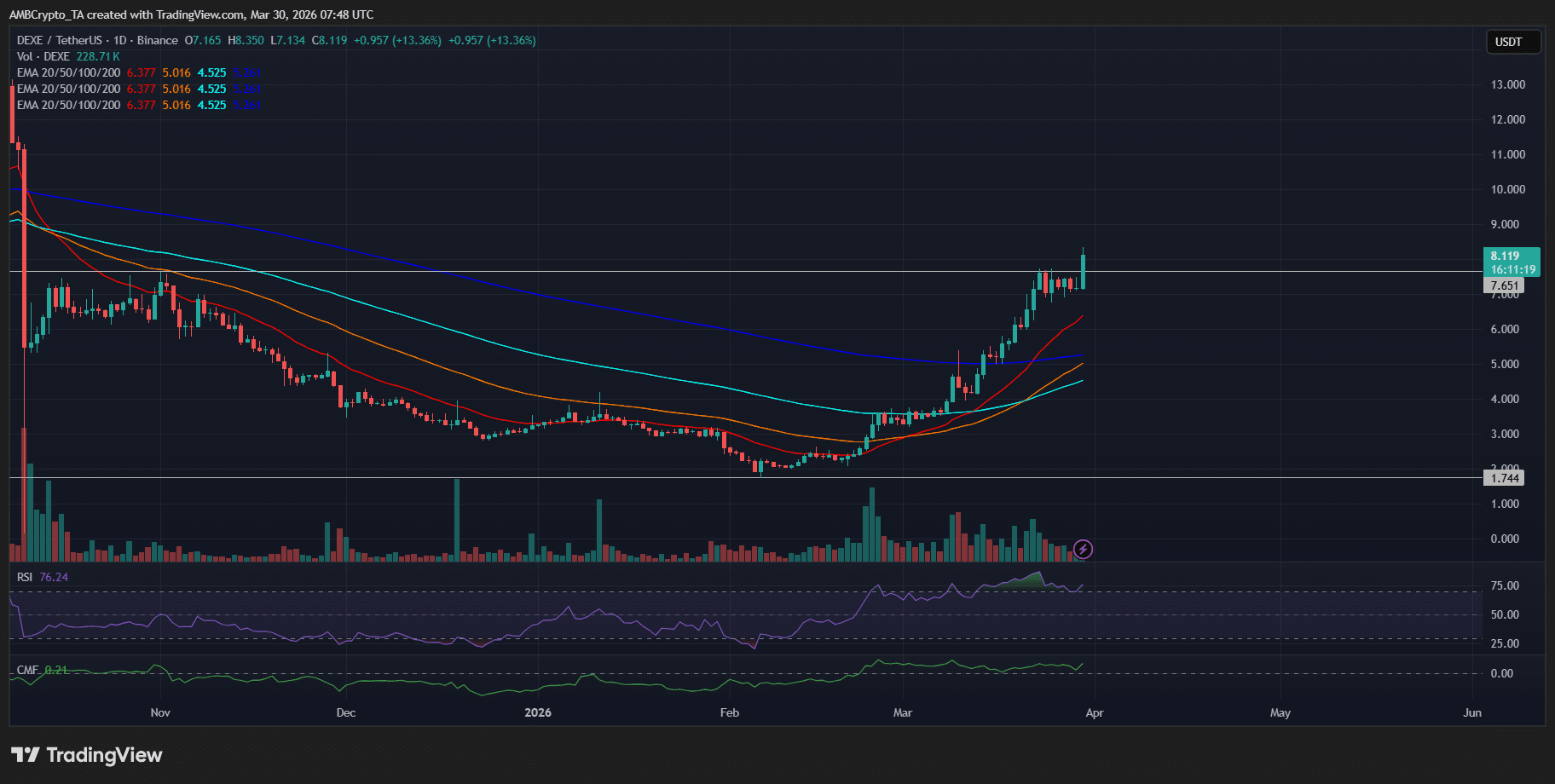
Dexe’s [DEXE] price action shows demand returning after a long period of weakness. Price opened the uptrend near $7.165, dipped to $7.134, then rose sharply to $8.350 before closing around $8.119, gaining 13.36% in a day.

This move follows a base formed above $1.744 in early February, where selling pressure eased and buyers began to take control.
Source: TradingView

As confidence improved, price moved above the 100 EMA at $4.525 and the 200 EMA near $5.261, which signals a shift from a weak trend to a stronger upward structure. This move also came with higher volume, showing that more participants are entering the market.

DEXE exhibits strong momentum, with RSI hovering around 76.24, while CMF at 0.21 shows steady capital inflows. As the price tests the $8.1–$8.3 range, further gains depend on continued buying strength.
DEXE’s Open Interest expansion reinforces the trend

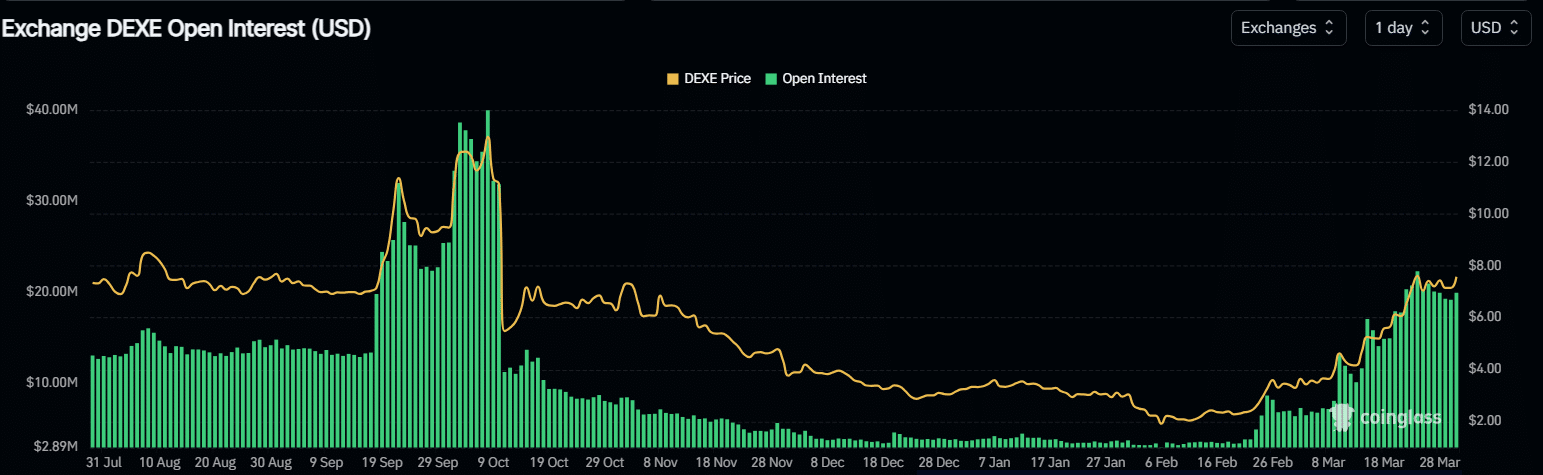
The move toward the $8 region is now attracting more activity, as derivatives traders increase their positions. Open Interest has risen from $6.94 million to $19.92 million in a month, showing that positions are growing alongside price rather than declining.

Source: CoinGlass

This increase signals stronger conviction, as traders use leverage to expand exposure while momentum improves. As more positions enter the market, they help support the uptrend by absorbing supply and maintaining upward pressure.

However, this support depends on continued inflows. If participation slows or reverses, positions may close quickly, which can pressure price.

For now, rising Open Interest supports the trend but also increases the risk of higher volatility if momentum weakens.

Consolidation tests trend continuation

DEXE’s rally now shows a clear change in behavior as momentum shifts from expansion into decision-making.

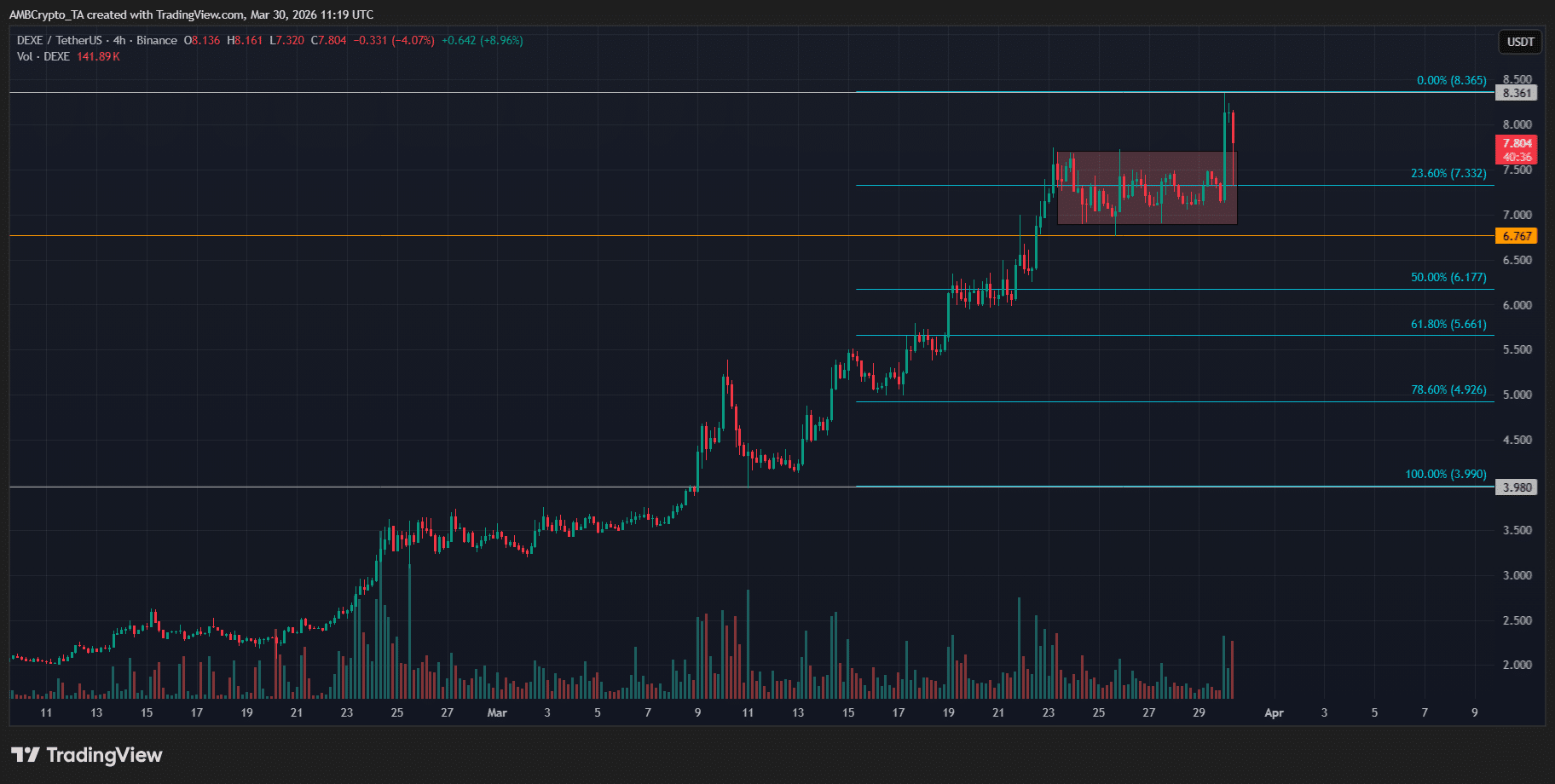
After driving quickly toward $8.36, the price pulls back and compresses between $7.30 and $7.80, which signals that buyers are stepping back while early positions begin to take profit.

This pause emerges because the market is testing whether demand can absorb supply at higher levels.

Source: TradingView

The earlier move carried price through key Fibonacci zones at $6.17 (50%) and $5.66 (61.8%), which confirms strong underlying demand.

Now, attention shifts to the 23.6% level near $7.33, where buyers are actively defending structure. Holding this level shows strength, as it keeps higher lows intact and maintains control.

If buyers regain momentum and push above $8.36, the trend can extend. However, if support weakens, the move risks rotating back toward $6.17, where deeper demand may re-enter.


Final Summary

  • Dexe’s trend strengthens as Open Interest surges 187%, but continuation depends on sustained demand holding above $7.30.
  • DEXE’s consolidation tests strength, with a break above $8.36 signaling upside, while loss of support risks a pullback toward $6.17.

Related Questions

QWhat was the percentage gain in DEXE's price in a single day, and what were the key levels it moved between?

ADEXE gained 13.36% in a day, opening near $7.165, dipping to $7.134, then rising sharply to $8.350 before closing around $8.119.

QWhat technical indicators are mentioned as signaling a shift to a stronger upward trend for DEXE?

AThe price moving above the 100 EMA at $4.525 and the 200 EMA near $5.261, accompanied by higher volume, signaled a shift from a weak trend to a stronger upward structure.

QHow much did Open Interest (OI) increase over the past month, and what does this suggest about trader sentiment?

AOpen Interest surged from $6.94 million to $19.92 million, a 187% increase, indicating stronger conviction among derivatives traders and their use of leverage to expand exposure as momentum improved.

QWhat is the significance of the $7.33 price level for DEXE according to the Fibonacci retracement analysis?

AThe $7.33 level corresponds to the 23.6% Fibonacci retracement level. Holding this level is crucial as it shows buyers are actively defending the structure, keeping higher lows intact, and maintaining control.

QWhat are the two potential price scenarios for DEXE mentioned in the article's final summary?

AIf buyers push above $8.36, the uptrend can extend. However, if support weakens and is lost, the price risks a pullback toward the $6.17 level.

Related Reads

Has the Cryptocurrency Market Hit Bottom? Here's What Institutions Think

"Has the crypto market bottomed out? Major institutions are divided on the outlook, according to a recent analysis by Matt Hougan, Chief Investment Officer of Bitwise. Three prominent research firms published in-depth reports on the topic with differing conclusions. Galaxy Digital argues Bitcoin has not yet found its bottom, pointing to only 4 out of 13 historical bottoming indicators being met. Their analysis suggests a potential bottom range of $30,000 to $54,000. NYDIG adopts a more cautious stance, noting that while metrics are close to historical bear market lows, a classic panic-selling capitulation event is missing. They acknowledge the possibility of a bottom but consider it unlikely, citing structural changes from institutional adoption. In contrast, Standard Chartered Bank asserts the bottom is already in at around $59,000. Their revised bullish view, predicting a year-end target of $100,000, hinges on anticipated reductions in ETF selling pressure linked to events like a potential SpaceX IPO. Despite the surface-level disagreement on the exact price floor, the reports share significant common ground crucial for long-term investors. All three institutions agree that a market bottom will likely form within the current year, that current prices are closer to the bottom than to previous cycle highs, and that Bitcoin is poised for another major bull cycle in the future. The core takeaway is that while the precise bottom level remains debated, the long-term value proposition for Bitcoin remains strong and may even be strengthening. Key supportive trends include rising global debt, persistent inflation, declining trust in traditional institutions, accelerating digitization, and improving market infrastructure. Therefore, for investors with a long-term horizon, the focus should shift from pinpointing the exact bottom to recognizing that the cycle's peak is likely still ahead, making current levels an attractive entry point for substantial potential upside."

Foresight News6m ago

Has the Cryptocurrency Market Hit Bottom? Here's What Institutions Think

Foresight News6m ago

2029 Finale Prediction: When Cryptocurrency Completely "Vanishes", Who Can Remain in This Financial Upheaval?

By 2029, the crypto industry will have transformed into a largely invisible but foundational layer for traditional finance. This timeline outlines the key shifts from now until then. By mid-2026, the most sought-after assets on-chain will not be traditional tokens, but synthetic perpetual contracts for private, high-growth companies (like SpaceX, OpenAI). These become primary price discovery tools, highlighting the market's craving for real-world asset value. Most altcoins enter a sustained bear market as their fundamental lack of asset-backed value is exposed. In late 2026, the "AI + Crypto" narrative largely fades as AI giants prove they don't need crypto infrastructure, except for prediction markets betting on model performance. Simultaneously, a quiet but significant wave of tokenization for institutional assets (money market funds, private credit) begins. The industry splits into a noisy speculative economy and a silent institutional one. Throughout 2027, major public blockchain foundations pivot decisively to serve institutional clients, building compliance toolkits and sales teams. However, key sectors hit growth ceilings: private perpetual contracts are legally restricted from public promotion, stable币 growth is capped by looming political uncertainty, and tokenization projects remain cautious. In 2028, following a U.S. election assumed to maintain a regulatory (not prohibitive) stance, a pivotal change occurs. After a major liquidation crisis exposes the flaws of synthetic contracts lacking a real-asset anchor, new regulations allow the *public solicitation* of private security sales (secondary market shares) to accredited investors. This creates a legitimate, direct on-ramp for retail capital into previously illiquid private equity. By 2029, the resulting bull market is driven by trading in real, innovative company shares (biotech, robotics, AI labs), not speculative tokens. "Crypto" as a distinct asset class recedes; it becomes the mundane, unseen plumbing for this new global private markets infrastructure. Tokens that survive are those capturing real cash flows from this infrastructure. Speculation persists but is marginalized. The core questions posed at the start are answered: token value is tied to legally enforceable claims on real assets, frontier tech adoption happens via private market channels, and crypto's absorption into traditional finance is marked by its becoming boring and invisible. The key validation for this entire thesis is whether, by late 2028, a legal pathway exists for ordinary accredited investors to access private assets directly.

marsbit49m ago

2029 Finale Prediction: When Cryptocurrency Completely "Vanishes", Who Can Remain in This Financial Upheaval?

marsbit49m ago

After the U.S. Banned Fable 5, Zhipu's Stock Soared 47%

On June 15, Chinese AI company Zhipu's stock surged up to 47.6% in Hong Kong, closing with a 32.82% gain. This sharp rise followed two key industry events. On June 12, Anthropic was compelled by a U.S. government export control order to suspend global access to its latest flagship models, Claude Fable 5 and Claude Mythos 5, impacting developers and businesses reliant on them. The next day, Zhipu announced it was opening access to its new open-source flagship model, GLM-5.2, for all Coding Plan users, with API and model weights (under the MIT license) to follow. The Anthropic incident highlighted a critical shift in the AI industry: beyond raw capability, the stability, continuous accessibility, and control over AI models are becoming equally vital, especially as AI integrates deeper into business workflows. Zhipu's move, emphasizing that "frontier intelligence should not belong to a few nor be subject to arbitrary revocation," positioned its open, accessible model as an alternative. GLM-5.2 focuses on "Long Horizon Tasks" with a 1M context window, aiming for consistency in complex, extended projects. Market analysts suggest this event exposes the risk of dependency on closed-source models subject to single jurisdiction policies, potentially accelerating a shift toward domestic base models and localized deployments. The investment response indicates a new valuation metric is emerging—prioritizing which companies can provide AI capabilities that are not only advanced but also reliably and sustainably accessible.

marsbit50m ago

After the U.S. Banned Fable 5, Zhipu's Stock Soared 47%

marsbit50m ago

PANews Column Registration and Article Submission Guide

"PANews Column Registration and Submission Guide" provides instructions for users to register as columnists and publish articles on the PANews platform. Key application requirements are emphasized: content should focus on in-depth analysis within Crypto, Web3, blockchain, data, and viewpoints. Content primarily for brand/product introductions will not be approved, and heavily AI-generated content will be rejected. Promotional (PR/soft) content is directed to the business channel. **Registration Process:** * **Web:** Go to the official website footer, click "Apply for Column," and register with a phone number or email (login via verification code, no password). Fill in the column name, description, upload an avatar, and submit links to previously published work. * **Mobile:** Navigate to "My" -> "Contribute & Create" and complete the form. **Article Submission Tutorial:** 1. Log in to the PANews website. 2. Access the "Creator Center" from your personal homepage. 3. Use the editor to create and publish articles. **Video Upload:** The platform supports embedding videos from third-party sites (e.g., Bilibili). Copy the embed code from the source video, use the editor's "Insert/Edit media" button, paste the code under the "Embed" tab, and adjust the display size (recommended: width 100%, height 560px). **PANews Skills (AI Agent Tool):** PANews offers an official AI Agent skill set called PANews Skills, enabling AI tools to query platform content, track trends, and publish column articles directly. It includes three main skills: 1. `panews`: For tracking daily must-read lists, popular articles, and funding news. 2. `panews-creator`: For managing columns, publishing articles, and uploading images. 3. `panews-web-viewer`: For parsing PANews webpages into Markdown. These skills are compatible with various AI Agent tools (OpenClaw, Cursor, Claude Code, ChatGPT, Gemini, etc.). To use the `panews-creator` skill, users must obtain a specific authentication value from the PANews website after logging into their columnist account.

marsbit1h ago

PANews Column Registration and Article Submission Guide

marsbit1h ago

Trading

Spot
Futures

Hot Articles

How to Buy DEXE

Welcome to HTX.com! We've made purchasing DeXe (DEXE) simple and convenient. Follow our step-by-step guide to embark on your crypto journey.Step 1: Create Your HTX AccountUse your email or phone number to sign up for a free account on HTX. Experience a hassle-free registration journey and unlock all features.Get My AccountStep 2: Go to Buy Crypto and Choose Your Payment MethodCredit/Debit Card: Use your Visa or Mastercard to buy DeXe (DEXE) instantly.Balance: Use funds from your HTX account balance to trade seamlessly.Third Parties: We've added popular payment methods such as Google Pay and Apple Pay to enhance convenience.P2P: Trade directly with other users on HTX.Over-the-Counter (OTC): We offer tailor-made services and competitive exchange rates for traders.Step 3: Store Your DeXe (DEXE)After purchasing your DeXe (DEXE), store it in your HTX account. Alternatively, you can send it elsewhere via blockchain transfer or use it to trade other cryptocurrencies.Step 4: Trade DeXe (DEXE)Easily trade DeXe (DEXE) on HTX's spot market. Simply access your account, select your trading pair, execute your trades, and monitor in real-time. We offer a user-friendly experience for both beginners and seasoned traders.

3.7k Total ViewsPublished 2024.03.29Updated 2026.06.02

How to Buy DEXE

Discussions

Welcome to the HTX Community. Here, you can stay informed about the latest platform developments and gain access to professional market insights. Users' opinions on the price of DEXE (DEXE) are presented below.

活动图片