Delphi Digital's Top 10 Predictions for 2026: Perp DEXs Devour Wall Street, AI Agents Usher in the Era of Autonomous Trading

marsbitPublished on 2026-01-17Last updated on 2026-01-17

Abstract

Delphi Digital's 2026 predictions outline a transformative phase for crypto, positioning it as the new infrastructure layer for global finance. Key forecasts include: AI Agents achieving autonomous transactions via protocols like x402 and ERC-8004, enabling an agent-driven economy; Perp DEXs consolidating traditional finance roles into single smart contracts, with platforms like Hyperliquid leading; and prediction markets evolving into primary derivatives for real-time financial hedging. Stablecoin revenue is shifting from issuers to ecosystems, while DeFi solves undercollateralized lending using zkTLS proofs. On-chain FX will disrupt inefficient forex markets, and gold/Bitcoin will lead as macro hedges. Major exchanges are transforming into "Everything Apps," integrating broader financial services. Privacy infrastructure is advancing due to regulatory pressure, and altcoins will see capital concentration on assets with real utility and revenue, not broad rallies. The overarching theme is crypto's institutional maturation and its integration as critical financial infrastructure.

Perpetual contract decentralized exchanges (Perp DEXs) will become the new Wall Street, AI Agents will enable autonomous trading, and trading platforms will transform into "super apps". Here are the core predictions from the report:

1. AI Agents Begin Autonomous Trading
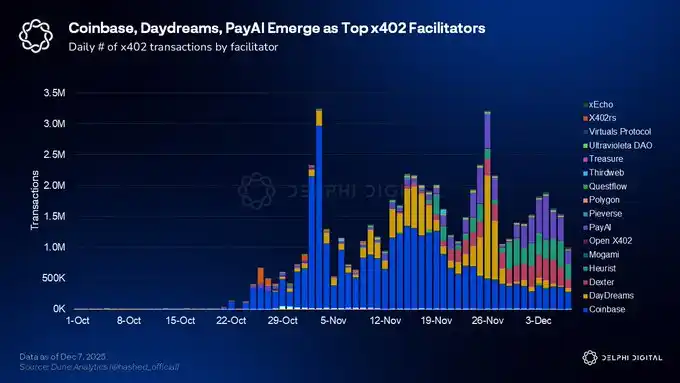
The x402 protocol allows any API to set access permissions via cryptocurrency payments. When an AI Agent requires a service, it can pay instantly with stablecoins, consuming a shopping cart or subscription. The ERC-8004 standard adds a layer of trust by establishing reputation (including performance history and staked collateral). The combination of these two forms the foundation of an autonomous agent economy. Users can delegate tasks like travel planning; the AI Agent will automatically subcontract to miner search agents, pay data fees via x402, and book tickets on-chain, all without human intervention.

2. Perp DEXs Devour Traditional Finance
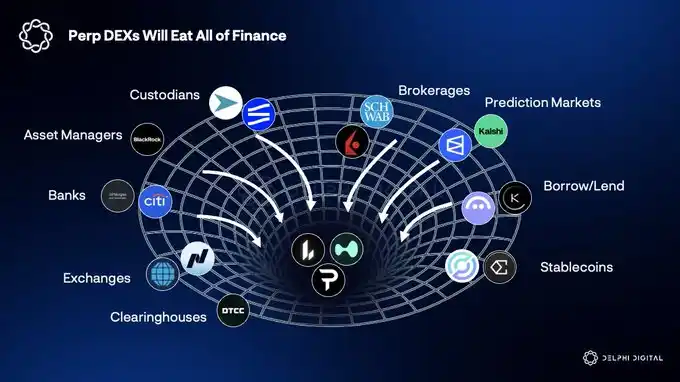
Traditional finance is expensive due to fragmentation: trading happens on exchanges, settlement at the NYSE, and custody at banks. Blockchain compresses all this into a single smart contract. Currently, Hyperliquid is building restructuring capabilities. Perp DEXs could simultaneously become dealers, exchanges, custodians, banks, and the Manhattan exchange. Ports like Aster_DEX, Lighter_xyz, and paradex are accelerating to catch up.

3. Prediction Markets Evolve into Traditional Financial Infrastructure
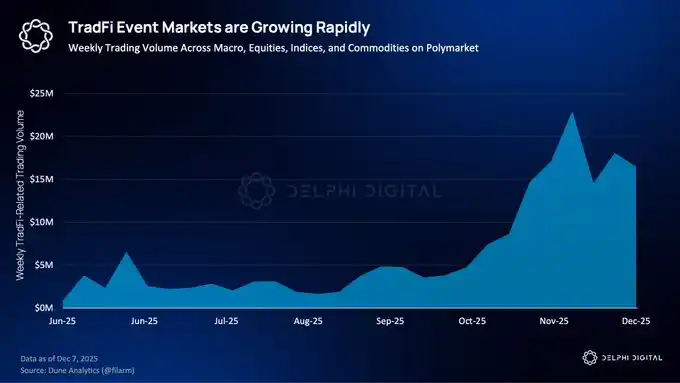
Interactive Brokers (IBKR) Chairman Thomas Peterffy views prediction markets as a real-time information layer for investment portfolios. Early demand is concentrated on weather consistency for energy, logistics, and insurance risks. 2026 will usher in new categories: equity event markets for earnings report performance, macro value indicator markets for CPI and Fed decisions, and cross-asset relative markets. A trader holding tokenized Apple stock (AAPL) can hedge earnings risk with simple binary contracts or operate complex options. Prediction markets will become primary derivative products.

4. Ecosystems Reclaim Stablecoin Revenue from Issuers
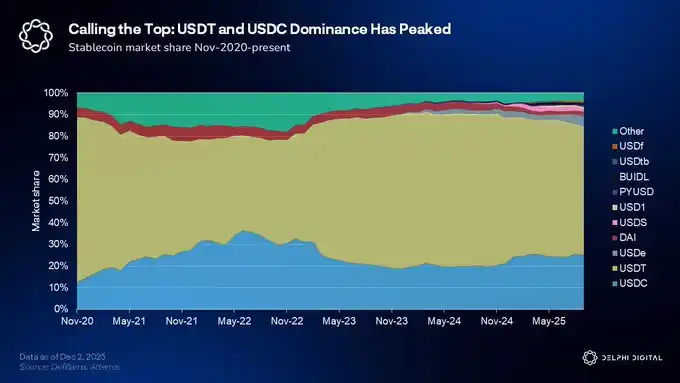
Last year, Coinbase earned over $900 million just from the issuance channel of USDC reserve interest. Public chains like Solana, BSC, and Arbitrum generate roughly $800 million in annual fees collectively, yet their networks host over $30 billion in idle USDC and USDT. This is changing. Hyperliquid has captured the reserve revenue for USDH through an auction model. Ethena's "stablecoin-as-a-service" model is being adopted by Sui, MegaETH, and Jupiter. Revenue that previously flowed to issuers is being recaptured by the platforms that create the demand.

5. DeFi Cracks Under-Collateralized Lending

While DeFi lending protocols have massive Total Value Locked (TVL), almost all require over-collateralization. zkTLS (Zero-Knowledge Transport Layer Security) is the key: users can prove sufficient bank balance without revealing identity or account details. 3jane leverages verified Web2 financial data to provide instant USDC under-collateralized credit lines, dynamically adjusting interest rates based on real-time monitoring. This framework can also provide financing directly based on an AI Agent's performance history (credit score). Maple Finance, Centrifuge, and USDai have been tackling related areas. 2026 is the year under-collateralized debt moves from experiment to infrastructure.

6. Onchain FX Finds Product-Market Fit
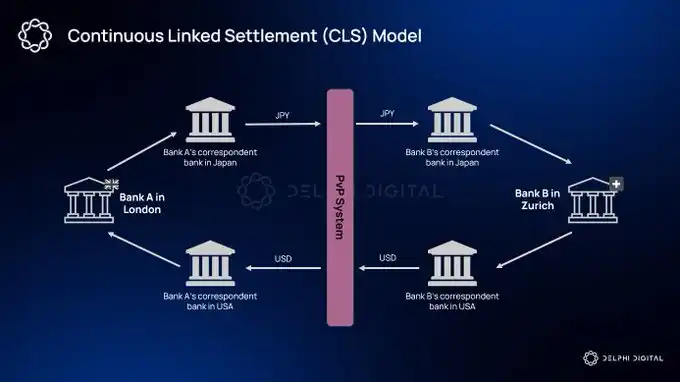
USD stablecoins account for 99.7% of supply, but this might be the peak of their dominance. The traditional forex market is vast but riddled with friction and inefficient settlement. Onchain FX eliminates intermediate steps by placing all currencies as tokenized assets on a shared execution layer. Emerging market currency pairs will explode, as traditional forex is most expensive and inefficient there. These neglected areas are where crypto carries the most obvious value proposition.

7. Gold & Bitcoin Lead the Currency Debasement Trade
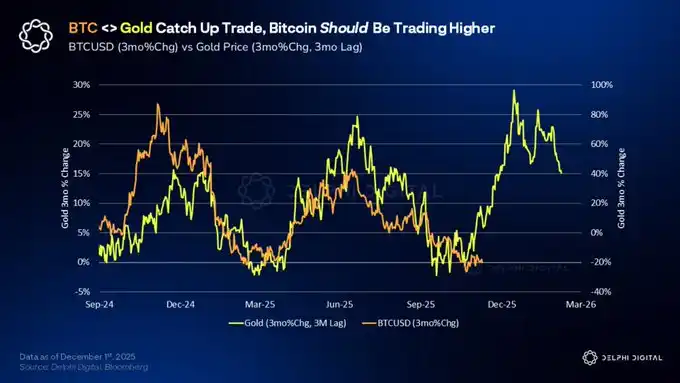
Gold surged 60% after breaking out and central banks bought over 600 tons even as prices hit record highs. The macro backdrop supports continued strength: global central banks cutting rates, persistent fiscal deficits, and global M2 at all-time highs. Gold typically leads Bitcoin by three to four months. As debasement becomes a central theme around 2026, both gold and Bitcoin will attract safe-haven inflows.

8. Exchanges Transform into "Everything Apps"
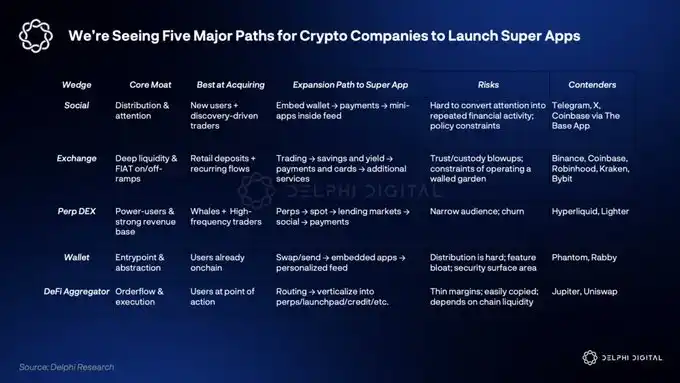
Coinbase, Robinhood, Binance, and Kraken are no longer just exchanges. Coinbase acts as a platform, the Base App as the interface, with USDC providing supplemental revenue. Robinhood's Gold membership grew 77%, becoming a retention engine. Binance has over 270 million users and payment volume reached $250 billion. When distribution costs decrease, the platforms that own the customer relationship capture the highest value. In 2026, the winners will begin to pull away.

9. Privacy Infrastructure Catches Up to Market Demand

Privacy is under immense pressure: the EU passed the "Chat Control Act," and cash transactions are limited to €10,000. Privacy infrastructure is rising to the challenge. payy_link launched a private crypto card, SeismicSys offers protocol-level encryption for fintech, and KeetaNetwork enables anonymous KYC. Without private payment rails, stablecoin adoption will hit a ceiling.

10. Altcoins Return to Dispersion (No Uniform Rally)
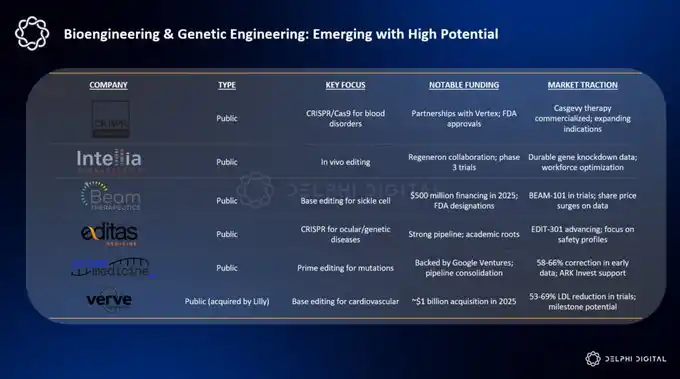
The era of "everything goes up" bull markets is over. Over $30 billion in token unlocks loom overhead, and there's competition for capital from AI, robotics, and biotech. Capital will concentrate around structural demand: tokens with ETF inflows, protocols with real revenue and buybacks, and apps with clear product-market fit. Winners will be concentrated among teams that have built moats around real economic activity.

Conclusion

Crypto is entering a new phase: institutionalization has arrived. Prediction markets, on-chain credit, the agent economy, and stablecoin infrastructure represent genuine paradigm shifts. Crypto is becoming the infrastructure layer for global finance.


Trending Cryptos

Related Questions

QWhat is the key innovation that enables AI agents to conduct autonomous transactions according to the article?

AThe x402 protocol, which allows any API to set access permissions via cryptocurrency payments, combined with the ERC-8004 standard that establishes trust through reputation and staked collateral, forms the foundation of the autonomous agent economy.

QHow are Perp DEXs predicted to disrupt traditional finance?

APerp DEXs are expected to consolidate fragmented traditional finance functions—such as trading, settlement, custody, and banking—into a single smart contract, effectively compressing roles like broker, exchange, custodian, and bank into one decentralized platform.

QWhat role are prediction markets expected to play in 2026?

APrediction markets are predicted to evolve into primary derivative products, serving as a real-time information layer for portfolios, with new categories emerging for stock event markets (e.g., earnings performance), macro indicators (e.g., CPI, Fed decisions), and cross-asset relative markets.

QHow is the DeFi sector addressing the challenge of undercollateralized lending?

ADeFi is leveraging zkTLS (zero-knowledge Transport Layer Security) to allow users to prove sufficient bank balances without revealing identity, enabling platforms like 3jane to offer instant undercollateralized credit lines based on verified Web2 financial data or AI agent performance history.

QWhy is 2026 considered a turning point for stablecoin revenue distribution?

AEcosystems are reclaiming stablecoin revenue from issuers by adopting models like Hyperliquid's bidding for reserve yields and Ethena's 'stablecoin-as-a-service,' redirecting lost revenue to platforms that generate demand instead of central issuers.

Related Reads

7 Months After the Collapse of Huiwang, Southeast Asia's Escrow Platforms Undergo a Major Reshuffle

Following the collapse of Huione Pay—dubbed the "Alipay of Southeast Asia"—seven months ago, the region's underground financial guarantee platform sector is undergoing a significant reshuffle. This power vacuum has been swiftly filled by emerging platforms such as XinBi, Tiger/Navigator, JinBei (renamed JinBo), Dali/Tiancheng, and FullyLight. These platforms, operating largely via Telegram and offering services like escrow for illicit transactions, have absorbed the vast user base and markets left behind by Huione. While positioning themselves as "trust intermediaries," their primary clientele consists of networks involved in online scams, money laundering, illegal gambling, and even human trafficking. For instance, the Tiger/Navigator platform explicitly provides "escrow" services for kidnapping-for-ransom operations ("强押车交易"). Data underscores the immense scale: Huione alone processed over $103 billion in cryptocurrency payments and facilitated over $31 billion through its escrow market before its downfall, linking it to Cambodia's notorious Prince Group. Since its collapse, competitors have seen explosive growth. For example, the XinBi platform has accumulated over $1.6 billion in total USDT revenue, while platforms like NewPay, OkPay (under Dali), and FullyLight Wallet collectively processed over $4.8 billion in USDT in a single year. This ecosystem thrives in regions like Cambodia and Myanmar, where regulatory gaps allow these platforms to act as critical financial infrastructure for sprawling cybercrime industries, from scam compounds to online casinos. The article concludes that the moniker "Southeast Asian Alipay" is a misnomer, obscuring the platforms' fundamental role in enabling serious criminal enterprises rather than representing legitimate financial innovation.

Odaily星球日报4m ago

7 Months After the Collapse of Huiwang, Southeast Asia's Escrow Platforms Undergo a Major Reshuffle

Odaily星球日报4m ago

The Changing Landscape: What Are Crypto VCs Experiencing?

Title: The Shifting Landscape of Crypto Venture Capital The era of dedicated crypto venture capital funds is undergoing a significant transformation. Once essential for navigating the sector's complexity and high risk, these specialized funds are now facing an identity crisis as the market matures. This shift mirrors historical patterns in other specialized investment classes like cleantech and SPACs, where initial information advantages dissipate as technologies become mainstream and integrated into existing industry frameworks. The article argues that crypto is reaching a critical inflection point, transitioning from a "building phase" to an "integration phase." Major players like Stripe, BlackRock, and Visa now engage with crypto not for its novel mechanics but as a foundational financial infrastructure. Their needs—regulatory compliance, banking partnerships, distribution channels—align with traditional fintech, a domain easily understood by large, generalist funds like Sequoia and Founders Fund. This evolution creates a "barbell effect" within the VC landscape. On one end are massive, diversified platforms that can incorporate crypto as one vertical among many. On the other are small, nimble funds focused on niche, experimental projects. The middle ground—medium-sized dedicated crypto funds—is being squeezed out. Their typical fund size makes it impossible to generate sufficient returns solely from early-stage crypto bets, yet they cannot compete with giants for later-stage deals. Consequently, leading crypto-native firms like Paradigm and Framework Ventures are expanding into AI, robotics, and other sectors, driven partly by LP pressure for better returns amid a broader VC DPI crisis. Others, like Dragonfly and a16z, have narrowed their crypto focus predominantly to financial infrastructure like stablecoins, reframing the sector's core narrative. For crypto entrepreneurs, this consolidation presents challenges. While generalist funds offer larger checks and broader resources, crypto projects now compete fiercely with AI for attention and capital within these firms. Furthermore, the long-term, non-commercial foundational work that built the ecosystem—funded by dedicated crypto VCs—is less likely to attract generalist capital focused on direct returns. The conclusion is that "crypto investor" as a standalone category is becoming obsolete, akin to "internet investor." Crypto is becoming a baseline infrastructure layer. The future will see a barbell structure: large-scale growth financing handled by generalist funds, while pioneering, speculative projects are funded by small, specialized vehicles. The dedicated crypto funds of the 2017-2021 boom, which incubated core infrastructure, are giving way to this new, bifurcated reality.

Foresight News21m ago

The Changing Landscape: What Are Crypto VCs Experiencing?

Foresight News21m ago

As Consensus Accelerates, What Are Young Investors Betting On?

Title: As Consensus Forms Faster, What Are Young Investors Betting On? In the rapid evolution of tech investment, a new generation of young investors is navigating a landscape where AI, robotics, commercial aerospace, and quantum computing are advancing simultaneously. Traditional investment logic based on financial models is giving way to a need for deep technical understanding and the ability to act before industry consensus forms. An analysis of trends from the "WAIC FUTURE TECH" list of young investment leaders reveals key shifts in focus. The first major trend is the movement of AI from the digital screen into the physical world. Investment is shifting from large language models and chatbots towards embodied AI, robotics, AI hardware, and edge computing. While demonstrations generate excitement, the real challenge lies in achieving scalable, reliable, and cost-effective delivery in complex real-world environments like factories and logistics. Success depends not just on algorithms but on the integration of sensors, actuators, and control systems. Second, the competitive focus for large models is moving beyond raw capability toward building an "intelligence flywheel." The goal is to create self-reinforcing systems where user interaction generates data, improving the model, which in turn enhances the user experience and attracts more engagement. Companies that successfully embed AI into workflows to create these closed-loop systems can build lasting value that isn't easily erased by the next model upgrade. Third, facing a potential bottleneck in high-quality human-generated data, investors are looking at new underlying technologies. Reinforcement learning and self-play, as demonstrated by AlphaGo Zero, offer paths for AI to generate its own experience. Scientific foundation models, which aim to build general AI capabilities for fields like life sciences and materials discovery, represent a non-consensus direction that could unlock new frontiers of knowledge and data. Finally, in deep-tech areas like quantum computing, commercial aerospace, and space-based infrastructure, patient capital is essential. These fields have long, uncertain development and validation cycles involving complex engineering, supply chains, and regulations. Investment here requires a long-term view, focusing on foundational team capabilities and the eventual emergence of market demand, even if commercial returns are distant. Collectively, these trends illustrate how young investors are adapting to a new era. They are learning to make earlier, technically-informed judgments, balance hype with real-world viability, and provide the patient capital needed to build the deep-tech foundations of the future.

marsbit49m ago

As Consensus Accelerates, What Are Young Investors Betting On?

marsbit49m ago

Trading

Spot

Hot Articles

Discussions

Welcome to the HTX Community. Here, you can stay informed about the latest platform developments and gain access to professional market insights. Users' opinions on the price of S (S) are presented below.

活动图片














