Deciphering Circle's Q1 Financial Report: After the Interest Rate Dividend Ebbs, USDC Is Planning a Grand Strategy

Odaily星球日报Published on 2026-05-11Last updated on 2026-05-11

Abstract

Circle's Q1 2026 financial report shows total revenue and reserve income of $6.94 billion, slightly below expectations, with net profit at $550 million, down 15% year-over-year. The company attributes the slowdown in revenue growth to declining reserve asset yields following a Federal Reserve rate cut. However, other revenue streams reached a record $420 million, indicating a diversification away from interest dependence. Key operational highlights include USDC's circulating supply reaching 77 billion, a 28% annual increase, while its on-chain transaction volume surged 263% to $21.5 trillion, showing significantly higher usage frequency. Circle's core RLDC Margin improved to 41%, reflecting better cost control. Looking beyond interest rate reliance, Circle is expanding into new areas. Its Arc Network completed a $2.22 billion ARC token presale at a $30 billion valuation. The company also launched Agent Stack, an infrastructure suite for AI Agent economies, and its Circle Payments Network (CPN) shows an estimated annual transaction volume of $83 billion. The report suggests Circle's strategy is evolving from merely issuing a stablecoin to building USDC into a foundational dollar network for the internet, targeting cross-border payments, enterprise settlement, and the emerging AI-driven economy.

Original | Odaily Planet Daily (@OdailyChina)

Author | Azuma (@azuma_eth)
Before the U.S. market opened on May 11th, stablecoin issuer Circle officially released its first-quarter 2026 financial report.

The financial report data shows, Circle's total revenue and reserve income for the first quarter were $694 million, slightly below the market expectation of $715 million; EPS was $0.21, higher than the market expectation of $0.18; adjusted EBITDA was $151 million, a year-on-year increase of 24%; net profit was $55 million, a year-on-year decrease of 15%.

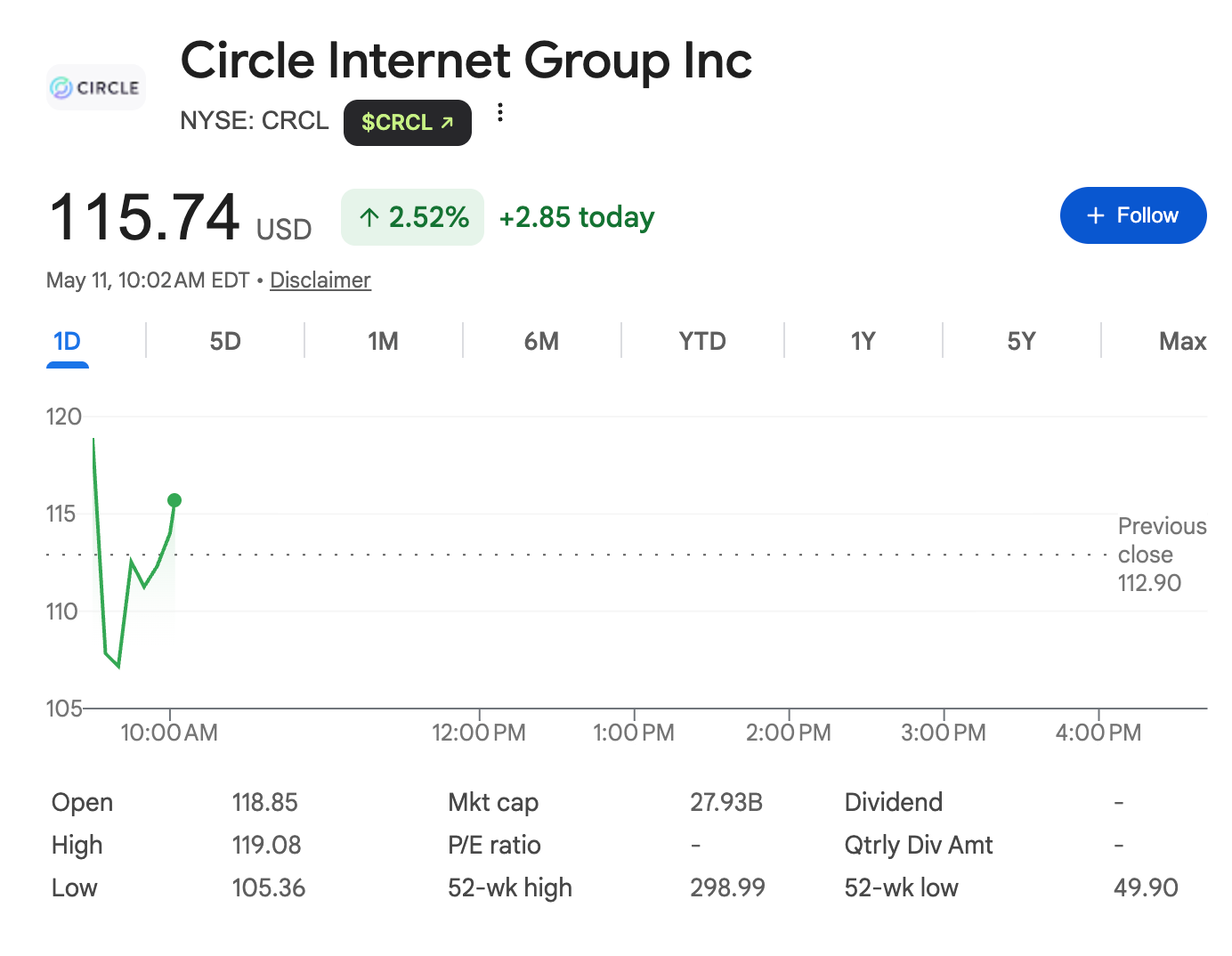
Influenced by the earnings release, CRCL experienced significant volatility in pre-market trading. A nearly 6% pre-market gain was gradually erased amid fluctuations. As of 22:00, CRCL saw further substantial declines after-hours, but then quickly rebounded from losses to gains, temporarily reported at $115.74, representing a daily increase of 2.52%.
Interpretation of Core Data

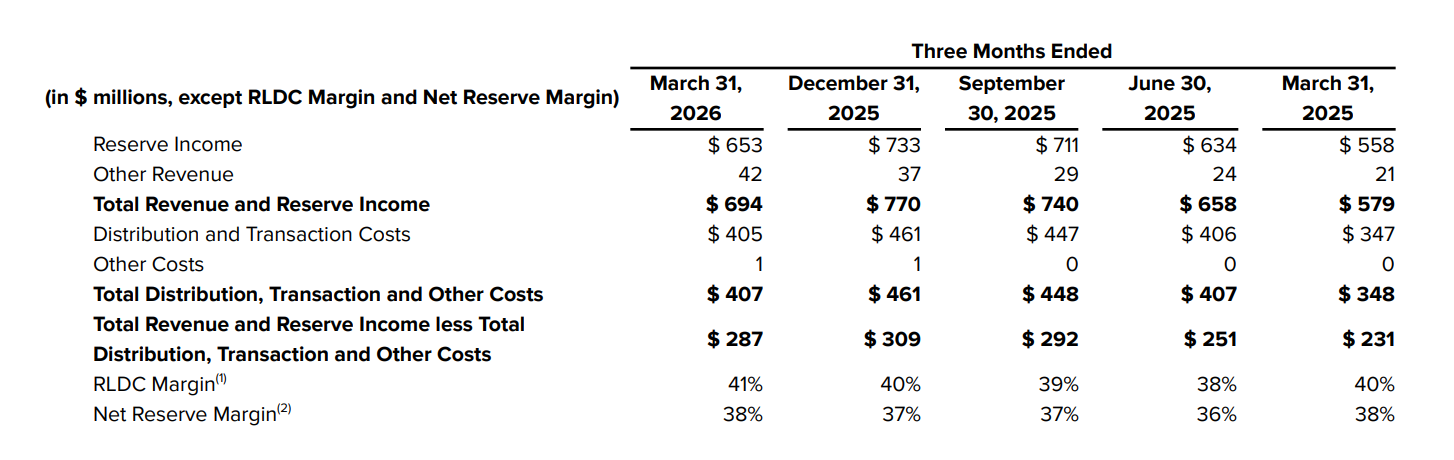
As shown in the report, this quarter Circle's total revenue and reserve income was $694 million, representing a 20% year-on-year increase. However, this broke the previous consecutive quarterly growth trend ($579M ➡️ $658M ➡️ $740M ➡️ $770M ➡️ $694M) and also failed to meet market expectations.

Circle attributed the slowdown in revenue growth to a decline in the reserve return rate. On December 10, 2025, the Federal Reserve lowered the target range for the federal funds rate by 25 basis points to 3.5%-3.75%, thereby compressing the yield on Circle's reserve assets, which are primarily U.S. Treasuries.
Despite the relatively weak revenue, Circle's financial report still revealed some locally optimistic data points.

First, Circle's other revenue (excluding reserve income) hit a record high of $42 million, showing a consecutive quarterly growth trend ($21M ➡️ $24M ➡️ $29M ➡️ $37M ➡️ $42M).

As we mentioned in this afternoon's article "Earnings Report, Legislation, Federal Reserve... Circle Faces Three Major Tests This Week," this indicates that Circle's revenue sources are becoming more diversified. Its platform services, API tools, and payment products are generating substantial commercial returns, and its reliance on interest income is decreasing.

Another noteworthy data point is the RLDC Margin, which is the profit margin after subtracting distribution costs from revenue. This reflects the core business profitability after deducting distribution expenses and is widely regarded as Circle's most critical profitability indicator. This quarter, Circle's RLDC Margin reached 41%, achieving growth for four consecutive quarters (36% ➡️ 39% ➡️ 40% ➡️ 41%). This means Circle's control over distribution costs is becoming more efficient.
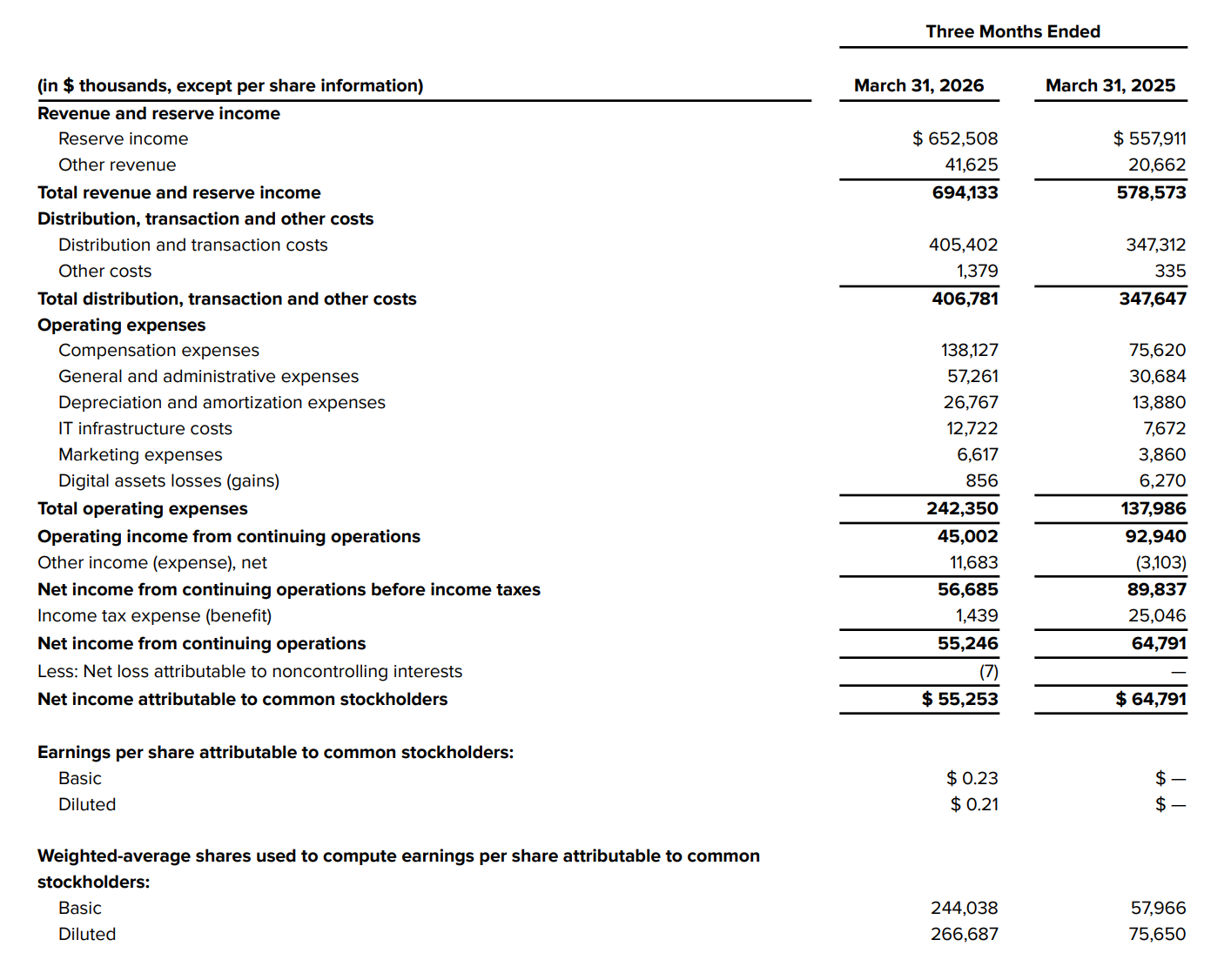
Now, let's look at the expenditure situation. Distribution and Transaction Costs remain Circle's largest expense item, reaching a high of $405 million this quarter, a year-on-year increase of 17%. This expense is primarily linked to the USDC distribution contract with Coinbase. This contract is set to expire in August this year, and how it is renewed (mainly whether the revenue-sharing ratio will be adjusted) will significantly impact Circle's subsequent expenditures and profit situation.

Excluding distribution costs, Total Operating Expenses also surged from $138 million last year to $242 million, a year-on-year increase of 76%. The most significant increase came from Compensation expenses, which rose from $75.62 million to $138 million, almost doubling — Circle explained this was mainly due to stock-based compensation expenses and related taxes following the IPO.

Affected by the sharp increase in expenditures, Circle's operating profit for this quarter fell to $45 million from $92.94 million in the same period last year; net profit attributable to common shareholders decreased from $64.79 million last year to $55.25 million; Earnings Per Share (EPS) was $0.23, diluted to $0.21.

Other Operational Highlights

In addition to core financial data, Circle also disclosed several operational highlights in the Q1 report.

The most critical data point is that USDC's circulation at the end of the first quarter reached 77 billion tokens, a year-on-year increase of 28%. However, simultaneously, the on-chain transaction volume of USDC in the first quarter reached a staggering $21.5 trillion, a year-on-year increase of 263%. Data analysis from Visa Onchain Analytics also shows that USDC accounted for 63% of the total stablecoin transaction volume in the network during the first quarter.
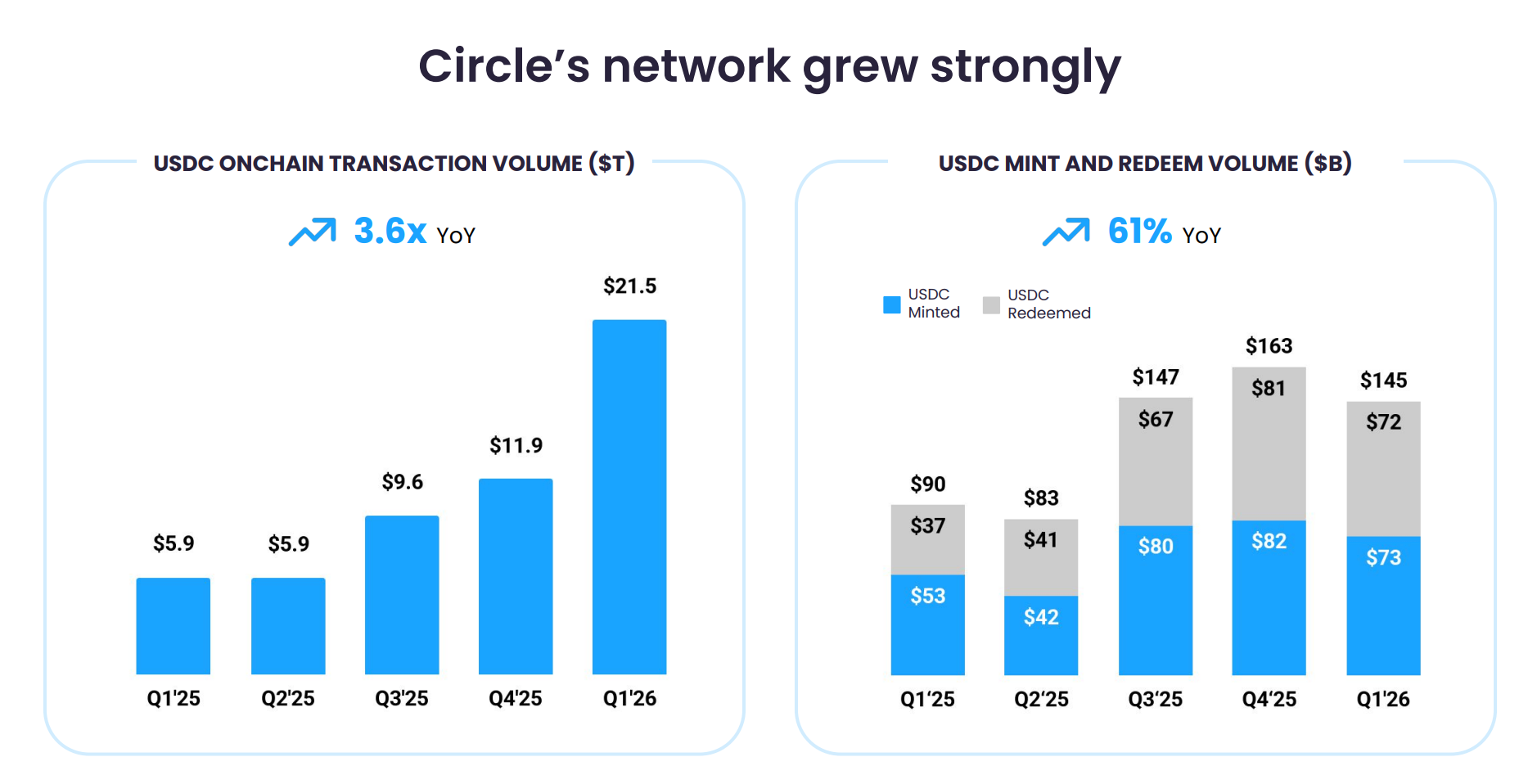
The growth rate of transaction volume far exceeds that of circulation volume, meaning the frequency at which each USDC token is transferred and used on-chain has significantly increased — USDC is not sitting statically in wallets but is being genuinely and frequently used for payments, DeFi, cross-border settlements, and other scenarios.

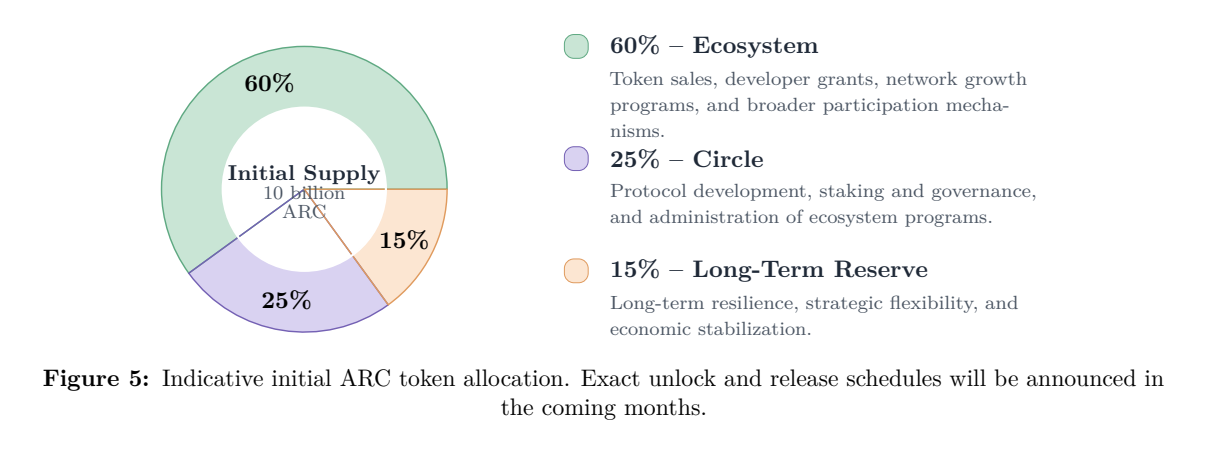
Another key highlight is that Circle also disclosed that its payment network Arc Network has completed a $222 million ARC token pre-sale, with a valuation as high as $3 billion. Investors include prominent institutions like a16z, BlackRock, Intercontinental Exchange, Standard Chartered, SBI, etc. The ARC token whitepaper disclosed today shows that 60% of the tokens will be allocated to the ecosystem (token sales, developer grants, network growth); 25% will be allocated to Circle (protocol development, staking, and governance); 15% will be allocated to long-term reserves (strategic flexibility and economic stability).
Furthermore, the estimated annual transaction volume (projected based on 30-day data as of March 31st) for Circle's institutional-focused payment service, Circle Payments Network (CPN), has also reached $8.3 billion; in April, Circle also launched the "Managed Payments" product to expand its payment offerings. This product allows financial institutions to initiate stablecoin payment businesses without managing digital assets themselves.

To prepare for the AI Agent-driven commercial future, Circle also announced the launch of Agent Stack. This is a suite of infrastructure services and tools for the AI Agent economy, designed to provide high-speed, low-cost financial service capabilities for autonomously operating AI Agents. Circle co-founder and CEO Jeremy Allaire's vision regarding this is expressed as: "With the pre-sale of the ARC token, the accumulation of momentum for the Arc Network, and the launch of the Agent Stack, we are building trusted infrastructure for AI-native economic activity and a more programmable internet financial system."

Circle's New Game Plan

Against the macro backdrop of the ebbing high-interest dividend (Warsh is expected to advocate a "rate cut + balance sheet reduction" strategy upon succeeding as Fed Chair), Circle clearly does not want to be entirely subject to the Federal Reserve's interest rate policy. Its strategic focus has quietly shifted towards the diversified expansion of non-interest income.

Judging from the details disclosed in this quarterly report, after successively launching services like CPN, Managed Payments, Agent Stack, and Arc Network, Circle's goal is no longer merely to be a "stablecoin issuer." Instead, it is attempting to build USDC into the underlying dollar network for the Internet era. Under this new vision, Circle's service targets are no longer limited to exchanges or crypto-native users but are extending into cross-border payments, corporate settlements, and even the AI Agent economy.

Circle's ambition is already quite clear: to completely transform USDC from a "static reserve asset" into "flowing economic lifeblood." This is perhaps the grand strategy that Circle truly wants to execute.


Trending Cryptos

Related Questions

QWhat were the key financial highlights of Circle's Q1 2026 earnings report?

ACircle's Q1 2026 total revenue and reserve income was $6.94 billion, slightly below expectations of $7.15 billion. Adjusted EBITDA was $1.51 billion, up 24% year-over-year. However, net income fell 15% year-over-year to $550 million.

QWhy did Circle's total revenue and reserve income growth slow down in Q1 2026 according to the article?

ACircle attributed the slowdown in revenue growth to a decline in the Reserve Return Rate, which was compressed due to the Federal Reserve lowering the federal funds rate target range to 3.5%-3.75% in December 2025.

QWhat positive trends in Circle's revenue composition does the article point out?

AThe article highlights that Circle's 'Other Revenue' (excluding reserve income) reached a record high of $420 million in Q1, showing a consecutive quarterly growth trend. This indicates revenue diversification and reduced reliance on interest income.

QWhat significant development regarding the Arc Network was disclosed in the Q1 report?

ACircle disclosed that its Arc Network payment network completed a $2.22 billion ARC token presale at a $30 billion valuation, with backing from major institutions like a16z, BlackRock, and others. 25% of the tokens are allocated to Circle for protocol development, staking, and governance.

QAccording to the article, what is Circle's broader strategic ambition beyond being a stablecoin issuer?

AThe article states Circle's ambition is to transform USDC from a 'static reserve asset' into 'flowing economic blood' by building trusted infrastructure for an AI-native economy and a more programmable internet financial system. Its goal is to make USDC the underlying dollar network for the internet era.

Related Reads

Wall Street Morning Report: Nvidia Falls for 7 Consecutive Days, AI Stocks Continue to Bleed Out; U.S. Treasury Buybacks Criticized as Temporary Fix, Inflation and Deficit Are the Real Big Problems

Wall Street Morning Report: Tech and Treasury Tensions U.S. stocks were mixed. The Dow gained 0.26%, supported by defensive and consumer staples stocks, while the S&P 500 fell 0.28% and the Nasdaq dropped 0.76% amid a sell-off in AI hardware. The U.S. announced new sanctions targeting Iran's key economic sectors, temporarily easing oil prices (Brent -2.35%). However, concerns over potential disruption to the Strait of Hormuz could pressure European natural gas prices. Meanwhile, the Treasury's upcoming bond buyback plan faced criticism from major banks (Goldman Sachs, Deutsche Bank, Citadel), who argue it doesn't address the root causes of high long-term yields: persistent inflation and the massive fiscal deficit. The 10-year Treasury yield dipped slightly to around 4.70%. Gold rose, with Citi raising its short-term target to $4,800/oz. The AI hardware and semiconductor sector saw intense selling. The Philadelphia Semiconductor Index fell nearly 3%. NVIDIA dropped 2.91%, marking its seventh consecutive daily decline—its longest losing streak since 2022—due to pre-earnings caution despite strong analyst estimates. Memory chip stocks (Micron -6%, others down 5-6%) fell after Samsung's shareholder returns disappointed, raising cycle peak fears. Optical communications was also a big loser, led by Applied Optoelectronics (-14%) on equity dilution concerns. Wall Street is growing wary of off-balance-sheet credit risks in AI infrastructure financing. In other moves, Tesla fell 3.83% on a major China recall. Meta rose 1.66% on news of its upcoming "Hatch" AI platform. Defensive stocks like Visa and Walmart supported the Dow. Key upcoming events include the Jefferies Semiconductor Conference (Aug 25-26), Gamescom (Aug 26-30), and NVIDIA's earnings report (Aug 28).

marsbit14m ago

Wall Street Morning Report: Nvidia Falls for 7 Consecutive Days, AI Stocks Continue to Bleed Out; U.S. Treasury Buybacks Criticized as Temporary Fix, Inflation and Deficit Are the Real Big Problems

marsbit14m ago

Analog Chip Giants TI and ADI Are Stepping Up

Analog chip giants Texas Instruments (TI) and Analog Devices (ADI) have both reported strong quarterly results, signaling an industry recovery. TI's Q2 2026 revenue reached $5.463 billion, a 23% year-over-year (YoY) increase. ADI's Q3 FY2026 revenue hit $4.022 billion, up 40% YoY, marking a new quarterly record. Both companies benefited from rising demand in industrial and data center markets, though their growth paths differed. TI experienced broad-based strength across its segments. Industrial revenue (33% of total) grew approximately 30% YoY, while data center revenue (9%) doubled. The automotive segment (33%) also showed a strong rebound, attributed to demand from China's EV/hybrid market and low inventory levels at automakers. ADI's growth was led by its industrial (49% of revenue, +53% YoY) and communications (16%, +84% YoY) segments, with data center products constituting 80% of the latter. Management highlighted a significant "AI exposure," with data center and ATE-related businesses now accounting for 20% of total revenue. Key differences emerged in their strategies and supply chain dynamics. ADI attributed a larger portion of its growth to AI infrastructure demand and has built "strategic inventory" to a record high of ~$1.93 billion to support future growth, despite channel inventory being below target levels. Its product lead times have extended to up to six months, and price increases are contributing to margin expansion. TI's inventory remained high at $4.6 billion but saw improved turnover. The company emphasized that its growth is primarily volume-driven, with minimal contribution from recent price hikes. TI maintains a competitive lead time below 13 weeks and expressed confidence in its capacity sufficiency for the next three years. In summary, both companies are riding a recovery wave fueled by industrial and AI/data center demand. TI's approach leverages its broad market presence and prepared capacity, while ADI is more focused on AI-driven growth and strategic inventory buildup. Their differing paths highlight the evolving structure of demand within the analog semiconductor market's rebound.

marsbit39m ago

Analog Chip Giants TI and ADI Are Stepping Up

marsbit39m ago

Trading

Spot

Hot Articles

Discussions

Welcome to the HTX Community. Here, you can stay informed about the latest platform developments and gain access to professional market insights. Users' opinions on the price of S (S) are presented below.

活动图片