Crypto.com says market maker boosts liquidity, denies trading edge on customers

cointelegraphPublished on 2025-12-23Last updated on 2025-12-23

Abstract

Crypto.com is establishing an internal market-making team to support its expansion into prediction markets, a move it states is fully compliant with regulations and designed to boost liquidity. The company denies its internal team has any unfair advantage, asserting it does not get a "first look" at customer orders or proprietary data. It emphasized that all market makers operate under the same rules to ensure fairness and that proprietary trading is not a revenue source. The practice is common among competitors like Kalshi and Polymarket, which also use market makers to provide liquidity.

Cryptocurrency exchange Crypto.com is building an internal market-making team as part of its expansion into prediction markets, a move the company says is fully aligned with federal regulations and intended to improve liquidity, even as market-making in outcome-based trading continues to draw scrutiny.

Bloomberg reported Tuesday that the exchange is recruiting for a new role on its market-making desk, citing a job posting for a “quant trader” who would help buy and sell contracts tied to the outcomes of sporting events on Crypto.com’s prediction platform.

Source: Bloomberg

The report has drawn attention to the practice of exchanges facilitating trading against customer orders, a structure that can raise questions about conflicts of interest as prediction markets gain traction across both crypto and traditional finance.

In a statement to Cointelegraph, a Crypto.com spokesperson said the company’s internal trading team is fully disclosed to the US Commodity Futures Trading Commission and makes markets across its North American derivatives business.

“The bottom line for customers is [that] more competition and liquidity on the platform creates a better overall experience,” the spokesperson said, adding that internal and external market makers operate under the same rules to ensure market fairness and integrity.

“No market maker at Crypto.com gets a ‘first look’, and our internal market maker does not have access to proprietary data or customer order flow before other market makers or market participants,” the spokesperson said.

They added that Crypto.com does not rely on proprietary trading as a revenue source. “We have a simple business model providing our retail customers access to digital assets for a fee, while staying risk neutral," they said.

Related: Phantom taps Kalshi to offer regulated prediction markets in wallet

Market-making isn’t unique to Crypto.com

Crypto.com is not the only prediction-market operator to rely on market makers to support liquidity.

The Bloomberg report noted that competitors such as Kalshi and Polymarket also use professional trading companies or dedicated liquidity providers to facilitate trading on their platforms.

Kalshi, which operates a federally regulated event-contract exchange, relies on designated market makers rather than a purely peer-to-peer order book, and those arrangements have largely been public. It has been reported that quantitative trading company Susquehanna International Group has provided market-making services to Kalshi since 2024, helping supply liquidity as trading volumes surged.

Polymarket, a decentralized prediction market that drew widespread attention during the US presidential election for accurately predicting the outcome, is also building an internal market-making unit, according to Bloomberg.
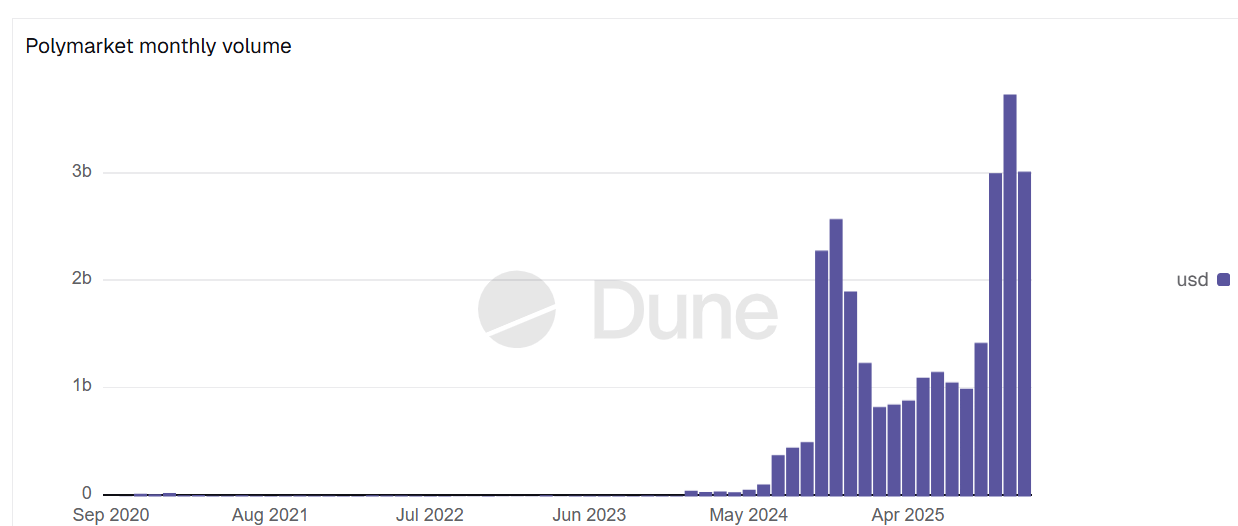
Polymarket’s monthly volumes began to surge in the run-up to the 2024 US presidential election. Source: Dune

Related: DraftKings eyes crypto offerings as it expands into prediction markets

Related Questions

QWhat is the primary reason Crypto.com is building an internal market-making team, according to the company?

ACrypto.com states that building an internal market-making team is intended to improve liquidity and create a better overall experience for customers, and it is fully aligned with federal regulations.

QHow does Crypto.com address concerns about conflicts of interest and unfair advantages for its internal market maker?

ACrypto.com states that its internal market maker does not get a 'first look' at proprietary data or customer order flow before other market participants, and all market makers operate under the same rules to ensure fairness and integrity.

QBesides Crypto.com, which other prediction-market operators use market makers to support liquidity, as mentioned in the article?

AThe article mentions that competitors such as Kalshi and Polymarket also use professional trading companies or dedicated liquidity providers to facilitate trading on their platforms.

QWhat is Crypto.com's stated business model regarding proprietary trading and revenue?

ACrypto.com states that it does not rely on proprietary trading as a revenue source and has a simple business model of providing retail customers access to digital assets for a fee while staying risk neutral.

QWhich quantitative trading company has been reported to provide market-making services to Kalshi since 2024?

AQuantitative trading company Susquehanna International Group has been reported to provide market-making services to Kalshi since 2024.

Related Reads

How to Do Research Well: Deliberately Practice the Real Skills That Matter

No one truly teaches you how to do research. You're often given a desk, a pre-selected problem, and vague instructions to "create something new." Consequently, many people reverse-engineer the job based on visible outputs—papers, posts, announcements—learning only how to *appear* like a researcher rather than how to *become* one. True research capability is built from stacking small, trainable skills, nearly all of which can be developed through deliberate practice. **Pick Your Own Problem:** Most researchers absorb problems from advisors or trends, lacking the underlying reasoning. Choosing a problem you genuinely care about, as John Schulman advises, leads to original work. Develop "taste" like a muscle: predict experiment outcomes, guess paper results from methods, and track which findings remain important over time. **Upgrade Your Inputs:** Relying on shared reading lists (arXiv hot lists, filtered group chats) leads to unoriginal conclusions. Undervalued old literature often holds crucial insights (e.g., MoE, LSTM, backpropagation). Richard Sutton's "The Bitter Lesson" or Claude Shannon's 1952 talk on creative thinking are more predictive than lengthy modern surveys. Breadth matters as much as depth: draw from neuroscience, mechanism design, hardware knowledge, and honest statistics. Read papers directly, especially appendices and limitations sections. **Write Everything Down:** As Paul Graham noted, writing exposes flaws in seemingly mature ideas. Writing is the cheapest defense against self-deception. Following Feynman's principle, Darwin programmatically wrote down facts contradicting his theory to combat memory bias. Maintain a detailed log of hypotheses, setups, predictions, results, and updated understandings. Reviewing past logs fosters essential humility.

marsbit1h ago

How to Do Research Well: Deliberately Practice the Real Skills That Matter

marsbit1h ago

Following US Ban on Fable 5, Zhipu AI's Stock Soars 47%

On June 15th, shares of Zhipu AI surged dramatically on the Hong Kong stock market, peaking at a 47.6% gain before closing 32.82% higher. This sharp increase was directly triggered by two recent industry events. On June 12th, Anthropic announced it was suspending global access to its latest flagship models, Claude Fable 5 and Claude Mythos 5, to comply with a U.S. government export control order. The next day, Zhipu AI announced it would open access to its latest open-source flagship model, GLM-5.2, under the permissive MIT license. The Anthropic incident highlighted a critical issue beyond raw model capability: the risk of sudden, unpredictable loss of access to advanced AI models, especially for developers and enterprises deeply integrated with them. This has shifted industry and market focus toward factors like stability, sustainable access, and controllability. Zhipu's move, promoting "frontier intelligence for all," positions its openly available model as a reliable and accessible alternative. The GLM-5.2 model emphasizes "Long Horizon Task" capabilities with a 1M context window, targeting complex, multi-step coding and engineering workflows where maintaining context is crucial. Analysts note this event exposes the risk of dependency on closed-source models subject to single jurisdictional controls, potentially accelerating a shift toward domestic base models and localized deployments. The market's reaction signals a new valuation dimension in AI: providers who can offer stable, long-term, and sustainably accessible AI capabilities are gaining strategic importance.

marsbit2h ago

Following US Ban on Fable 5, Zhipu AI's Stock Soars 47%

marsbit2h ago

Fully Entering the AI Era: Alipay Bets on Conversation, WeChat Holds Fast to Social

In May 2026, Alipay announced over 300 million AI payment transactions. Shortly after, WeChat opened its mini-programs for AI integration, sparking controversy by requiring developer source code access. This highlights their diverging approaches to AI integration. Alipay is testing "Project Treasure," an optional AI-native interface replacing traditional app grids with a conversational window. Users can command complex tasks (e.g., "book a ride and order coffee") handled end-to-end by AI. This shift follows an abandoned standalone AI app, focusing instead on enhancing its existing user base. For unmodified mini-programs, Alipay's AI uses "screen-reading" to simulate user interactions, bypassing the need for developer overhaul. It also introduced "Token Pay" for micro-transactions and "AI Wallets" for autonomous agent spending. WeChat, prioritizing its core social function, is taking an embedded approach. Its AI agent will operate within existing contexts like group chats and official accounts, assisting without a separate interface. To enable this, WeChat offers developers two paths: granting source code access for direct AI control ("Automatic Mode") or manually encapsulating services into standardized "Skills." Both place significant burden on developers. Key differences emerge in handling legacy services: WeChat demands developer cooperation (code or labor), while Alipay's screen-reading offers immediate, if potentially less stable, compatibility. Alipay's 3 billion AI transactions demonstrate user acceptance of AI-driven commercial actions. The divergent strategies may reshape mini-program ecosystems—Alipay passively "AI-fying" services, WeChat potentially favoring resource-rich developers—and set competing technical standards. Ultimately, the competition centers on where users entrust the command to "help me get things done."

marsbit2h ago

Fully Entering the AI Era: Alipay Bets on Conversation, WeChat Holds Fast to Social

marsbit2h ago

Trading

Spot
Futures
活动图片