Crypto Predictions 2026: CoinFund President Shares His Forecast

bitcoinistPublished on 2026-01-01Last updated on 2026-01-01

Abstract

Christopher Perkins, President of CoinFund, outlines seven key predictions for the crypto industry in 2026. He anticipates a major surge in mergers and acquisitions, projecting deal value to reach $25 billion, driven by consolidation and cross-industry integration. Stablecoin market cap is expected to double to $600 billion, fueled by their role as a settlement layer. Perkins also forecasts a major hack exceeding $2 billion that could trigger significant policy changes. He predicts a resurgence of regulated crypto derivatives in the U.S., but no passage of a comprehensive market-structure bill due to political gridlock. Bitcoin and Ethereum are expected to reach new all-time highs of $150,000 and over $5,000, respectively. Finally, he foresees an NFT revival focused on financial applications rather than digital art.

CoinFund President Christopher Perkins is betting 2026 will be defined less by shiny new token narratives and more by balance sheets, regulation-enabled product launches, and the messy maturation of crypto into an industry that buys, sells, and consolidates itself. In a Dec. 31 thread on X, Perkins laid out seven predictions:

#1 Crypto ‘M&A Summer’ And A $25 Billion Deal Year

Perkins’ first and loudest call: 2026 will be “the year of crypto M&A.” He pegged 2025 M&A activity at roughly $8.6 billion in total deal value, then projected 2026 will “reach $25bn,” framing it as a step-change rather than a modest grind higher.

He sketched consolidation pressure across multiple fronts, from “DAT/Labs/Foundation consolidation” to “DAT vs DAT (mNAV reckoning),” plus a two-way bridge between traditional finance and crypto. The direction of travel, in his telling, is straightforward: TradFi firms trying to catch up and crypto firms buying their way into regulated capabilities.

“TradFi → Crypto (ugh, I’m behind and need to catch up),” he wrote. “Crypto (DATs, Exchanges) → TradFi (we need operating companies, securities capabilities and licenses, too!).” He also flagged “Asia→US” as a theme, arguing that a clearer regulatory environment will pull international players toward the US market.

“2021 was stablecoin summer; 2026 is going to be M&A summer,” Perkins concluded.

#2 Stablecoins To $600 Billion

Perkins’ second prediction is a market-cap doubling in stablecoins, “surpassing $600bn (2x).” His reasoning hinges less on retail use and more on issuer economics and market plumbing.

“For every stablecoin, someone is making net interest income. Who wouldn’t want one?” he wrote. “As markets tokenize, you’ll need stablecoins to buy and sell them. Watch the growth accelerate in 2026.”

The subtext is that stablecoins become the default settlement asset for on-chain financial activity—especially if more real-world assets and market structures migrate on-chain—while issuer incentives remain strong.

#3 A $2 Billion-Plus Crypto Hack As A Policy Catalyst

Perkins also forecast a major security event: “A major hack >$2bn will shake confidence, lead to a drawdown and catalyze to policy changes.” He pointed to what he described as worsening trends, citing $3.4 billion in hacking during 2025, “a 51% increase,” then argued the attack surface grows as tokenization and stablecoins bring “hundreds of billions more” on-chain.

He went further than the usual call for better security practices, floating a provocative historical reference as a possible policy direction. “Maybe it’s time for a new change to policy, like Letters of Marque and Reprisal,” he wrote. “Just sayin’....” The implication: if losses scale up, the policy response could become more aggressive—and less abstract.

#4 Regulated Derivatives Return

On market structure, Perkins predicted US crypto derivatives will come “back to the US in a major way,” with a “big battle for marketshare” as “new players enter the space.” Even as he expects the US share of global derivatives volume to triple, he argued CME’s slice of US crypto futures could fall amid broader competition.

His thesis is rooted in regulatory momentum and institutional trading behavior. “Now that the regulatory path is clear, there will be a proliferation of new regulated futures products launched in the US,” Perkins wrote. “As crypto enters its institutional era, demand will be off the charts because basis trading will be their first step. This will breathe life back into alts.”

#5 No Market-Structure Bill

Not everything is acceleration. Perkins’ fifth prediction: a comprehensive market structure bill “will not be passed,” blaming political calendar gravity. “Sorry guys, this one is going to be too difficult. Midterms will take the oxygen out of the room,” he wrote.

#6 New ATHs For Bitcoin And ETH

Despite that, he still expects new highs in the majors, calling for bitcoin at $150,000 and ether above $5,000. “BTC and $ETH will hit ATHs,” Perkins wrote. “BTC hits $150,000; ETH makes passes $5,000. Institutional adoption makes this possible.”

#7 NFTs Return, But Not As Jpegs

Finally, Perkins forecast an NFT revival with a format change. “NFTs will make a comeback, but version 2.0 will not be jpegs,” he wrote, carving out an exception for CryptoPunks while dismissing a broader JPEG-led resurgence. Instead, he expects “financial, non-fungible tokens,” potentially tied to “individualized, tokenized security/yield vaults.”

At press time, the total crypto market cap stood at $2.94 trillion.
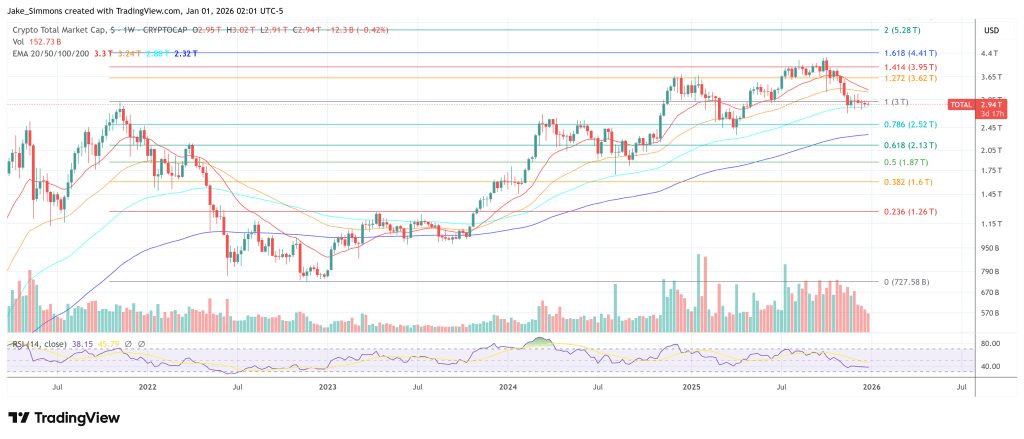
Total crypto market cap holds above the 2021 high, 1-week chart | Source: TOTAL on TradingView.com

Trending Cryptos

Related Questions

QWhat does CoinFund President Christopher Perkins predict will be the total value of crypto M&A deals in 2026?

AChristopher Perkins predicts that the total value of crypto M&A deals will reach $25 billion in 2026.

QAccording to Perkins, what will be the new all-time high price for Bitcoin in 2026?

APerkins predicts that Bitcoin will hit a new all-time high of $150,000.

QWhat is the predicted total market cap for stablecoins in 2026, and what is the reasoning behind this growth?

AStablecoins are predicted to surpass a $600 billion market cap, doubling in size. The growth is driven by issuer economics, as they earn net interest income, and the need for stablecoins as a settlement asset for buying and selling tokenized markets.

QWhat major event does Perkins forecast will act as a catalyst for policy changes in the crypto industry?

APerkins forecasts that a major hack exceeding $2 billion will shake confidence, lead to a market drawdown, and catalyze policy changes.

QHow does Perkins describe the comeback of NFTs, and what form will they take?

APerkins predicts NFTs will make a comeback, but not as JPEGs (with an exception for CryptoPunks). Instead, he expects 'version 2.0' to be financial, non-fungible tokens, potentially tied to individualized, tokenized security or yield vaults.

Related Reads

Michael Saylor: 110 Reasons to Oppose BIP-110

Michael Saylor presents 110 arguments against Bitcoin Improvement Proposal (BIP) 110, a soft fork aimed at restricting certain non-monetary data storage uses (like inscriptions) on the Bitcoin blockchain. He acknowledges the proponents' valid concerns—such as node costs, fee pressure, and preserving Bitcoin's monetary focus—but fundamentally disagrees with the proposed solution. Saylor argues that BIP 110 represents a dangerous precedent of using consensus rules to enforce value judgments on transaction validity, moving away from Bitcoin's core principles of neutrality and permissionless innovation. His key objections are organized into eleven categories: 1) It violates neutrality and hard consensus by banning currently valid transactions. 2) It fails to meet the high burden of proof required for a consensus change, lacking concrete data on the alleged crisis. 3) Its seven bundled technical restrictions are overly broad, targeting generic script functionalities and blocking future upgrade paths. 4) It sacrifices compatibility and future optionality by closing off designed upgrade hooks. 5) Its temporary rules add significant complexity (grandfathering, expiry states) without sufficient justification. 6) The economic and security impacts, particularly on miner revenue and fee markets, are uncertain and unmodeled. 7) Superior, market-based tools (fee markets, relay/mining policies) already exist to manage blockchain load. 8) It stifles innovation by creating a chilling effect for developers. 9) Its modified activation mechanism (55% threshold, forced signaling) is aggressive and risks network splits. 10) The precedent it sets—using consensus to suppress disliked but legal uses—is more dangerous than the problem it aims to solve. 11) A better path exists: improving measurements, refining resource-based policies, and allowing market forces to work. Saylor concludes that Bitcoin's strength lies in its neutral rules, open markets, and hard consensus. Changing these foundational elements to target specific use cases is an unnecessary and risky "iatrogenic" intervention. He advocates for guarding Bitcoin's neutrality rather than acting as its redeemer.

marsbit15m ago

Michael Saylor: 110 Reasons to Oppose BIP-110

marsbit15m ago

Trading

Spot

Hot Articles

Discussions

Welcome to the HTX Community. Here, you can stay informed about the latest platform developments and gain access to professional market insights. Users' opinions on the price of S (S) are presented below.

活动图片












