Crypto moves on as banks push back – What Brazil and Venezuela reveal

ambcryptoPublished on 2025-12-14Last updated on 2025-12-14

Abstract

U.S. banking groups are challenging the OCC's approval of national trust charters for crypto firms, arguing it creates regulatory gray areas and risks financial instability. Meanwhile, regulatory and financial systems worldwide are advancing crypto integration. The CFTC is testing systems to include crypto in cross-margining with U.S. Treasuries. Brazil’s largest bank, Itaú Unibanco, advises clients to allocate up to 3% of their portfolio to Bitcoin as a long-term hedge. In Venezuela, stablecoins like USDT have become essential for daily transactions, remittances, and payroll due to hyperinflation and unreliable banking. Despite traditional resistance, crypto adoption continues to grow, signaling its irreversible integration into the global financial system.

U.S. banking groups are pushing back against the OCC’s approval of crypto trust charters. Elsewhere, the conversation has already moved on.

Brazil’s largest bank is advising Bitcoin [BTC] exposure. U.S. regulators are integrating crypto into treasury market plumbing. In Venezuela, stablecoins have become a necessity.

Traditional banks may still be arguing the case. The financial system, meanwhile, is getting on with it.

To be, or not to be…a bank?

Trade groups representing traditional banks challenged the Office of the Comptroller of the Currency’s (OCC) decision to approve national trust charters for crypto firms.

At the center of the dispute are conditional approvals granted to a handful of digital asset players. This is a move the OCC insists followed the same review process applied to any bank charter.

Banking groups disagreed.

They argued the move created a gray zone. These firms resembled banks, gained federal status, yet lacked deposit insurance and full bank-level oversight.

On behalf of the American Banking Association, Rob Nichols, President and CEO, said,

“We are concerned that expanding the trust charter in this way… could blur the lines of what it means to be a bank and create opportunities for regulatory arbitrage.”

The ICBA went further. In their statement, President and CEO Rebeca Romero Rainey noted,

“The OCC’s dramatic policy change… allows for an inconsistent regulatory framework that threatens financial instability.”

And while this chatter goes back and forth, crypto is gaining steam on higher levels.

Regulation takes over on the other side

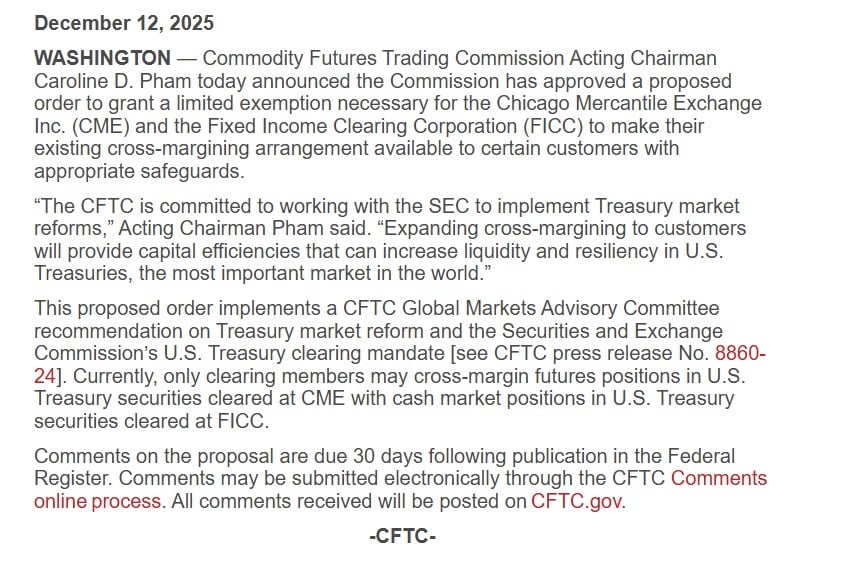
The CFTC’s recent move to expand cross-margining for U.S. Treasuries may sound technical, but the intent is pretty straightforward.

By letting Treasuries be netted alongside futures, regulators are testing systems that could eventually hold crypto and tokenized assets in the same portfolio. The idea is to increase efficiency and risk control.

In the press release, CFTC Acting Chairman Caroline Pham said,

“Expanding cross-margining to customers will provide capital efficiencies that can increase liquidity and resiliency in U.S. Treasuries, the most important market in the world.”

And whatever the industry debate looks like on the surface, the groundwork for integration is already being laid.

Source: cftc.gov

Brazil isn’t going to wait!

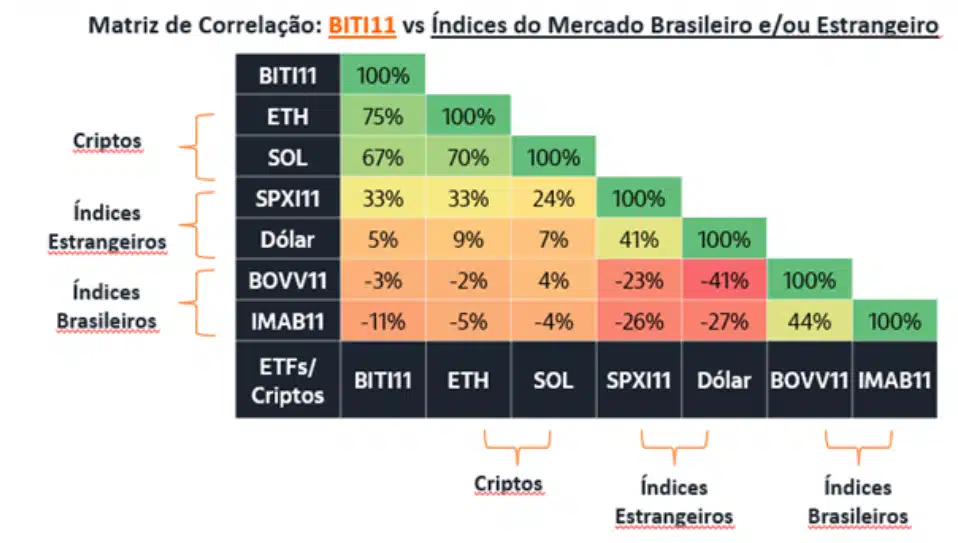
The country’s largest private bank is already treating Bitcoin like a portfolio tool.

Itaú Unibanco has recently advised clients to allocate a small slice (up to 3%) to Bitcoin. Not as a trade, but as protection!

Source: Itau

The logic is simple. Bitcoin doesn’t move like local stocks or bonds, and it offers some shelter when the real weakens. Itaú is clear this isn’t about chasing price swings or making crypto a core holding.

It’s meant to be limited, long-term, and disciplined.

For Venezuelans, crypto is non-negotiable

In Venezuela, stablecoins replaced traditional banking functions for many households and businesses.

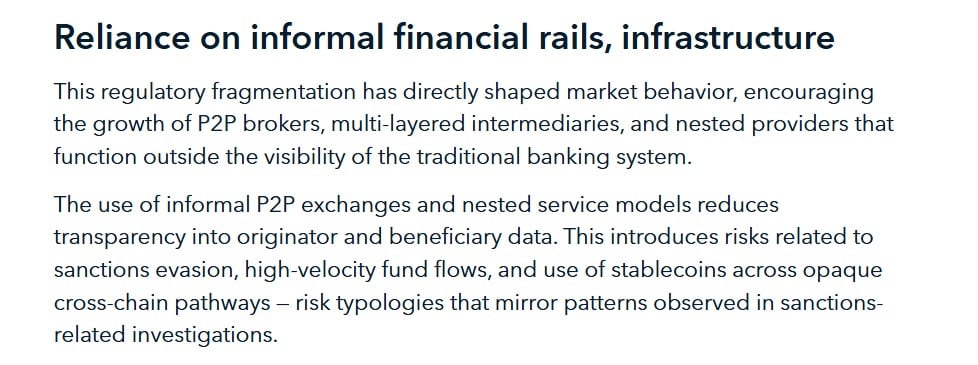
USDT supported payroll, remittances, vendor payments, and cross-border purchases. Peer-to-peer platforms played a central role.

More than 38% of local crypto traffic flowed through a single P2P service enabling crypto-to-fiat conversions.

Source: TRM Labs

A report from TRM Labs noted that, absent major economic or regulatory changes, demand for stablecoins will likely keep growing.

For Venezuelans, crypto means survival. It is a reliable medium of exchange where the bolívar continues to lose value and traditional banking remains unreliable.

A gap that keeps growing

The clash between banks and crypto-forward regulators brings to mind a fundamental gap in priorities. Traditional banks worry about rules, parity, and systemic risk.

Regulators, global institutions, and forward-looking banks are focused on efficiency, resilience, and meeting real market demand.

What happens next could will define crypto’s global role.

National charters, market-structure reforms, institutional allocations, and widespread adoption internationally all point to the same trend: digital assets are becoming part of the financial system, whether legacy banks like it or not.

Resistance from traditional players may slow the pace, but it can’t stop the integration.


Final thoughts

  • While US banks resist crypto charters, regulators and global institutions are already moving ahead.
  • Crypto adoption is advancing beyond regulatory debate.
Next: Bitcoin stuck below $94K: Demand fails to kickstart a recovery
Share
  • Share
  • Tweet

Trending Cryptos

Related Reads

Dialogue with Yihui Capital, SoundAI Technology, Ling Universe, and Zhongbo Jili: Opportunities and Challenges in the AI Smart Hardware Track

On June 28, 2026, an event titled "New Opportunities in AI Hardware: The Battle for Interactive Entry Points Begins" was held in Beijing. It featured a report from ITJuzi and discussions with experts from SoundAI, Ling Universe, One Reed Capital, and Zhongbo Juli on the opportunities and challenges in China's AI hardware sector. Key report findings highlight the sector's intense activity: 327 out of 431 startups founded post-2023 have secured funding, with 179 investments in H1 2026 alone. The landscape is dominated by embodied intelligent robots, while wearable tech like smart rings and AI glasses shows rapid growth. Geographically, Shenzhen leads, leveraging its superior hardware supply chain, followed by Beijing and Shanghai. The overarching trend is for companies to focus on micro-innovations within specific scenarios rather than reinventing foundational technology. Industry leaders shared several critical insights: 1. **Balancing Innovation & Market Readiness**: Entrepreneurs face the "hammer looking for a nail" dilemma. Success requires balancing technical capability with user acceptance, cost control, and incremental design improvements rather than chasing disruptive innovation. 2. **Competitive Landscape**: The future interactive entry point may not be a single super-device but a mix of universal terminals and specialized, scenario-specific hardware. While large companies have ecosystem advantages, startups can win by deeply targeting vertical markets and specific user groups. 3. **Core Challenges & Business Models**: Key hurdles include deep understanding of AI models and navigating non-transparent hardware supply chains. Viable business models may involve selling hardware at cost and generating revenue through software subscriptions, but this requires tight control over both hardware BOM and model inference costs. 4. **The Road to Commercialization**: The ultimate test is market validation—achieving sales growth and sustainable cash flow. Companies must find the right application scenario, use edge computing effectively, and close the loop from technology to commercial success. 5. **The Future of Interaction**: Proactive, context-aware interaction is the next frontier, though it's currently limited by issues like model hallucinations and environmental perception. The near-term focus should be on identifying target users and creating a coherent experience in specific domains, such as health wearables. In summary, to succeed in the competitive AI hardware arena, companies must strategically choose their niche, build a team with the right geographical advantages (e.g., leveraging Shenzhen's supply chain), and most importantly, execute a flawless commercialization strategy that translates technology into market-accepted products and sustainable business growth.

marsbit42m ago

Dialogue with Yihui Capital, SoundAI Technology, Ling Universe, and Zhongbo Jili: Opportunities and Challenges in the AI Smart Hardware Track

marsbit42m ago

CryptoQuant Founder: The Cost to Double BTC Has Increased by 20,000 Times, Where Will the $100 Billion Buying Power Come From?

CryptoQuant founder Ki Young Ju analyzes Bitcoin's current capital challenge. He notes that the cryptocurrency market has grown too large for retail-driven momentum alone to generate massive price increases as in past cycles. His calculations show that in 2011, approximately $2.7 million in capital inflow could push BTC's price up by 550x, whereas the current cycle requires an estimated $101 billion in new capital just for a 100% price increase. This shift underscores that sustaining a bull run now depends on attracting large-scale, long-term institutional capital rather than short-term speculative trading. Recent outflows from US spot Bitcoin ETFs, totaling nearly $10 billion since May, highlight the fragility of current demand and challenge the narrative of deep institutional support. While surveys indicate continued institutional interest, these entities prioritize regulated products, risk management, and portfolio integration over speculative gains. For the next significant bull market, Bitcoin must transition to being a core macro asset. The key drivers are no longer just more buyers, but capital allocation from larger, slower-moving entities like wealth advisors, corporate treasuries, banks, and sovereign wealth funds. This new phase pits Bitcoin against other major asset classes like AI for a share of institutional capital, making its growth trajectory dependent on sustained, high-quality inflows from diversified financial balance sheets.

marsbit46m ago

CryptoQuant Founder: The Cost to Double BTC Has Increased by 20,000 Times, Where Will the $100 Billion Buying Power Come From?

marsbit46m ago

Trading

Spot

Hot Articles

How to Buy PUSH

Welcome to HTX.com! We've made purchasing Push Protocol (PUSH) simple and convenient. Follow our step-by-step guide to embark on your crypto journey.Step 1: Create Your HTX AccountUse your email or phone number to sign up for a free account on HTX. Experience a hassle-free registration journey and unlock all features.Get My AccountStep 2: Go to Buy Crypto and Choose Your Payment MethodCredit/Debit Card: Use your Visa or Mastercard to buy Push Protocol (PUSH) instantly.Balance: Use funds from your HTX account balance to trade seamlessly.Third Parties: We've added popular payment methods such as Google Pay and Apple Pay to enhance convenience.P2P: Trade directly with other users on HTX.Over-the-Counter (OTC): We offer tailor-made services and competitive exchange rates for traders.Step 3: Store Your Push Protocol (PUSH)After purchasing your Push Protocol (PUSH), store it in your HTX account. Alternatively, you can send it elsewhere via blockchain transfer or use it to trade other cryptocurrencies.Step 4: Trade Push Protocol (PUSH)Easily trade Push Protocol (PUSH) on HTX's spot market. Simply access your account, select your trading pair, execute your trades, and monitor in real-time. We offer a user-friendly experience for both beginners and seasoned traders.

3.9k Total ViewsPublished 2024.03.29Updated 2026.06.02

How to Buy PUSH

Discussions

Welcome to the HTX Community. Here, you can stay informed about the latest platform developments and gain access to professional market insights. Users' opinions on the price of PUSH (PUSH) are presented below.

活动图片