Author: Deep Tide TechFlow
Yesterday's Market Dynamics
US Initial Jobless Claims for the Week Ending Feb 21: 212K, Expected 215K
US initial jobless claims for the week ending February 21 were 212,000, compared to an expectation of 215,000. The previous week's figure was revised from 206,000 to 208,000.
Reuters: US CFTC States It Has Authority to Regulate Improper Trading in Prediction Markets
According to a Reuters report, the US Commodity Futures Trading Commission (CFTC) stated on Wednesday that it has the authority to regulate illegal trading activities in prediction markets. This announcement came after the prediction market platform Kalshi reported two cases of insider trading to the agency.
The CFTC declared it has "full regulatory authority" over misconduct in event market contracts, citing Kalshi's report. The company had flagged and frozen trading accounts associated with two insider trading incidents. As prediction markets grow, concerns about insider trading are increasing, with a senior US Department of Justice official listing it as a key enforcement area this month. State gambling regulators are also seeking to oversee these markets as they compete with casinos and traditional betting companies.
Previous news: Kalshi cracks down on insider trading, imposing bans and fines on a MrBeast employee and a former California gubernatorial candidate.
Bipartisan US Lawmakers Introduce Bill to Protect Blockchain Developers from Criminal Charges
According to a disclosure by Eleanor Terrett, US Republican Congressmen Fitzgerald (Wisconsin), Cline (Virginia), and Democratic Congresswoman Lofgren (California) have jointly introduced the "Blockchain Development Innovation Act of 2026," aiming to clarify the scope of application of Section 1960 of the criminal code. The bill explicitly states that Section 1960 applies only to entities controlling customer funds, not developers merely writing code. Previously, in cases like Tornado Cash and Samourai Wallet, regulators applied this section to non-custodial software developers, sparking strong backlash from the crypto industry. This bill will provide legal protection for blockchain developers, addressing a long-standing point of conflict between crypto innovation and regulation.
US OCC Releases Proposed Rule to Implement the GENIUS Act, Seeks Public Comment
According to crypto reporter Eleanor Terrett, the US Office of the Comptroller of the Currency (OCC) today released a proposed rule to implement the GENIUS Act and is seeking public comment. This framework will establish basic rules for licensed stablecoin issuers under OCC supervision and foreign payment stablecoin issuers, while also covering specific custody activities.
OCC Acting Comptroller Jonathan Gould stated that the goal of the rule is to create a system where stablecoins can "flourish in a safe and sound manner." Notably, the rule does not yet include anti-money laundering (BSA/AML) and Office of Foreign Assets Control (OFAC) related provisions; these will be handled separately in coordination with the Treasury Department.
ZachXBT: Axiom Trading Platform Executives Abused Internal Tools for Insider Trading
ZachXBT exposed Axiom trading platform's Senior Business Development Manager, Broox Bauer, for allegedly abusing internal system access privileges since early 2025 to conduct insider trading by tracking users' private wallet activities through referral codes, wallet addresses, or user IDs. Evidence shows that Broox shared screenshots of internal dashboards in April and August 2025, leaking private wallet and registration information of several traders. Axiom was founded in 2024 by Mist and Cal, incubated by Y-Combinator, and has rapidly grown, generating over $390 million in revenue to date.
Magic Eden to Shut Down Bitcoin and EVM Markets, Terminate Multi-Chain Wallet Service
According to Blockspace, the NFT trading platform Magic Eden plans to shut down its Bitcoin and EVM markets and terminate its multi-chain wallet service. Insiders revealed that Magic Eden could announce this decision as early as this Friday, with plans to shut down the Bitcoin and EVM markets in the first week of March. Subsequently, its multi-chain wallet will enter export-only mode in mid-March and cease service completely in early April.
It is reported that Magic Eden will continue to support Solana NFTs and assets, indicating the company is returning to its original Solana ecosystem focus. Magic Eden was a dominant market for Bitcoin Ordinals (a Bitcoin-specific NFT standard). Magic Eden CEO Jack Lu previously stated that the company is shifting from an NFT marketplace to new directions in "crypto entertainment," such as prediction markets.
Caixin: Rumors Suggest Chinese Regulators Reviewing Jane Street's Behavior Patterns in China's ETF Market Trading
According to Caixin Net, rumors suggest Chinese regulators are reviewing Jane Street's behavior patterns in trading within China's ETF market. However, a person close to Jane Street said: "Know nothing about these rumors and have no reason to believe they are true. These rumors should not be linked to Jane Street." This week, Jane Street, its co-founders, and two employees were accused of insider trading, fraud, and market manipulation, actions also alleged to have accelerated the $40 billion collapse of the TerraUSD (UST) stablecoin and its sister token Luna in 2022.
Founded in 1999, Jane Street is one of the world's largest proprietary quantitative trading firms. Its net trading revenue in 2024 exceeded $20 billion, with net profit接近 $13 billion. Unlike hedge funds, Jane Street does not accept external client funds, resulting in far lower disclosure obligations than traditional asset management institutions. This structure has long maintained its mystique.
Global Times Publishes Article: 'The Cases of Chen Zhi and Changpeng Zhao: US Profits Nearly $20 Billion'
Global Times published a WeChat article titled 'The Cases of Chen Zhi and Changpeng Zhao: US Profits Nearly $20 Billion'. According to a joint report by China's National Computer Virus Emergency Response Center and other agencies, the US uses its technological hegemony to harvest global virtual currency assets on a large scale. Between 2022 and 2025, the US confiscated global virtual currency assets worth over $30 billion through various cases. In the Chen Zhi case, approximately 127,000 bitcoins were confiscated, worth about $15 billion, accounting for 50% of the total. In the case of Binance founder Changpeng Zhao, the US obtained a $4.3 billion fine through "civil + criminal" dual accountability.
The report also disclosed that from 2023 to 2025, hacker groups with suspected US government backing launched targeted attacks against over 20 major global virtual currency exchanges, stealing user wallet private keys, platform transaction records, and other information. The report pointed out that through these actions, the US not only increases fiscal revenue but also strengthens the global virtual currency asset trading system's reliance on the US dollar.
SBF: The Biggest Question in Crypto Is Whether AI Will Use It as a Payment Method
FTX founder Sam Bankman-Fried's (SBF) X account posted: "The biggest question in the crypto space is: Will AI use it? Suppose an instance of ChatGPT or Claude needs more computing resources. Does it support wire transfers, credit cards, or crypto payments? On one hand, traditional finance models don't work for AI. For example—how do they do KYC? They don't have passports, addresses, social security numbers, or even names. Crypto works much better—it's natively digital, permissionless, AIs can already query the blockchain, etc. On the other hand, we might see a 'proxy' model: Each AI is treated as an agent for a specific human, and that human is responsible for doing KYC, being liable for the AI's actions, etc. This raises a related question: who should bear legal responsibility for AI's actions? Regardless, work needs to be done to integrate AI into trading and payments. That work will either be natively digital and crypto-based, or it will rely on human 'handlers' to control the AI. Where it goes has huge implications for the world. One of those is the future of crypto."
Supreme People's Court: Next Step is to Focus Crackdown on Associated Crimes Like 'Money Laundering' Using Virtual Currency, Underground Banks
According to the Shanghai Securities News, Wang Bin, Head of the Third Criminal Division of the Supreme People's Court, stated at a press conference on "People's Courts' Work in Punishing Telecom Fraud and Property Crimes According to Law" on February 26th that the next step for courts is to focus the crackdown on principal elements and key members of criminal groups, telecom fraud "gold masters," "snakeheads" organizing illegal border crossings, organizations providing armed庇护 for cross-border telecom fraud crimes, as well as associated crimes committed during telecom fraud, such as intentional homicide, intentional injury, kidnapping, and other violent crimes, and "money laundering" using virtual currency and underground banks.
Wang Bin also stated that People's Courts will lawfully increase the application of property penalties against telecom fraud criminals, preventing criminals from gaining economically, guide individuals involved in "two-card" (帮信, 掩隐) crimes to voluntarily compensate victims, consider restitution as a factor for leniency in sentencing for pleading guilty and showing remorse, and severely punish criminals who have the ability but refuse to make restitution.
Crypto Trading Platform STS Digital Completes $30 Million Funding Round, Led by CMT Digital
According to a Fortune report, cryptocurrency trading platform STS Digital recently announced the completion of a $30 million funding round led by CMT Digital, with participation from Kraken, Arrington Capital, and an investment arm of Fidelity. The platform focuses on providing options trading services for over 400 cryptocurrencies to institutional investors and acts as a market maker providing liquidity.
STS Digital was founded in 2022 by former Credit Suisse and UBS traders Maxime Seiler and Gideon Hyams and has grown to nearly 50 employees. The company's revenue tripled between 2024 and 2025, it is profitable, and its clients include well-known crypto companies like the Uniswap Foundation.
The company plans to use this funding round to scale its trading operations, serve larger institutional clients, and increase its headcount. Amid crypto market volatility, STS Digital believes options trading provides institutional investors with better risk management tools compared to perpetual contracts.
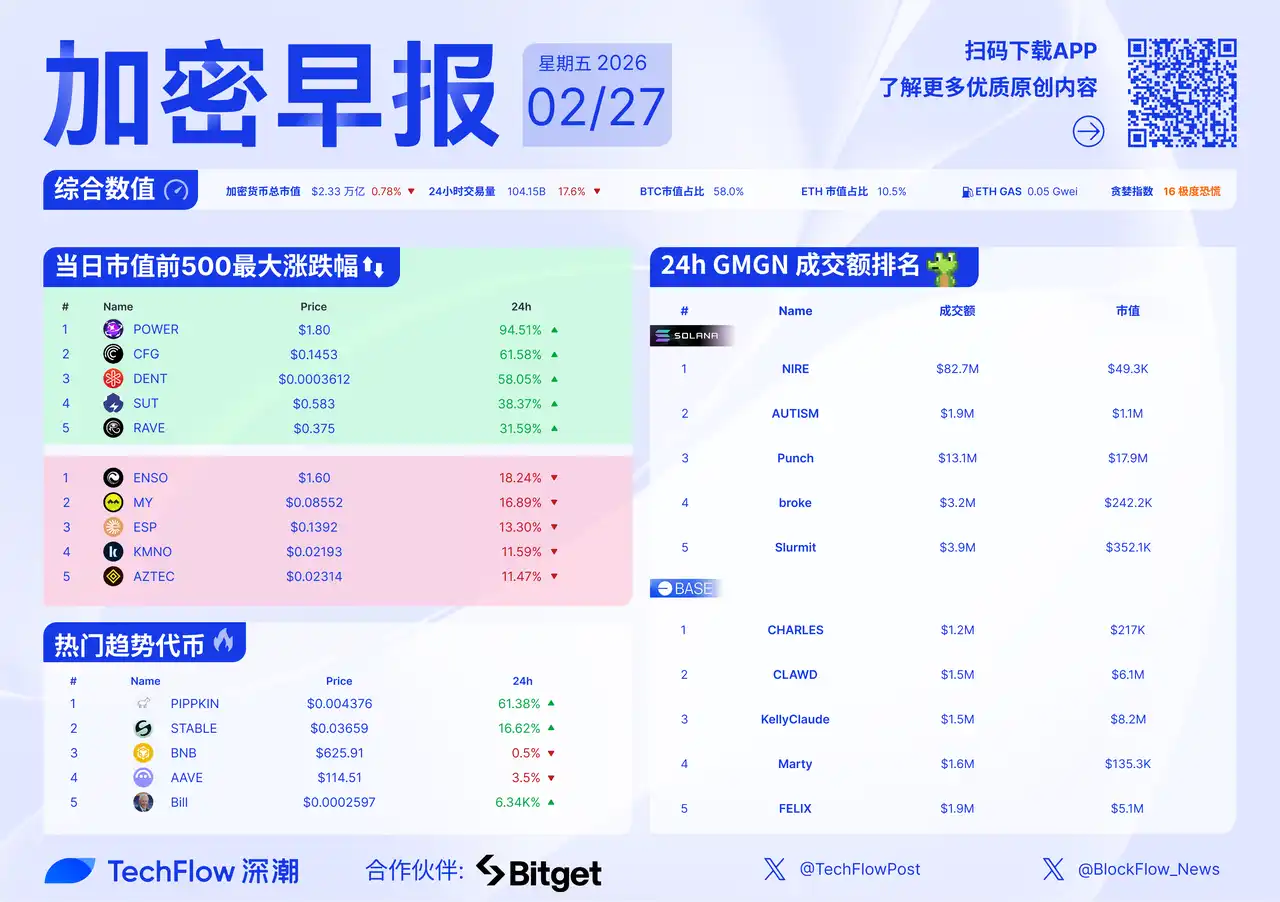
Market Dynamics
Recommended Reading
Full ZachXBT Investigation: Axiom Employees Used Internal Permissions for Insider Trading
This article accuses multiple employees of the crypto trading platform Axiom of abusing internal permissions for insider trading, involving the use of user wallet information to help accomplices quickly profit $200,000. This behavior exposed major vulnerabilities in the platform's permission controls. The investigative report details the operational details of the employees involved, including using backend data to track user information, collaborating with team members to set rules, and transferring funds through centralized exchanges. The report emphasizes Axiom's lack of monitoring mechanisms and permission management and recommends further legal action.
Token Going Global: Selling Chinese Computing Power to the World
This article explores how China's AI models and related technologies are achieving "computing power出海 (going global)" through Tokens and occupying an important position in the global developer market. This phenomenon is seen as a new technological and economic game, particularly with profound significance in the strategic competition between China and the US.
In This Pig-Butchering Scam, AI is Responsible for the Romance and the Fake Lawyer License
This article details the modus operandi of a fraud ring, including how they use AI for romantic conversations, generate false information, estimate the "squeezing value" of victims, and further defraud victims of money through fake law firms and虚假 dating platforms. The article also mentions that while AI technology hasn't changed the nature of fraud, it significantly reduces the cost of fraud, allowing the scale of scams to expand. Furthermore, the article emphasizes the potential risks of AI technology, especially with locally deployed open-source models, which could be harder to track and prevent.
February 26 Market Summary: Nvidia Earnings Ignite AI Frenzy, Circle Leads Crypto Market Counterattack
This article discusses how Nvidia's earnings report ignited an AI boom, and the crypto market was boosted by Circle's financial results, with Bitcoin rising sharply. The importance of stablecoins as crypto market infrastructure is evident, with the rising circulation of USDC indicating capital flowing into the crypto market. US tech stocks staged a strong rebound, led by the Nasdaq, with Nvidia's earnings further driving market gains.
We Built a Perp DEX, Everyone Says It's Incredible
This article introduces a decentralized exchange (DEX) called Perpl, the first to achieve fully on-chain execution, a true Central Limit Order Book (CLOB), and efficient Gas fee support. The article details Perpl's technical architecture, performance optimization, market advantages, and its potential impact on the decentralized finance (DeFi) ecosystem.