Crypto Morning Brief: WLFI Launches Lending Market, BitMine Plans to Slow ETH Accumulation

marsbitPublished on 2026-01-13Last updated on 2026-01-13

Abstract

Crypto Briefing: Market Dynamics: Multiple institutions, including Citi and Goldman Sachs, have revised their forecasts, pushing the earliest expected Fed rate cuts to June 2024. Former Fed chairs have voiced support for Chair Powell amid an unprecedented criminal investigation. The new CFTC Chairman has rebranded a committee to focus on digital assets and AI, appointing leaders from Polymarket and Gemini. Former NYC Mayor Eric Adams announced an "NYC Token" to combat antisemitism, though details are scarce. Dubai has banned privacy coins and tightened stablecoin regulations. South Korea has lifted its ban, now allowing corporations to invest up to 5% of equity in top-20 cryptocurrencies. Key Developments: Trump-affiliated project WLFI (World Liberty Financial) has launched a lending market powered by Dolomite, supporting ETH, USDT, and its own tokens. Standard Chartered plans to establish a crypto custody brokerage service. Custodian BitGo has filed for a US IPO seeking up to $201M. ETH treasury firm BitMine warned it may slow its accumulation of Ethereum if shareholders do not approve a proposal to issue new shares this week.

Author: Shenchao TechFlow

Yesterday's Market Dynamics

Multiple Institutions Predict Fed's Earliest Rate Cut Timing to Be Delayed

According to Jinshi Data, multiple institutions predict the Fed's earliest rate cut timing will be delayed:

Citigroup: Expects the Fed to cut rates by 25 basis points each in March, July, and September, previously predicted cuts in January, March, and September this year.

Goldman Sachs: Expects the Fed to implement a 25 basis point rate cut each in June and September this year, previously expected in March and June.

Barclays: Expects the Fed to implement a 25 basis point rate cut each in June and December this year, previously expected in March and June.

Morgan Stanley: Expects the Fed to implement a 25 basis point rate cut each in June and September, previously predicted for January and April this year.

JPMorgan: No longer expects the Fed to cut rates in 2026, anticipates a rate hike in 2027. Previously expected a 25 basis point cut in January, now forecasts a 25 basis point hike in Q3 2027.

Multiple Former Fed Chairs Support Powell, Calling Criminal Investigation an "Unprecedented" Attack on Fed Independence

According to Jinshi Data, former Fed Chairs Yellen, Bernanke, and Greenspan issued a statement supporting current Fed Chair Powell. The group stated the criminal investigation against Powell is an "unprecedented" attack on the Fed's independence.

CFTC Chair Selig Establishes Innovation Committee to Strengthen Digital Asset and Prediction Market Regulation

According to The Block, new U.S. Commodity Futures Trading Commission (CFTC) Chair Michael Selig announced on January 12 the renaming of the Technology Advisory Committee to the Innovation Advisory Committee and plans to appoint members of the CEO Innovation Committee as charter members. This committee will include industry leaders such as Polymarket CEO Shayne Coplan, Kalshi CEO Tarek Mansour, and Gemini CEO Tyler Winklevoss.

Selig stated: "Innovators are using technologies like AI, blockchain, and cloud computing to modernize traditional financial systems and build entirely new ones. Under my leadership, the committee will develop fit-for-purpose market structure regulations for new frontiers in finance."

Former NYC Mayor Eric Adams Announces Launch of "NYC Token"

According to Fortune, former New York City Mayor Eric Adams announced after leaving office the launch of a cryptocurrency called "NYC Token," stating the project aims to raise funds to combat anti-Semitism, anti-American sentiment, and promote blockchain education for children. Adams introduced the token in Times Square but did not disclose partners, issuance timing, fund usage, or specific mechanisms, only stating that ordinary New Yorkers can participate in the investment. Adams strongly supported the crypto industry during his tenure but also faced controversy over ethics and conflict of interest issues. New Mayor Zohran Mamdani has explicitly stated he will not purchase the token.

Dubai to Ban Privacy Tokens and Tighten Stablecoin Regulations, New Regulatory Framework Effective January 12

According to CoinDesk, the Dubai Financial Services Authority (DFSA) has completely banned privacy tokens in the Dubai International Financial Centre (DIFC), citing incompatibility with global compliance standards and risks related to money laundering and sanction compliance.

The updated crypto token regulatory framework, effective January 12, shifts token approval responsibility to businesses and tightens the definition of stablecoins. The DFSA limits the "fiat crypto token" category to tokens pegged to fiat currency and backed by high-quality liquid assets, capable of meeting redemption demands during market stress. Algorithmic stablecoins like Ethena are not considered stablecoins under the DIFC framework but are classified as crypto tokens.

DFSA Deputy Director of Policy & Legal, Elizabeth Wallace, stated that privacy tokens have features that hide transaction history and holders, making it nearly impossible for businesses to comply with Financial Action Task Force (FATF) requirements. The new rules also prohibit regulated firms from using or providing privacy tools like mixers or tumblers that obscure transaction details.

South Korea Ends Nine-Year Corporate Crypto Ban, Allows 5% Equity Investment in Top 20 Cryptocurrencies

According to Be in Crypto, South Korean Financial Services Commission (FSC) has officially approved listed companies and professional investors to invest up to 5% of their equity annually in the top 20 cryptocurrencies by market cap, ending a ban in place since 2017. Approximately 3,500 eligible entities will be permitted market access.

WLFI Launches Lending Market Powered by Dolomite

According to market news, WLFI has launched a lending market powered by Dolomite.

Bloomberg: WLFI Crypto Lending Platform Named "World Liberty Markets," Supports ETH, USD1, USDT, etc.

According to Bloomberg, the Trump family's crypto project World Liberty Financial has launched a platform allowing users to lend digital assets to each other, named "World Liberty Markets." The service will officially launch on Monday. In addition to Ethereum, stablecoins USDC and USDT, it will also support the company's own token WLFI and stablecoin USD1.

Bloomberg: Standard Chartered Plans to Establish Crypto Custody Brokerage Services

According to Bloomberg, Standard Chartered plans to establish cryptocurrency custody brokerage services to strengthen its competitiveness in the digital asset space.

Sources reveal that the London-based bank will set up this new business within its wholly-owned venture capital arm, SC Ventures. Placing the new business within SC Ventures may help Standard Chartered avoid the strict capital requirements for digital assets in its corporate and investment bank.

BitGo Plans US IPO, Aims to Raise Up to $201 Million

According to Reuters, crypto asset custody startup BitGo stated in a regulatory filing on Monday that it plans to raise up to $201 million in a US Initial Public Offering (IPO).

BitMine: Will Slow ETH Accumulation Speed Without Shareholder Approval

According to CoinDesk, BitMine company chairman Thomas Lee stated on Monday that BitMine's ability to continue accumulating ETH depends on whether shareholders approve the issuance of new shares. Without approval, the company may be forced to slow its purchasing pace in the coming weeks. Lee explained: "BitMine is about to exhaust its current authorization of 500 million shares, at which point our ETH accumulation will slow down." A related shareholder vote is scheduled for this Thursday, and the proposal requires support from 50.1% of the issued shares to pass.

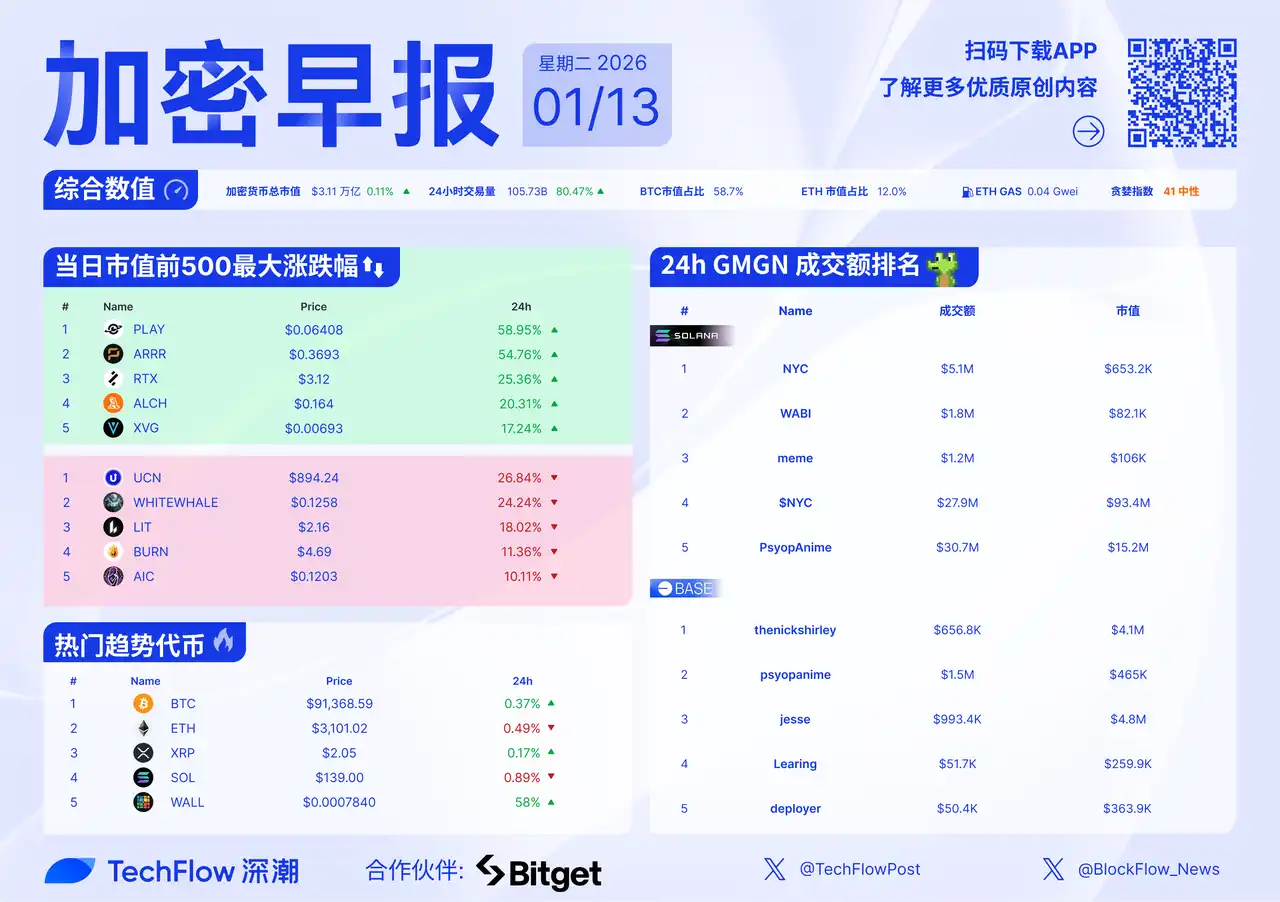
Market Dynamics
Recommended Reading

A-Shares Frenzy Crashes Servers, Crypto Still Waiting for Twitter to Save It

This article explores the current state and trends of the stock market and cryptocurrency market, focusing on the analysis of the A-share frenzy and the crypto market's困境 (difficult situation/pred困境 is translated as困境/difficulties), and questions the impact of social platform features on cryptocurrency adoption.

1000 RMB "Are You Dead" App Achieves 10 Million RMB Valuation

This article introduces an app called "Are You Dead" (死了么). Developed by three post-95s developers with 1000 RMB cost within a month, this simple application's function is for users to check in daily to confirm they are still alive. If a user fails to check in for two consecutive days, the system automatically sends an email to their emergency contact. Despite its simplicity, the app quickly went viral after launch, topped the Apple paid charts with a download fee of 8 RMB, and reached a valuation of 10 million RMB. The article also discusses the differences in valuation standards between the internet and crypto industries.

a16z: Three Major AI Trends for 2026

This article discusses three major trends and challenges that artificial intelligence (AI) may bring in the coming years, as well as its impact on areas such as open networks, economic foundations, and identity verification. The article also mentions some technical solutions and potential future development directions.

New "Yi Zhongtian" Emerges Overnight! GEO Explodes in Popularity, Explained in One Article

This article explores the importance of Generative Engine Optimization (GEO) in the era of AI search and how it redefines brand exposure and marketing strategies. Compared to traditional Search Engine Optimization (SEO), GEO focuses more on the awareness and credibility of brand content, optimizing content to be cited by AI, thereby achieving higher visibility in AI-generated answers. This represents a shift from "traffic thinking" to "answer thinking," while also bringing new business models and market opportunities to the advertising industry.

IOSG | Cryptocurrency Marketing Ecosystem Research: Focusing on the South Korean Market

This article provides an in-depth analysis of the current state, development trends, major media agencies, marketing agencies, research companies, and blockchain conference ecosystem of the South Korean cryptocurrency market. It explores the importance of the South Korean market in the global crypto field and how international projects can enter and establish themselves in this market.


Related Questions

QWhat is the new lending market launched by WLFI and what powers it?

AWLFI launched a lending market powered by Dolomite, supporting assets like ETH, USD1, USDT, and its own token WLFI.

QWhy might BitMine slow down its ETH accumulation, and what is required to prevent this?

ABitMine may slow down ETH accumulation if shareholders do not approve the issuance of new shares. Approval of the proposal, requiring 50.1% support from outstanding shares in a vote scheduled for Thursday, is needed to continue accumulation at the current pace.

QWhat major change did South Korea's Financial Services Commission (FSC) make regarding corporate crypto investments?

AThe FSC ended a nine-year ban, allowing listed companies and professional investors to invest up to 5% of their equity capital annually in the top 20 cryptocurrencies by market capitalization.

QWhat did the Dubai Financial Services Authority (DFSA) ban, and what was the reason?

AThe DFSA banned privacy tokens within the Dubai International Financial Centre (DIFC) because they are incompatible with global compliance standards and pose money laundering and sanctions compliance risks.

QWhat did former New York Mayor Eric Adams announce after leaving office, and what is its stated purpose?

AEric Adams announced the launch of a cryptocurrency called 'NYC Token' to raise funds for combating anti-Semitism, anti-American sentiment, and promoting blockchain education for children.

Related Reads

Apple's Desired On-Device AI Sees a Dark Horse Emerge: The First Cognitive Model is Born, 4B Matches GPT-5.4

A Chinese company, Tomorrow's Journey (Nextie), has introduced what it is calling the industry's first "cognitive model" for edge devices. Named New Journey Alpha, this 4-billion-parameter model reportedly matches the performance of trillion-parameter giants like GPT-5.4 in group intelligence tasks such as debate and collective decision-making. The development follows Andrej Karpathy's vision of stripping vast factual knowledge from large language models to retain only a smaller "cognitive core" capable of reasoning, planning, and knowing its own limits. This approach directly addresses the soaring computational costs and token expenses hindering AI's widespread deployment, as highlighted by incidents like Amazon shutting down an internal AI tool due to prohibitive costs. Trained via reinforcement learning on a corpus of academic papers from 1800-2020 to enhance generalization, the model enables three key advancements: 1) Improved decision quality in multi-agent systems, 2) Drastically reduced compute costs, allowing for cost-effective cloud or on-device (e.g., MacBook) deployment, and 3) The feasibility of "proactive" AI agents that act autonomously without user prompts, unlocking new commercial possibilities beyond today's reactive models. Built by the former Microsoft Xiaoice team—known for creating a 3.6B model that outperformed a 65B Llama model—the company is now focusing on the multi-agent systems sector, a field gaining significant investor interest. The model's economic impact is profound; by achieving high-level performance with minimal parameters, it fundamentally alters the cost structure of AI services, challenging the prevailing model of ever-larger parameter counts.

marsbit30m ago

Apple's Desired On-Device AI Sees a Dark Horse Emerge: The First Cognitive Model is Born, 4B Matches GPT-5.4

marsbit30m ago

OpenAI's 'Blueprint for the Future': Making AI Beneficial for Every Person on the Planet

A new transformative technology emerges every few generations. OpenAI draws a parallel with the advent of electricity in the 1920s, which initially brought convenience but ultimately enabled unprecedented progress in medicine, engineering, and living standards by empowering people to create new possibilities. AI is poised to recreate this phenomenon. Its true significance lies not in the technology itself, but in what people can achieve with it—from understanding a medical bill or starting a business to aiding scientific discovery. OpenAI believes AI should be universally accessible, allowing everyone to use it according to their own needs. This future, however, is not guaranteed. While transformative tech can centralize power, OpenAI's philosophy is that AI must serve humanity, augmenting human capabilities and broadly distributing its benefits. The company's first commitment is to build AI for human service, aiming to empower the many rather than concentrate power in a few. Safety, alignment with human intent, and oversight are paramount. OpenAI is optimistic about AI's potential to expand human welfare but remains clear-eyed about risks. The goal is to help people achieve more, not to replace them. Full automation is not the desired future; human judgment, values, and direction will become even more critical. OpenAI outlines three core goals: 1. Build automated AI researchers to accelerate and increasingly automate the research process itself, maintaining close human collaboration. The internal projection is that by March 2028, a significant portion of their research will be conducted by AI systems working alongside human researchers. 2. Accelerate economic development by advancing science, boosting productivity, and fostering growth, while ensuring the fruits are widely shared. 3. Provide a personal AGI for everyone on Earth, allowing individuals to benefit from this transformative technology in their own way. The company is entering its third phase, moving from foundational AGI research (Phase 1) to product deployment and learning from real-world use (Phase 2). The current challenge is making advanced AI abundant, affordable, safe, practical, and usable for all individuals and organizations. OpenAI concludes that a widely distributed power structure leads to a more resilient, adaptable, and free society. A positive AI future should not be controlled by a handful of entities but built, benefited from, and owned by many. If realized correctly, AI can become a cornerstone for enhancing global productivity, creativity, scientific advancement, and economic opportunity, fulfilling the mission to ensure AGI benefits all of humanity.

marsbit1h ago

OpenAI's 'Blueprint for the Future': Making AI Beneficial for Every Person on the Planet

marsbit1h ago

Arthur Hayes' New Article: AI Bubble Nears Bursting, Crypto Market Faces Short-Term Pressure

In a new essay, Arthur Hayes argues that the AI market bubble is approaching a rupture, which will place significant short-term pressure on crypto assets. He identifies rising oil prices, a trio of massive tech IPOs (SpaceX, Anthropic, OpenAI), and potential anti-AI political rhetoric from Trump as the three key catalysts for a correction. Hayes posits that the prolonged blockage of the Strait of Hormuz will drive energy prices higher, increasing operational costs for data centers and squeezing AI company profits. Simultaneously, the market may struggle to absorb the upcoming wave of multi-trillion dollar tech IPOs. Furthermore, with high inflation hurting his election chances, Trump could pivot to attacking the AI sector with proposals for heavy taxation and regulation to win over voters, spooking the market. Hayes notes that nearly all new dollar liquidity since 2022 has flowed into the AI sector, leaving little for Bitcoin, explaining its recent underperformance. He believes an AI stock crash would trigger a broad risk-off sentiment and credit contraction, dragging down crypto in the near term. Consequently, his fund, Maelstrom, has sold all AI-related stocks and non-core cryptocurrencies, retaining only Bitcoin and Ethereum while building positions in traditional energy stocks. He anticipates Bitcoin will bottom and resume its bull run only after the AI bubble pops and a new monetary easing cycle begins.

marsbit1h ago

Arthur Hayes' New Article: AI Bubble Nears Bursting, Crypto Market Faces Short-Term Pressure

marsbit1h ago

Trading

Spot
Futures

Hot Articles

How to Buy WLFI

Welcome to HTX.com! We've made purchasing Official World Liberty Financial (WLFI) simple and convenient. Follow our step-by-step guide to embark on your crypto journey.Step 1: Create Your HTX AccountUse your email or phone number to sign up for a free account on HTX. Experience a hassle-free registration journey and unlock all features.Get My AccountStep 2: Go to Buy Crypto and Choose Your Payment MethodCredit/Debit Card: Use your Visa or Mastercard to buy Official World Liberty Financial (WLFI) instantly.Balance: Use funds from your HTX account balance to trade seamlessly.Third Parties: We've added popular payment methods such as Google Pay and Apple Pay to enhance convenience.P2P: Trade directly with other users on HTX.Over-the-Counter (OTC): We offer tailor-made services and competitive exchange rates for traders.Step 3: Store Your Official World Liberty Financial (WLFI)After purchasing your Official World Liberty Financial (WLFI), store it in your HTX account. Alternatively, you can send it elsewhere via blockchain transfer or use it to trade other cryptocurrencies.Step 4: Trade Official World Liberty Financial (WLFI)Easily trade Official World Liberty Financial (WLFI) on HTX's spot market. Simply access your account, select your trading pair, execute your trades, and monitor in real-time. We offer a user-friendly experience for both beginners and seasoned traders.

5.9k Total ViewsPublished 2025.09.01Updated 2026.06.02

How to Buy WLFI

Discussions

Welcome to the HTX Community. Here, you can stay informed about the latest platform developments and gain access to professional market insights. Users' opinions on the price of WLFI (WLFI) are presented below.

活动图片