Author: Deep Tide TechFlow
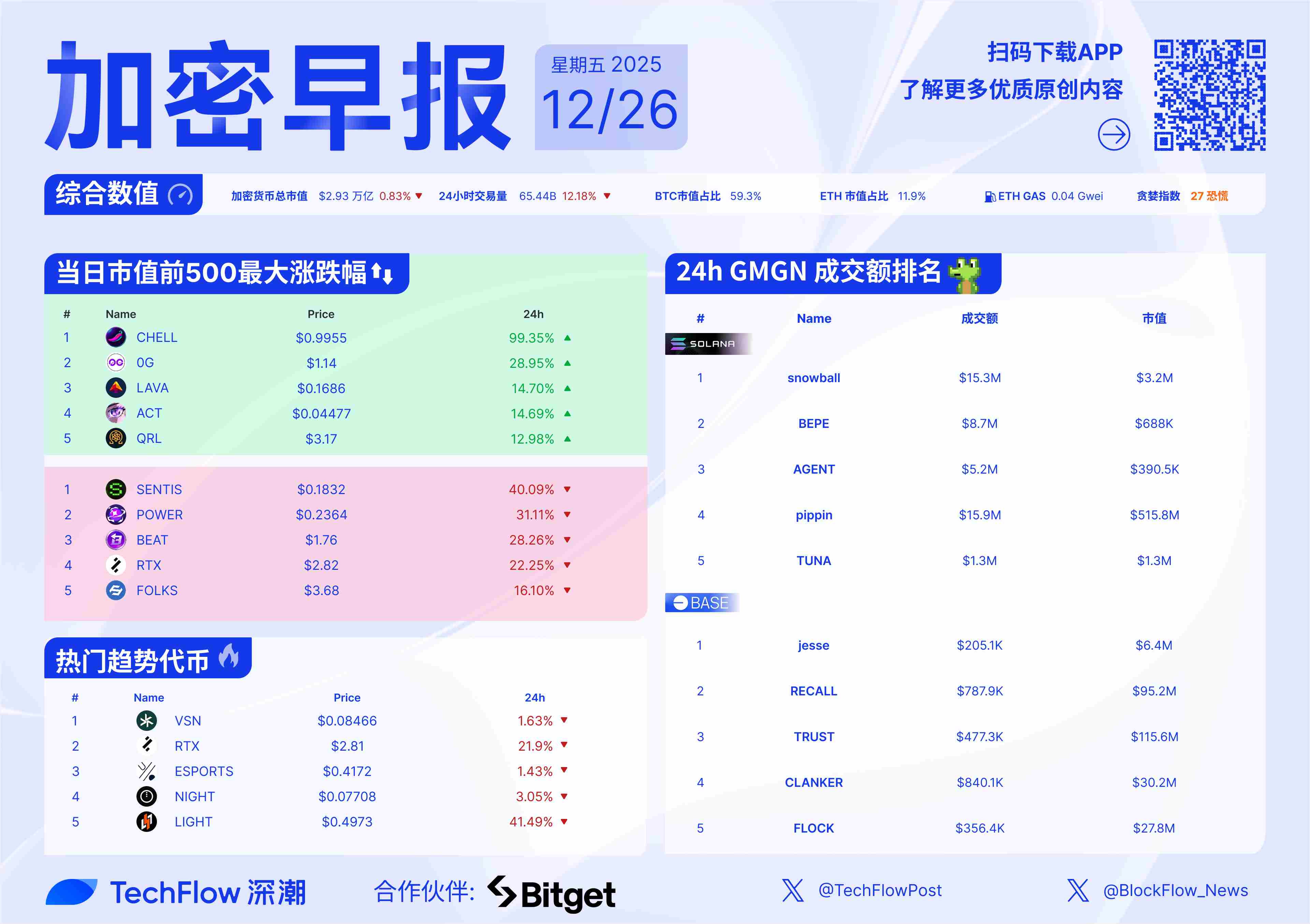
Yesterday's Market Dynamics
Offshore yuan breaks through the 7.0 mark against the US dollar again, onshore yuan breaks through 7.01
According to Sina quotes, the offshore yuan once again broke through the 7.0 mark against the US dollar. According to China Foreign Exchange Trade System, the onshore yuan broke through the 7.01 mark, hitting a new high since September 27, 2024.
Bitcoin mining difficulty increases by 0.04% to 148.26 T
According to CloverPool data, Bitcoin mining difficulty adjusted on December 25, 2025, at 11:48:06 (at block height 929,376), increasing by 0.04% to 148.26 T. The current seven-day average network hash rate is 1.08 EH/s.
Wu Jiezhuang: Legislation on digital asset OTC trading and custody can legitimize related services and combat fraud
Hong Kong Legislative Council member Wu Jiezhuang posted on X platform: "Welcome the Hong Kong SAR Government's Financial Services and the Treasury Bureau's new developments in promoting digital asset trading. The legislative proposal for digital asset trading and custody services has officially entered consultation, representing a further clarification of related digital asset regulatory activities and responding to market demands and ideas. Past consultations with the industry on the direction of related OTC trading and custody services have received many opinions. This proposed legislation can not only legitimize crypto and digital asset OTC trading and custody services, allowing the industry to operate more compliantly, but also combat suspected fraudulent activities disguised as such services."
"On-chain detective" ZachXBT: Trust Wallet users' stolen funds reach at least $6 million
According to on-chain detective ZachXBT (@zachxbt) monitoring, hundreds of Trust Wallet users have experienced fund theft, with losses amounting to at least $6 million. ZachXBT stated that if the responsibility is confirmed to belong to Trust Wallet, the platform may need to compensate the affected users.
Additionally, Trust Wallet issued an announcement: A security vulnerability was found in browser extension version 2.68, users need to upgrade immediately.
Analyst: Verified Trend Research ETH actual entry cost is about $3150
On-chain analyst Ai Aunt (@ai 9684xtpa) posted saying, according to confirmation by Yi Lihua himself, the actual entry cost for the 645,000 Ethereum (ETH) accumulated since November by his institution Trend Research is about $3150, currently floating a loss of about $143 million. Yi Lihua stated that subsequently $1 billion will be invested to continue increasing holdings, expecting to control the average ETH holding cost to about $3050.
WSJ: Zhao Changpeng becomes beneficiary of Trump's "informal pardon", exposes "pardon deal" market price of millions
The Wall Street Journal published an article disclosing that "Zhao Changpeng became one of the beneficiaries of a new, informal presidential pardon path emerging during Trump's second term. According to people around Trump, this new approach is partly driven by Trump's own experience as a criminal defendant, spawning a 'pardon deal' industry, with lobbyists saying their market price is $1 million.
It was revealed that those seeking pardons offered success fees as high as $6 million to some lobbyists close to the president, conditional on them getting it done."
AI crypto tokens market cap plummets 75% in 2025, evaporating $53 billion
According to a CryptoPresales.com report, AI-related cryptocurrencies experienced a severe correction in 2025, with market capitalization falling about 75% year-on-year, wiping out approximately $53 billion in market value. Although they experienced explosive growth in 2023-2024, as hype subsided and liquidity decreased, the market continued under pressure in 2025. The decline intensified in the fourth quarter, with nearly $10 billion evaporated in December alone. Eight major AI tokens fell more than 70%, with Artificial Superintelligence Alliance, Render, and The Graph all falling over 80%. The total market capitalization of AI and big data tokens has now dropped to $16.8 billion.
Infinex founder: Lowers INX token Sonar sale valuation to $99.99 million
Infinex founder Kain Warwick @kaiynne announced that the fully diluted valuation (FDV) for the INX token Sonar sale has been significantly reduced from the originally planned $300 million to $99.99 million, in response to market feedback that the initial pricing was too high. This sale will open for registration on December 27 and officially launch on January 3, aiming to raise $5 million, representing 5% of the total supply. Tokens will have a one-year lock-up period but retain an early unlock mechanism, with the unlock price gradually decreasing from $300 million to $100 million over time. Due to the lower valuation, the sale is expected to be significantly oversubscribed, so allocations for Patron NFT holders are not guaranteed. The entire sale will use an RNG mechanism, with a minimum investment of $200 and a maximum of $2500.
Pantera Capital partner: Predicts DAT consolidation next year, tokenized gold will rise, prediction markets will differentiate
Pantera Capital Junior Partner Jay Yu posted on social media making 12 predictions for 2026 crypto trends, including:
· Capital-efficient consumer credit: Launch of convenient lending applications through on-chain/off-chain credit modeling, modular design, and AI behavior learning.
· Prediction market differentiation: Prediction markets split into financial direction (integrated with DeFi, leveraged) and cultural direction (community-driven, long-tail enthusiasts).
· Agent commerce & x402 expansion: Agent commerce expands to micro-payments and regular payments using x402 endpoints, Solana exceeds Base in low-value transaction volume.
· AI as a crypto interface layer: AI-assisted trading (e.g., trend analysis) becomes mainstream, gradually integrated into consumer applications.
· Rise of tokenized gold: Tokenized gold becomes an important RWA (Real World Asset) asset, chosen as a store of value due to US dollar issues.
· Bitcoin quantum panic: Quantum technology breakthroughs spark institutional discussion on Bitcoin's quantum resistance, technology not yet a threat to value.
· Unified privacy development experience: Privacy technologies (e.g., Ethereum's Kohaku) provide simplified development interfaces, possibly launching privacy-as-a-service.
· DAT consolidation: Digital Asset Trading platforms (DAT) consolidate to 2-3 per major market, achieved through liquidation or merger.
· Rethinking token & equity separation: Governance token crisis prompts companies to choose privatization, possibly introducing redeemable equity tokens.
· Perpetual DEX consolidation: Hyperliquid dominates the market, HIP3 markets and yield stablecoins (e.g., HyENA) become key, USDC loses ground on HYPE.
· Multi-chain Prop AMM: Prop AMM expands to multi-chain, accounts for over half of Solana trading volume, prices more assets like RWA.
· Traditional fintech adoption of stablecoins: Stripe, Ramp, etc. use stablecoins for international payments, stablecoin chains like Tempo become fiat on-ramp bridges.
Jay Yu claimed his prediction accuracy rate for 2025 was as high as 7/10, including accurate predictions on Solana developer migration.
CoinGlass annual report: Binance, OKX, Bitget lead BTC, ETH liquidity
CoinGlass released the "2025 Cryptocurrency Derivatives Market Annual Report". The report shows that in the 2025 bilateral liquidity depth ranking for major assets like BTC and ETH, Binance, OKX, and Bitget ranked top three among global CEXs respectively.
In terms of derivatives trading volume and market share, Binance ranked first with approximately $77.45 billion in average daily trading volume and a 29.3% market share; OKX ranked second with $33.2 billion in average daily volume and a 12.5% market share; Bybit ranked third with approximately $29.1 billion in average daily volume and an 11% market share; Bitget ranked fourth with $25.2 billion in average daily volume and a 9.5% market share.
Additionally, CoinGlass conducted a comprehensive scoring and ranking of major derivatives exchanges in the report. The assessment used basic trading data as the core weight, combined with multiple dimensions such as product system, security, transparency, and market quality, to form sub-item scores and a weighted total score. The results showed Binance ranked first with a score of 94.33, OKX ranked second with 88.77, and Bitget ranked third with 83.10.
Caixin: Issuing and using U Cards domestically carries an additional layer of special legal risk
Caixin.com authored an article "The Crazy Ads on Xiaohongshu for U Cards: The Secret of Their Popularity and Fatal Risks". The article points out that users can use bank cards printed with the Visa logo to make payments such as ChatGPT Plus subscription fees, with deductions made through USDT in cryptocurrency wallets. These types of overseas bank cards are commonly known as "U Cards", a type of overseas bank card based on USDT stablecoin payments. The Caixin article also pointed out that issuing and using U Cards domestically carries an additional layer of special legal risk. Whether it is a short-lived transitional product or hides the password to the future payment landscape remains unknown.
Market Dynamics
Recommended Reading
Ten People Redefining the Power Limits of Cryptocurrency in 2025
This article describes how 2025 is a key year for the institutionalization of the cryptocurrency industry, with traditional financial institutions and governments beginning to participate in the crypto market on a large scale, pushing it from an "anti-system tool" to a "core component of the system". At the same time, the influence of individual authority, political power, and institutionalization trends on the crypto market has significantly increased, challenging the original intention of decentralization.
Dialogue with Raoul Pal: The 2026 Decisive Point Under the Five-Year Cycle, Choosing the Right Assets for Long-Term Holding Without Luck
This article is a detailed compilation of Raoul Pal's views and insights on cryptocurrency investment from an interview. He proposed a success framework for 2026 cryptocurrency investment, emphasizing choosing the right assets, holding long-term, understanding the importance of liquidity, and maintaining patience. Additionally, the article explores future trends in the cryptocurrency market, the potential of smart contracts, the current state of NFTs and their value contribution to the underlying blockchain, and how to succeed in the crypto market through research and conviction.
Even Satoshi Nakamoto Would Have to Kowtow to the God of Wealth
This article explores how increasingly more people in the cryptocurrency industry view feng shui and metaphysics as a form of psychological support to cope with market volatility and uncertainty. Through several cases, the article analyzes the application of feng shui in the cryptocurrency field, including investment decisions, risk avoidance, and psychological comfort.
Crypto People Reading Fortunes in K-Line Charts
This article discusses the流行 trend of metaphysics as a psychological compensation and social tool in the cryptocurrency market. It focuses on analyzing the爆火 phenomenon of the "Life K-Line" application, which generates K-line charts based on birth dates, and the demand and psychological dependence of cryptocurrency traders on metaphysics. The article also mentions that the popularity of metaphysics in the crypto circle is not only because it alleviates traders' anxiety about uncertainty but also because its ambiguity and social attributes make it a流行 culture.
Circle 2025 Annual Review: Building a Full-Stack Crypto Economy Platform
This article is Circle's 2025 annual review report, detailing its progress in building a full-stack crypto economy platform, including the application of stablecoins in mainstream finance, the landing of global regulatory frameworks, the growth of digital assets, the expansion of institutional cooperation, and the newly launched Arc blockchain, among other content. The article also mentions that Circle has promoted the transformation of the global financial system towards an open, inclusive internet-native form through technological innovation and ecological synergy.