Crypto market’s weekly winners and losers – MYX, PEPE, UNI, HYPE

ambcryptoPublished on 2026-01-04Last updated on 2026-01-04

Abstract

Crypto markets opened 2026 with broad-based gains, as the CoinMarketCap Top 20 Index rose nearly 5%. Bitcoin and Ethereum posted gains of nearly 5% and 7%, respectively. Weekly winners included MYX Finance (MYX), which surged 77% ahead of its upcoming V2 upgrade, showing strong buying pressure. World Liberty Financial (WLFI) climbed roughly 22%, breaking out of a tight range. Pepe (PEPE) led memecoins with over 70% gains, backed by sustained volume. Other notable gainers included Toncoin (up ~12%), Canton (up 28%), and Dogecoin (up 22%). Weekly losers included Uniswap (UNI), which slipped after failing to hold above $6 amid selling pressure. Hyperliquid (HYPE) fell toward $25 due to profit-taking and repeated rejections at resistance. Monero (XMR) pulled back to $420 after a rejection at $450. Tokenized assets like Tether Gold and PAX Gold both fell nearly 5%, indicating reduced hedging demand. The market showed renewed momentum but selective leadership, with advice to avoid chasing rallies and conduct due diligence.

New year, new market?

The crypto community stepped into 2026 with just enough green to make us all happy. Many top 100 coins closed the week on a high, with CoinMarketCap’s top 20 index up by nearly 5%.

Crowd favorites Bitcoin [BTC] and Ethereum [ETH] posted gains of nearly 5% and 7%.

Source: CoinMarketCap

What about the rest? Settle in with your drink of choice, and here’s a recap of how the market moved this week.

Weekly winners

MYX Finance [MYX] – Huge surge ahead of developments

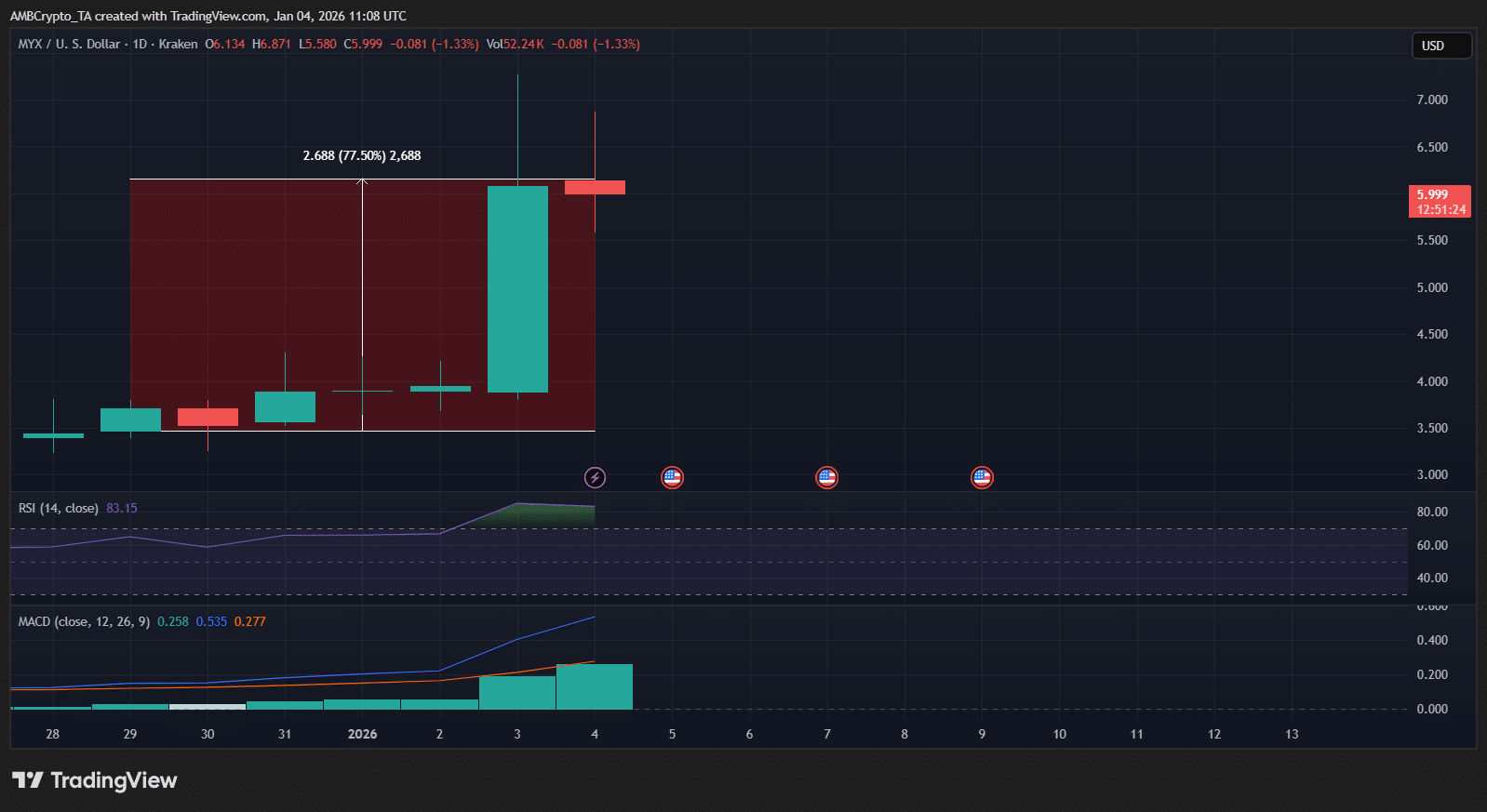
MYX Finance [MYX] has had a standout week, surging 77% at press time with attention on its upcoming V2 upgrade. Price went from the mid-$3 range to above $6 in a matter of days, with a strong candle early in the week.

Source: TradingView

RSI indicated heavy buying pressure, and MACD accelerated too; there’s a quick change in trend strength. While price pulled back from its intraday highs, the move so far looks caused by anticipation.

For now, it looks like traders are preparing ahead of the upgrade rather than reacting after it.

World Liberty Financial [WLFI] – In the momentum trade

World Liberty Financial [WLFI] posted strong gains coming into the new year! The token climbed roughly 22% over the period, breaking out of a tight range that had capped price action through late December.

RSI showed rising momentum, and OBV turned higher after weeks of decline. There’s a lot of fresh buying activity.

WLFI has cooled just slightly near recent highs. There seems to be more speculative interest than anything else, but only time (and announcements) will tell.

Pepe [PEPE] – Leading the memecoin pack!

Pepe [PEPE] has been a clear standout among memecoins this week. At the time of writing, it is the best-performing meme token on the market, posting gains of over 70%. The next closest contender, Bonk [BONK], was far behind with a 46% rise.

There’s been a clean breakout from consolidation, followed by strong follow-through. The RSI showed an aggressive pace, while OBV proved more sustained buying interest.

Unlike other short-lived pumps, Pepe’s move has been backed by rising volume across multiple sessions. This keeps it firmly ahead of the memecoin field.

Other notable winners

Beyond the week’s top performers, a few names also stood out. Toncoin [TON] rose around 12% over the week, moving higher alongside Telegram’s launch of its self-custodial wallet in the United States.

Canton [CC] gained 28% this week, extending a multi-week rally that began after its partnership with DTCC came into focus.

Dogecoin [DOGE] also joined the move, climbing 22% as interest across large-cap and memecoin names picked up again.

Weekly losers

Uniswap [UNI] – Fading pace

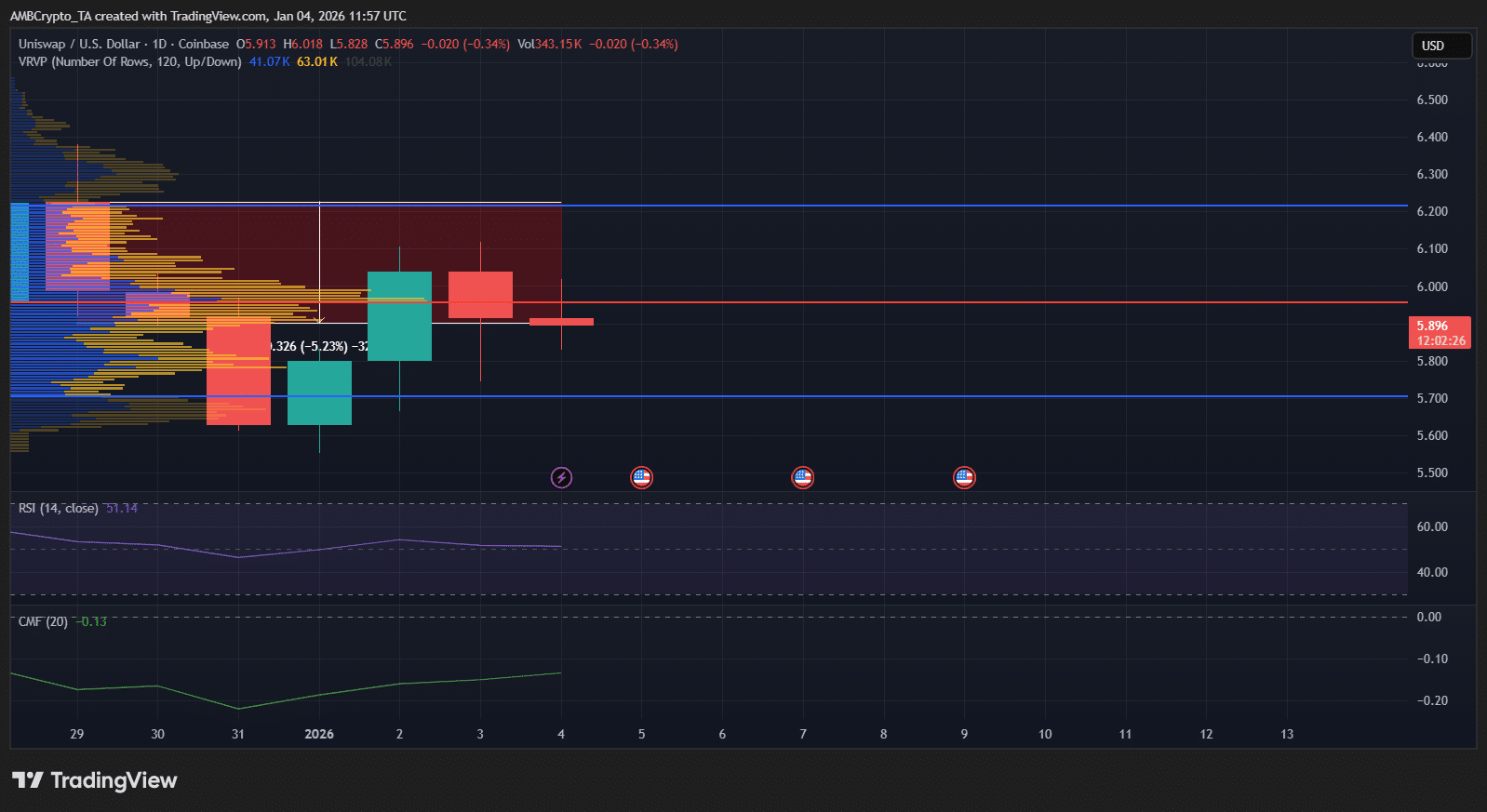
Uniswap [UNI] struggled this week, slipping back after failing to hold above the $6 level.

Price got rejected near a high-volume zone, with sellers stepping in quickly after the brief push higher. RSI was just above 50, so pace has cooled.

Source: TradingView

Meanwhile, CMF was negative, so capital was slowly leaking out. Price was trading near short-term support around $5.8, where buyers previously showed up.

Unless UNI can reclaim $6 with stronger volume, the move is highly likely to be a pause under resistance.

Hyperliquid [HYPE] – Moving against the market

While much of the top 20 finished the week in the green, Hyperliquid [HYPE] moved the other way. Price slipped back toward the $25 zone after failing to hold above recent highs.

There were repeated rejections near resistance, with each bounce getting sold into quickly.

RSI showed a weak pace. Importantly, the pullback comes after a prior run-up, so profit-taking is starting to dominate. At press time, HYPE was absorbing gains, even with risk appetite being strong everywhere else.

Monero [XMR] – Cooling post-rejection

Monero’s [XMR] price was rejected near the $450 zone, causing a pullback toward $420 before buyers stepped back in. There was aggressive selling, but demand hadn’t disappeared.

The MACD remained in bearish territory, but selling pressure was clearly easing. CMF nudged back above zero, so there were mild capital inflows after the dip.

XMR is consolidating after a failed breakout, with the market still seemingly undecided on the next move.

Other notable losers

Losses this week weren’t limited to high-beta tokens. Tokenized assets Tether Gold [XAUt] and PAX Gold [PAXG] both slipped nearly 5%, so demand for defensive, commodity-linked exposure rotated elsewhere.

There’s less interest in hedging, even during uncertainty. Meanwhile, Dash [DASH] fell 3%, continuing its slow grind lower.

Conclusion

As the year unfolds, excitement will come and go faster than most New Year’s resolutions. Keep your head firmly on your shoulders, don’t chase every green candle, and DYOR before jumping in.

Here’s wishing you a calm portfolio, good timing, and a happy New Year!


Final Thoughts

  • Crypto opened 2026 with broad-based gains, as the CoinMarketCap Top 20 Index rose nearly 5%.
  • Rallies in MYX, PEPE, and WLFI show momentum is back, but leadership remains selective.
Next: SPX rallies 16% amid fresh capital inflow – Can bulls keep control?
Share
  • Share
  • Tweet

Trending Cryptos

Related Questions

QWhich cryptocurrency was the top weekly performer and what was the main reason for its surge?

AMYX Finance (MYX) was the top weekly performer, surging 77% due to anticipation of its upcoming V2 upgrade.

QAmong memecoins, which token significantly outperformed its closest competitor this week?

APepe (PEPE) was the best-performing memecoin with a 70% gain, far outperforming its closest competitor Bonk (BONK), which rose 46%.

QWhat was the primary technical reason for Uniswap's (UNI) price decline this week?

AUniswap (UNI) declined after failing to hold above the $6 resistance level, with sellers stepping in quickly after a brief push higher and the Chaikin Money Flow (CMF) turning negative.

QWhich two tokenized gold assets were notable losers this week, and what does their decline suggest about market sentiment?

ATether Gold (XAUt) and PAX Gold (PAXG) both declined nearly 5%, indicating reduced demand for defensive, commodity-linked assets and less interest in hedging during uncertainty.

QWhat was the overall performance of the crypto market at the start of 2026 according to the CoinMarketCap index?

AThe crypto market opened 2026 with broad-based gains, as the CoinMarketCap Top 20 Index rose nearly 5% for the week.

Related Reads

Analysis of the Latest Portfolio Adjustment by the "Top Player" in the U.S. Stock Market: $9 Billion Short on NVIDIA, Shifting Focus to Power and Memory Sectors

AI investor Leopold Aschenbrenner has made a significant portfolio shift, taking a $9 billion nominal short position against top AI infrastructure stocks like NVIDIA, ASML, and Oracle. Simultaneously, he is redirecting capital towards what he sees as the next critical bottlenecks in the AI boom: power, memory, and data center networking, alongside private investments in AI model companies like Anthropic. This move is interpreted not as a call that the AI bubble has burst, but as a rotation within the infrastructure stack. The analysis highlights NVIDIA's recent $25 billion bond issuance as a potential signal, questioning why a cash-rich company would seek external debt despite high profits and increased dividends/buybacks. The core investment thesis is that the initial, crowded "picks and shovels" trade in semiconductors is maturing. The next wave of capital is expected to flow into the physical and logistical constraints of AI expansion: electricity supply, memory chip capacity, data center construction, and enabling technologies like optical networking (fiber) for high-bandwidth communication, where copper remains crucial for short distances. Aschenbrenner's substantial (approx. 20% of fund) private stake in Anthropic is noted as a key part of his strategy—investing directly in the "mine" (AI models) rather than just the "shovels." The discussion concludes that while certain segments may be overvalued, the overarching AI infrastructure demand driven by real product usage remains robust. The most promising long-term investments are seen in essential, non-sexy infrastructure—particularly energy and power companies—whose demand is viewed as a global constant irrespective of AI's cyclicality.

marsbit20m ago

Analysis of the Latest Portfolio Adjustment by the "Top Player" in the U.S. Stock Market: $9 Billion Short on NVIDIA, Shifting Focus to Power and Memory Sectors

marsbit20m ago

BIT Research: Liquidity is Disappearing, Will Bitcoin Replay the Bottoming Pattern of 2022?

The crypto market is currently in an adjustment phase driven by policy expectations and liquidity shifts. Despite a brief rebound fueled by geopolitical easing and SpaceX's strong IPO performance, unexpectedly hawkish signals from new Fed Chair Kevin Warsh have removed anticipated easing support. Concurrently, stablecoin liquidity is shrinking, with insufficient new capital inflows, pushing the market into a typically quiet summer period. Pricing lacks catalysts for a sustained rally. Daily trading volume has significantly contracted, stablecoin growth has slowed markedly, and the supportive effect of Strategy's (formerly MicroStrategy) STRC preferred stock-financed Bitcoin purchases is fading. Amid policy uncertainty, seasonal weakness, and liquidity contraction, Bitcoin faces near-term downward pressure. Warsh's hawkish pivot and refusal to provide a clear policy outlook have increased risk premiums, historically unfavorable for Bitcoin. Technically, the trend remains bearish below $73,700, with $62,446 as critical support. A break below could accelerate declines, though a prolonged consolidation phase, similar to 2022's bottoming process, is possible. Liquidity is a core constraint. Current daily volume is around $500 billion, roughly 25% of the peak during the July-Oct 2025 rally. The 12-month growth rates for USDT and USDC have fallen to ~20%, with 6-month growth near zero, indicating weak new inflows. Bitcoin ETF and Strategy-driven inflows have also weakened, with a 30-day rolling net outflow. With inflation at 4.2% above the Fed's target, combined hawkish policy, seasonal factors, and liquidity shortages challenge Bitcoin's ability to hold above $60,000. However, this adjustment phase may be forming a cyclical low this summer, potentially setting the stage for the next bull cycle.

marsbit48m ago

BIT Research: Liquidity is Disappearing, Will Bitcoin Replay the Bottoming Pattern of 2022?

marsbit48m ago

Who Makes the Best Use of Claude Code? The Answer Might Not Be Programmers

Claude Code Usage Report Summary (Based on ~400k sessions) Core Finding: In agentic programming with Claude Code, a clear division of labor has emerged: humans primarily decide *what* to build (planning decisions), while Claude decides *how* to build it (execution decisions). Key Insights: 1. **Effectiveness is not limited to programmers.** In code-generation tasks, success rates for users in non-technical fields (law, finance, management, research) are nearing those of software engineers. What matters most is the user's domain expertise and understanding of the problem to be solved. 2. **Domain expertise drives success and efficiency.** Sessions where users exhibited "expert" proficiency in the task's domain saw verified success rates double compared to "novice" sessions. Experts also delegated more work per instruction, with Claude executing more actions and producing more output. 3. **AI is amplifying, not replacing, domain knowledge.** Claude Code lowers the *implementation* barrier, not the *judgment* barrier. The value of knowing the "what" and "why" is increasing relative to just knowing the "how" to code. 4. **Usage is evolving.** Over a 7-month period (Oct '25 - Apr '26), the share of sessions for debugging halved, while use for software operations, data analysis, and non-code writing roughly doubled. The estimated economic value of typical tasks increased by ~25%. Conclusion: The data suggests coding agents are making programming background less critical for completing technical tasks. However, they reward and amplify deep domain understanding. The ability to successfully direct an AI agent stems more from mastery of a specific field than from coding skill itself. The primary gains come from being competent in a domain; deep specialization adds only marginal additional advantage. This may signal a shift where software creation becomes integrated into various professions.

marsbit1h ago

Who Makes the Best Use of Claude Code? The Answer Might Not Be Programmers

marsbit1h ago

Trading

Spot
Futures

Hot Articles

Discussions

Welcome to the HTX Community. Here, you can stay informed about the latest platform developments and gain access to professional market insights. Users' opinions on the price of S (S) are presented below.

活动图片