Crypto markets slide after Fed decision as Powell warns inflation risks persist

ambcryptoPublished on 2026-03-18Last updated on 2026-03-18

Abstract

Crypto markets declined sharply following the Federal Reserve's decision to hold interest rates steady, driven by Chair Jerome Powell's cautious tone on inflation. Bitcoin fell over 5%, Ethereum dropped more than 6%, and other major cryptocurrencies like XRP, Solana, and BNB also posted significant losses. Powell emphasized that inflation remains elevated, with PCE at 2.8% and core inflation at 3.0%, both above the Fed’s 2% target. He reinforced a data-dependent approach, indicating rate cuts are not imminent. This strengthened the "higher-for-longer" interest rate narrative, which negatively impacts risk assets like cryptocurrencies. The broad sell-off underscores crypto’s continued sensitivity to macroeconomic signals and U.S. monetary policy expectations. Markets are likely remain volatile and reactive to incoming economic data and geopolitical developments.

Crypto markets turned sharply lower following the Federal Reserve’s latest policy decision, with major assets posting broad losses as investors reacted to a more cautious macro outlook.

Data from TradingView’s heatmap showed widespread selling pressure across the market, with large-cap tokens leading the decline.

Bitcoin fell over 5%, while Ethereum dropped more than 6%, reflecting heightened sensitivity to macro signals. XRP declined by around 5.3%. Solana slipped 5.7%, and BNB recorded a more modest 3.7% loss.
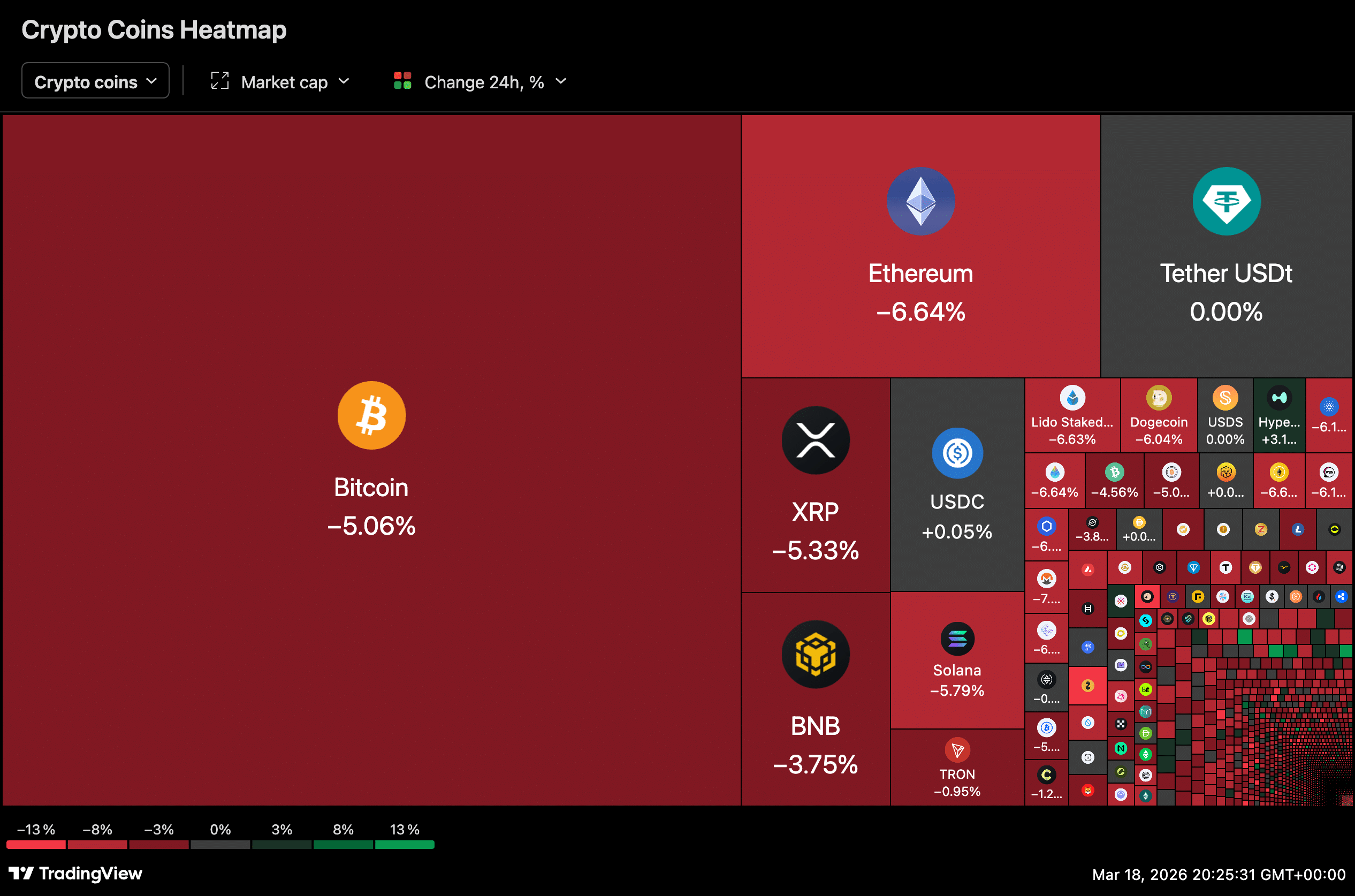
Source: TradingView

The sell-off extended across altcoins, with only a handful of assets showing resilience, underscoring a broad risk-off move rather than isolated weakness.

Powell’s tone dampens rate cut expectations

While the Fed’s decision to hold rates steady was largely expected, market reaction appears to have been driven by Chair Jerome Powell’s press conference and the central bank’s updated projections.

Powell reiterated that inflation remains elevated and warned that recent developments — particularly rising energy prices linked to Middle East tensions — could keep price pressures higher in the near term.

He noted that headline PCE inflation stood at 2.8%, with core inflation at 3.0%, both still above the Fed’s 2% target.

Crucially, Powell made clear that:

  • Policy is not on a preset path
  • The Fed will remain data-dependent
  • It is too early to determine the full impact of geopolitical risks

This reinforced the view that rate cuts are not imminent — a key trigger for the market pullback.

Higher-for-longer narrative hits risk assets

The Fed’s projections and Powell’s remarks together strengthened the “higher-for-longer” narrative, which tends to weigh on speculative assets like crypto.

Although policymakers still expect inflation to ease over time, the pace of disinflation appears gradual. At the same time, the U.S. economy remains resilient, reducing the urgency for aggressive monetary easing.

For crypto markets, this creates a challenging short-term setup:

  • Liquidity remains constrained
  • Rate cuts are delayed
  • Macro uncertainty remains elevated

These factors typically limit upside momentum and increase volatility across digital assets.

Market reaction signals macro sensitivity remains high

The scale of the sell-off highlights how closely crypto markets are still tied to macroeconomic signals, particularly U.S. monetary policy.

Despite improving fundamentals in parts of the crypto ecosystem, price action continues to react strongly to interest rate expectations and broader risk sentiment.

The synchronized decline across Bitcoin, Ethereum, and altcoins suggests that traders are repositioning in response to shifting expectations rather than asset-specific developments.

What comes next?

With the Fed offering no clear timeline for easing, markets are likely to remain highly reactive to incoming data.

Inflation readings, labour market updates, and geopolitical developments — particularly those affecting energy prices — will play a critical role in shaping expectations for future policy moves.

Until clearer signals emerge, crypto markets may continue to trade cautiously, with macro conditions acting as the dominant driver.


Final Summary

  • Crypto markets dropped sharply as Powell reinforced a data-dependent, higher-for-longer stance.
  • The sell-off highlights how macro policy expectations continue to drive short-term price action.

Trending Cryptos

Related Questions

QWhat was the main reason for the sharp decline in crypto markets following the Fed's decision?

AThe decline was primarily driven by Fed Chair Jerome Powell's press conference, where he reinforced a data-dependent, higher-for-longer stance on interest rates, dampening expectations for imminent rate cuts.

QHow much did Bitcoin and Ethereum drop during the sell-off?

ABitcoin fell over 5% and Ethereum dropped more than 6%.

QWhat are the PCE and core inflation rates mentioned by Powell, and how do they compare to the Fed's target?

AHeadline PCE inflation stood at 2.8% and core inflation at 3.0%, both still above the Fed's 2% target.

QWhat three key points did Powell emphasize about the Fed's policy approach?

APowell made clear that: 1) Policy is not on a preset path, 2) The Fed will remain data-dependent, and 3) It is too early to determine the full impact of geopolitical risks.

QWhat factors create a challenging short-term setup for crypto markets according to the article?

AThe challenging setup includes: liquidity remaining constrained, rate cuts being delayed, and macro uncertainty remaining elevated.

Related Reads

Thanks to Dice Rolls, Bitcoin Keys Are Stored Offline, But Not Everyone Will Do It

The article discusses using dice rolls to generate secure Bitcoin wallet seeds, providing entropy independent of potentially flawed hardware random number generators. It explains that each fair dice roll offers about 2.585 bits of entropy, with around 50 rolls needed for a standard 12-word seed phrase and 99+ recommended for higher security. This method gained attention after a vulnerability was revealed in some Coldcard hardware wallets, where a faulty firmware RNG (dating back to 2021) compromised generated keys. The analysis notes that while a dice-generated main seed was safe from this specific flaw, other Coldcard functions (like creating paper wallets, backup keys, or passwords) could still be vulnerable if they used the defective RNG. The piece argues that while dice-based entropy is technically robust, the manual process is error-prone, tedious, and unrealistic for most new users, who might make mistakes in recording or inputting rolls. It concludes that while manual entropy generation should remain an option for advanced users, the long-term goal is to develop reliable, user-friendly hardware and software that securely generates randomness without requiring specialized knowledge. Coldcard users are advised to check their firmware version and replace any secondary secrets (like paper wallet keys) created with vulnerable devices, while also considering multi-signature setups with devices from different manufacturers for added security.

cryptonews.ru4h ago

Thanks to Dice Rolls, Bitcoin Keys Are Stored Offline, But Not Everyone Will Do It

cryptonews.ru4h ago

Trading

Spot

Hot Articles

Discussions

Welcome to the HTX Community. Here, you can stay informed about the latest platform developments and gain access to professional market insights. Users' opinions on the price of S (S) are presented below.

活动图片















