Copper Price Stays Above $14,000 for Nine Consecutive Days! LME Squeeze Signal Reappears, Shorts Are Being Cornered

Published on 2026-08-19Last updated on 2026-08-19

Abstract

Copper prices on the London Metal Exchange remain under sustained pressure, with spot premiums soaring to their highest level since 2021. Multiple supply disruptions, combined with rising speculative long positions, are driving copper prices close to historical records.

Copper prices on the London Metal Exchange continue to face upward pressure, with the spot premium soaring to its highest level since 2021. Multiple supply disruptions, coupled with a rise in speculative long positions, are pushing copper prices close to a record high.

On Monday, LME three-month copper rose as much as 1.7% intraday to $14,396 per ton, just a step away from the all-time high of $14,527.50 set in January of this year.
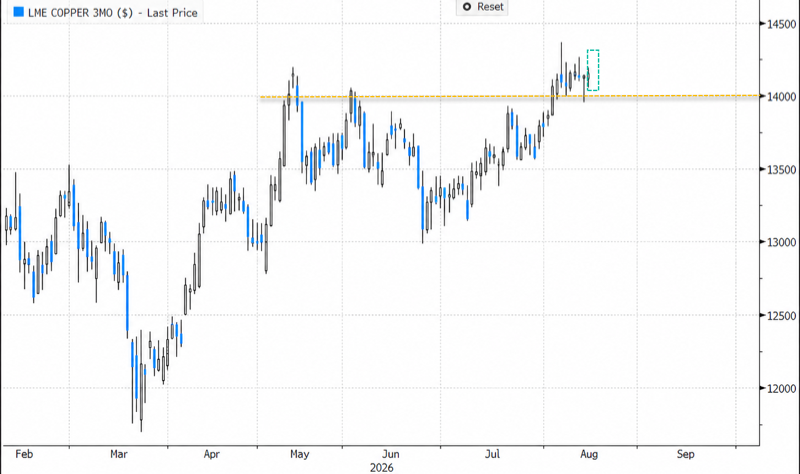
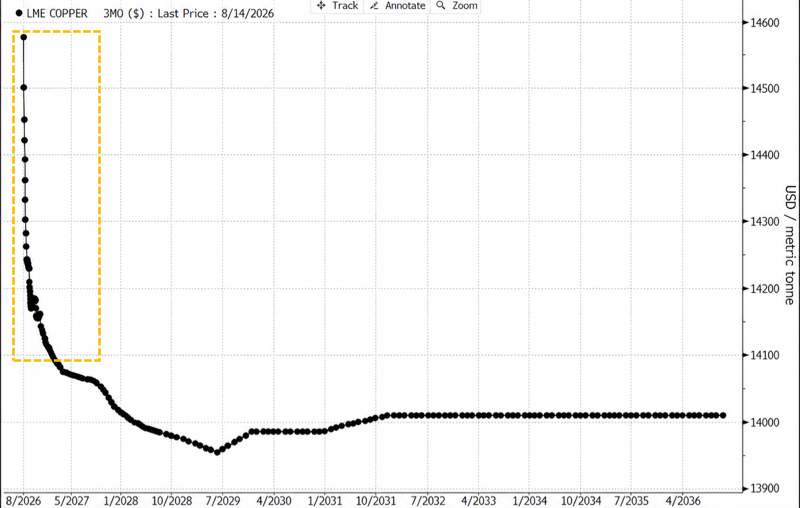
The premium of the spot price over the three-month futures contract widened to as much as $543.50 per ton, the highest since the market squeeze in 2021. Copper has now held above $14,000 per ton for nine consecutive trading days.
In a research note on Monday, Barclays analyst Richard Garchitorena pointed out that the trend of tightening copper supply is set to continue, and mining stocks have further room to rise.

David Wilson, head of metals strategy at BNP Paribas, also stated that momentum for copper to break its historical high "is building," even though the market has entered overbought territory.

Multiple Supply-Side Disruptions Push Up Spot Premium

The core driver of the current copper price rally comes from the persistent tightening of supply.

According to Garchitorena's report, Chile's copper production fell 6.7% year-on-year as of June, prompting the country's Copper Commission (Cochilco) to lower its 2026 production forecast by 2.6% to 5.27 million tons.

Mining giant Antofagasta has cut its full-year production guidance by about 5% due to severe weather disruptions at its Los Pelambres mine.

Meanwhile, a shutdown occurred at the Gresik smelter in Indonesia, causing delays in shipments, with the restart timetable yet to be determined.

Inventory data also confirms the tight supply situation. LME copper stocks have plunged 32% compared to a month ago, to 205,000 tons. Garchitorena noted that speculative net-long positions increased to 77,123 lots, up 20% from July, indicating sustained bullish sentiment in the market.

This dynamic is directly linked to expectations of potential US tariffs on refined copper. According to Garchitorena, Comex copper inventories rose 8% over the same period to 735,000 tons. Traders are awaiting the final decision on US tariffs on refined copper, leading to a continuous flow of material into the US market, which further exacerbates the spot tightness on the LME.

Monthly Settlement Day Approaches, Pressure on Shorts May Intensify

According to Bloomberg, this squeeze is happening just as the LME contract approaches its monthly major liquidity node.

The upcoming settlement date on the third Wednesday of the month could create additional pressure for traders holding short positions in the preceding time window.

BNP Paribas's Wilson acknowledged that copper has entered overbought territory but added:

Given how tight the market is at the moment, I'm not sure that means anything.

Against the backdrop of copper prices nearing record highs, Barclays' Garchitorena believes mining stocks have further upside potential.
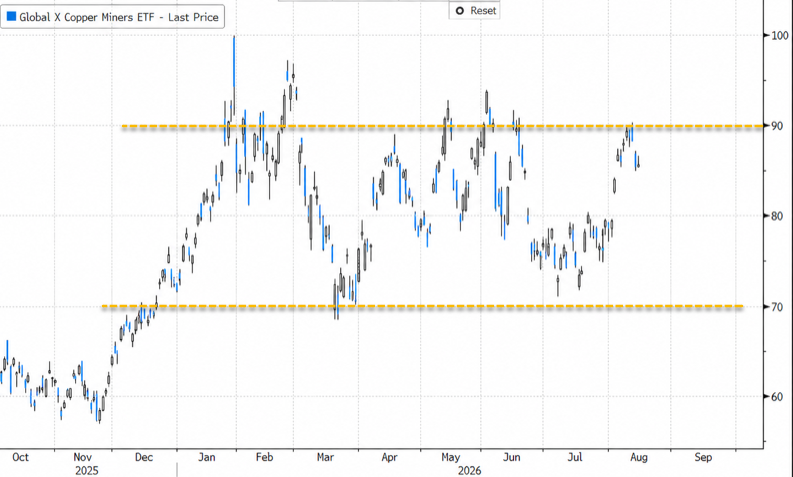
(Global X Copper Miners ETF performance)

Related Reads

CryptoQuant Noted a Signal of a Bitcoin Reversal

CryptoQuant has highlighted a potential reversal signal for Bitcoin, suggesting the bearish phase might be nearing its end as on-chain metrics show initial signs of spot demand recovery. Their analysis indicates that the 30-day spot demand metric has recovered from -206,000 BTC in late July to approximately -5,000, close to turning positive for the first time since February 2026. Historically, such a reversal has been followed by a median 60-day price gain of 18.1%, with a win rate of 78% (increasing to 87% when valuations are depressed). However, they caution that this is a favorable sign, not a guarantee. Analysts from Bitfinex Alpha note that two of three conditions for a sustainable Bitcoin recovery are already met: improved Federal Reserve rate expectations and relatively accommodative financial conditions, thanks to easing inflation and reduced odds of a near-term rate hike. The missing third catalyst is a capital rotation from traditional markets (like stocks and AI infrastructure) into cryptocurrencies. If this occurs, Bitcoin could reclaim $70,000. Conversely, continued negative flows might see support tested around $57,000. Current headwinds include significant weekly outflows from US spot Bitcoin ETFs (roughly $385 million) and reduced stablecoin supply. Wintermute offers a more cautious outlook, pointing to the same large ETF outflows and ongoing miner selling pressure. They note that Bitcoin has failed to rally despite the improved Fed outlook, which is typically bullish for risk assets. As an example, they cite miner Riot Platforms, which sold a substantial portion of its Bitcoin reserves in Q2 as its mining cost (~$91,000 per BTC) remains far above the current market price, forcing sales for liquidity. This combination of ETF outflows and miner selling is suppressing new demand.

cryptonews.ruJust now

CryptoQuant Noted a Signal of a Bitcoin Reversal

cryptonews.ruJust now

Is a Strong Ruble Good? Not for the Budget: Treasury Already Short 1.5 Trillion

The Russian budget has lost about 1.5 trillion rubles in revenue since the start of 2026 due to the ruble being stronger than the government's planned exchange rate. The budget was based on an average annual rate of 92.2 rubles per US dollar, but the actual average for the first seven and a half months was just 76.9 rubles. This discrepancy creates a significant shortfall, as every ruble of appreciation against the dollar reduces annual budget revenues by 140–160 billion rubles. When accounting for oil and gas revenues, the sensitivity is even higher, with potential annual losses reaching up to 2.5 trillion rubles. So far this year, the budget has already missed out on roughly 1.7 trillion rubles. The ruble's exchange rate has shown considerable volatility in 2026, ranging from a low near 71 rubles per dollar in May to over 85 rubles by mid-August. Despite this recent weakening, the year's average remains well below the budget target, creating a structural deficit in oil and gas revenues. Forecasts suggest the final average rate for 2026 will be around 80–82 rubles, which would result in a budget shortfall of about 1.6 trillion rubles. A strong ruble reduces import costs and inflation but also cuts the ruble earnings of exporters and threatens the funding of social obligations. The gap between the planned and actual rate is attributed not only to oil price dynamics but also to the fiscal rule mechanism, which can influence the currency's direction. The Ministry of Finance recently halted foreign currency sales under this rule, removing dollar supply from the market and contributing to pressure on the exchange rate. The budget policy is now forced to adapt to a stronger ruble than originally planned.

cryptonews.ru1m ago

Is a Strong Ruble Good? Not for the Budget: Treasury Already Short 1.5 Trillion

cryptonews.ru1m ago

Robinhood CEO: The Tokenization Wave of U.S. Stocks is Coming, America Must Not Be Left Behind

We are at the early stage of a global supercycle for asset tokenization, a transformative force reshaping finance. Robinhood has actively expanded this frontier outside the US, recently launching Robinhood Chain, a public EVM chain designed for Real World Assets (RWA) and focused on stock tokens. It enables global users to access over 190 US stocks backed 1:1 by underlying securities. However, a key gap remains: these tokenized stocks are not yet available within the United States itself. In the US, the debate around stock tokenization centers on its practical value, given existing low-cost access to equities. Critics question the need, but this misses the core innovation: tokenizing premium financial assets to make them portable, programmable, self-custodied, and tradable 24/7 within an open financial ecosystem. This is more than moving stocks onto a blockchain; it's rebuilding the foundational infrastructure of asset ownership. For US investors, this new infrastructure offers three core advantages: 1. **Real-time clearing and settlement**, enhancing market resilience by eliminating the systemic risks and capital burdens inherent in the traditional T+2/T+1 settlement cycle, as starkly revealed during events like the GameStop volatility. 2. **Native 24/7 trading capability**, allowing all investors to manage risk and react to global news outside standard market hours, a tool previously largely accessible only to institutions. 3. **Greater user control and portability of assets**, enabling instant transfers between platforms and into DeFi. This self-custody model fosters competition among service providers and unlocks new use cases like lending and using tokens as collateral. Realizing these benefits in the US requires more than technology; it necessitates modernizing a century-old securities regulatory framework built for legacy infrastructure. Policymakers must act swiftly to adapt rules for this new paradigm while preserving investor protections. Other jurisdictions are advancing, and the US risks being left behind in shaping the future of asset ownership—a future largely built around American assets and innovation. Tokenizing publicly traded stocks is just the beginning, paving the way for broadening access to other asset classes like private equity. US investors deserve to participate in this innovation.

marsbit36m ago

Robinhood CEO: The Tokenization Wave of U.S. Stocks is Coming, America Must Not Be Left Behind

marsbit36m ago

BIT Trading Moment: BTC Buying Pressure Rises but Bearish Sentiment Remains Strong, 50-Month EMA Difficult to Break, SK Hynix Attempts to Stabilize Memory

BIT Trading Hours: BTC Buying Rebounds but Bearish Sentiment Persists; 50-Month EMA Presents Resistance; SK Hynix Attempts to Stabilize the Memory Sector. Bitcoin briefly reclaimed $65,000, its first time since August 10th, showing a temporary decoupling from traditional risk assets pressured by soaring long-term U.S. Treasury yields. Key support is seen at $62k-$63k, with resistance near the 50-month Exponential Moving Average around $65.4k. While on-chain data indicates recovering spot demand, potentially signaling a local bottom, the options market remains skewed bearish. BIT analysis notes significant downside risk remains if historical bear market patterns repeat, with a potential drop to ~$45.5k. Global equity markets faced intense selling pressure, driven by a bond market storm. The U.S. 30-year yield hit a multi-year high above 5.33%, raising global funding costs. The AI sector was at the epicenter of the sell-off, with the Philadelphia Semiconductor Index plunging ~5% as investors questioned the sustainability of massive AI capital expenditures amid high debt costs. Storage stocks like Micron led declines. SK Hynix's announcement of a major share buyback provided some stability to the memory sector during after-hours trading. However, most tech stocks remained under pressure. In Asia, South Korean and Japanese indices fell sharply, heavily impacted by chip stock declines. Chinese robotics company Unitree Tech had a volatile market debut on Shanghai's STAR Market, soaring over 600% at one point before paring gains, making its founder a billionaire. Despite this individual success, the broader robotics sector in A-shares sold off heavily. Key upcoming events include the U.S. 20-year Treasury auction and the release of the Federal Reserve's July meeting minutes, which will be crucial tests for bond market stability and monetary policy expectations.

marsbit38m ago

BIT Trading Moment: BTC Buying Pressure Rises but Bearish Sentiment Remains Strong, 50-Month EMA Difficult to Break, SK Hynix Attempts to Stabilize Memory

marsbit38m ago

Trading

Spot
活动图片