Cooling US Inflation Fails to Alter Rate Cut Expectations, JPMorgan Leads Financial Stocks Lower, Yen Falls to 159, Bitcoin Hits New Yearly High

华尔街日报Published on 2026-01-13Last updated on 2026-01-13

Abstract

U.S. inflation data did not alter market expectations for the timing of Federal Reserve rate cuts. The core CPI for December remained at 2.6%, matching a four-year low, yet markets continued to price in the first rate cut for June. Major U.S. stock indices closed lower, with the financial sector underperforming as JPMorgan fell over 4% due to weaker investment banking revenue. Treasury yields were largely flat, with the 10-year near 4.17%, while bond market volatility declined. The dollar strengthened, pushing USD/JPY above 159 amid concerns over Japan's potential debt crisis. Despite dollar strength, gold hit a record high above $4,600 before retreating slightly, and the gold-silver ratio fell to a multi-year low of 52. Analysts noted that precious metals are acting as hedges against macroeconomic uncertainty rather than reacting solely to inflation and rate expectations. Oil prices rose for a fourth consecutive session, with WTI crude surpassing $61 per barrel following geopolitical tensions. Bitcoin also climbed, nearing its yearly high. European equities were mixed, with the Euro Stoxx 50 hitting a record high for the third straight session, while the broader Stoxx 600 dipped slightly.

US inflation data did not change market expectations for the timing of the Federal Reserve's rate cuts. The three major US stock indices closed lower, US Treasuries fluctuated and ended little changed, the dollar strengthened to recoup yesterday's losses, while commodities and cryptocurrencies performed strongly.

According to Wall Street News, the US core CPI in December was only 2.6% year-on-year, matching a four-year low. Although core inflation cooled, it did not alter the key pricing for the Fed, with the interest rate market still betting on the next rate cut occurring in June this year. This means that the "good news" on inflation is not enough to secure more accommodative financial conditions.

Wall Street News mentioned that Nick Timiraos, the chief economic correspondent for the Wall Street Journal, known as the "new Fed whisperer," commented:

To resume rate cuts, Fed officials may need to see new evidence that labor market conditions are weakening or that price pressures are subsiding. The latter may require at least a few more months of inflation reports to be confirmed.

Consequently, the algorithmic buying triggered after the CPI data release quickly faded, and the benchmark US stock indices retreated and turned lower during European trading hours. The S&P index pulled back from its historical high. JPMorgan confirmed in its earnings report that investment banking revenue was below guidance, falling over 4% and dragging down the financial sector.
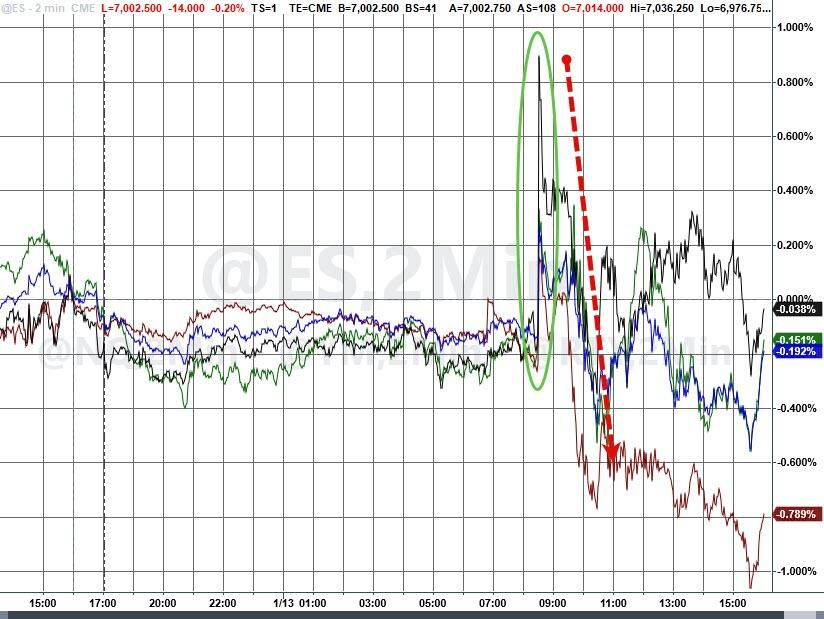
(US benchmark stock indices initially strengthened after the release of the slightly cooler CPI data)

US Treasuries briefly strengthened after the CPI release but similarly failed to sustain the move. The 10-year Treasury yield ultimately ended largely flat around 4.17%, while the 2-year yield edged lower. Notably, as the yield curve steepened, bond market volatility decreased significantly.
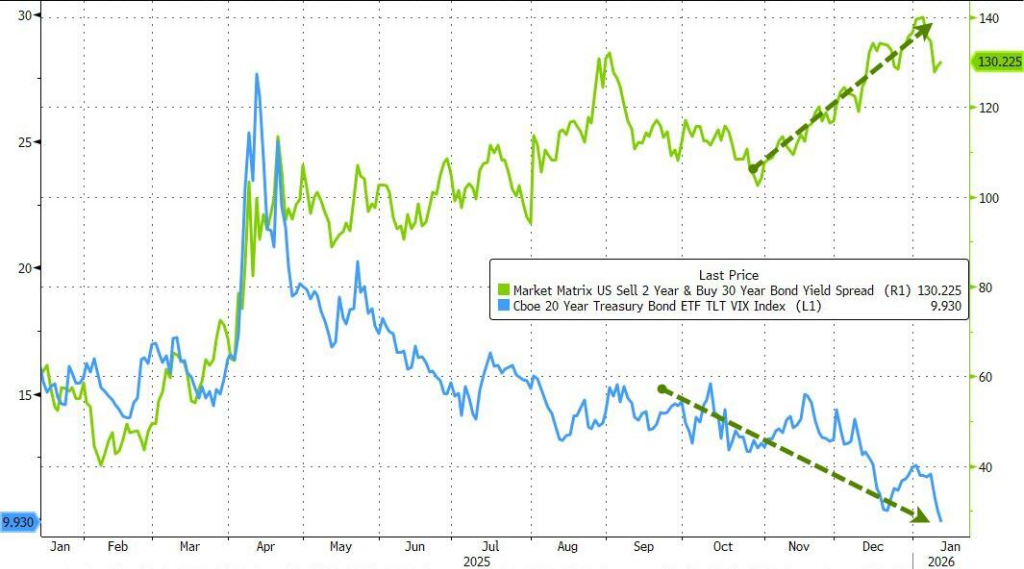
(20-year Treasury ETF volatility continues to decline)

The strengthening dollar recouped yesterday's losses, driving the USD/JPY pair significantly higher, with the exchange rate breaking through 159. Notably, the 10-year Japanese government bond yield rose 6 basis points. Analysis suggests the market is increasingly focusing on Japan's potential debt crisis. In particular, the potential for Sanae Takaichi to call an early election, and the risks associated with potential fiscal expansion, continue to weigh on the yen's exchange rate.

Despite the stronger dollar, spot gold once again hit a new historical high during the session, briefly surpassing $4600, before retreating slightly to close lower, though the overall structure remained intact. Silver maintained its strength, touching the $89 mark for the first time.Gold and Silver ratio fell to 52 times, hitting a new low since December 2012.
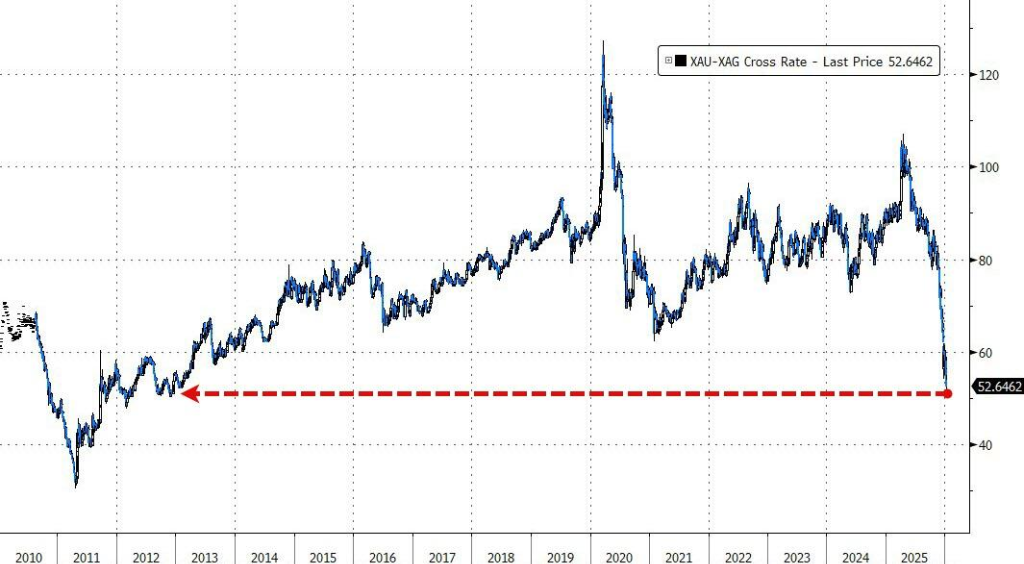
(Gold/Silver ratio falls to 52x)

Analysis believes that, unlike previous precious metal rallies dominated by "inflation-interest rates," this round of gains resembles a repricing of macroeconomic uncertainties: ambiguous monetary policy prospects, deepening fiscal dominance, and ongoing geopolitical tensions are causing gold and silver to continue playing the role of a "hedge against systemic risks."

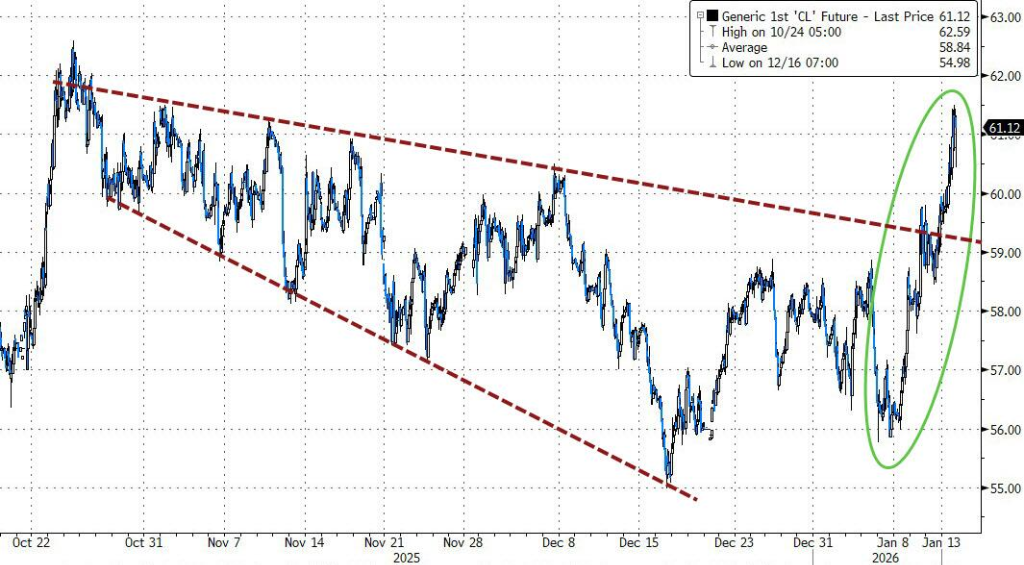
Commodity and cryptocurrency markets performed notably well. International crude oil prices continued to climb after the US President made hawkish remarks regarding Iran, with WTI crude prices breaking through $61. Cryptocurrencies also saw significant gains, with Bitcoin returning near its year-to-date high.

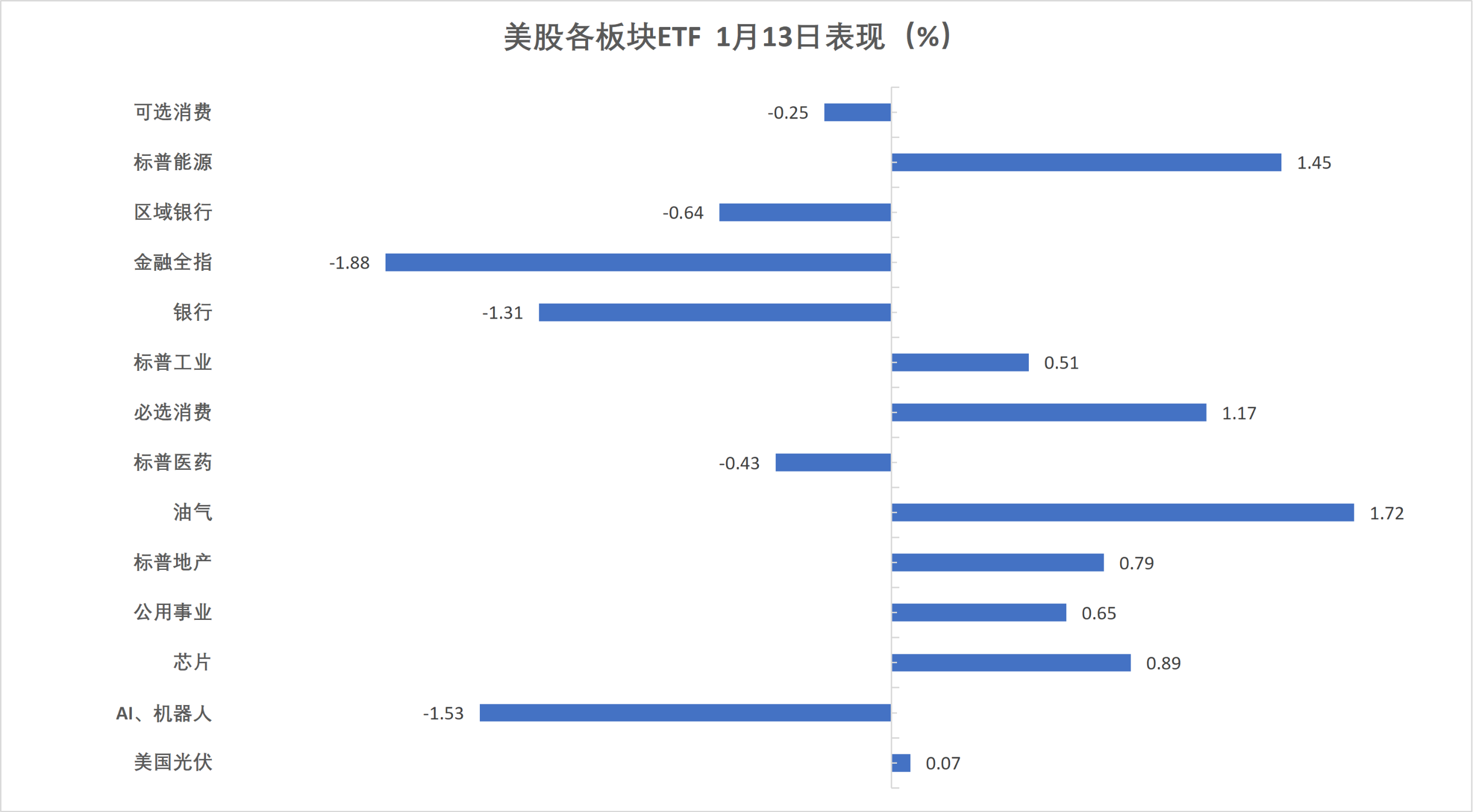
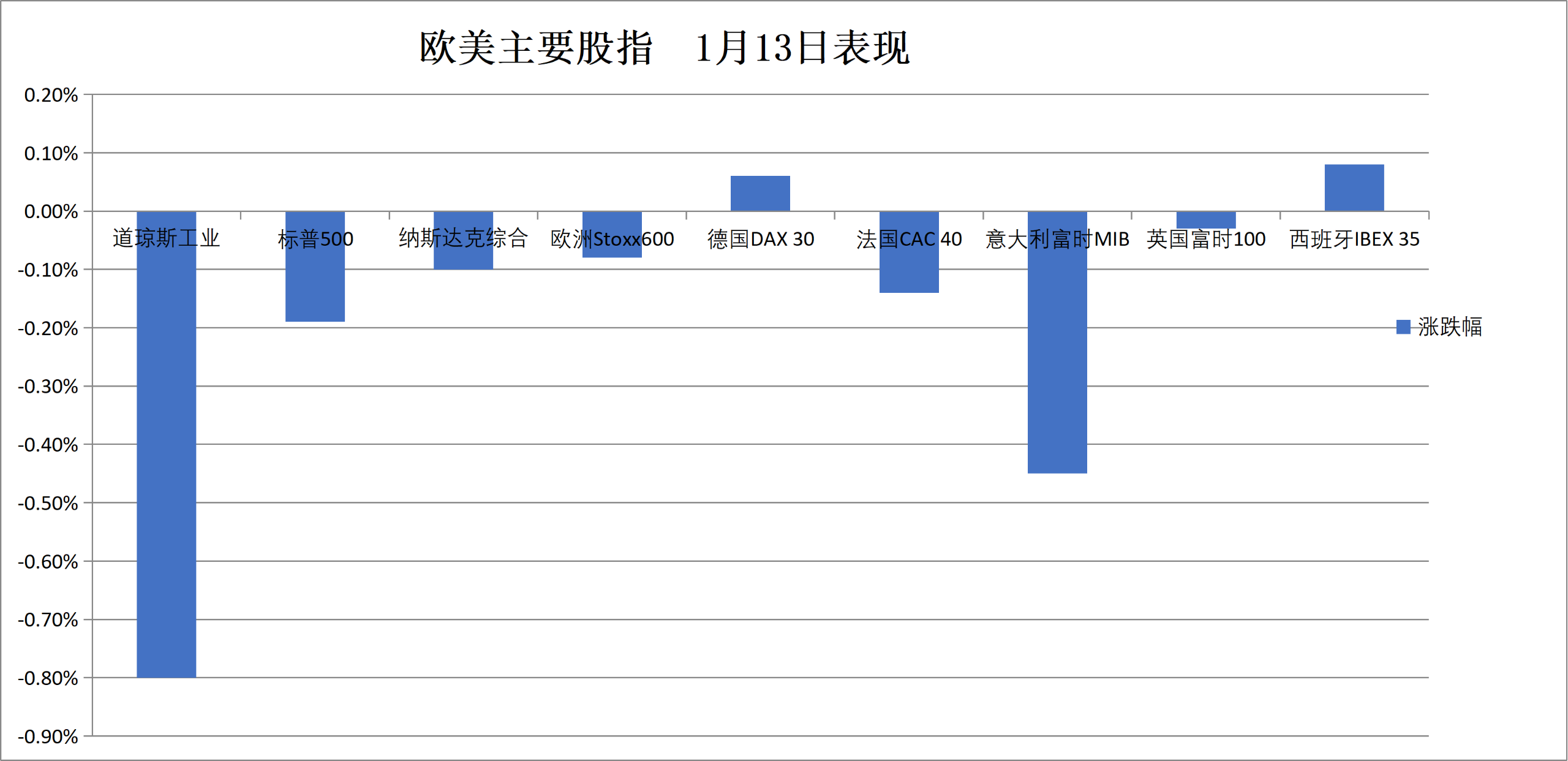
On Tuesday, the three major US stock indices closed lower, with the Dow down about 400 points and the Nasdaq down 0.1%. The Financial Select Sector ETF fell over 1.9%, leading the decline among US sector ETFs, while the S&P Energy sector rose over 1.5%.

US Benchmark Indices:

  • S&P 500 Index closed down 13.53 points, or 0.19%, at 6963.74 points.

  • Dow Jones Industrial Average closed down 398.21 points, or 0.80%, at 49191.99 points.

  • Nasdaq Composite closed down 24.032 points, or 0.10%, at 23709.873 points. Nasdaq 100 Index closed down 45.711 points, or 0.18%, at 25741.952 points.

  • Russell 2000 Index closed down 0.10%, at 2633.10 points.

  • CBOE Volatility Index (VIX) closed up 4.35%, at 15.12.

US Sector ETFs:

  • Financial Select Sector SPDR Fund (XLF) closed down 1.92%, U.S. Global Jets ETF (JETS) down 1.68%, SPDR S&P Bank ETF (KBE) down 0.94%, SPDR S&P Regional Banking ETF (KRE) down 0.66%.

(January 13th - US Sector ETFs Performance)

Magnificent 7 Tech Stocks:

  • The Wind Magnificent 7 Index fell 0.22%.

  • Google (Alphabet) closed up 1.24%, Nvidia up 0.47%, Apple up 0.31%, Tesla down 0.39%, Microsoft down 1.36%, Amazon down 1.57%, Meta down 1.69%.

Chip Stocks:

  • PHLX Semiconductor Index (SOX) closed up 0.95%, at 7747.993 points.

  • TSMC ADR down 0.22%, AMD up 6.39%.

Chinese Stocks (US Listed):

  • Nasdaq Golden Dragon China Index closed down 1.86%, at 7874.82 points.

  • Among popular Chinese stocks, Pony.ai fell 9.6%, Pinduoduo fell over 5%, Alibaba rose 0.4%.

Other Stocks:

  • Circle rose 0.72%.

Eurozone blue-chip index hit a closing record high for the third consecutive day. German stocks hit a closing record high for the seventh straight day, Danish stocks rose about 1%.

Pan-European Indices:

  • STOXX Europe 600 Index closed down 0.08%, at 610.44 points, retreating from its record closing high, showing a W-shaped pattern overall, after hitting a new intraday record high of 611.86 points early in the European session.

  • Euro STOXX 50 Index closed up 0.22%, at 6029.83 points, setting a record closing high for the third consecutive trading day.

National Indices:

  • German DAX 30 Index closed up 0.06%, at 25420.66 points, barely eking out its seventh consecutive record closing high.

  • French CAC 40 Index closed down 0.14%, at 8347.20 points.

  • UK FTSE 100 Index closed down 0.03%, at 10137.35 points.

    (January 13th - Performance of Major European and US Indices)

Sectors and Stocks:

  • Among Eurozone blue-chips, Argenx closed up 3.75%, TotalEnergies up 2.321%, Italian energy giant Eni up 2.15%, Safran up 2.13%, Infineon up 2.09%.

  • Among all components of the STOXX Europe 600 Index, Swiss Sika AG closed down 9.50%, Rockwool down 7.72% – Russia temporarily took over the company's assets in Russia; Vuzzi, which has operations in Russia, fell 7.16%, the third largest decliner.
Crude oil rose for the fourth consecutive day, with WTI crude prices briefly breaking through $61.

Crude Oil:

  • WTI February crude futures settled at $61.15/barrel.

(WTI Crude Oil Futures)

  • Brent March crude futures settled at $65.47/barrel.

Natural Gas:

  • NYMEX February natural gas futures settled at $3.4190/MMBtu.
Related Questions

QWhat was the core CPI data for the US in December and what was its significance?

AThe US core CPI for December was 2.6% year-on-year, equaling a four-year low. Despite this cooling inflation, it did not change the market's key pricing for the Federal Reserve, with the interest rate market still betting on the first rate cut occurring in June.

QWhich financial stock led the decline in the financial sector and why?

AJPMorgan Chase led the decline in the financial sector, falling over 4%. This was because it confirmed in its earnings report that its investment banking revenue was below guidance.

QWhat level did the USD/JPY exchange rate break through?

AThe USD/JPY exchange rate broke through the level of 159.

QWhat new milestone did Bitcoin reach?

ABitcoin rose sharply, returning to near its year-to-date high.

QDespite a stronger US dollar, which asset still hit a new all-time high during the session?

ADespite a stronger US dollar, spot gold hit a new all-time high during the session, briefly breaking above $4,600.

Related Reads

Trading

Spot
Futures

Hot Articles

What is $BITCOIN

DIGITAL GOLD ($BITCOIN): A Comprehensive Analysis Introduction to DIGITAL GOLD ($BITCOIN) DIGITAL GOLD ($BITCOIN) is a blockchain-based project operating on the Solana network, which aims to combine the characteristics of traditional precious metals with the innovation of decentralized technologies. While it shares a name with Bitcoin, often referred to as “digital gold” due to its perception as a store of value, DIGITAL GOLD is a separate token designed to create a unique ecosystem within the Web3 landscape. Its goal is to position itself as a viable alternative digital asset, although specifics regarding its applications and functionalities are still developing. What is DIGITAL GOLD ($BITCOIN)? DIGITAL GOLD ($BITCOIN) is a cryptocurrency token explicitly designed for use on the Solana blockchain. In contrast to Bitcoin, which provides a widely recognized value storage role, this token appears to focus on broader applications and characteristics. Notable aspects include: Blockchain Infrastructure: The token is built on the Solana blockchain, known for its capacity to handle high-speed and low-cost transactions. Supply Dynamics: DIGITAL GOLD has a maximum supply capped at 100 quadrillion tokens (100P $BITCOIN), although details regarding its circulating supply are currently undisclosed. Utility: While precise functionalities are not explicitly outlined, there are indications that the token could be utilized for various applications, potentially involving decentralized applications (dApps) or asset tokenization strategies. Who is the Creator of DIGITAL GOLD ($BITCOIN)? At present, the identity of the creators and development team behind DIGITAL GOLD ($BITCOIN) remains unknown. This situation is typical among many innovative projects within the blockchain space, particularly those aligning with decentralized finance and meme coin phenomena. While such anonymity may foster a community-driven culture, it intensifies concerns about governance and accountability. Who are the Investors of DIGITAL GOLD ($BITCOIN)? The available information indicates that DIGITAL GOLD ($BITCOIN) does not have any known institutional backers or prominent venture capital investments. The project seems to operate on a peer-to-peer model focused on community support and adoption rather than traditional funding routes. Its activity and liquidity are primarily situated on decentralized exchanges (DEXs), such as PumpSwap, rather than established centralized trading platforms, further highlighting its grassroots approach. How DIGITAL GOLD ($BITCOIN) Works The operational mechanics of DIGITAL GOLD ($BITCOIN) can be elaborated on based on its blockchain design and network attributes: Consensus Mechanism: By leveraging Solana’s unique proof-of-history (PoH) combined with a proof-of-stake (PoS) model, the project ensures efficient transaction validation contributing to the network's high performance. Tokenomics: While specific deflationary mechanisms have not been extensively detailed, the vast maximum token supply implies that it may cater to microtransactions or niche use cases that are still to be defined. Interoperability: There exists the potential for integration with Solana’s broader ecosystem, including various decentralized finance (DeFi) platforms. However, the details regarding specific integrations remain unspecified. Timeline of Key Events Here is a timeline that highlights significant milestones concerning DIGITAL GOLD ($BITCOIN): 2023: The initial deployment of the token occurs on the Solana blockchain, marked by its contract address. 2024: DIGITAL GOLD gains visibility as it becomes available for trading on decentralized exchanges like PumpSwap, allowing users to trade it against SOL. 2025: The project witnesses sporadic trading activity and potential interest in community-led engagements, although no noteworthy partnerships or technical advancements have been documented as of yet. Critical Analysis Strengths Scalability: The underlying Solana infrastructure supports high transaction volumes, which could enhance the utility of $BITCOIN in various transaction scenarios. Accessibility: The potential low trading price per token could attract retail investors, facilitating wider participation due to fractional ownership opportunities. Risks Lack of Transparency: The absence of publicly known backers, developers, or an audit process may yield skepticism regarding the project's sustainability and trustworthiness. Market Volatility: The trading activity is heavily reliant on speculative behavior, which can result in significant price volatility and uncertainty for investors. Conclusion DIGITAL GOLD ($BITCOIN) emerges as an intriguing yet ambiguous project within the rapidly evolving Solana ecosystem. While it attempts to leverage the “digital gold” narrative, its departure from Bitcoin's established role as a store of value underscores the need for a clearer differentiation of its intended utility and governance structure. Future acceptance and adoption will likely depend on addressing the current opacity and defining its operational and economic strategies more explicitly. Note: This report encompasses synthesised information available as of October 2023, and developments may have transpired beyond the research period.

363 Total ViewsPublished 2025.05.13Updated 2025.05.13

What is $BITCOIN

Discussions

Welcome to the HTX Community. Here, you can stay informed about the latest platform developments and gain access to professional market insights. Users' opinions on the price of BTC (BTC) are presented below.

活动图片