Computing Power Subprime Crisis: The AI Infrastructure Debt Wave, Miner Leverage, and the Vanishing 'Liquidation Liquidity'

marsbitPublished on 2025-12-18Last updated on 2025-12-18

Abstract

AI Infrastructure Debt Crisis: A Looming "Compute Subprime" Scenario Beneath the surface of booming AI investment and data center expansion, a severe financial mismatch is brewing. Credit investors are growing alarmed as the industry uses long-term, real-estate-like debt models to finance rapidly depreciating tech assets with an effective shelf life of just 18 months. The core issue is a fundamental asset-liability mismatch. AI compute is inherently deflationary; inference costs are falling 20-40% annually due to technological advances, eroding the future cash flows used to service debt taken out at peak 2024 prices. This risk is amplified by a shift in financing. High-risk, venture-grade tech assets are being packaged into low-risk, utility-grade project finance and asset-backed loans (ABL), transforming potential equity losses into systemic defaults. Crypto miners, often portrayed as successfully "pivoting" to AI, are particularly vulnerable. Many have not deleveraged but have instead taken on double leverage—using volatile crypto holdings as collateral to borrow more dollars to buy GPUs. This creates a dangerous correlation risk where a crypto crash and a drop in AI rental prices could occur simultaneously. The final, critical flaw is the illusion of collateral. Unlike real estate, a defaulting borrower's GPUs are nearly impossible to liquidate. They are physically dependent on specialized infrastructure, face rapid obsolescence, and lack a deep secondary market, mean...

Author: Anita @anitahityou

If you only read tech news in 2025, the world seems rosy: AI investment continues, North American data center construction accelerates, and crypto miners have finally "exited the cycle," successfully transforming their highly volatile mining operations into stable AI computing power services.

But in the credit departments of Wall Street, the atmosphere is completely different.

Credit investors aren't discussing model performance or which generation of GPU is stronger. They stare at the core assumptions in their Excel spreadsheets and begin to feel a chill: we seem to be using a 10-year real estate financing model to purchase a perishable product with a shelf life of only 18 months.

Back-to-back reports from Reuters and Bloomberg in December revealed the tip of the iceberg: AI infrastructure is rapidly becoming a "debt-intensive industry." But this is just the surface; the real crisis lies in a deep financial structure mismatch—when high-depreciation computing assets, highly volatile miner collateral, and rigid infrastructure debt are forcibly bundled together, a hidden chain of default transmission has already formed.

I. Deflation on the Asset Side: The Brutal Revenge of "Moore's Law"

The core logic of credit is Debt Service Coverage Ratio (DSCR). Over the past 18 months, the market assumed AI compute租金 (rent) would be as stable as real estate rent, or even as inflation-resistant as oil.

Data is mercilessly shattering this assumption.

According to Q4 2025 tracking data from SemiAnalysis and Epoch AI, the unit cost of AI inference has decreased by 20–40% year-over-year in the past year.

  • The adoption of model quantization, distillation techniques, and efficiency improvements in dedicated inference chips (ASICs) have led to an exponential increase in the efficiency of computing power supply.
  • This means so-called "compute租金" has a natural deflationary attribute.
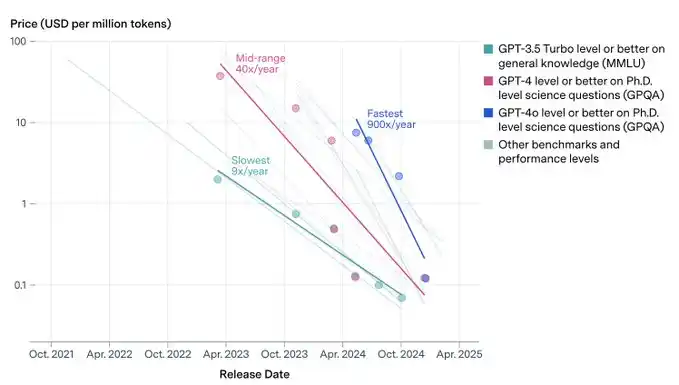
This creates the first duration mismatch: the issuing entities purchased GPUs at 2024 peak prices (CapEx), locking in a rental income curve destined to plummet post-2025.

If you are an equity investor, this is called technological progress; if you are a creditor, this is called collateral depreciation.

II. The Distortion on the Financing Side: Packaging Venture Risk as Infrastructure Returns

If returns on the asset side are thinning, the liability side should rationally become more conservative.

But reality is恰恰相反 (precisely the opposite).

According to the latest statistics from The Economic Times and Reuters, the total debt financing for AI data centers and related infrastructure surged 112% in 2025, reaching a scale of $25 billion. The main drivers of this surge are "Neo-Cloud" vendors like CoreWeave and Crusoe, as well as transitioning mining companies, which are大规模采用 (large-scale adoption of) Asset-Backed Lending (ABL) and Project Finance.
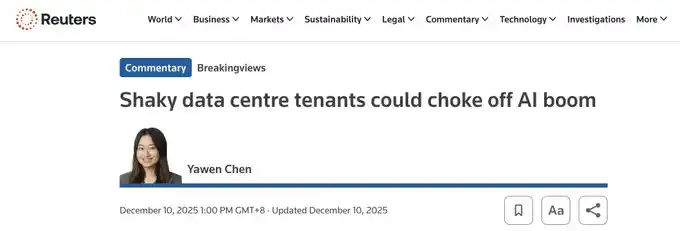
The本质变化 (essential change) in this financing structure is extremely dangerous:

  • Past: AI was a game for tech VCs; failure meant equity goes to zero.
  • Present: AI has become an infrastructure game; failure means debt default.

The market is mistakenly placing high-risk, high-depreciation tech assets (Venture-grade Assets) into a low-risk financing model (Utility-grade Leverage) meant for highways and hydropower plants.

III. Miners' "Fake Transformation" and "Real Leverage"

The most fragile link appears among crypto miners. The media loves to praise miner转型 (transformation) to AI as "de-risking," but from a balance sheet perspective, this is risk叠加 (stacking).

Consulting data from VanEck and TheMinerMag reveals a counterintuitive fact: the net debt ratios of leading listed mining companies in 2025 have not substantially decreased compared to the 2021 peak.甚至 (Even), the debt scale of some aggressive mining firms has surged by 500%.
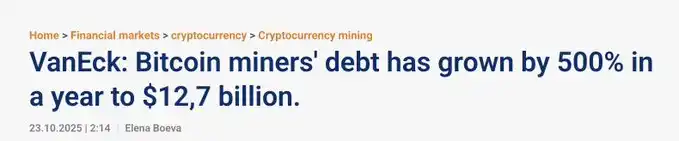
How did they achieve this?

  • Left hand (Asset side): Still holds highly volatile BTC/ETH, or uses future computing income as implicit collateral.
  • Right hand (Liability side): Issues convertible notes or high-yield bonds, borrows USD to purchase H100s/H200s.

This is not deleveraging; this is a Rollover (debt extension).

This means miners are playing a "double leverage" game: using Crypto's volatility as collateral to bet on GPU cash flow. During顺风期 (favorable periods) this means double profits, but once the macro environment tightens, "coin price decline" and "compute租金 decline" will occur simultaneously**. In credit models, this is called correlation convergence, the nightmare of all structured products.

IV. The Non-Existent "Repo Market" (The Missing Repo Market)

What keeps credit managers awake at night is not the default itself, but the清算 (liquidation) after default.

In the real estate subprime crisis, banks could at least foreclose and auction houses. But in AI compute financing, if a miner defaults, who can the creditor sell those ten thousand H100 GPUs to?

This is a secondary market whose liquidity is严重高估 (severely overestimated):

  1. Physical Dependence: High-end GPUs aren't something you can just plug into a home computer; they heavily depend on specific liquid-cooled racks and power density (30-50kW/rack).
  2. Technical Obsolescence (Hardware Obsolescence): With the release of NVIDIA's Blackwell and even Rubin architectures, older cards face non-linear depreciation.
  3. Buy-Side Vacuum: When systemic selling occurs, there is no "lender of last resort" willing to take on obsolete electronic waste.

We must be wary of this "collateral illusion"—the LTV on the books looks safe, but that secondary repo market capable of absorbing tens of billions of dollars in selling pressure simply doesn't exist in reality.

This Isn't Just an AI Bubble; It's a Failure of Credit

It needs to be clarified that this article does not否定 (deny) AI's technological prospects, nor does it deny the real demand for computing power. What we question is the wrong financial structure.

When deflationary assets (GPUs) driven by Moore's Law are priced like inflation-resistant real estate; when miners who haven't truly deleveraged are financed like premium infrastructure operators—the market is actually conducting a credit experiment that has not been sufficiently priced in.

Historical experience repeatedly proves: credit cycles often peak earlier than technology cycles. For macro strategists and credit traders, the primary task before 2026 might not be predicting which large model will win, but重新审视 (re-examining) the true credit spreads of those "AI Infra + Crypto Miners" combinations.

<1>https://epoch.ai/data-insights/llm-inference-price-trends

<2>https://epochai.substack.com/p/the-epoch-ai-brief-april-2025

<3>https://semianalysis.com/2025/

<4>https://www.reuters.com/commentary/breakingviews/shaky-data-centre-tenants-could-choke-off-ai-boom-2025-12-10/

<5>https://longbridge.com/en/news/269179463

<6>https://economictimes.indiatimes.com/topic/data-center-capacity

<7>https://www.webpronews.com/ais-debt-fueled-data-center-frenzy-risks-mounting-in-2025-boom/

<8>https://www.alpha-matica.com/post/assessing-risks-in-ai-infrastructure-finance

<9>https://www.blackstone.com/news/press/coreweave-secures-7-5-billion-debt-financing-facility-led-by-blackstone-and-magnetar/

<10>https://www.prnewswire.com/news-releases/coreweave-secures-7-5-billion-debt-financing-facility-led-by-blackstone-and-magnetar-301848093.html

<11>https://www.cnbc.com/2024/05/17/ai-startup-coreweave-raises-7point5-billion-in-debt-blackstone-leads.html

<12>https://happycoin.club/en/vaneck-za-god-dolgi-bitkoin-majnerov-vyrosli-na-500-do-127-mlrd/

<13>https://www.binance.bh/en-BH/square/post/10-23-2025-crypto-news-bitcoin-miner-debt-surges-500-as-industry-gears-up-for-hashrate-

<14>https://www.aicerts.ai/wp-content/uploads/2025/02/Publications-Certification-Impact-Report-1.pdf

<15>https://www.webpronews.com/ais-debt-fueled-data-center-frenzy-risks-mounting-in-2025-boom/

<16>https://www.alpha-matica.com/post/assessing-risks-in-ai-infrastructure-finance

Related Questions

QWhat is the core financial mismatch that the article identifies as the root of the potential 'Compute Subprime Crisis'?

AThe core financial mismatch is using long-term, real estate-style infrastructure financing models (e.g., 10-year debt) to purchase rapidly depreciating and deflationary tech assets (e.g., GPUs with an 18-month effective lifespan). This creates a duration mismatch where the cost of capital is locked in at a high price point, but the revenue from the asset is on a steeply declining curve due to technological progress.

QAccording to the article, why is the 'AI compute rental' income stream inherently deflationary?

AAI compute rental income is deflationary due to rapid technological advancements, specifically model quantization, distillation techniques, and the efficiency gains from specialized inference chips (ASICs). These factors cause the cost of performing a unit of AI inference to decrease by 20-40% year-over-year, crushing the assumption of stable, inflation-resistant rental income.

QHow does the article characterize the risk transformation from the 'past' state of AI to the 'now' state?

AThe article states that in the past, AI was a venture capital (VC) game where the risk was borne by equity investors, and failure meant equity going to zero. Now, AI has become an infrastructure game where the risk is shifted to debt markets, and failure means a debt default, posing a systemic risk to the credit system.

QWhat 'double leverage' game are crypto miners playing according to the analysis?

ACrypto miners are playing a 'double leverage' game by using their highly volatile crypto assets (BTC/ETH) or future compute revenue as collateral to take on more dollar-denominated debt (e.g., via convertible notes) to purchase more GPUs. This creates a dangerous correlation convergence where a downturn could simultaneously crash both crypto prices and AI compute rental rates, triggering a crisis.

QWhy does the article argue that the secondary market for GPUs (the 'repo market') is an illusion and a critical vulnerability?

AThe article argues the secondary market is an illusion because high-end GPUs lack true liquidity for large-scale liquidation events. They are physically dependent on specialized infrastructure like liquid-cooled racks, become obsolete quickly due to new architectures, and there is no 'lender of last resort' to absorb billions of dollars worth of outdated hardware during a systemic sell-off, making the collateral's stated loan-to-value (LTV) ratio dangerously misleading.

Related Reads

Bankless Co-founder: Why I Sold All My ETH

Author David Hoffman, founder of Bankless, explains his decision to sell all his ETH, despite being a prominent figure in the Ethereum ecosystem. He clarifies that his move is not a bearish take on Ethereum itself, which he remains highly optimistic about as a network. His core argument is that the "ETH is money" thesis, which he helped popularize, has largely played out. Hoffman argues that ETH has achieved the market valuation it deserves based on Ethereum's current success and competitive position. He details several reasons for this view. First, the path for ETH to become global money required nearly flawless execution and sustained dominance across Ethereum's entire technical and social stack—a coordination challenge he now believes had a narrower window for success than anticipated. Second, market data shows a strong correlation between L1 chain activity/fees and the price of its native asset; Ethereum's fee dominance has been challenged by competitors like Solana. Third, the "strong version" of crypto (decentralized, native crypto economies) that ETH's monetary thesis relied upon has struggled to maintain a positive mainstream narrative and stable adoption beyond a brief period. Finally, Ethereum's architecture as a "giver"—providing secure block space and tokenization capabilities at cost to L2s and applications—means it doesn't capture premium value directly. Its rollup-centric roadmap further directs most profits to L2s and applications ("fat app theory"). In conclusion, Hoffman believes the opportunity for ETH to be revalued significantly upward as money has diminished. He sold not because ETH will fail, but because its monetary thesis has matured, and he seeks to allocate capital to other opportunities he finds more compelling.

链捕手1h ago

Bankless Co-founder: Why I Sold All My ETH

链捕手1h ago

From Issuer to Infrastructure Owner: Circle's Arc Strategy and the Fatal Gap in the GENIUS Act

Circle raised $222 million for its proprietary Layer-1 blockchain, Arc, positioning itself not just as a stablecoin issuer but as the owner of the settlement infrastructure USDC relies on. This move, backed by investors like BlackRock and Apollo, highlights a significant structural conflict unaddressed by the GENIUS Act of 2025. While the act focuses on stablecoin reserves and issuer oversight, it remains silent on the market structure implications of an issuer controlling the underlying network—a scenario akin to a currency issuer also owning the payment rails. Traditionally, financial regulations separate issuers from settlement infrastructure to ensure neutrality. With Arc, Circle gains control over transaction ordering, fees, and network rules, potentially favoring USDC over competitors. The article argues that this creates a permanent structural temptation, even if no abuse occurs. The solution lies in applying established market infrastructure principles: mandating neutral transaction ordering, transparent fee schedules, and governance separated from Circle’s commercial interests. The current pre-mainnet phase offers a critical window for regulators to establish these rules before Arc becomes entrenched. Once operational, enforcing changes would be costly and disruptive. The core question remains: should a regulated stablecoin issuer be allowed to own the settlement network its competitors must use? The GENIUS Act doesn’t answer this, but Circle’s Arc strategy makes it urgent.

marsbit1h ago

From Issuer to Infrastructure Owner: Circle's Arc Strategy and the Fatal Gap in the GENIUS Act

marsbit1h ago

What Are the Key Variables Determining the AI Bull Market?

Title: What Determines the AI Bull Market? Key Variables Revealed Despite rising oil prices above $100/barrel, persistent inflation, and fragile Fed rate cut expectations—a traditionally hostile environment for high-valuation tech stocks—the AI sector continues to drive the market to new highs. According to analysts, the current AI boom is in a phase of "rational fervor": while bubbles exist, they are not yet out of control. The crucial shift is the emergence of Agentic AI, which is evolving from an assisting tool (Copilot) to an autonomous execution tool (Autopilot), creating a clearer commercial path from investment to revenue. This shift accelerates Token consumption and inference computing demand while boosting revenue forecasts for leading firms. The market is now rewarding capital expenditure as it transforms from a burden into a competitive moat, supporting hardware chains like GPUs, optical modules, and storage. However, valuations have already priced in growth expectations for 2027-2028. The forward P/E ratio for the "Magnificent Seven" tech giants is about 35x, compared to 25x for the rest of the S&P 500. This premium implies AI adoption must occur 5 to 8 times faster than past technological revolutions—a scenario with little room for error. The sustainability of the AI bull market hinges on three key variables: 1. **Short-term liquidity shocks**: Risks include sustained high oil prices, resurgent inflation, rising interest rates, and potential unwinding of the yen carry trade. The critical question is whether the upward revision speed of Annual Recurring Revenue (ARR) can outpace the rise in interest rates. 2. **Mid-term industry realization**: Can the actual pace of AI adoption and commercialization match the current lofty valuations? Historically, general-purpose technology revolutions follow a non-linear path with periods of acceleration and deceleration. 3. **Long-term structural constraints**: These include energy and power grid limitations, employment displacement and consumer purchasing power, social acceptance and potential backlash, and potential hardware technology breakthroughs that could disrupt current supply chains. While the long-term prospects for AI remain optimistic with potential for significant productivity gains, the stock market's pricing depends not just on the vision but on the actual speed of realization amid these growing constraints. The direction is clear, but the pace of execution will determine whether the bubble remains controlled or spirals out of control.

marsbit1h ago

What Are the Key Variables Determining the AI Bull Market?

marsbit1h ago

Trading

Spot
Futures

Hot Articles

Discussions

Welcome to the HTX Community. Here, you can stay informed about the latest platform developments and gain access to professional market insights. Users' opinions on the price of AI (AI) are presented below.

活动图片