Coinbase's Walled Garden

marsbitPublished on 2025-12-23Last updated on 2025-12-23

Abstract

Coinbase is strategically shifting from being a simple crypto on-ramp to building a comprehensive "everything exchange" to combat fee compression and cyclical trading volumes. This mirrors a common industry pattern where initial specialization gives way to integrated platforms that win through convenience, not perfection. The company is aggregating diverse assets—cryptocurrencies, stocks, perpetual futures, and prediction markets—into a single app. The thesis is that users, after a single KYC and bank link, prefer a unified platform over managing multiple specialized apps. This strategy aims to boost engagement; for instance, prediction markets keep users active during calm crypto periods. While the core business remains monetizing users through various fees and subscriptions, the real long-term differentiation is its control over the Base blockchain. This infrastructure could enable truly on-chain, 24/7 trading with instant settlement, something traditional brokers like Robinhood can't easily replicate. However, this move towards a centralized super-app conflicts with crypto purists who value decentralization. Coinbase's bet is that convenience and a seamless user experience will create a powerful ecosystem lock-in through low switching costs, not contracts. It aims to serve the mass market that prioritizes ease of use, even if it means sacrificing ideological purity. The challenge is to avoid becoming a bloated app while executing this Amazon-like strategy of bein...

Author: Thejaswini M A

Compiled by: Block unicorn

There is a pattern that repeats itself across industries, eras, and markets. It starts with explosive growth. Countless products spring up, each claiming to be better at something than any other. Specialized tools emerge, niche tools proliferate. Consumers are told that choice is freedom, customization is power, and the future belongs to those who break the old monopolies.

Then, quietly but inevitably, the pendulum begins to swing back.

It's not that the experts were wrong, nor is it that the overall system is necessarily better, but the cost of fragmentation accumulates silently. Each additional tool means another password to remember, another interface to learn, another point of failure in a system you are responsible for maintaining. Sovereignty begins to feel like a burden, freedom like overhead.

In the integration phase, the ultimate winners are not those who do everything perfectly, but those who do enough things well enough that the friction of leaving (and rebuilding the entire system elsewhere) becomes too great. They don't bind you with contracts or lock-in clauses; they capture you with convenience. A convenience born from countless tiny integrations and efficiencies that, on their own, might not be worth switching for, but together form a formidable moat.

We've seen this happen in e-commerce, cloud computing, and streaming. Now, we are witnessing it happen in finance.

Coinbase just made a bet on which side of the cycle we are about to enter.

Let me flashback first.

For most of its history, Coinbase was straightforward. It was the go-to platform for Americans to buy Bitcoin without feeling like they were doing anything shady. It had regulatory licenses, a clean interface, and customer service that, while often terrible, at least existed in theory. The company went public in 2021 with a valuation of $65 billion, with the core idea of being the on-ramp to cryptocurrency, and for a while, it worked.

But by 2025, the "crypto on-ramp" positioning began to look shaky. Spot trading fees were compressing. Retail trading volume was highly cyclical, surging in bull markets and plummeting in bear markets. Bitcoin whales increasingly preferred self-custody wallets. Regulators were still suing the company. And Robinhood, which started as a stock trading app and later ventured into crypto, saw its market cap suddenly soar to $105 billion, nearly double that of Coinbase. In 2021, over 90% of Coinbase's revenue came from trading. By Q2 2025, that proportion had fallen below 55%.
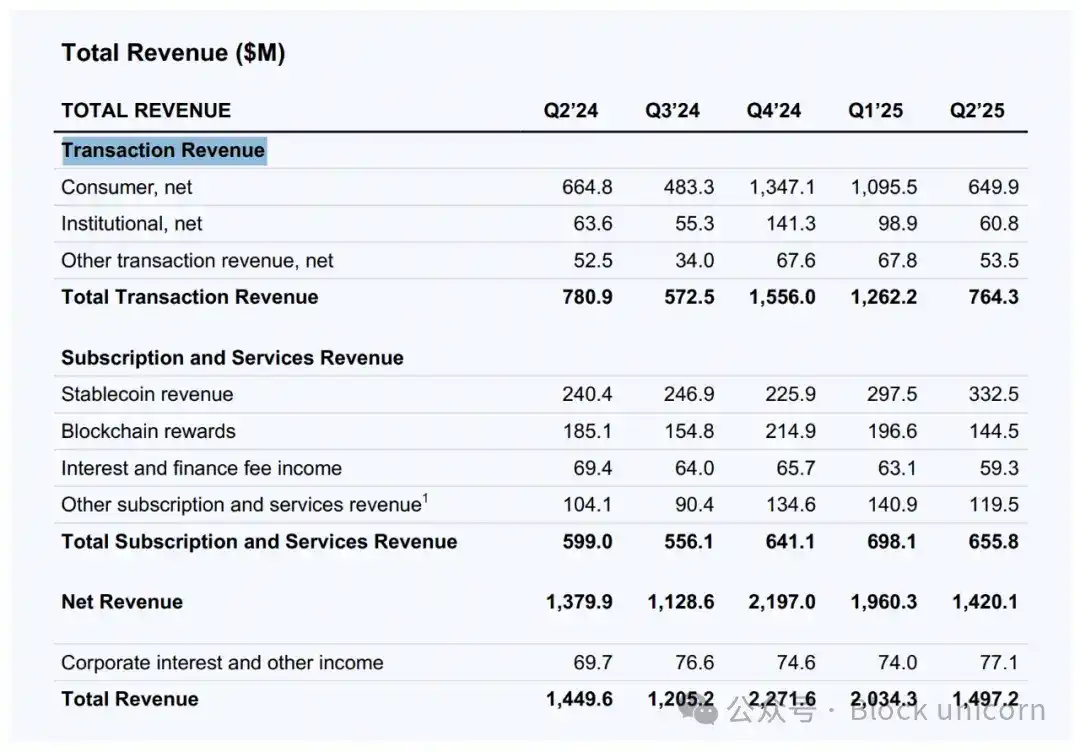
So, when the core product came under pressure, Coinbase did what you would do: it tried to become everything else.

They call it the "Exchange for Everything" theory, which posits that aggregation will beat specialization.

Stock trading means users can now react to Apple's earnings at midnight using USDC without leaving the app. Prediction markets mean they can check the price of "Will the Fed cut rates?" during lunch. Perpetual futures mean they can leverage a Tesla position 50x on a Sunday. Every new market is a reason to open the app, an opportunity to capture spreads, fees, or interest on idle stablecoin balances.

Is the strategy "Let's be Robinhood" or "Let's ensure users never need Robinhood"?

There has always been a view in fintech that users need specialized apps. One for investing, one for banking, one for payments, one for crypto trading. Coinbase is betting against that: they believe that once a user completes one KYC and links one bank account, they shouldn't have to do it nine more times elsewhere.

This is the "aggregation beats specialization" argument. In a world where the underlying assets are increasingly just tokens on a blockchain, it makes sense. If stocks are tokens, prediction market contracts are tokens, meme coins are tokens, why can't they all trade in the same venue?

The mechanism is: you deposit dollars (or USDC), trade all assets, and withdraw dollars (or USDC). No need to transfer funds between platforms. No minimum deposit requirements for multiple accounts. Just one pool of capital flowing between all asset classes.

The more Coinbase resembles a traditional broker, the more it must compete on traditional broker terms. Robinhood has 27 million funded accounts, while Coinbase has about 9 million monthly active users. So, Coinbase's differentiation can't just be "we offer stock trading now," it has to be the trading platform itself.

The offer is 24/7 liquidity for all trade types. No trading hours, no settlement delays, no waiting for your broker to approve your margin application while the trade moves against you.

Does this matter to most users? Probably not yet. Most people don't need to trade Apple stock at 3 a.m. on a Saturday. But some do. If you provide the platform where they can do it, you get their order flow. Once you get their order flow, you get their data. Once you get their data, you build better products. Once you have better products, you get more order flow.

It's a flywheel, provided the flywheel can start spinning.

The Prediction Market Gambit

Prediction markets are the most unusual part of this bundle, and perhaps the most important. They are not "trading" in the traditional sense, but structured bets on binary outcomes. For example: Will Trump win? Will the Fed hike rates? Will the Lakers make the playoffs?

These contracts disappear after settlement, so there is no long-term holder base. Liquidity is event-driven, meaning it is volatile and unpredictable. Yet, platforms like Kalshi and Polymarket saw their trading volume surge to over $7 billion in November.
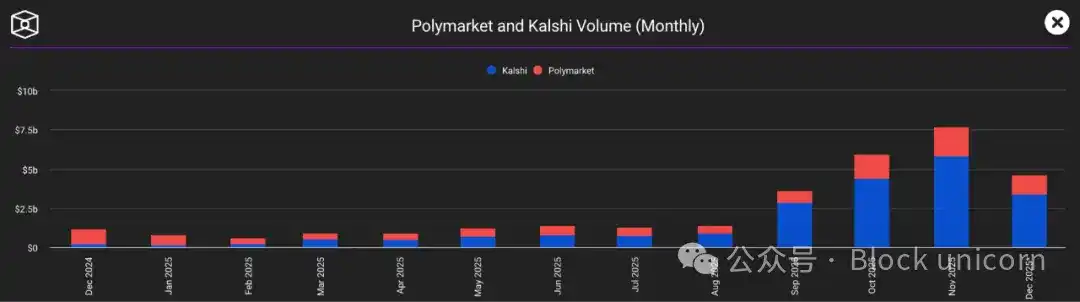
Why? Because prediction markets are a social tool. They allow people to express an opinion and put risk behind it. They give people a reason to check their phone during the fourth quarter of a game or on election night.

For Coinbase, prediction markets solve a specific problem: user engagement. When crypto prices are flat, users might get bored. When your stock portfolio is stagnant, stock trading can be dull. But there is always some event capturing attention. Integrating Kalshi gives users a reason to stay in the app even if Bitcoin isn't moving.

The bet is that users who come for election markets will stay for stock trading, and vice versa. The bet is that the broader the coverage, the higher the user retention.

The Business Model is Margin Stacking

Strip away the innovation narrative, and this is a company trying to make more money from the same user in more ways. Stock trading fees, DEX swap spreads, interest on stablecoin balances, crypto staking fees, Coinbase One subscription revenue, and infrastructure fees from developers using the Base blockchain.

I'm not criticizing. This is how exchanges work. The best exchange isn't the one with the lowest fees; it's the one users are reluctant to leave because leaving means rebuilding the whole system elsewhere.

Coinbase is building a walled garden, but the walls are not to lock users in; they are to provide convenience. You can still withdraw your crypto, you can still transfer your stocks to Fidelity. You probably won't, though, because why would you?

Coinbase's advantage is its on-chain tech, which can offer tokenized stocks, instant settlement, and programmable money. But for now, its stock trading looks very much like Robinhood's stock trading, just with longer hours. Its prediction markets look very much like Kalshi's, just embedded in a different app.

The real differentiation is the Base layer-2 blockchain that Coinbase built and controls. If stock trading truly happens on-chain, payments truly use stablecoins, and AI agents truly start trading autonomously using protocols like x402, then Coinbase has built something Robinhood can't easily replicate.

But that's the long game. In the short term, the competition is about who has the stickiest app. And adding more features doesn't automatically make an app stickier. It can also make the interface more cluttered, more complex, and more overwhelming for a new user who just wants to buy Bitcoin.

A segment of the crypto user base will be unhappy about this. They are the true believers. They wanted Coinbase to be the on-ramp to decentralized finance, not a centralized super-app with some DeFi features buried in a submenu.

Coinbase has clearly chosen scale over purity. It wants a billion users, not a million purists. It wants to be the default financial platform for the masses, not the preferred exchange for those running their own nodes.

This might be the right business decision. The mass market doesn't care about decentralization. They care about convenience, speed, and not losing money. If Coinbase can deliver on those, the philosophy behind it doesn't matter.

But it does create a peculiar tension. Coinbase is trying to be both the infrastructure for the on-chain world and the centralized exchange competing with Charles Schwab. It is trying to be both a champion of crypto and a company that makes crypto invisible. It is trying to be both rebellious and regulated.

Maybe it can be. Maybe the future is a regulated, on-chain exchange that feels as easy to use as Venmo. Or perhaps, trying to be everything to everyone makes you nothing to anyone.

This is the Amazon playbook. Amazon is not the best at anything. It's not the best bookstore, not the best grocer, not the best streaming service. But it is good enough at enough things that most people can't be bothered to go elsewhere.

However, many companies have tried to build an app for everything, and most have ended up with a bloated app for nothing.

If Coinbase can own the full loop from earning, trading, hedging, borrowing, to paying, then it might not matter if specific features are slightly inferior to specialized competitors. The switching costs and the hassle of managing multiple accounts will keep users in its ecosystem.

That's all about the Coinbase Exchange for Everything.

Recommended reading:

Why Isn't Asia's Largest Bitcoin Treasury Company, Metaplanet, Buying the Dip?

Multicoin Capital: The Era of Fintech 4.0 Has Arrived

a16z's Heavily Backed Web3 Unicorn Farcaster Forced to Pivot, Is Web3 Social a False Proposition?


Related Questions

QWhat is the core argument of the 'everything exchange' theory that Coinbase is adopting?

AThe core argument is that aggregation will beat specialization. It posits that users, after completing KYC and linking a bank account once, prefer a single platform that does many things well enough, rather than using multiple specialized apps. The convenience and reduced friction of an integrated system create a powerful moat.

QHow do prediction markets, like the integration with Kalshi, specifically benefit Coinbase's strategy?

APrediction markets solve a user engagement problem. They provide a reason for users to stay within the Coinbase app even when cryptocurrency or stock prices are stagnant, as there is always some event to follow and bet on. This increased engagement can lead to more activity in other areas of the app, like stock trading.

QWhat is the fundamental contradiction in Coinbase's current business approach as described in the article?

ACoinbase is trying to be two things at once: the infrastructure for the on-chain, decentralized world and a centralized exchange competing with traditional brokers like Charles Schwab. It aims to be both a champion of crypto and a company that makes crypto invisible, embracing both a rebellious spirit and regulation.

QWhat is the primary role of Coinbase's Base blockchain in its long-term differentiation strategy?

AThe Base blockchain is the foundation for true long-term differentiation. If stock trading occurs on-chain, payments use stablecoins, and AI agents trade autonomously, Coinbase will have built a product that competitors like Robinhood cannot easily replicate, as it controls this core infrastructure.

QAccording to the article, why might a user choose to stay on Coinbase even if specific features are better on competing platforms?

AUsers might stay because the switching cost and the hassle of managing multiple accounts become a significant barrier. The convenience of having a single platform for earning, trading, hedging, borrowing, and paying creates a powerful ecosystem lock-in, even if individual features are slightly inferior to specialists.

Related Reads

Exclusive from Yingke | Tang Wenbin's 'Yuanli Lingji' Merges with Logistics Robotics Company, and Secures Investment from Zhipu, SenseTime, Jieyue, and Others

Exclusive report: Embodied AI company "Yuanli Lingji" recently completed a new round of financing from major AI model firms including Zhipu AI, Stepfun, and SenseTime, alongside continued investments from industrial backers like Huaqin and SAIC Hengxu. Founded in March 2025 by Tang Wenbin, former co-founder and CTO of Megvii, Yuanli Lingji is a general-purpose embodied AI model company. In a notable move, the company has merged with logistics robotics firm "Atomix" (formerly known as Yuanli Juhe) through a share acquisition. Atomix, which originated from Megvii's logistics robotics business led by Tang in 2016 and was spun off in July 2024, has grown to become the world's second-largest supplier of pallet shuttle robots, with annual revenue nearing 1 billion RMB and over 500 projects globally for clients like Uniqlo and CATL. This merger aims to break the industry's "data deadlock" by combining Atomix's extensive real-world operational data from more than 20 countries with Yuanli Lingji's model training capabilities. The company's embodied AI model "DM0" utilizes a cross-domain training approach, integrating internet semantics, autonomous driving rules, and robotics data to achieve hardware-agnostic, precise manipulation even with a compact 2.4B parameter size. The collective investment from key AI players and the strategic merger signal a shift in the competitive landscape, as major model companies pivot from language tokens to physical actions ("from Token to Action"). The industry is entering a consolidation phase where hardware, AI models, data, and application scenarios converge to scale embodied intelligence, a trend mirrored by recent moves from giants like ByteDance and Skild AI.

marsbit3m ago

Exclusive from Yingke | Tang Wenbin's 'Yuanli Lingji' Merges with Logistics Robotics Company, and Secures Investment from Zhipu, SenseTime, Jieyue, and Others

marsbit3m ago

U.S. Stock Market Trends: Dow Hits New High, Nasdaq Falls, Whom Did Broadcom's Slap Wake Up?

U.S. Stocks Split: Dow Hits Record High as Nasdaq Slips; Broadcom's Plunge Sparks Rotation On June 4, the U.S. stock market saw a sharp divergence. The Dow Jones surged 875 points (+1.73%) to a record high of 51,561.93, while the Nasdaq Composite edged down 0.09%. The S&P 500 rose 0.41%. The primary catalyst was a sharp sell-off in AI-related chip stocks, led by Broadcom (AVGO). Despite reporting a 143% year-over-year jump in AI semiconductor revenue to $10.8 billion, the company's shares plunged about 14%. This was triggered by its maintained long-term AI revenue target, which failed to meet heightened expectations for a stock that had gained 55% this quarter and traded at a high P/E ratio. The slide dragged down the broader semiconductor sector and the technology板块. Conversely, money rotated into sectors like Healthcare (+3.14%), Financials (+2.67%), and Real Estate (+1.87%). UnitedHealth and Goldman Sachs were major contributors to the Dow's gains. The rotation was attributed to a search for value outside overheated tech names and a slight dip in Treasury yields. In other major news, SpaceX confirmed its IPO for June 12, targeting a record $75 billion raise at a ~$1.75 trillion valuation. Additionally, initial jobless claims rose to a four-month high, adding nuance to the labor market narrative ahead of the key May non-farm payrolls report. The day's action signaled that while the AI growth story remains intact, excessive valuations are prompting a market reassessment. Funds are moving, at least temporarily, from high-flying tech to more defensive and value-oriented sectors. The sustainability of this rotation hinges on upcoming economic data, particularly the jobs report, and the market's absorption of the massive SpaceX IPO.

marsbit6m ago

U.S. Stock Market Trends: Dow Hits New High, Nasdaq Falls, Whom Did Broadcom's Slap Wake Up?

marsbit6m ago

From 'Old Dogs' to 'New Darlings': How AI is Revaluing Old Infrastructure, from Dell to Nokia

"Old Dogs" Become AI's New Darlings: Revaluing Legacy Infrastructure The AI investment narrative is shifting. Beyond the spotlight on core chipmakers like Nvidia, a new wave of interest is rising for legacy tech companies—Dell, HPE, Nokia, Cisco, Corning, Western Digital—once labeled as slow-growth, outdated stories. This resurgence stems from AI's evolution from model development to real-world deployment, creating massive demand for physical infrastructure. As AI moves into data center construction and enterprise adoption, the focus turns to who can actually build and deliver complex systems. These established players hold decades of experience in supply chains, integration, networking, and enterprise delivery—assets now critical for scaling AI. The revaluation can be grouped into three key infrastructure areas: 1. **Servers & Integration (e.g., Dell, HPE):** They are becoming essential system integrators, transforming GPUs into full-scale AI servers with networking, power, and cooling, then delivering them to clients. Strong recent earnings and AI-specific revenue/order growth for Dell and HPE underscore this shift. 2. **Networking & Connectivity (e.g., Corning, Nokia, Cisco):** As AI clusters grow, high-speed data transfer becomes paramount. Corning benefits from fiber demand for data center links, Nokia is exploring AI-integrated wireless networks (AI-RAN), and Cisco sees surging orders for data center switches—all critical for efficient AI operations. 3. **Storage (e.g., Western Digital, Seagate):** The AI data explosion requires vast capacity. Beyond high-speed memory (HBM), there's growing need for high-capacity HDDs to store training data, logs, video, and cold/archival data cost-effectively. This revaluation, however, is not a blanket endorsement. True reassessment requires concrete proof: AI-driven orders and revenue growth, upward revisions to company guidance, and sustainable improvements in profit quality, not just top-line sales. In essence, AI is not turning all old tech firms into high-growth stocks; it is selectively re-pricing the "old assets" of companies that are mission-critical for building the new AI infrastructure, transforming their legacy capabilities into renewed growth engines.

marsbit15m ago

From 'Old Dogs' to 'New Darlings': How AI is Revaluing Old Infrastructure, from Dell to Nokia

marsbit15m ago

Trading

Spot
Futures

Hot Articles

Discussions

Welcome to the HTX Community. Here, you can stay informed about the latest platform developments and gain access to professional market insights. Users' opinions on the price of S (S) are presented below.

活动图片