Claude Mythos Officially Announced: Performance Crushes Opus 4.6, 'Imprisoned' for Being Too Dangerous

marsbitPublished on 2026-04-08Last updated on 2026-04-08

Abstract

Anthropic has officially announced Claude Mythos, a highly advanced AI model that reportedly surpasses Opus 4.6 across multiple benchmarks, including a 24% improvement in bug-fixing capability and a 17% boost in agent-based computer operations. However, due to its dangerous ability to identify and exploit security vulnerabilities at a level exceeding most human hackers, the model has been deemed a significant risk to public and economic security. Instead of releasing it publicly, Anthropic has initiated "Project Glasswing," a collaborative security effort involving major tech companies like Amazon, Apple, Google, Microsoft, and NVIDIA, along with open-source organizations. These partners will use the preview version of Mythos to strengthen defenses and identify vulnerabilities in critical systems before the model is widely available. Anthropic is also providing up to $100 million in usage credits and donating $4 million to support open-source security initiatives. The move underscores the urgent need to address AI safety at a global scale, as rapidly advancing capabilities could soon outpace existing security measures.

The beast is about to break free.

Just moments ago, Anthropic's legendary strongest model—

Claude Mythos—released its preview version.
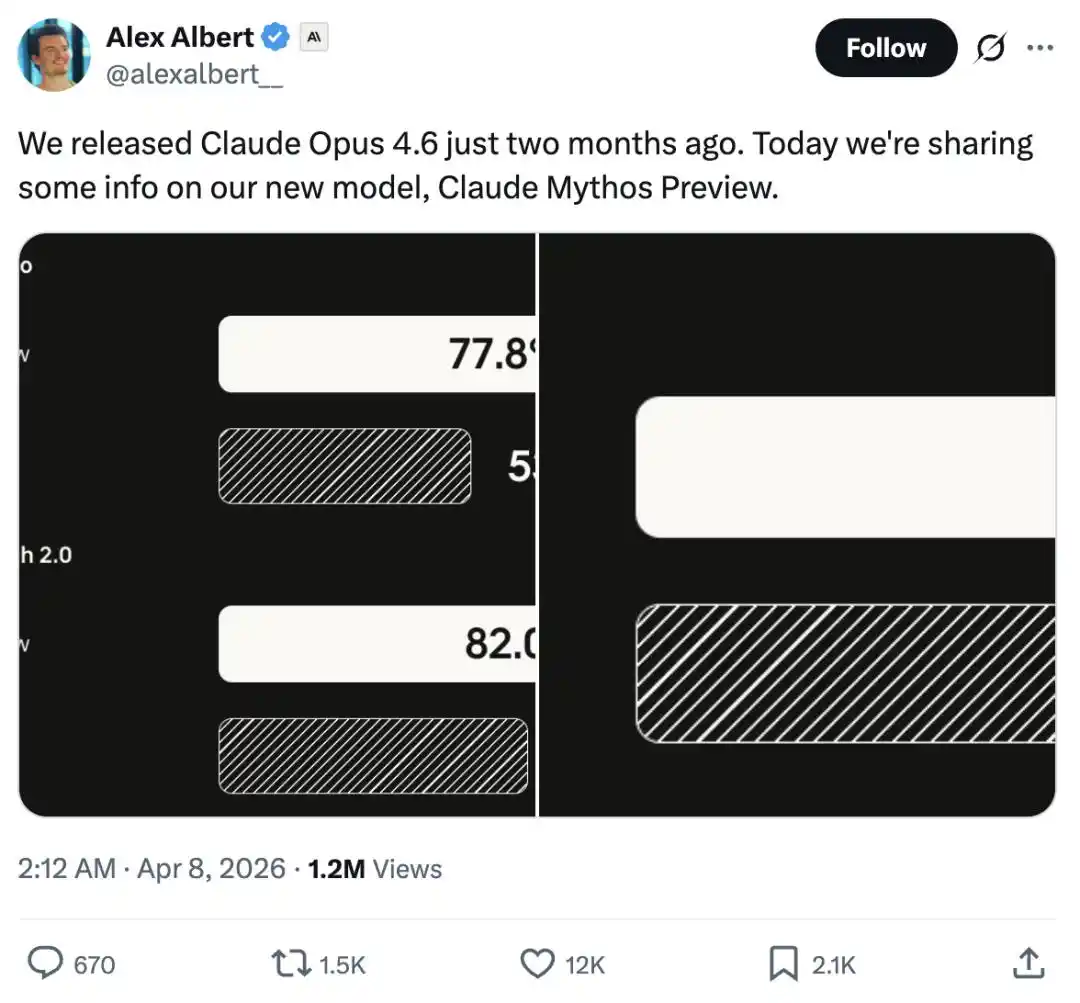
The rumors were right; this is indeed an epoch-making model.

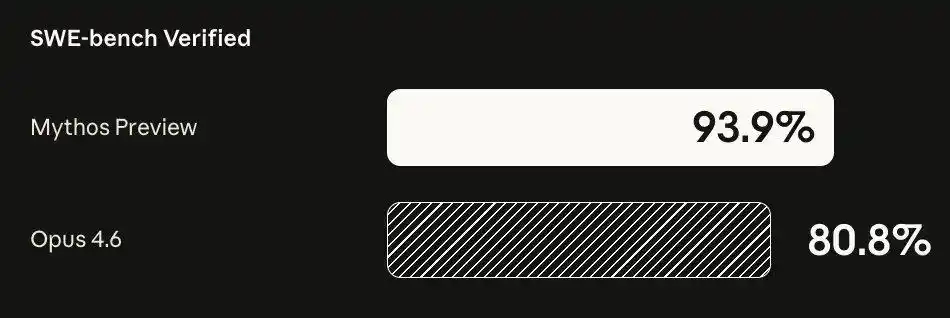
On various benchmarks, it completely crushes Opus 4.6.

Not just an improvement, it's a true "crushing"......

SWE-bench Pro: Bug-fixing capability surged by 24%

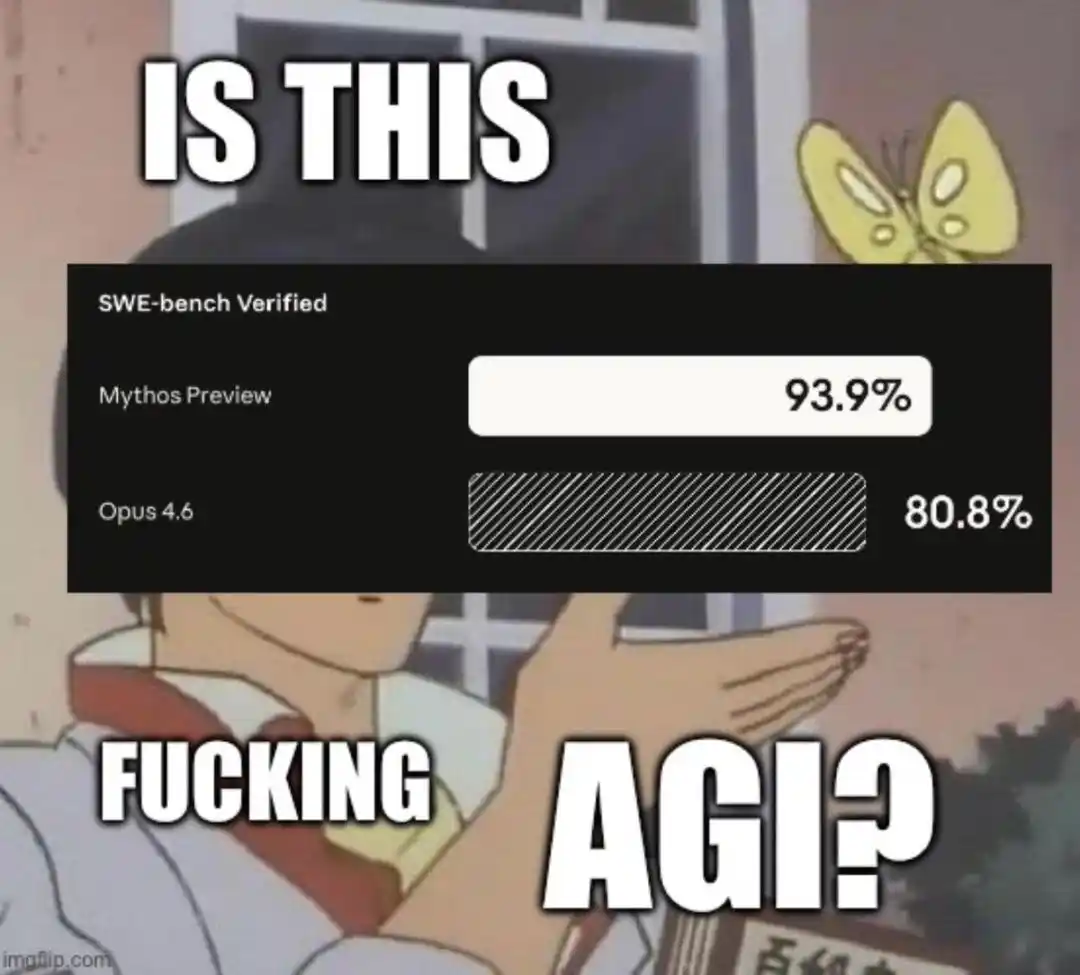
SWE-bench Verified: Tested again with the stricter version, still a 13% improvement.

Terminal-Bench 2.0: Computer operation/Agent capability, improved by 17%.
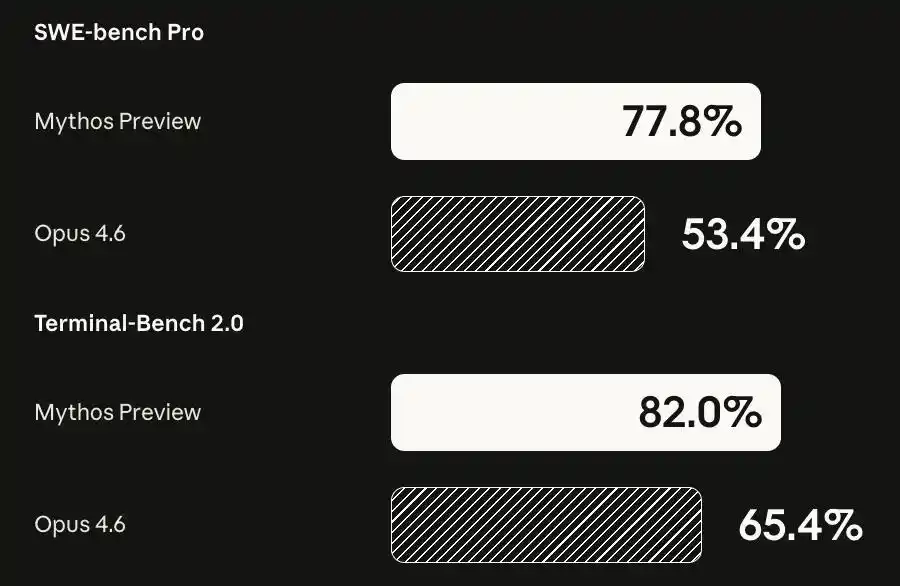
A model stronger than Opus 4.6? And it's still beating Opus down??

Friends, I simply cannot imagine what this thing will even be like.

Following Sonnet and Opus, OpenAI now meets its strictest father

Mythos.

But this time, Anthropic doesn't want to talk about benchmarks.

Compared to excitement and boasting, the official announcement blog subtly reveals a hint of hard-to-conceal "concern."

Even, panic.

Because this mythical model has a fatal "flaw."

Mythos Preview has already discovered thousands of high-risk vulnerabilities; all major mainstream operating systems and browsers are affected.

That's right. As AI's programming capabilities rapidly improve, making it more and more like a competent engineer, its other, dual-faceted ability is also growing uncontrollably.

Now, Mythos's ability to attack security vulnerabilities far surpasses that of the vast majority of hackers.

AI's capabilities at the code level have become so strong that in finding and exploiting vulnerabilities, it can exceed the vast majority of human engineers, leaving only the top few able to compete.

The other side of the coin has finally been flipped before us.

Anthropic states that at the current pace of AI development, this capability will soon proliferate and could even fall into the hands of those with less than secure intentions.

If it gets out of control, it would be a catastrophic disaster for the economy and public safety.

To give everyone enough time to respond, upon first announcing this new model, Anthropic made a very unusual move for an AI company.

They are temporarily not releasing it to the public.

Yes, Mythos will be part of the Glasswing Project (Project Glasswing1), initially opened to various partners first.
Their task is to build the strongest possible safety guardrails before this beast is fully unleashed.

The Imprisoned Claude Mythos

This is a massive "containment" operation.

To tame the beast that is Mythos, Anthropic has called upon almost all the legacy internet giants.

Participants include: Amazon, Apple, Google, Linux Foundation, Microsoft, NVIDIA......

In this project, there are no bystanders. All partners will deploy Mythos Preview into their own defensive security work.

They will unlock Mythos's true capabilities early, letting it out of its cage.

This is a preemptive training session. Before being riddled by the official version of Mythos, they will use the Mythos preview's capabilities to the fullest to strengthen their defenses.

Security, this time, is for real.

Anthropic says it will share the experience gained from this process so the entire industry can benefit.

The project is also open to over 40 additional builders and maintainers of critical software infrastructure, allowing them to use this model to scan and fortify their own systems and open-source systems.

Even more夸张的是, Anthropic has also pledged up to $100 million in usage credits to support this work and directly donated $4 million to open-source security organizations.

Wait, hold on, you're actually serious about this??

Haven't seen something like this in a long time.

Labs have always talked about limiting their internal models' capabilities, but honestly, it always felt like PR posturing.

But this Glasswing Project is the first time I've genuinely felt a chill down my spine.

Such a powerful model, yet tightly held back, creating such a huge stir just to announce a safety plan.

The level of seriousness is completely different. Who would give away so much money just for publicity?

So the Pro and Max users' Token usage, leaking like a sieve, was all to support your security cause, huh (doge).

Fine.

After all, if Mythos's capabilities are truly as announced, the release of this model would undoubtedly completely change the cybersecurity landscape.

AI safety is really no longer some scientists' "unfounded worry." This beast has already let out its first roar from behind the cage bars.

The Glasswing Project is just the starting point.

Anthropic states that cybersecurity is something no single organization can solve alone; frontier AI companies, software vendors, security researchers, the open-source community, and governments worldwide must all participate.

Defending global network infrastructure could be a project lasting years, while AI capabilities may see significant leaps in the coming months.

If we don't want to be turned into sieves by AI, we must act now, immediately, right away.

The Beast is Unleashed

Token usage burning through rapidly, Pro users "downgraded" to free users, OpenClaw cut off from resources, Claude Code inexplicably open-sourced......

Everything, suddenly, makes sense.

Anthropic might truly be swamped and dizzy.

The security issues with Mythos have become so severe that the internal team has no mind for other projects, forced to bet all their available GPUs, all-in on security.

Because—

The beast, is about to break free.

Reference links:[1]https://x.com/alexalbert__/status/2041579938537775160?s=46&t=iTysI4vQLQqCNJjSmBODPw[2]https://www.anthropic.com/glasswing

This article is from the WeChat public account "QbitAI", author: Focus on Frontier Technology

Related Questions

QWhat is the name of the new AI model announced by Anthropic and how does it perform compared to Opus 4.6?

AThe new model is called Claude Mythos. It is described as a groundbreaking model that 'crushes' or 'overwhelmingly outperforms' Opus 4.6 across various benchmarks, with significant improvements in bug-fixing (24% on SWE-bench Pro) and agent-based computer operation tasks (17% on Terminal-Bench 2.0).

QWhat is the major safety concern associated with the Claude Mythos model?

AThe major safety concern is that Claude Mythos possesses an extremely advanced and dangerous capability to discover and exploit high-risk security vulnerabilities. It has already found thousands of such vulnerabilities in major operating systems and browsers, and its ability to attack security flaws surpasses that of most human hackers.

QWhat is the name of the project under which Anthropic is releasing the preview of Claude Mythos, and what is its purpose?

AThe project is called 'Project Glasswing' (or Glasswing). Its purpose is to contain the potential danger of Claude Mythos by first releasing it to a consortium of partners (like Amazon, Apple, Google, etc.) so they can use its capabilities to strengthen their own defensive security measures before the model is publicly released.

QWhich major companies and organizations are mentioned as partners in the 'Glasswing' project to help secure systems against Claude Mythos?

AThe partners mentioned include Amazon, Apple, Google, the Linux Foundation, Microsoft, and NVIDIA. Additionally, over 40 builders and maintainers of critical software infrastructure are involved.

QWhat financial commitments did Anthropic make to support the security efforts outlined in the article?

AAnthropic committed up to $100 million in usage credits to support the defensive security work of its partners. It also directly donated $4 million to open-source security organizations.

Related Reads

Agents Take Over Traffic Distribution Power: What Are Tencent, ByteDance, and Alibaba Competing For?

In the race to dominate the AI era's entry point, China's tech giants—Tencent, ByteDance, and Alibaba—are aggressively deploying AI Agents to control the future of traffic distribution. Alibaba is pursuing a dual-track "closed loop + openness" strategy. Its Qianwen app is evolving into a super-Agent integrated across its ecosystem (Taobao, Alipay, etc.) to handle complex tasks like travel planning. Concurrently, it is opening its platform to external brands (Luckin Coffee, KFC) and has launched a B2B Agent platform, "Wukong," targeting enterprise automation. Its other flagship, Quark, aims to be an "AI super search box" for information and tasks. ByteDance is executing an omnipresent "sprawl strategy." Its Doubao app boasts over 300 million monthly active users and is evolving into a default AI entry point for daily life, with plans for paid versions and e-commerce integration. Its core weapon is the Kouzi platform, a visual "AI assembly factory" for developers to build custom Agents. ByteDance is also pushing hardware integration, collaborating on AI phones and developing smart glasses to embed Doubao everywhere. Tencent is playing its long-held "ultimate card" by quietly embedding an AI Agent directly into WeChat. This Agent, accessible via a swipe, can understand user commands and automatically execute tasks by calling upon WeChat's millions of mini-programs (e.g., finding and ordering coffee). This leverages WeChat's unparalleled 1.4-billion-user ecosystem to position the app as an AI-powered "service operating system," a move that could dramatically reshape the competitive landscape. The core battleground is shifting from competing for "user screen time" to competing to be the "default execution layer" for user intent. The business model is evolving from an "attention economy" to an "intent economy," where the Agent that can most efficiently fulfill a user's need gains control over service access and token flow. This represents a fundamental change in how users connect with digital services, making the fight for the Agent入口 (entry point) a pivotal moment for redefining industry leadership in the AI age.

marsbit51m ago

Agents Take Over Traffic Distribution Power: What Are Tencent, ByteDance, and Alibaba Competing For?

marsbit51m ago

From Banning Doubao to Embracing Honor: Why Did WeChat Suddenly 'Change Its Face'?

The article explores the sudden shift in WeChat's strategy towards AI assistants from mobile phone manufacturers, transitioning from strict opposition to active collaboration. For over a year, WeChat fiercely resisted attempts by phone AI assistants (like ByteDance's Doubao in late 2025) to control its features via GUI automation ("simulated clicking"), citing security and data control concerns. This stance created a significant barrier for system-level AI integration. Now, Tencent has initiated A2A (Agent-to-Agent) partnerships with major phone brands like Honor, Xiaomi, OPPO, and vivo. This model allows a phone's system AI (e.g., Honor's YOYO) to parse a user's voice command and send a structured request directly to WeChat's own internal AI agent via secure APIs. WeChat then executes the action (e.g., sending a message) and returns the result. The article attributes Tencent's "change of face" to strategic pressure. While leading in social app usage, Tencent trails rivals like ByteDance and Alibaba in standalone AI app popularity. WeChat, with its vast mini-program ecosystem, is Tencent's key asset for an AI comeback. The upcoming WeChat AI agent aims to handle tasks like booking and payments within the app. However, phone system assistants remain the primary AI entry point for most users. The A2A collaboration allows Tencent to extend WeChat's AI reach to this crucial system layer while maintaining control over its core functions and data. For phone manufacturers, embracing A2A is a pragmatic move. The GUI route proved unviable due to WeChat's blocks. A2A offers a compliant path to integrate a vital service, enhancing their AI assistants' usefulness. It allows them to focus on developing their own AI ecosystems for other services while cooperating on WeChat access. The collaboration is framed as a mutual, strategic necessity: Tencent gains a distribution channel, and manufacturers gain a key functionality. The partnership relies on a "dual authorization" mechanism for security, requiring both user and app consent for each action. While questions about long-term data privacy practices remain, experts note A2A is more secure and compliant than GUI automation. Ultimately, this cooperation is seen as a tentative, calculated truce. Tencent's long-term goal is to make WeChat an AI-powered "service OS." Phone manufacturers aim to make their system AI the central user interface. Their paths may converge or clash in the future, but for now, the A2A deal represents the opening chapter in the battle for the AI-era user入口, driven by necessity and strategic calculus on both sides.

marsbit2h ago

From Banning Doubao to Embracing Honor: Why Did WeChat Suddenly 'Change Its Face'?

marsbit2h ago

Trading

Spot
Futures

Hot Articles

Discussions

Welcome to the HTX Community. Here, you can stay informed about the latest platform developments and gain access to professional market insights. Users' opinions on the price of S (S) are presented below.

活动图片