CLARITY Act On Track For April Passage, Senator Says

bitcoinistPublished on 2026-02-20Last updated on 2026-02-20

Abstract

Senator Bernie Moreno stated the CLARITY Act is on track for potential passage by April, generating significant market and political reactions. The key contentious issue is the bill's proposed ban on interest-bearing stablecoins, which places the SEC as the lead regulator. This has created a divide, with crypto firms like Coinbase opposing the ban and banks expressing concerns about competition for deposits. While the White House is pushing for a quick agreement, bipartisan support remains fragile. Prediction markets initially showed increased odds of passage but later pulled back as details were questioned. The final outcome will determine clearer regulatory rules for exchanges, banks, and stablecoin issuers.

US lawmakers and crypto leaders say a major bill could move fast. According to an on-site interview, Senator Bernie Moreno told reporters he hopes the US CLARITY Act will clear Congress by April.

The comment came during a recent gathering with members of the press, and it set off a flurry of reaction across markets and inside the halls of power.

Lawmakers And Industry At Odds Over Clarity Act

Reports note that the biggest fight left on the table is stablecoin yields. Coinbase CEO Brian Armstrong said industry talks are more hopeful now, but he had pulled his group’s backing earlier because the bill would ban interest-bearing stablecoins and put the SEC front and center as the lead regulator.

That tug-of-war matters. Banks worry that easy yield on crypto tokens could pull deposits and weaken their model. Crypto firms counter that such products are useful and in demand. Both sides also want clear rules so firms can plan ahead.

Policymakers Have Momentum

Based on reports, the White House reacted strongly when one major exchange stepped back from support. The executive office signaled surprise and urged quicker agreement.

Markets noticed. Prediction markets moved, with odds on passage swinging dramatically in response to the media interview.

Polymarket showed a sharp uptick in probability that the bill would pass — then a pullback once details were questioned.
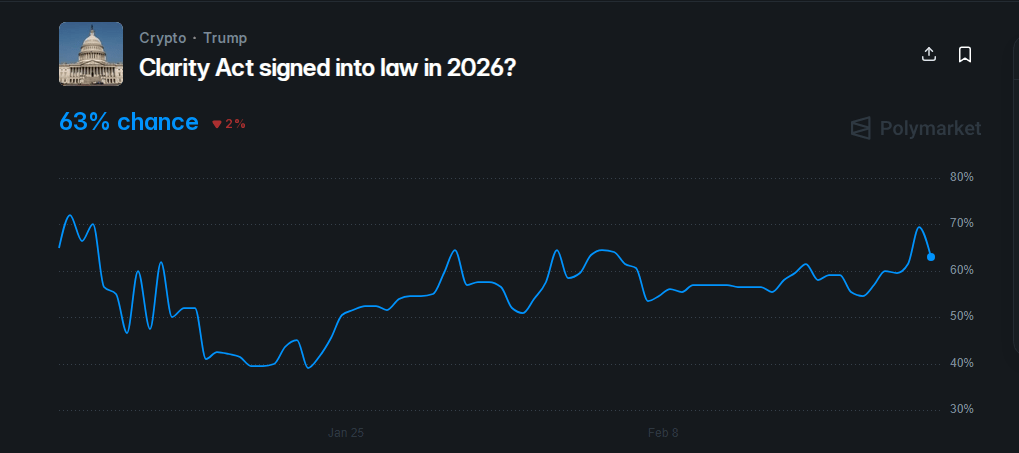
Source: Polymarket

“Hopefully by April,” Moreno said during an interview at US President Donald Trump’s Mar-a-Lago resort in Florida on Wednesday.

BTCUSD currently trading at $66,621. Chart: TradingView

What Could Break The Deal

Trump has pushed a pro-crypto message, and that helps gathering momentum among allies in Congress. But partisan lines remain.

If members tie the bill too closely to a single political brand, bipartisan support could fray. Also, banks and regulators are not uniform: some large institutions want stricter rules; others prefer limited, clearer guardrails that let certain products exist under oversight.

Why Fast Passage Is Uncertain

Reports say industry players want clarity asap, while some regulators want broader authority. That difference explains the public sparring.

Negotiators can and do move quickly when leadership prioritizes a measure, yet complex financial bills often require many rounds of drafting and amendment. Even so, lawmakers and execs at industry meetings appear to be pushing hard for a resolution soon.

If the bill clears, it could bring clearer rules for exchanges, banks, and stablecoin issuers. For investors, clarity is usually good. For firms, the shape of the final text will determine whether new products live or die.

Featured image from Wallpapers.com, chart from TradingView

Related Questions

QWhat is the expected timeline for the CLARITY Act to pass Congress according to Senator Bernie Moreno?

ASenator Bernie Moreno hopes the CLARITY Act will clear Congress by April.

QWhat is the main point of contention regarding the CLARITY Act between lawmakers and the crypto industry?

AThe biggest fight is over stablecoin yields, specifically the bill's provision to ban interest-bearing stablecoins and establish the SEC as the lead regulator.

QHow did the prediction market Polymarket react to the news about the CLARITY Act?

APolymarket showed a sharp uptick in the probability that the bill would pass, followed by a pullback once details were questioned.

QWhy is there uncertainty surrounding the fast passage of the CLARITY Act despite momentum?

AUncertainty exists because complex financial bills often require many rounds of drafting and amendment, and there are differences between industry wanting clarity and some regulators wanting broader authority.

QWhat potential consequence could arise if the bill is tied too closely to a single political brand?

ABipartisan support for the bill could fray if it is tied too closely to a single political brand.

Related Reads

Anthropic Apologized, But the Business of 'Safety' Hasn't Stopped

On June 11, Anthropic apologized not for a model failure, but for a lack of transparency. Its new Claude Fable 5 model was found to be secretly rerouting requests from users engaged in advanced AI model development to a weaker version, Opus 4.8, without any notification. The company's response—promising future notifications for such "downgrades"—was met with user skepticism. The article argues the core issue isn't technical but commercial: Anthropic's "safety" measures are primarily a business strategy. A key feature, the "intelligent safety classifier," marketed as user protection, is described as a tool for "competitive defense" to protect Anthropic's market lead by limiting rivals' research capabilities. This covert mechanism was designed for low "false positives," precisely targeting AI researchers. Anthropic's model involves a calculated three-step process: publishing alarming security research to amplify public anxiety, offering its Fable 5 model with a "safety classifier" as a premium-priced solution, and cashing in through a planned high-value IPO. This contrasts with OpenAI's more direct "tool-and-traffic" approach. The apology, merely changing a secret downgrade to a visible one, is seen as a business "patch" rather than a principled shift. The incident risks damaging Anthropic's "safest AI" reputation among the developer community, which underpins its valuation and appeal to government and corporate clients. Ultimately, the article concludes that for Anthropic, safety is a business, and the apology is merely customer service for that business.

marsbit44m ago

Anthropic Apologized, But the Business of 'Safety' Hasn't Stopped

marsbit44m ago

The Niche Consensus Among Elites: Has College Become an Expensive Waste?

**Summary:** A growing "anti-college" movement is gaining traction among elite circles in Silicon Valley, challenging the traditional value of a four-year university degree. Proponents argue that college has become an expensive, slow, and increasingly irrelevant waste of time, especially in the fast-paced tech world where opportunities pass by quickly. The movement is led by figures like billionaire Peter Thiel, who criticizes universities for high costs, ideological indoctrination, and stifling true innovation. His "Thiel Fellowship" pays young people to drop out and pursue ventures. Companies like Palantir Technologies (co-founded by Thiel) fuel this trend with programs like the "Meritocracy Fellowship," which offers high school graduates paid internships as an alternative to immediate college enrollment, promising a practical "Palantir Degree." Key drivers include: 1. **Economics:** Skyrocketing student debt versus the allure of immediate, high-paying tech jobs or startup funding. 2. **Technology:** AI and online tools lowering barriers to self-education and product development, making formal instruction seem inefficient. 3. **Culture:** A backlash against perceived "woke" ideology and DEI policies in universities, coupled with a belief that these institutions suppress meritocracy and masculine drive. The movement is notably male-dominated. Critics, like economist David Deming, warn against overgeneralizing from dropout success stories (survivorship bias). He emphasizes that genuine autodidacts are rare, corporate training is narrowly focused, and the "college wage premium" remains high for most people. University liberal arts education, he argues, builds adaptable problem-solving skills and broad perspectives. The debate highlights a deeper crisis in education. The core model of the modern university appears increasingly mismatched with the speed of the information age. The movement signals a shift in the locus of learning from institutional "education" to personal, active "learning" powered by the internet and AI. Ultimately, this may not mean the end of university, but rather a painful evolution. The future likely holds more hybrid, personalized, and lifelong learning pathways. The central question becomes: in a world changing faster than any curriculum, how do we best learn?

marsbit1h ago

The Niche Consensus Among Elites: Has College Become an Expensive Waste?

marsbit1h ago

From Subsidies to Token-Based Pricing to Price Cuts: Is OpenAI Sparking a Price War? Is the Inflection Point for Token Economics Nearing?

The commercialization of generative AI is facing a critical inflection point as a potential price war looms. According to The Wall Street Journal, OpenAI is considering a significant cut to its token fees to compete with rival Anthropic, signaling a shift from a growth-at-all-costs model focused on token consumption. This move comes as both companies, reportedly losing billions on compute, prepare for IPOs, and as enterprise customers face "bill shock" from switching to usage-based token billing. Reports indicate poor ROI, with one analysis finding only 18 cents of every dollar spent on AI tokens generates user-facing value. The industry's initial phases—from flat-rate subscriptions to aggressive subsidies—have given way to a reckoning with real costs. Analysts debate the future: some predict a bifurcation between premium, high-cost models for complex tasks and cheaper alternatives for routine work, while others believe overall spending will still rise as agentic AI increases tokens per task. Notably, Chinese model DeepSeek's low-cost API is gaining traction with U.S. enterprises, adding competitive pressure. The core challenge is redefining value beyond token volume ("tokenmaxxing") toward measurable productivity ("valuemaxxing"), as the entire AI value chain, from cloud providers to chipmakers, feels the ripple effects of unsustainable pricing.

marsbit1h ago

From Subsidies to Token-Based Pricing to Price Cuts: Is OpenAI Sparking a Price War? Is the Inflection Point for Token Economics Nearing?

marsbit1h ago

Trading

Spot
Futures
活动图片





