Circle's Acquisition of Axelar Sparks Controversy: Giant Wants the Team, Not the Token

Odaily星球日报Published on 2025-12-16Last updated on 2025-12-16

Abstract

Circle, the stablecoin giant, has announced the acquisition of the core team and intellectual property of Interop Labs, the initial developer of the cross-chain protocol Axelar Network. However, the deal explicitly excludes the Axelar Network project itself, its foundation, and its native token AXL. These will continue to operate independently under community governance, with another contributing team, Common Prefix, taking over Interop Labs' former activities. This "acquire-the-team, not-the-token" structure has caused significant controversy and triggered a 15% drop in the price of AXL. The crypto community is divided into opposing camps. The opposition, including VCs and prominent figures, argues the move is a de facto "rug pull." They contend it is unethical for the team and equity holders to profit from the acquisition while token holders, who funded the project's early development, are left with an asset that may now be worthless. Critics state this highlights a fundamental conflict between equity and token-based financing. Supporters, including investment chiefs, defend the move as a normal market behavior. They explain that in traditional capital structures, tokens sit at the very bottom, below debt and equity. In acquisitions, it is standard for higher-priority stakeholders to be paid first, and tokens have no inherent claim to proceeds. They argue Circle acted within existing commercial frameworks by purchasing only the most valuable assets—the talent and IP. Th...

Original | Odaily Planet Daily (@OdailyChina)

Author | Azuma (@azuma_eth)
In the early hours of December 16, stablecoin giant Circle officially announced the signing of an agreement to acquire the core talent and technology of Interop Labs, the initial development team behind the cross-chain protocol Axelar Network. This move is intended to advance Circle's cross-chain infrastructure strategy and help achieve seamless, scalable interoperability for core products like Arc and CCTP.

This seemed like another classic case of an industry giant acquiring a high-quality team, appearing to be a win-win situation. However, the key issue lies in the fact that — Circle explicitly stated in the acquisition announcement that the transaction only involves the Interop Labs team and its proprietary intellectual property, while the Axelar Network, the Axelar Foundation, and the AXL token will continue to operate under community governance. The other contributing team to the original project, Common Prefix, will take over the relevant activities previously handled by Interop Labs.

In simple terms, Circle has taken the original development team of Axelar Network but has explicitly discarded the Axelar Network project itself and its AXL token.

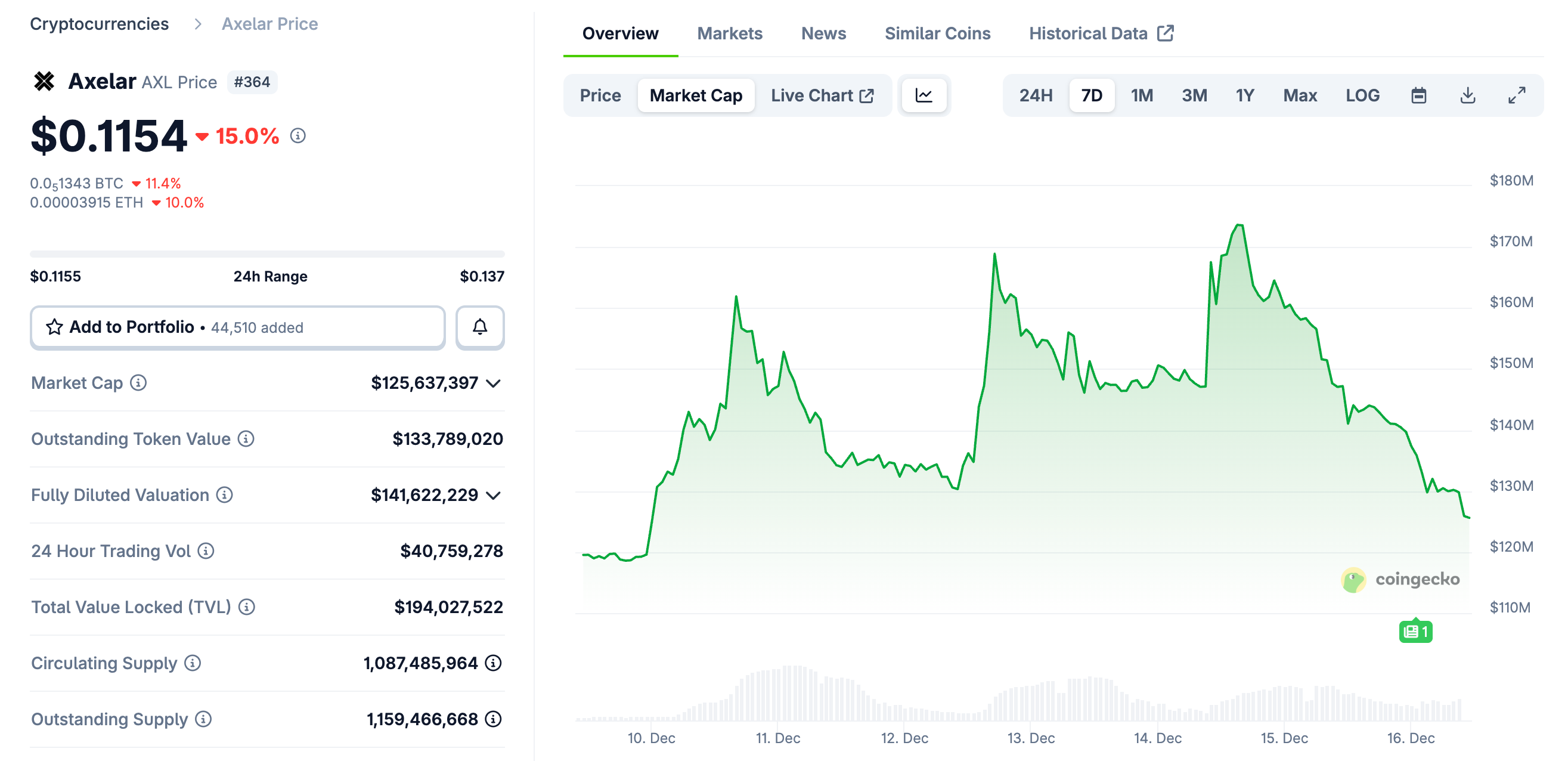
Affected by this sudden news, AXL experienced a sharp short-term drop, trading at around $0.115 as of 10:00 AM today, marking a 24-hour decline of 15%.
Simultaneously, the unique "take the team, not the token" nature of the acquisition and the ensuing debate over "equity vs. token" issues have sparked extensive discussion within the community, with supporters and opponents of this acquisition model arguing their respective points.

Opposing Views: De facto Rug Pull, Circle's Misstep, Only Token Holders Get Hurt......

The core of the opposition consists of some VCs, which is understandable — "I invested real money in the project's token, holding a bunch of tokens. Now you've taken the working team away, what use are these tokens to me?"

Moonrock Capital founder Simon Dedic commented on this: "Another acquisition, another rug pull. Circle acquires Axelar but explicitly excludes the Foundation and the AXL token. This is practically criminal. Even if not illegal, it violates ethics. If you are a founder wanting to issue a token: either treat it like equity, or get lost."

The Block co-founder and 6MV founder Mike Dudas commented: "For everyone thinking this is a token vs. equity issue, let me be clear, this is entirely Circle's doing. There are rumors that Circle's VP of Corporate Development once told an Axelar co-founder 'I don't care about your investors,' and 'bought' the CEO and IP out from under the investors without paying them any consideration, even though this IP and team are crucial for Arc's launch."

<2>Lombard Finance founder posted a chart of AXL's price movement and predicted: "Axelar's core team has been bought by Circle, AXL might be worthless now. It's been over three years since the token was issued, the team's equity has long been fully vested. But this outcome feels very uncomfortable: the team and/or investors sell tokens for profit, while token holders can only pin their hopes on a distant dream."

ChainLink community figurehead Zach Rynes stated: "This once again the token vs. equity conflict of interest plaguing the crypto industry. The development team behind the protocol gets successfully acquired, while the token holders who funded that team get nothing. So-called continued independent operation under community governance is no different than the development team abandoning its users for better prospects. If we want to attract real capital, this is the primary issue the industry urgently needs to solve."

SOAR Ecosystem Lead Nicholas Wenzel stated: "Axelar token is going to zero, thanks for playing. Yet another acquisition where token holders get nothing and equity holders get paid."

Supporting Views: Normal Market Behavior, Tokens Are Naturally at the Bottom of the Capital Stack

If the opposition focuses more on the unfair treatment of token holders, the supporters focus more on the rules of financing and M&A markets.

Arca Chief Investment Officer Jeff Dorman believes Circle's approach is not problematic and explained at length the capital structure of corporate financing and the naturally disadvantaged position of tokens.

Companies raise capital through different tiers of the capital structure, and these tiers themselves have a clear order of priority—some tiers are inherently senior to others — Secured Debt > Unsecured Senior Debt > Subordinated Debt > Preferred Stock > Common Stock > Tokens.

History is full of examples where gains for one type of investor come at the expense of another.

  • In bankruptcies, creditors win at the expense of equity investors;
  • In Leveraged Buyouts (LBOs), equity holders often profit at the expense of creditors;
  • In take-unders, creditors are usually prioritized over equity holders;
  • In strategic acquisitions, usually both creditors and equity holders benefit (but not always);
  • And tokens are often at the very bottom of the capital stack......

This doesn't mean tokens have no value, nor does it mean tokens necessarily need some form of "protection," but the market needs to recognize the reality: when someone acquires a company whose value is low and whose issued token is also nearly worthless, token holders don't magically receive a dividend. In such cases, gains for equity often come at the expense of the token.

Electric Capital co-founder Avichal Garg also commented: "This is normal. If all future value is created by the team, no company will want to pay returns to investors."

Core Contradiction: What Exactly Is a Token?

Surrounding the "take the team, not the token" acquisition storm involving Axelar and Circle, both sides of the debate seem to have their points.

The anger of the opposition is real: Token holders bore the risk when the project was at its most difficult, needing liquidity and narrative support the most, yet were completely excluded at the critical moment of value realization. From the result, the core team and intellectual property achieved value realization, while the token was left in the vacuum narrative of "community governance." The market voted most directly with the price, which is indeed deeply frustrating for all who believed in the token's value.

The judgment of the supporters is also reasonable in a practical sense: From a strict capital structure perspective, tokens are neither debt nor equity and naturally lack priority in the context of M&A and liquidation. Circle did not violate existing commercial rules; it just冷静地 chose the assets most valuable to itself.

The true core of the contradiction is not whether Circle acted morally, but lies in a question the industry has long deliberately avoided: What exactly is a token in the legal and economic structure?

When prospects are bright, tokens are tacitly assumed to be "quasi-equity," imbued with the imagination of a claim on future success; but in practical scenarios like acquisitions, bankruptcy, and liquidation, they are quickly reduced to their original form of a "rights-less instrument." This narrative equity-like treatment combined with structural subordination is the root cause of recurring conflicts.

The Axelar acquisition may not be the last similar controversy, but hopefully it can serve as an opportunity for the industry to further contemplate the positioning and meaning of tokens — Tokens do not inherently possess rights; only institutionalized, structured rights are acknowledged at critical moments. The specific form of implementation still requires all practitioners to explore and practice together.


Related Questions

QWhat was the main controversy surrounding Circle's acquisition of Axelar's development team?

AThe controversy centered on Circle acquiring only the core development team and intellectual property of Axelar's Interop Labs, while explicitly excluding the Axelar Network, its foundation, and the AXL token from the deal, leaving the token and project to operate independently under community governance.

QHow did the price of AXL token react to the news of the acquisition?

AThe AXL token price experienced a sharp decline, dropping 15% in 24 hours following the announcement, trading at approximately $0.115.

QWhat was a key argument from critics (the opposition) of this acquisition model?

ACritics argued that the acquisition was effectively a 'rug pull,' where the core team and IP were sold for the benefit of equity holders (like VCs and the team), while token holders who funded the project's early stages were left with a potentially worthless asset and received no compensation.

QWhat was the core argument from supporters justifying Circle's actions?

ASupporters argued it was a normal market behavior, explaining that tokens naturally sit at the very bottom of the capital structure (below secured debt, unsecured debt, and equity) in corporate finance. In acquisitions, gains for one class of investor (equity) often come at the expense of another (token holders), and Circle was simply acquiring the most valuable assets under existing commercial rules.

QWhat fundamental industry problem did this acquisition controversy highlight according to the article?

AThe controversy highlighted the fundamental ambiguity over what a token represents legally and economically. Tokens are often narratively treated as 'quasi-equity' promising future value, yet in real-world scenarios like acquisitions or bankruptcies, they are structurally at the bottom with no formal rights, creating a recurring conflict between narrative expectations and structural reality.

Related Reads

Near Returns to the AI Stage: Transformation into a Public Chain Due to 'Payroll Difficulties,' Agent and Privacy Emerge as New Growth Narratives

NEAR Returns to AI Origins: From Payroll Struggles to Blockchain, Now Focusing on AI Agents and Privacy NEAR Protocol's journey began not with grand blockchain ambitions, but from a practical hurdle: its AI startup founders, including Transformer paper co-author Illia Polosukhin, couldn't efficiently pay international developers in 2017. This led them to pivot and build a high-performance, scalable blockchain. After years navigating various crypto narratives like sharding and cross-chain interoperability, NEAR is now leveraging its AI roots to re-enter the AI arena. A key driver is its "NEAR Intents" layer, which abstracts complex cross-chain transactions. Users simply state their goal (e.g., swap BTC for ETH), and a solver network finds the optimal route. This system has processed over $20B in cross-chain volume, generating significant fee revenue. A major growth area is private transactions via "Confidential Intents/Swaps," which hide trade details until settlement to protect against MEV and front-running. Remarkably, private swaps recently accounted for over 40% of NEAR's transaction volume, highlighting strong demand but also potential regulatory scrutiny. With its AI-founder pedigree, NEAR is positioning itself at the intersection of blockchain, AI agents, and privacy, aiming to become infrastructure for the emerging agent economy while navigating the challenges of its rapid adoption.

marsbit2h ago

Near Returns to the AI Stage: Transformation into a Public Chain Due to 'Payroll Difficulties,' Agent and Privacy Emerge as New Growth Narratives

marsbit2h ago

From Ethereum to AI's 'CROPS': What Exactly is This Set of 'Slow Variables' That Vitalik Repeatedly Emphasizes?

In recent discussions, Vitalik Buterin has frequently emphasized the concept of "CROPS," a framework defining core values for Ethereum's development. CROPS stands for Censorship Resistance, Capture Resistance, Open Source, Privacy, and Security. Initially outlined in the Ethereum Foundation's "EF Mandate," it represents a commitment to user sovereignty, ensuring that the network resists external control, remains open, protects privacy, and prioritizes security. The relevance of CROPS extends beyond Ethereum's foundational principles, becoming crucial in the context of AI integration. As AI agents begin handling wallet operations and automated transactions, the risk increases that users may cede control over their digital assets, privacy, and intentions to centralized AI service providers. A "CROPS AI" would therefore emphasize local execution where possible, privacy-preserving remote model calls (e.g., using zero-knowledge proofs), and transparent, verifiable processes to maintain user agency. Vitalik highlights a significant convergence between "CROPS Ethereum access layer" and "CROPS AI." Both address the same fundamental challenge: how users can access powerful services—be it blockchain data via RPCs or AI models—without exposing sensitive information or relinquishing ultimate control. This intersection points toward a future digital entry point that is more private, secure, and user-controlled. Ultimately, CROPS is not merely an abstract ideal but a practical guidepost. It steers development—from protocol resilience and wallet design to AI agent safety—towards a future where users retain self-sovereignty even as digital systems grow more complex and powerful. In an era of accelerating AI adoption, these "slow variables" of censorship resistance, openness, privacy, and security may define Ethereum's enduring value.

marsbit2h ago

From Ethereum to AI's 'CROPS': What Exactly is This Set of 'Slow Variables' That Vitalik Repeatedly Emphasizes?

marsbit2h ago

Silicon Valley 'Startup Guru' Steve Hoffman: Web3 + AI Could Be a Trap

Silicon Valley investor and "Godfather of Startups" Steve Hoffman warns that combining Web3 with AI is likely a trap, not a promising venture. In an interview, Hoffman argues that while AI is a foundational technology touching all industries, Web3 adds complexity, friction, and regulatory risk without solving mainstream consumer or business needs. He advises founders to focus on deep, specialized applications where startups can out-iterate giants, rather than on generic features easily replicated by large tech companies. Hoffman observes that Silicon Valley will lead foundational AI research, while China excels at rapid, large-scale application and commercialization, particularly in robotics. He stresses that AI-driven autonomous agents capable of collaborative, multi-step tasks are 2-4 years away, which will cause significant job displacement. The solution is not to slow AI but to redesign business models around human-AI collaboration and reform social systems like education and retraining. For startups, Hoffman recommends focusing on vertical, expertise-heavy domains to build defensibility. He sees major opportunities in AI fraud detection and cybersecurity. Key founder mindsets include systemic thinking over feature-focus, relentless customer centricity, building adaptive teams, and deeply understanding AI's capabilities and limits. Hoffman is also leading a non-profit initiative to establish university centers aimed at training future leaders in responsible, human-value-aligned AI innovation.

marsbit4h ago

Silicon Valley 'Startup Guru' Steve Hoffman: Web3 + AI Could Be a Trap

marsbit4h ago

Token Inefficient, Economy Tokenless

The article "Tokens Aren't Economical, Economics Aren't Tokenized" analyzes a pivotal shift in the AI industry from a technology-driven narrative to one dominated by capital efficiency. It highlights two concurrent trends: a severe capital shortage due to the exorbitant and recurring costs of compute (e.g., OpenAI's high burn rate) and a wave of corporate spin-offs where major tech companies are separating their AI units (like Kuaishou's Kling and Baidu's Kunlunxin). The core argument is that AI's "anti-internet" business model, where user growth increases costs rather than profits, has created a disconnect between high valuations and actual cash flow. Spin-offs address this by allowing AI assets to be valued independently. Within a parent company, they are seen as cost centers, but as standalone entities, they are priced based on their growth potential and scarcity in the primary market, leading to massive valuation premiums (e.g., Kling's estimated value tripling post-spin-off). The industry is at an inflection point, moving from "model worship" to "value realization." The competition is evolving from a pure compute (GPU) race to a broader focus on systemic efficiency and full-stack engineering (involving CPUs and orchestration) to achieve viable commercialization. The year 2026 is framed as a critical moment where the industry must definitively answer how to economically translate AI capability into tangible business value, reshaping the sector's future power structure.

marsbit4h ago

Token Inefficient, Economy Tokenless

marsbit4h ago

Trading

Spot
Futures

Hot Articles

Discussions

Welcome to the HTX Community. Here, you can stay informed about the latest platform developments and gain access to professional market insights. Users' opinions on the price of S (S) are presented below.

活动图片














