CFTC pulls ‘actual delivery’ crypto guidance, giving flexibility to exchanges

cointelegraphPublished on 2025-12-12Last updated on 2025-12-12

Abstract

Acting CFTC Chairman Caroline Pham has withdrawn the 2020 guidance on "actual delivery" of cryptocurrencies, a move praised for offering exchanges greater operational flexibility. The guidance, which previously required crypto to be delivered within 28 days for margin or leveraged trading, was deemed outdated and stifling to innovation. Industry experts, including StarkWare's general counsel, applaud the decision but note that guidance is not legally binding and could change with future leadership. While some see this as a signal of clearer CFTC jurisdiction and a pro-growth regulatory approach, critics warn that removing the guidance without replacement creates uncertainty regarding which exchanges must register with the CFTC.

US Commodity Futures Trading Commission Acting Chairman Caroline Pham has scrapped “outdated guidance” on the delivery of crypto, which has been applauded for offering exchanges more flexibility.

“Eliminating outdated and overly complex guidance that penalizes the crypto industry and stifles innovation is exactly what the Administration has set out to do this year,” Pham said on Thursday.

The guidance, originally finalized in March 2020, related to when the “actual delivery” of crypto happened in a commodity transaction, but the CFTC said in a notice that it had to “reevaluate such guidance in light of further developments during the past 5 years.”

The CFTC under Pham has worked on a more crypto-friendly approach, and Pham said the guidance was withdrawn on recommendations from the president’s crypto working group, which suggested the CFTC release guidance on how crypto may be considered commodities and expand on prior guidance regarding the actual delivery of virtual assets.

More flexibility for exchanges with guidance gone

StarkWare general counsel Katherine Kirkpatrick Bos applauded the move, saying the guidance was making it harder for exchanges to offer margin or leverage unless actual delivery occurred within 28 days.
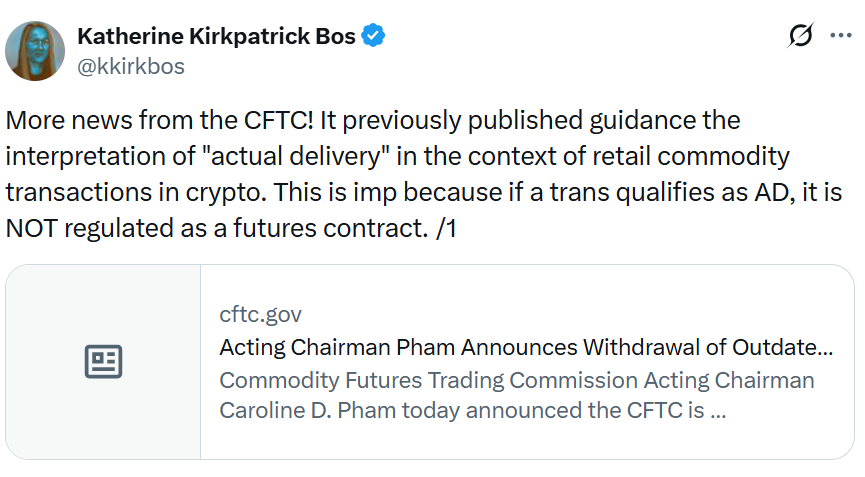
Source: Katherine Kirkpatrick Bos

“This offers way more flexibility for exchanges,” she said. “But PSA - this isn’t law! Just guidance. All of this can be changed again should leadership change.”

The CFTC can issue guidance to clarify its interpretation of legislation and give insight into how it may enforce rules in certain situations; however, it’s not generally legally binding in the same way as formal regulation.

Garry Krugljakow, the head of Bitcoin (BTC) strategy at the Berlin-based Bitcoin treasury company aifinyo AG, speculated in an X post on Thursday that it’s a “major tell” of what’s to come.

“This move signals two things: cleaner jurisdiction for the CFTC and a regulatory path designed for scale, not hesitation,” he said.

Related: CFTC pilot opens path for crypto as collateral in derivative markets

“Actual delivery made sense in 2020. It doesn’t in a world of real custody, collateralization, and Bitcoin-backed credit,” Krugljakow said.

No guidance leaves uncertainty

Meanwhile, Todd Phillips, a fellow at the American think tank the Roosevelt Institute, said the definition of actual delivery is important, “as it decides what exchanges need to register with the CFTC and which don’t.”

“The CFTC replaced the prior guidance with nothing,” he said. “Right now, we have no idea what the CFTC thinks actual delivery means, or who has to register.”

Magazine: When privacy and AML laws conflict: Crypto projects’ impossible choice

Trending Cryptos

Related Reads

MiCA is coming for DeFi vaults, but regulation will be difficult

The European Commission is exploring whether to extend the Markets in Crypto-Assets (MiCA) regulation to cover decentralized finance (DeFi) lending and borrowing, including lending vaults. These vaults, which channel billions into on-chain credit markets, present significant regulatory challenges because their decentralized structure doesn't map neatly onto existing financial frameworks. Their legal status is currently based on non-binding interpretations that they fall outside MiCA and EU fund rules. The article uses Morpho's decentralized lending protocol as an example, illustrating how responsibilities are divided among various participants (owner, curator, allocator, sentinel), making it difficult to identify a single "provider" to regulate. Experts warn that broadly categorizing "DeFi lending" could inadvertently capture vastly different structures. They argue that any regulatory approach should focus on the specific structure and control mechanisms of a vault, rather than using decentralization as a simple dividing line, and that DeFi lending may require a dedicated, carefully crafted framework distinct from traditional finance. The Commission's consultation closes on September 30, 2026. The core challenge for regulators is not just whether to regulate DeFi lending, but how to design rules that distinguish between different forms of on-chain lending and the entities that control them.

cointelegraph43m ago

MiCA is coming for DeFi vaults, but regulation will be difficult

cointelegraph43m ago

Grayscale Report: Financial Privacy in the AI Era, Why Zcash Should Not Be Overlooked?

Title: Grayscale Report: Financial Privacy in the AI Era – Why Zcash Should Not Be Overlooked The article argues that privacy is a fundamental, not niche, attribute of functional money. It highlights that technological shifts, like the rise of AI and stablecoins, are driving a new wave of public focus on financial privacy. Zcash, a decentralized digital currency similar to Bitcoin but with built-in privacy via zero-knowledge proofs, is positioned to address this need. Unlike transparent blockchains, Zcash offers users the option to conduct "shielded" transactions that hide sender, receiver, and amount while remaining verifiable. The report details Zcash's evolution, noting key upgrades that improved usability and security. It points to rising on-chain usage of privacy features as evidence of real demand. Currently, ZEC holds a minimal share (~0.4%) of the total crypto market cap. Grayscale suggests this reflects a market assumption that privacy is a marginal concern. The investment thesis hinges on a potential market re-evaluation: if privacy is recognized as a core monetary feature in an era of enhanced surveillance, Zcash's current valuation represents significant upside potential. Key risks discussed include regulatory challenges, historical trusted setup concerns for older pools (mitigated by newer protocols), quantum computing threats, and execution risks associated with future technical upgrades. The conclusion is that while the future scale of private digital currency is uncertain, the market currently prices in little chance of its value increasing substantially, presenting a potential opportunity for investors.

marsbit2h ago

Grayscale Report: Financial Privacy in the AI Era, Why Zcash Should Not Be Overlooked?

marsbit2h ago

Trading

Spot

Hot Articles

Discussions

Welcome to the HTX Community. Here, you can stay informed about the latest platform developments and gain access to professional market insights. Users' opinions on the price of US (US) are presented below.

活动图片