CEO Responds to Crisis with Jokes, AI Entrepreneurs Steal Crypto's Marketing Playbook

marsbitPublished on 2026-03-10Last updated on 2026-03-10

Abstract

CEO Roy Lee of AI startup Cluely turned a potential PR crisis—accusations of inflating revenue figures in a TechCrunch report—into a viral marketing opportunity. Instead of a formal apology, Lee posted a satirical video response where he rapped sarcastically while wearing a suit jacket and no pants, leaning into his controversial persona. Cluely, which began as a tool for cheating in coding interviews and led to Lee’s expulsion from Columbia University, has consistently used controversy and attention as a growth strategy. The company initially promoted itself with the tagline “Cheat on Everything” before pivoting to an AI note-taking assistant. Lee’s approach reflects a broader trend in tech, where capturing attention is seen as a critical competitive advantage. Investors like a16z, which participated in Cluely’s $15 million Series A, endorse this model, arguing that in an era of commoditized AI capabilities, virality and narrative can serve as a moat. This strategy mirrors tactics long used in crypto, where memes and drama often drive engagement and growth.

Original | Odaily Planet Daily (@OdailyChina)

Author | DingDang (@XiaMiPP)

In most startups, if someone exposes "falsified revenue," it would likely lead to a PR crisis—issuing a statement, explaining the misunderstanding, correcting data metrics, apologizing, and then steering the conversation back to focusing on the product or business growth.

But Cluely's CEO Roy Lee clearly had no intention of doing that.

A Company That Started as a "Cheating Tool"

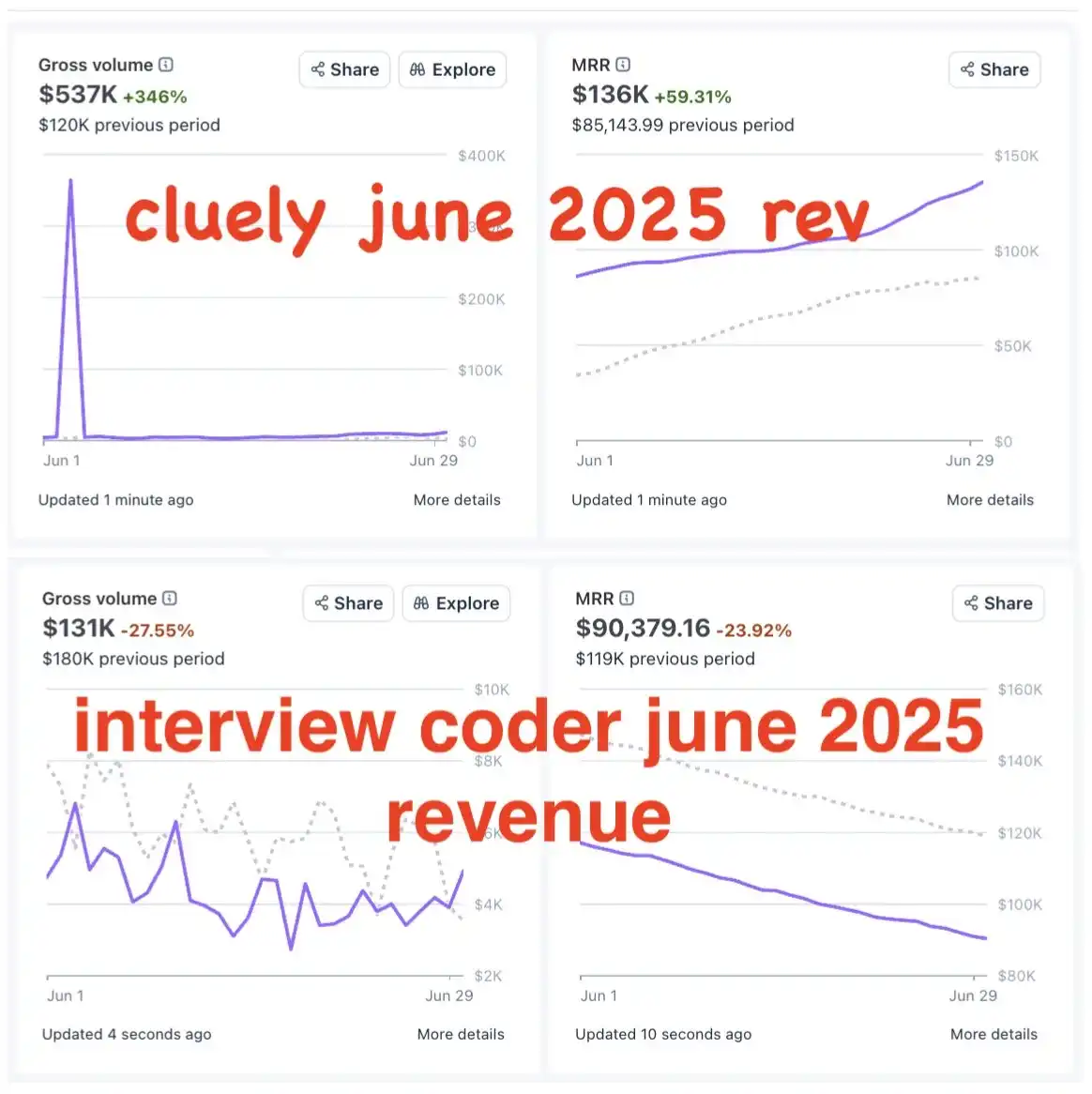
Cluely was founded in 2025, and its initial product came from a project called Interview Coder, developed by Roy Lee and his college roommate Neel. This was a tool that used AI to help users cheat in LeetCode interviews. Due to this project, both were eventually expelled from Columbia University.

If it were an ordinary person, being expelled from school would be a black mark to be concealed. But Roy Lee turned this incident into a marketing opportunity, even a "turning point in his life."

Cluely's initial product slogan was: "Cheat on Everything." It wasn't until November 2025 that Cluely began shifting its product narrative from a "cheating tool" to an AI note-taking assistant, such as using AI to automatically organize meeting content, optimize collaboration efficiency, and even modify attendees' expressions to cover up distraction. But no matter how the product adjusted, this company, or rather, its CEO, never shook off a very distinct vibe: it almost grew through controversy.

And the ensuing storm, to some extent, continued along this path.

A Farce Sparked by "Falsified Revenue"

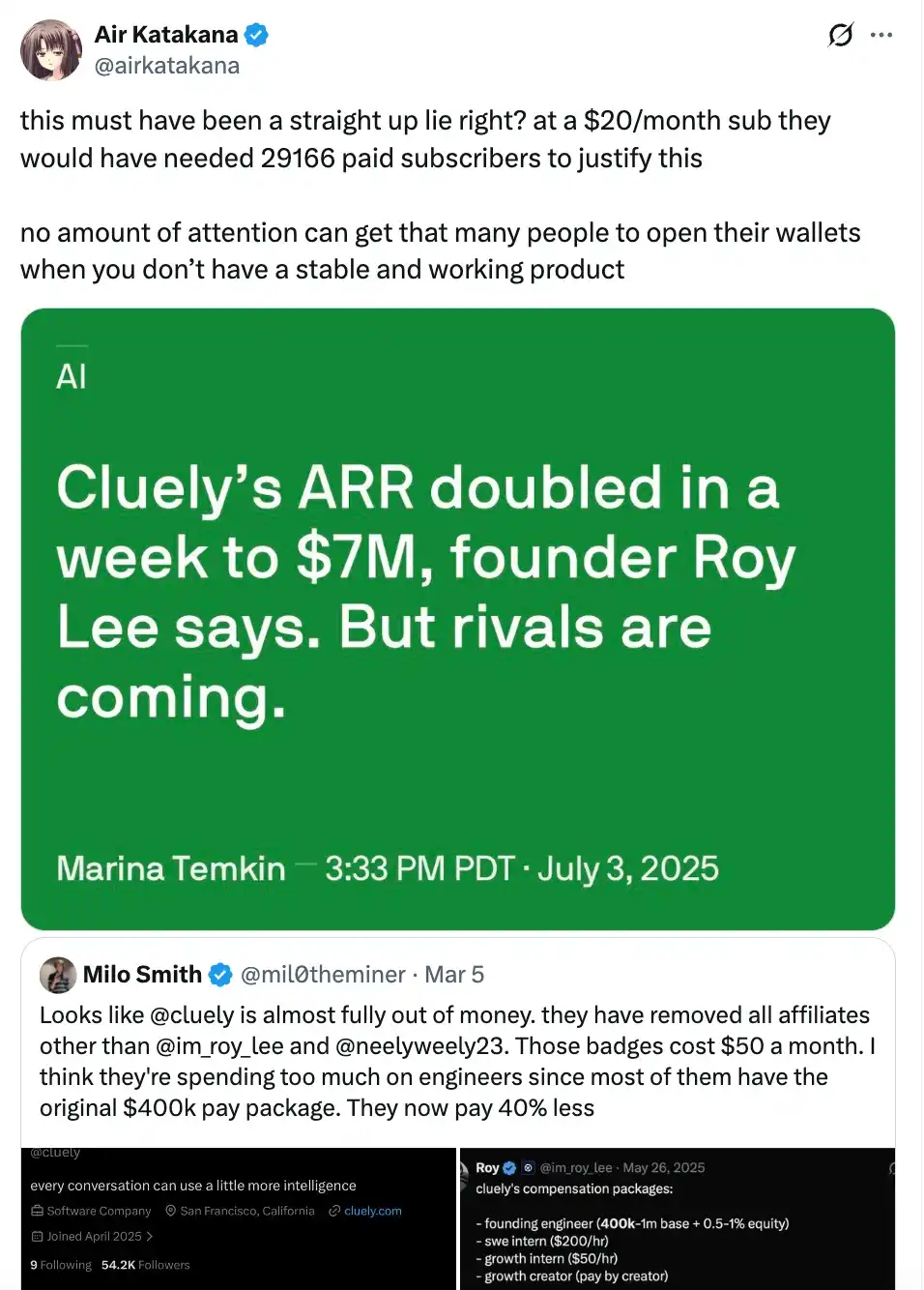
The incident began when someone dug up a TechCrunch report from July 2025. The article mentioned that Cluely's Annual Recurring Revenue (ARR) had doubled in a week, reaching $7 million. This data was questioned as being falsified.
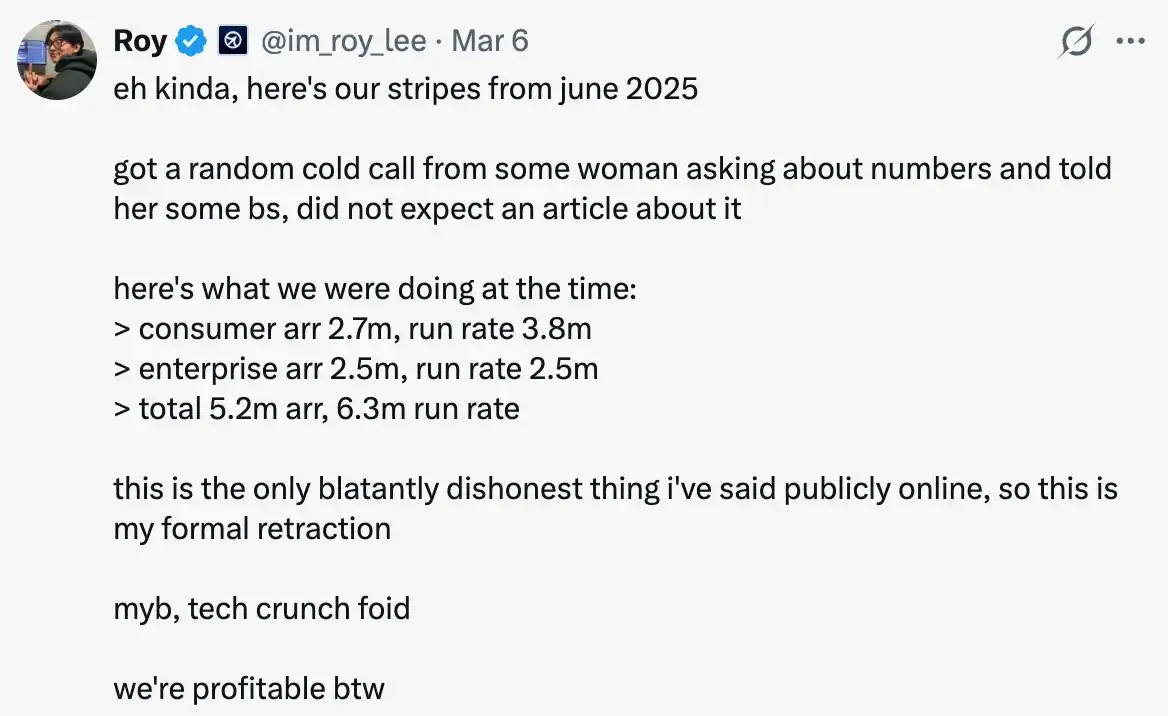
Facing the质疑, Cluely CEO Roy Lee was quite candid. He quickly posted admitting it, saying he had casually mentioned that number when a reporter called him, not expecting it to be written into a formal report. Seemingly to prove it wasn't a deliberate exaggeration, he also posted Cluely's real data from June 2025: consumer business annual revenue $2.7 million, enterprise business annual revenue $2.5 million, totaling $5.2 million.

Up to this point, there wasn't much of a stir; the explanation seemed plausible.
But on the same day, TechCrunch reporter Julie Bort published a rebuttal to Roy's claim. She stated that the interview was arranged proactively by Cluely's PR team, it was on the record, and not just a casual chat.

Roy Lee didn't continue with a textual explanation but chose a more dramatic way to respond. He released a video with the caption, Breaking News: Cluely CEO Officially Responds to TechCrunch.

In the video, he sat in front of the camera wearing sunglasses and a suit, a microphone on the desk, looking like he was preparing to make a serious statement. But the setting wasn't an office; it looked more like a living room, with an old desktop computer next to him, its screen playing Subway Surfers—a classic time-wasting game. Roy's response was also completely informal, more like a self-deprecating performance, mixed with self-mockery and bragging, his tone resembling a rapper freestyling.

Even more absurdly, at the end of the video, he stood up from behind the desk, revealing this ostensibly serious CEO... wasn't wearing pants......

Thus, a PR crisis originally about "falsified revenue" was handled as a traffic-attracting, self-mocking performance.

What a16z Is Betting On Is Actually the Attention Economy

The capital market doesn't seem to mind this kind of performative founder personality either. In June 2025, Cluely announced the completion of a $15 million Series A funding round, with participating institutions including the well-known venture capital firm Andreessen Horowitz (a16z). Its partner Bryan Kim once mentioned on a podcast: In the AI era, the traditional "artisan product + slow growth" model is no longer sufficient; viral spread itself is part of the product.

What he considers the "new AI startup template" is that in an era where model capabilities are increasingly commoditized, attention itself is becoming a key resource. Whoever can capture user attention first may build a new moat.

From the "cheating controversy" of Interview Coder, to the entrepreneurial story of being expelled from Columbia, to this absurd "response video," Roy Lee's entire personal brand has almost been built along this path: controversy itself is the content for dissemination. This might also explain why a16z chose to invest in Cluely, to invest in Roy Lee.

When Controversy Becomes a Growth Strategy

In past entrepreneurial narratives, growth usually came from product capabilities, technological barriers, and business models. But in today's internet environment, another resource is becoming increasingly important—attention.

This logic has actually been proven in the crypto industry long ago. Many crypto projects capture user attention by creating topics, controversies, or even dramatic events, and then convert this traffic into product growth or commercial value, especially with the rise of Memes—pure dissemination, no (traditional) product.

To some extent, Roy Lee's response video is a typical case of this logic: when negative news emerges, rather than trying to suppress the controversy, repackage the controversy itself into dissemination content.

Evidently, in the current internet environment, attention is often more valuable than explaining the truth.


Related Questions

QWhat was the initial product of Cluely, and what was its controversial purpose?

AThe initial product of Cluely was Interview Coder, an AI tool designed to help users cheat in LeetCode coding interviews.

QHow did Cluely's CEO, Roy Lee, respond to the allegations of falsifying revenue reported by TechCrunch?

ARoy Lee responded by releasing a satirical video where he offered a self-deprecating and humorous performance, rather than issuing a formal written statement or apology.

QWhich prominent venture capital firm invested in Cluely, and what was their stated reasoning for the investment?

AAndreessen Horowitz (a16z) invested in Cluely. Their reasoning was that in the AI era, viral attention itself is a critical resource and part of the product, and they believe capturing user attention can build a new moat.

QAccording to the article, what key resource is becoming increasingly important for growth in today's internet environment?

AAttention is the key resource becoming increasingly important for growth, as it can be leveraged into product growth or commercial value.

QWhat industry's marketing tactics does the article suggest AI entrepreneurs like Roy Lee are adopting?

AThe article suggests AI entrepreneurs are adopting marketing tactics from the Crypto industry, particularly using controversy and attention-grabbing stunts to drive growth.)

Related Reads

Investors Are Now Hunting for AI Projects on Bilibili and Xiaohongshu

Investors Turn to Bilibili and Xiaohongshu to Source AI Projects The AI hardware boom is in full swing in 2025, with a surge in smart wearables like AI glasses, rings, toys, and companion robots. This frenzy has investors scrambling, not just sifting through business plans, but actively hunting for promising "under-the-radar" projects on youth and tech-enthusiast content platforms like Bilibili and Xiaohongshu. The logic is straightforward: for consumer-facing AI hardware, genuine user demand and potential pitfalls are often revealed earlier in public discussions, comments, and critiques on these communities than in formal pitches. As one industry insider notes, these products must ultimately be tested and understood by real people. This shift highlights a crucial challenge in the sector: user education. The success of AI hardware depends on moving beyond mere efficiency gains to fulfilling higher-order needs like "unleashing personal creativity." Products must convince users they are natural, unobtrusive additions to daily life. Early hype, as seen with devices like the Rabbit R1, often fades if the product fails to clearly solve real-world problems, leading to high return rates and market rejection. The market is now entering a shakeout phase. 2026 is seen as a year of commercial validation. Some projects have already stalled or been canceled due to market resistance, lack of differentiation, or financial woes. However, the long-term opportunity remains vast, with forecasts predicting a multi-trillion dollar global AI hardware market by 2030. The competition is intensifying. With giants like OpenAI and Meta preparing their own hardware, and Chinese companies launching diverse AI-powered products, the battle for user attention, product excellence, and market understanding is just beginning. The core principle endures: in the AI era, it remains a user-sovereign market.

marsbit12m ago

Investors Are Now Hunting for AI Projects on Bilibili and Xiaohongshu

marsbit12m ago

"Agents' Last Exam", Claude Fable 5 Actually Loses to GPT 5.5

Surprisingly, in the newly released "Agents' Last Exam" (ALE) benchmark from UC Berkeley, GPT-5.5 has outperformed the recently launched and highly-regarded Claude Fable 5. ALE tests AI agents on their ability to perform real-world tasks across 55 professional domains—such as 3D modeling in Siemens NX, creating game scenes in Unreal Engine, and visual effects work in Adobe After Effects—by granting them full GUI and command-line access. In the core task completion rate ranking, GPT-5.5 configurations secured the top two spots (24.0% and 23.0%), while Claude Fable 5 with Claude Code came in third (22.0%). Notably, the highest pass rate was only 24%, and the most difficult "Last-Exam" tier saw most top models, including GPT-5.5 and Fable 5, scoring zero. The benchmark also revealed significant cost and efficiency gaps: Fable 5 spent over four times more money than GPT-5.5's most expensive configuration for a slightly lower score, and was much slower. ALE differs from previous knowledge-based benchmarks by evaluating practical "ability to do" rather than static knowledge retrieval. Its tasks are derived from real expert projects, automatically scored, and designed to prevent cheating through a rotating pool of private challenges. The results suggest that high performance on traditional benchmarks does not necessarily translate to proficiency in complex, open-ended real-world work. The study also notes that agents often fail by prematurely declaring tasks complete without proper verification, and that no single model excels uniformly across all diverse domains.

marsbit18m ago

"Agents' Last Exam", Claude Fable 5 Actually Loses to GPT 5.5

marsbit18m ago

Trading

Spot
Futures

Hot Articles

Discussions

Welcome to the HTX Community. Here, you can stay informed about the latest platform developments and gain access to professional market insights. Users' opinions on the price of S (S) are presented below.

活动图片