Cathie Wood’s Ark Invest Buys More Bullish Assets Just Days After Last Purchase, While LiquidChain Turns Heads

bitcoinistPublished on 2026-02-10Last updated on 2026-02-10

Abstract

Cathie Wood's Ark Invest has made another round of purchases in crypto-proxy assets just days after its last accumulation, signaling strong institutional conviction and a strategy that favors long-term structural shifts over short-term market volatility. This move suggests internal models view current valuations as a dislocation from reality. Concurrently, the article highlights growing interest in Layer 3 (L3) infrastructure projects like LiquidChain ($LIQUID), which aims to solve the significant liquidity problem between major blockchains. The protocol creates a unified execution layer that merges the liquidity of Bitcoin, Ethereum, and Solana into a single environment, minimizing the security risks associated with wrapped assets and cross-chain bridges. Early data from LiquidChain's ongoing presale shows over $533K raised, indicating substantial demand for such interoperability solutions. The project's architecture allows developers to deploy applications once to access users across all three chains, addressing a key inefficiency in the current ecosystem. The narrative is shifting from competition between chains to how they can be interconnected, creating a tailwind for L3 infrastructure. This aligns with the broader institutional movement, where capital is flowing into both the equities of companies facilitating crypto access and the underlying protocols enabling its utility.

Trusted Editorial content, reviewed by leading industry experts and seasoned editors. Ad Disclosure

Quick Facts:

  • ➡️ Cathie Wood’s Ark Invest continues to accumulate crypto-proxy assets, signaling strong institutional conviction despite market volatility.
  • ➡️ LiquidChain creates a Layer 3 infrastructure that merges Bitcoin, Ethereum, and Solana liquidity into a single execution environment.
  • ➡️ The project minimizes security risks associated with wrapped assets by utilizing a verifiable settlement architecture.
  • ➡️ Early data shows over $533K raised for the protocol, highlighting demand for interoperability solutions.

Wall Street’s most vocal innovation advocate isn’t flinching.

Just days after adding to its crypto-adjacent positions, Cathie Wood’s Ark Invest executed another round of accumulation, reinforcing a strategy that seemingly ignores short-term chart chop in favor of long-term structural shifts.

While the exact allocation details often shuttle between her flagship ARKK fund and the Ark Fintech Innovation ETF (ARKF), the pattern is undeniable: aggressive positioning in high-beta assets acting as proxies for the digital asset economy.

The dollar amount isn’t really the story here. The timing is.

When smart money doubles down within a 48-hour window, it typically suggests their internal models view current valuations as a dislocation from reality. Wood is betting that the infrastructure underpinning the digital economy, specifically exchanges and liquidity providers, is priced for failure rather than the adoption curve we’re actually witnessing.

But while Ark focuses on established giants (think Coinbase or Block), a different kind of capital flow is emerging further down the risk curve.

Sophisticated DeFi participants are turning their attention toward the fragmentation problem that plagues the current ecosystem. The narrative is shifting from ‘which chain wins’ to ‘how do we connect them all,’ creating a massive tailwind for Layer 3 (L3) infrastructure projects like LiquidChain ($LIQUID).

By addressing the friction between Bitcoin, Ethereum, and Solana, these protocols aim to solve the very liquidity bottlenecks that institutional giants are forced to trade around.

Read more about $LIQUID here.

Institutional Confidence Meets The Liquidity Trilemma

The market often misinterprets Ark Invest’s strategy as mere speculation. But a closer look at the ‘buy the dip’ cadence reveals a thesis centered on convergence. Wood frequently argues that disparate technologies, AI, blockchain, and robotics, are merging. In the crypto sector, however, the reality is still one of stubborn separation.

Bitcoin liquidity remains trapped on Bitcoin; Solana’s high-speed execution is isolated from Ethereum’s TVL. It’s the industry’s most expensive inefficiency.

LiquidChain ($LIQUID) enters this vacuum not as another competitor, but as a unifying execution layer. Operating as a Layer 3 protocol, it fuses the liquidity of the three largest ecosystems, Bitcoin, Ethereum, and Solana, into a single environment. The protocol’s architecture allows developers to deploy applications once and access users across all three chains simultaneously.

This effectively removes the ‘bridging risk’ that has historically led to billions in exploits, replacing complex wrapped-asset maneuvers with single-step execution.

For investors watching the macro moves by Ark, the parallel is clear. While institutions buy the equity of companies facilitating crypto access, the on-chain opportunity lies in the protocols facilitating crypto utility. The shift toward L3 infrastructure represents the next logical step in blockchain scalability, moving beyond simple transaction throughput to genuine interoperability.

$LIQUID is available here.

LiquidChain Presale Data Signals Early Infrastructure Demand

While public market heavyweights wrestle with ETF inflows and regulatory headlines, the presale market offers a rawer, real-time gauge of developer and speculator interest. The data surrounding LiquidChain ($LIQUID) suggests the market is hungry for solutions that simplify the user experience (UX) of DeFi.

According to live metrics, the project has successfully raised $533K in its ongoing funding round. With tokens currently priced at $0.0136, the valuation reflects an entry point typical of early-stage infrastructure plays before they hit mainnet discovery.
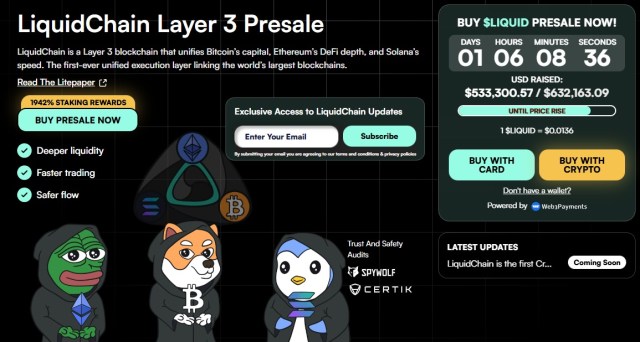
Unlike meme coins driven by social sentiment, infrastructure raises tend to track closer to the perceived utility of the underlying tech. The pitch here is ‘verifiable settlement’ across chains, a feature that appeals to institutional DeFi desks that can’t tolerate the security assumptions of standard bridges.

The economics of the $LIQUID token are designed to fuel this cross-chain machine. It functions as the transaction fuel for the Cross-Chain VM (Virtual Machine). As activity grows between the $BTC, $ETH, and $SOL ecosystems, the demand for the settlement layer naturally increases.

For early participants, the current price point of $0.0136 represents a bet on a future where liquidity is fluid rather than fragmented.
Check the $LIQUID presale dashboard.

Buy $LIQUID here.

This article is for informational purposes only and doesn’t constitute financial advice. Cryptocurrency investments carry inherent risks, including high volatility. Always perform your own due diligence.

Editorial Process for bitcoinist is centered on delivering thoroughly researched, accurate, and unbiased content. We uphold strict sourcing standards, and each page undergoes diligent review by our team of top technology experts and seasoned editors. This process ensures the integrity, relevance, and value of our content for our readers.

patrubogdan

Follow

Full Profile

Related Posts

Vitalik Buterin Outlines Ethereum’s AI Future, While SUBBD Token Targets the Creator Economy

Binance Dominates Trump’s USD1 Supply as Bitcoin Hyper Breaks Records

Polymarket Sues Massachusetts Over Prediction Market Regulation – SUBBD Token Takes Advantage

Bitcoin Hyper Could Conquer 2026 if Bitcoin Regains Lost Ground

Tether Pushes for $1 Despite Market Crash, While Maxi Doge Reaches New Heights

Ethereum Holds Strong Above $2K, While $LIQUID Starts Turning Heads: Price Analysis & Outlook

Trending Cryptos

Related Questions

QWhat recent investment action did Cathie Wood's Ark Invest take, and what does it signal?

ACathie Wood's Ark Invest executed another round of buying crypto-proxy assets just days after its last purchase. This signals strong institutional conviction and a strategy that ignores short-term market volatility in favor of long-term structural shifts in the digital asset economy.

QWhat is the core technological solution that LiquidChain ($LIQUID) provides?

ALiquidChain creates a Layer 3 (L3) infrastructure protocol that merges the liquidity of Bitcoin, Ethereum, and Solana into a single, unified execution environment. It minimizes security risks associated with wrapped assets by utilizing a verifiable settlement architecture, allowing developers to deploy applications once to access users across all three chains.

QAccording to the article, what problem in the current crypto ecosystem is creating a 'massive tailwind' for L3 infrastructure?

AThe problem of 'liquidity fragmentation' is creating a massive tailwind. The narrative is shifting from 'which chain wins' to 'how do we connect them all,' as liquidity of major ecosystems like Bitcoin, Ethereum, and Solana remains isolated from each other, which is described as the industry's 'most expensive inefficiency'.

QWhat key metric is provided as evidence of early interest in the LiquidChain project?

AThe article cites that the project's ongoing presale has raised over $533,000, highlighting significant early demand for its interoperability solution.

QHow does the article contrast Ark Invest's strategy with the emerging capital flow into projects like LiquidChain?

AThe article contrasts them by stating that Ark Invest is buying the equity of established 'crypto-adjacent' companies (like Coinbase and Block) that facilitate crypto access, while sophisticated DeFi participants are turning to on-chain infrastructure protocols like LiquidChain that facilitate crypto utility by solving interoperability and liquidity bottlenecks.

Related Reads

In Conversation with Ray Dalio: We Are Currently in an AI Bubble, with 1% of My Portfolio in Bitcoin

Ray Dalio, founder of Bridgewater Associates, warns in an interview that the current AI boom shows classic bubble characteristics, which could lead to significant economic downturns as seen in past cycles like 1929 or 2000. He explains that speculative enthusiasm, fueled by debt and overvaluation, often precedes a crash when rising rates or taxation force asset sales, causing widespread losses and recession. Dalio also outlines his "Big Cycle" theory, describing an approximate 80-year pattern where widening wealth gaps, massive government deficits, and shifting geopolitical power (like China's rise) create internal conflict and global instability. He emphasizes that we are in a late-cycle, transitional phase where traditional powers like the US and UK face decline. For personal wealth protection, Dalio advises diversification beyond cash into assets like stocks, bonds, real estate, and particularly gold, which he prefers over Bitcoin. While he holds about 1% of his portfolio in Bitcoin as a non-printable hard asset, he views gold as more secure from technological or governmental threats. Regarding AI's impact, Dalio believes it will disproportionately benefit capital owners, worsening inequality by replacing both physical and cognitive labor. He suggests that human intuition and emotional intelligence, combined with AI, will be key for future workers. On taxation, Dalio argues that wealth taxes are impractical and risk triggering asset sell-offs, reducing productive investment. He points to the UK as a cautionary example of debt, low productivity, and political strife. Geopolitically, Dalio foresees a more regionalized world, with the US showing weakness in prolonged conflicts like with Iran, akin to past imperial declines. The ideal outcome, he suggests, is coexisting powerful blocs (e.g., Americas, China-Asia Pacific) without major war.

marsbit2h ago

In Conversation with Ray Dalio: We Are Currently in an AI Bubble, with 1% of My Portfolio in Bitcoin

marsbit2h ago

Daily 7.2 Trillion KRW: Foreign Capital's Record Net Buying on Friday! Wall Street Says Headwinds for Korean Stock Fund Flows Have Subsided

South Korean stock market sees a dramatic shift in fund flows. On July 31, foreign investors made a record net purchase of approximately KRW 7.2 trillion in KOSPI stocks, marking a fundamental reversal from the persistent large-scale net outflows seen in previous months. This contributed to a significant narrowing of foreign net selling in July to KRW 9.8 trillion, down sharply from KRW 48.4 trillion in June and KRW 44.5 trillion in May. Simultaneously, domestic institutional pressure eased. South Korean pension funds and asset managers turned to a net buying position in July, purchasing KRW 1.0 trillion worth of KOSPI shares, contrasting with net sales in May and June. Market volatility is expected to be dampened by new financial regulations. Effective July 31, the Financial Services Commission tightened access for retail investors to single-stock leveraged ETFs by raising the minimum cash deposit requirement. Trading volumes for these products subsequently dropped to about 50% of their monthly average. Citigroup Research maintains its year-end KOSPI target of 10,000 points. The firm cites several supportive factors: the substantial easing of headwinds from capital outflows, a robust fundamental outlook for the semiconductor sector, historically low market valuations, strong economic fundamentals, and the potential for policy support from financial authorities if needed.

marsbit2h ago

Daily 7.2 Trillion KRW: Foreign Capital's Record Net Buying on Friday! Wall Street Says Headwinds for Korean Stock Fund Flows Have Subsided

marsbit2h ago

Thanks to Dice Rolls, Bitcoin Keys Are Stored Offline, But Not Everyone Will Do It

The article discusses using dice rolls to generate secure Bitcoin wallet seeds, providing entropy independent of potentially flawed hardware random number generators. It explains that each fair dice roll offers about 2.585 bits of entropy, with around 50 rolls needed for a standard 12-word seed phrase and 99+ recommended for higher security. This method gained attention after a vulnerability was revealed in some Coldcard hardware wallets, where a faulty firmware RNG (dating back to 2021) compromised generated keys. The analysis notes that while a dice-generated main seed was safe from this specific flaw, other Coldcard functions (like creating paper wallets, backup keys, or passwords) could still be vulnerable if they used the defective RNG. The piece argues that while dice-based entropy is technically robust, the manual process is error-prone, tedious, and unrealistic for most new users, who might make mistakes in recording or inputting rolls. It concludes that while manual entropy generation should remain an option for advanced users, the long-term goal is to develop reliable, user-friendly hardware and software that securely generates randomness without requiring specialized knowledge. Coldcard users are advised to check their firmware version and replace any secondary secrets (like paper wallet keys) created with vulnerable devices, while also considering multi-signature setups with devices from different manufacturers for added security.

cryptonews.ru7h ago

Thanks to Dice Rolls, Bitcoin Keys Are Stored Offline, But Not Everyone Will Do It

cryptonews.ru7h ago

Trading

Spot

Hot Articles

Discussions

Welcome to the HTX Community. Here, you can stay informed about the latest platform developments and gain access to professional market insights. Users' opinions on the price of S (S) are presented below.

活动图片















