Cardano Network Sees Sharp Growth As User Activity Reaches New Heights

bitcoinistPublished on 2026-04-09Last updated on 2026-04-09

Abstract

Despite facing prolonged bearish price pressure, the Cardano network has experienced a significant surge in user activity and engagement, reaching a historic milestone of over 120 million transactions on its mainnet. This growth reflects heightened adoption and strengthens Cardano's position in the blockchain sector. Additionally, large investors, or "whales," are returning, with addresses holding at least 10 million ADA increasing by 5.2% over nine weeks, indicating renewed confidence in the network's long-term potential. While ADA’s price remains under pressure, the rise in both transactions and whale activity could signal a potential recovery and broader market performance ahead.

Cardano’s (ADA) prolonged downside price action has failed to influence or slow down the engagement and demand for the leading blockchain network. During fading price strength, the network has been building up its pace with user activity witnessing one of its biggest growth in history.

Network Usage On Cardano Makes History

With a growing, volatile cryptocurrency landscape, the price of Cardano has steadily faced bearish pressure and persistent pullback. However, this has not been the case for the Cardano network, as momentum has been observed growing across the blockchain and its ecosystem.

After a steady growth, the network is experiencing notable interest, reaching yet another major milestone in its activity. As more players connect through transactions, decentralized apps, and on-chain services, the most recent milestone is indicative of consistent growth in the network’s user base.

In this waning period, transactions conducted on the network are spiking hard. Data from Cexplorer, the biggest and most featured OG blockchain explorer, shows that Cardano has just crossed 120,000,000 on the mainnet, cementing its position as a top contender in the crypto and blockchain sector.
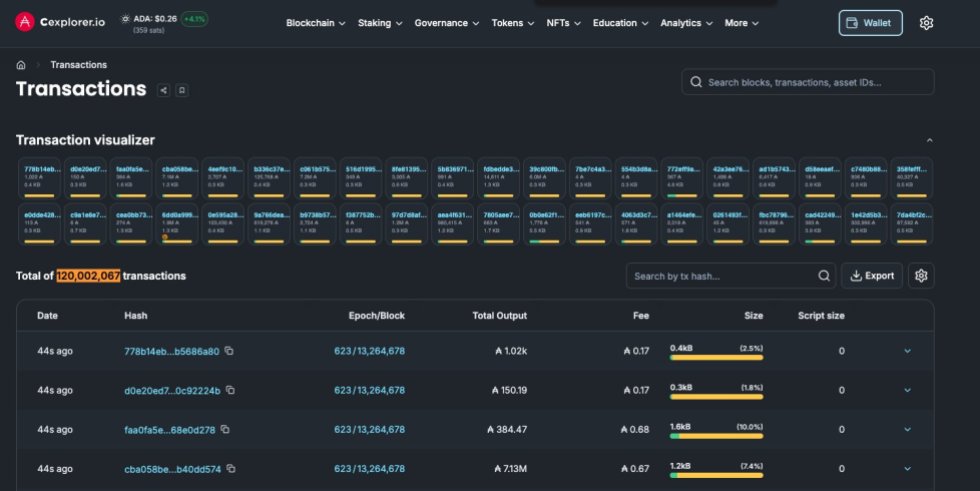
Source: Chart from Cexplorer on X

Currently, transaction counts on the network stand at 120,002,067, as seen in the chart shared by the platform. Such a huge amount of transactions demonstrates heightened adoption and strengthens Cardano’s standing in the larger blockchain environment. Should the user engagement continue expanding, it could spur a broader market performance, allowing ADA’s price to bounce back to key resistance levels.

Large ADA Investors Are Stepping Back In At A Fast Rate

Prior to the report regarding transaction growth, there was news about wallet addresses on the network spiking significantly to levels not seen in several months. These are not just mere ADA holders but wallet addresses holding a substantial amount of ADA, who are considered large investors or whales.

In the report shared on X by Santiment, a leading on-chain data analytics platform, it was highlighted that the number of wallet addresses holding at least 10 million ADA has skyrocketed. The rise in large-holder addresses indicates that wealthy investors are gradually increasing their holdings, which may indicate a resurgence of faith in the network’s long-term prospects.

Currently, these investors are not positioned at a 4-high 424, which represents a +5.2% rise in 9 weeks. Despite its downside trend, Cardano has not yet decoupled from other leading altcoins in 2026. ADA’s market value experienced a +11% since it reached its bottom back on February 5th, 2026.

Large investors are often seen as the main drivers for massive price movements, which implies that their activity could shape the impending move for ADA in the short and long term. In a bullish outlook, the growth might mark the start of a stronger phase for the altcoin.

ADA trading at $0.25 on the 1D chart | Source: ADAUSDT on Tradingview.com

Related Questions

QWhat major milestone did the Cardano network recently achieve in terms of transaction count?

AThe Cardano network recently crossed 120,000,000 transactions on its mainnet.

QAccording to the article, what is the significance of the increase in wallet addresses holding at least 10 million ADA?

AThe increase indicates that large investors, or 'whales', are gradually increasing their holdings, which may signal a resurgence of faith in the network's long-term prospects.

QWhat is the current price of ADA as shown in the chart from Tradingview.com?

AADA is trading at $0.25.

QWhich on-chain data analytics platform reported the growth in large ADA wallet addresses?

ASantiment, a leading on-chain data analytics platform, reported the growth on X.

QDespite ADA's bearish price trend, what has been the trend in user activity on the Cardano network?

AUser activity on the Cardano network has been growing significantly, reaching new heights and major milestones, with transactions spiking hard.

Related Reads

Breaking the DeFi Cascading Liquidation Curse: Vitalik Proposes a New Solution

Vitalik Buterin has proposed a new DeFi design to eliminate the automatic liquidation mechanism that causes market instability during sharp downturns. The current system, used by protocols like Aave, triggers forced sales when collateral value falls below a threshold, often exacerbating price drops and creating systemic selling pressure. Buterin's alternative model is based on splitting an asset like ETH into two synthetic option-like tokens, P and N, pegged to a price index. Their combined value always equals one ETH. Instead of sudden liquidation, a position's value gradually drifts from its target peg if the market moves. Users must proactively rebalance their holdings to maintain their desired exposure, transferring the management burden from the protocol to the user or automated tools. A key advantage is the reduced reliance on real-time oracles. Pricing decisions are deferred until contract expiry, allowing for more robust, fault-tolerant oracle designs. This removes a clear liquidation threshold that speculators can target for manipulation or MEV extraction. However, significant challenges remain. Frequent rebalancing could incur high slippage and transaction costs, necessitating new liquidity provider models. The design is better suited for hedging instruments than for stablecoins requiring a rigid 1:1 peg. While not an immediate replacement for existing systems, the proposal challenges the foundational assumption that instantaneous forced liquidation is an unavoidable necessity in DeFi, opening the door for fundamentally different risk management architectures.

marsbit2m ago

Breaking the DeFi Cascading Liquidation Curse: Vitalik Proposes a New Solution

marsbit2m ago

The End of Single-Factor Cryptography

The article "The End of Single-Factor Crypto" posits a fundamental shift in the cryptocurrency ecosystem. It argues the era where crypto asset valuations were predominantly driven by, and correlated with, Bitcoin's price is ending. The space is bifurcating into two distinct economies: endogenous and exogenous. The endogenous economy represents traditional crypto, where token and project values are directly tied to crypto market prices. The emerging exogenous economy comprises projects and businesses that may utilize blockchain technology or tokens but derive their fundamental value from external, non-crypto factors like consumer demand, subscription revenue, or real-world utility. Examples include AI inference platforms like Venice, fintech lenders using blockchain for efficiency, and stablecoin/payment infrastructure companies acquired by giants like Mastercard and Stripe. This shift means investment analysis must change. For exogenous assets, evaluating traditional business fundamentals—such as revenue streams, unit economics, and competitive moats—becomes more critical than tracking Bitcoin charts. While endogenous assets like Bitcoin remain relevant, the growth of the exogenous category is driven by measurable demand independent of crypto price cycles, paving the way for a new, more diversified market phase. Consequently, crypto is evolving from a single-factor, reflexive asset class into a multifaceted ecosystem with varied drivers and investment theses.

marsbit2m ago

The End of Single-Factor Cryptography

marsbit2m ago

Morning Post | Bitmine Plans to Raise $300 Million Through Preferred Stock Issuance; Polymarket Accuses Kalshi of Commercial Espionage

ChainCatcher's Daily Crypto Brief: Key developments from the past 24 hours include significant funding moves, regulatory actions, and market predictions. Bitmine announced a $300 million preferred stock fundraising. Polymarket accused rival prediction platform Kalshi of corporate espionage, citing numerous suspicious coincidences in product launches, a claim Kalshi strongly denied. The U.S. Department of Justice, in a joint "Disruption Week" anti-fraud operation with companies like Coinbase and Meta, froze over $3.8 million in cryptocurrency linked to scams. In infrastructure news, Macau completed its integration with the multi-central bank digital currency bridge, mBridge, aiming to build efficient cross-border payment channels. Cosmos Labs acquired the block explorer Mintscan. Market-wise, Geoffrey Kendrick, Standard Chartered's Head of Digital Assets Research, stated Bitcoin is nearing a bottom around $63,000, maintaining a year-end target of $100,000. He noted stability in U.S. spot Bitcoin ETF holdings. Ahead of SpaceX's anticipated IPO, internal insiders at Rocket Lab (RKLB) sold over $18.41 million in stock. In tokenization, Goldman Sachs partnered with Apex and Archax to launch a tokenized real estate fund. The meme token tracker GMGN reported the top trending tokens: on Ethereum, HEX, SHIB, LINK, PEPE, mUSD; on Solana, TROLL, swarms, WORLDCUP, neet, Buttcoin; and on Base, PEPE, toby, ODDS, ELSA, SKI.

链捕手17m ago

Morning Post | Bitmine Plans to Raise $300 Million Through Preferred Stock Issuance; Polymarket Accuses Kalshi of Commercial Espionage

链捕手17m ago

55TB to 28TB? The Rumor and Panic Behind Rubin's Memory Being Halved

Title: 55TB to 28TB? The Rumor and Panic Behind the Potential Halving of Rubin's Memory. On June 4th, a report from SemiAnalysis suggested NVIDIA's next-gen Vera Rubin NVL72 AI rack may ship with roughly 28TB of SOCAMM DRAM per rack instead of the anticipated 55TB, primarily using 96GB modules. This sparked a market panic, causing Micron's stock to drop over 10% on fears of halved memory demand. However, the article argues this panic is misguided for several key reasons. First, SOCAMM modules are socketed and upgradeable, not soldered. Lower initial configuration doesn't mean permanent demand loss. Second, the primary driver is a severe 2026 LPDDR5X supply shortage, not diminished need. NVIDIA is likely prioritizing rack shipments with available components. Third, with fixed total LPDDR5X supply, using less per rack could allow NVIDIA to ship *more* racks, not necessarily reducing overall memory orders. Micron's sharp drop was also attributed to a broader semiconductor sell-off triggered by Broadcom's earnings, with the SemiAnalysis report providing a convenient narrative for profit-taking after Micron's massive rally. In summary: the report on lower default configurations is likely accurate, but interpreting it as a demand collapse is wrong. The real risk for Micron lies in its reportedly minimal HBM4 share for Rubin, not in potentially flexible SOCAMM demand. The sell-off appears more like a correction amplified by coinciding negative catalysts.

marsbit34m ago

55TB to 28TB? The Rumor and Panic Behind Rubin's Memory Being Halved

marsbit34m ago

Exclusive from Yingke | Tang Wenbin's 'Yuanli Lingji' Merges with Logistics Robotics Company, and Secures Investment from Zhipu, SenseTime, Jieyue, and Others

Exclusive report: Embodied AI company "Yuanli Lingji" recently completed a new round of financing from major AI model firms including Zhipu AI, Stepfun, and SenseTime, alongside continued investments from industrial backers like Huaqin and SAIC Hengxu. Founded in March 2025 by Tang Wenbin, former co-founder and CTO of Megvii, Yuanli Lingji is a general-purpose embodied AI model company. In a notable move, the company has merged with logistics robotics firm "Atomix" (formerly known as Yuanli Juhe) through a share acquisition. Atomix, which originated from Megvii's logistics robotics business led by Tang in 2016 and was spun off in July 2024, has grown to become the world's second-largest supplier of pallet shuttle robots, with annual revenue nearing 1 billion RMB and over 500 projects globally for clients like Uniqlo and CATL. This merger aims to break the industry's "data deadlock" by combining Atomix's extensive real-world operational data from more than 20 countries with Yuanli Lingji's model training capabilities. The company's embodied AI model "DM0" utilizes a cross-domain training approach, integrating internet semantics, autonomous driving rules, and robotics data to achieve hardware-agnostic, precise manipulation even with a compact 2.4B parameter size. The collective investment from key AI players and the strategic merger signal a shift in the competitive landscape, as major model companies pivot from language tokens to physical actions ("from Token to Action"). The industry is entering a consolidation phase where hardware, AI models, data, and application scenarios converge to scale embodied intelligence, a trend mirrored by recent moves from giants like ByteDance and Skild AI.

marsbit41m ago

Exclusive from Yingke | Tang Wenbin's 'Yuanli Lingji' Merges with Logistics Robotics Company, and Secures Investment from Zhipu, SenseTime, Jieyue, and Others

marsbit41m ago

Trading

Spot
Futures

Hot Articles

Discussions

Welcome to the HTX Community. Here, you can stay informed about the latest platform developments and gain access to professional market insights. Users' opinions on the price of ADA (ADA) are presented below.

活动图片