Cardano Founder Shades XRP And Solana, What’s Going On?

bitcoinistPublished on 2025-12-22Last updated on 2025-12-22

Abstract

In a recent development, Cardano founder Charles Hoskinson highlighted the Midnight (NIGHT) token's trading volume surge, which reportedly exceeded the combined daily trading volumes of XRP and Solana. According to data, NIGHT recorded over $6 billion in daily volume, compared to $2.4 billion for XRP and $2.07 billion for Solana. The Midnight token, a privacy-focused sidechain of Cardano, initially crashed over 90% after its airdrop but has since rebounded strongly, rising over 30% in 24 hours and 44% weekly. Its launch reignited interest in the Cardano network, generating over 122,000 transactions. Despite this, Cardano itself remains in 10th place by market cap, with a daily trading volume of $405 million, while XRP and Solana hold 5th and 7th positions respectively.

Over the last few years, Cardano has fallen into the background when it comes to decentralized finance (DeFi) participation as the likes of Solana and XRP ramped up. Solana triggered the meme coin wave that swept the market for two years, and XRP continued to push into institutional adoption with deals and partnerships, as well as regulatory compliance, while Cardano lagged behind. That is, until recently, that an anticipated launch changed the tide in favor of Cardano.

The Midnight (NIGHT) Token Launch That Changed Everything

Earlier this month, a new token rocked the crypto sphere as the Midnight (NIGHT) went live with its airdrop. At first, the token looked to be off to a slow start, crashing by over 90% from its launch $1.81 all-time high to reach below $0.025. This had made widespread news as airdrop claimers rushed to dump their tokens.

However, what seemed like a dead drop has begun to change, with the Midnight (NIGHT) token moving fast and taking the Cardano network along for the ride. As Bitcoinist reported, the token launch had essentially reignited interest in the Cardano blockchain, leading to over 122,000 transactions containing NIGHT tokens.

Midnight, which is a side chain of the Cardano network, focuses on investor privacy, leveraging the recent privacy narrative that has taken hold in the crypto market. With a large number of airdrop claimers having collected their tokens, and presumably sold, the token has begun to recover.

On Sunday, market reports showed that Midnight (NIGHT) was one of the best-performing altcoins in the market, rising over 30% in a 24-hour period. On the weekly chart, it showed a 44% increase, as its market cap rose above $1.5 billion again. However, that is not the thing that caught the Cardano founder’s eye.

Cardano Founder Trolls XRP And Solana With Midnight (NIGHT)

With the Midnight (NIGHT) token price soaring, there was a major spike in its trading volume, enough to catch the attention of Cardano founder Charles Hoskinson. Stakepool had taken to X (formerly Twitter) to share with the community that the Midnight (NIGHT) token had secured more trading volume than Solana and XRP combined.

Responding to this post, the Cardano founder pointed out that Midnight (NIGHT) was a native token of the blockchain and has managed more trading volume than both XRP and Solana combined. This is backed by data from CoinMarketCap, which shows Midnight (NIGHT) with a daily trading volume of over $6 billion, compared to $2.4 billion for XRP and $2.078 billion for Solana in the same time period.

However, Cardan itself continues to struggle, with $405 million in daily trading volume for the same time period. XRP and Solana are the 5th and 7th-largest cryptocurrencies in the market, with Cardano at 10th place, and Midnight (NIGHT) at 46th position.

NIGHT price holds gains from Sunday | Source: NIGHTUSDT on Tradingview.com

Trending Cryptos

Related Questions

QWhat recent event changed the tide in favor of Cardano after it lagged behind Solana and XRP?

AThe launch of the Midnight (NIGHT) token, a side chain of the Cardano network, which reignited interest in the Cardano blockchain.

QHow did the Midnight (NIGHT) token perform immediately after its airdrop, and what was the market reaction?

AIt crashed by over 90% from its all-time high of $1.81 to below $0.025, leading to widespread news as airdrop claimers rushed to dump their tokens.

QWhat key feature of the Midnight blockchain is highlighted in the article as leveraging a current crypto market trend?

AIt focuses on investor privacy, leveraging the recent privacy narrative that has taken hold in the crypto market.

QAccording to the article, how did the daily trading volume of Midnight (NIGHT) compare to that of XRP and Solana combined?

AMidnight (NIGHT) had a daily trading volume of over $6 billion, which was more than the combined $2.4 billion for XRP and $2.078 billion for Solana.

QWhat was Cardano founder Charles Hoskinson's response to the trading volume achievement of the Midnight token?

AHe pointed out on X (formerly Twitter) that Midnight, a native token of the blockchain, had managed more trading volume than both XRP and Solana combined.

Related Reads

Olympus DAO Myth Reappears? A "Sovereign On-Chain Central Bank" Written with 4000 Lines of Immutable Code

A new project called The Standard Reserve has emerged, branding itself as a "sovereign on-chain central bank." It aims to replicate core central bank functions—currency issuance, money supply adjustment, and reserve accumulation—entirely through 4,000 lines of immutable code, with no human governance. Its core mechanism is a "reflexive monetary policy" based on a single signal: the net ETH flow into or out of the system's sole Uniswap v4 ETH/$STANDARD pool. Sustained net ETH inflows trigger an "expansion" phase, increasing $STANDARD issuance and using protocol fees to buy tokenized gold as a permanent hard reserve. Net outflows (or zero flow) trigger an immediate "contraction" phase, reducing issuance and using fees to buy back and burn $STANDARD. The system involves six key entities: the $STANDARD token (hard-capped at 1 billion), the central Uniswap pool, the Central Bank contract, Charter NFTs (acting as "banking licenses"), Branch units under each Charter (which earn a share of newly minted $STANDARD), and separate Vaults for expansion (buying gold) and contraction (buying back $STANDARD). To participate, users ideally acquire a Founding Charter NFT (initially 1,000 are free via allowlist/public mint). Each Charter comes with one Branch; more can be opened by burning $STANDARD for "expansion permits," increasing revenue share. Retiring a Branch lets users claim accumulated $STANDARD but imposes a dynamic exit fee (higher if many exit simultaneously), with half the fee burned and half distributed to remaining participants. All protocol revenue (from pool fees and Charter auctions) is allocated: 70% to the active Vault (for gold or buybacks), 15% to permanent protocol-owned liquidity, and 15% to the team. The project presents an innovative, game-theoretic model where user actions (expanding Branches by burning tokens or exiting) align with system goals of building reserves or inducing deflation. However, it is fully anonymous, with key parameters undefined and unaudited code, posing significant risks.

marsbit5m ago

Olympus DAO Myth Reappears? A "Sovereign On-Chain Central Bank" Written with 4000 Lines of Immutable Code

marsbit5m ago

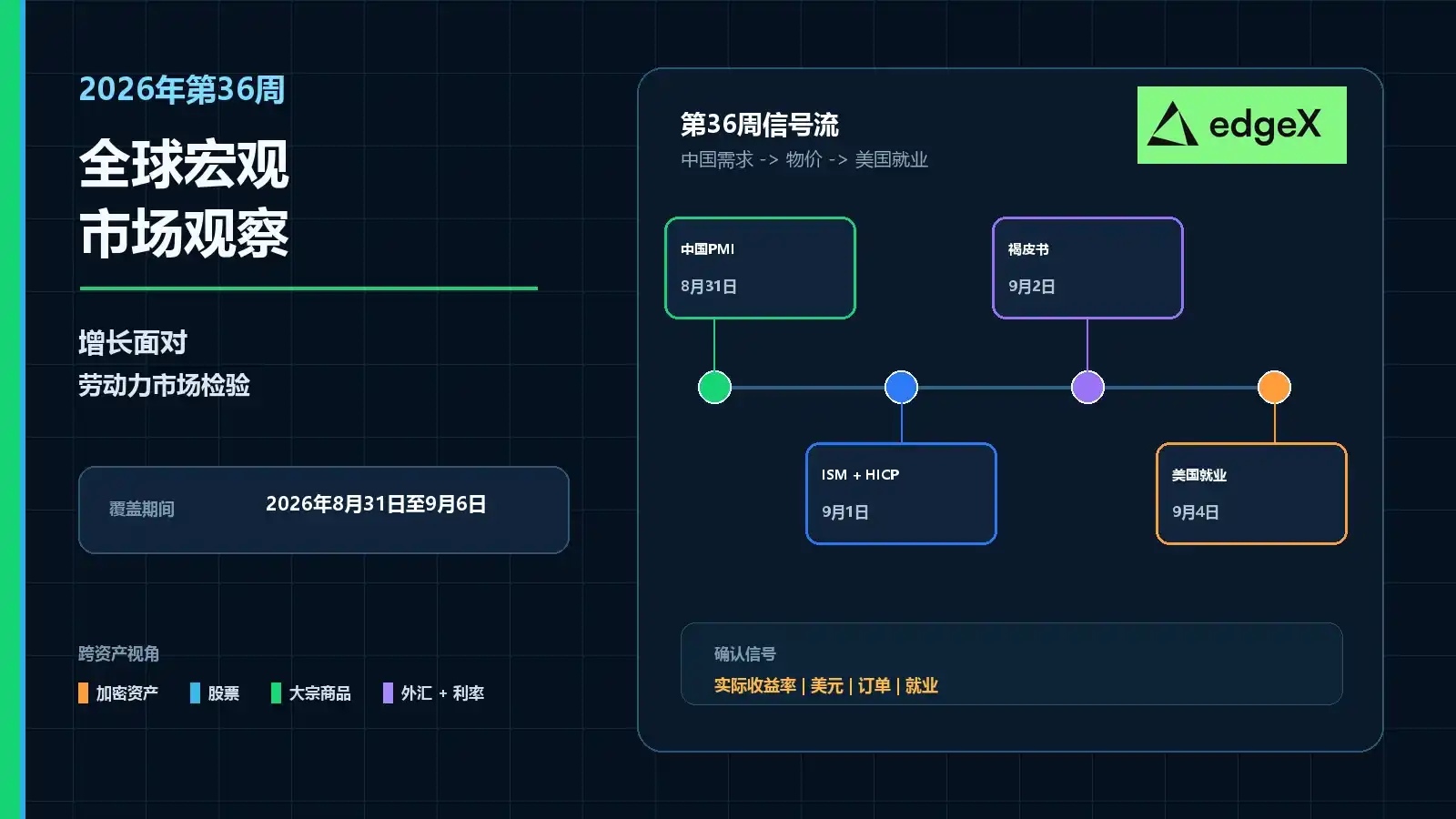
US Jobs, China PMI, and Inflation on Stage: Can Global Growth Maintain Resilience?

**Week 36 Macro Outlook: Key Data to Test Global Growth Resilience** The week from August 31 to September 6 will shift focus from policy discussions to a critical test of global economic activity. The sequence of events is key, starting with China's official August PMI on Aug 31, which will provide early signals on factory orders, services, and employment following July's contraction. The data flow then broadens. On September 1, US ISM Manufacturing PMI and the Eurozone's flash inflation estimate will offer simultaneous checks on demand, prices, and regional divergence. The subsequent US Federal Reserve Beige Book on September 2 adds granular, qualitative evidence on consumer spending, wages, and regional conditions. Australian Q2 GDP and Canadian trade and jobs data will test resilience in other major economies. The week's pivotal event, however, is the US August employment report on September 4. It will decisively influence expectations for interest rates, the US dollar, and broader risk appetite, acting as a final cross-check for the preceding data. The core question for markets is whether global growth can remain resilient. An ideal outcome would combine a rebound in China's PMI, stable US jobs growth, cooling inflation, and signs of a gradual demand slowdown. Conversely, weak Chinese manufacturing, sticky Eurozone prices, and disappointing US non-farm payrolls would create a more complex scenario of reduced corporate confidence and limited room for aggressive monetary easing, increasing pressure on cyclical assets. Investors should monitor the breadth of improvements—such as new orders and employment—rather than headline PMI figures alone. Confirmation across different data points is crucial. A positive combination of steady activity and disinflation could support equities, industrial commodities, and risk assets like crypto. However, if a growth slowdown triggers lower yields, it must be distinguished from a scenario of rising recession risks that would pressure corporate earnings, potentially limiting rallies. The market's final reaction will hinge on whether the week's signals align to either reinforce or challenge the current growth narrative.

marsbit8m ago

US Jobs, China PMI, and Inflation on Stage: Can Global Growth Maintain Resilience?

marsbit8m ago

Trading

Spot

Hot Articles

Discussions

Welcome to the HTX Community. Here, you can stay informed about the latest platform developments and gain access to professional market insights. Users' opinions on the price of S (S) are presented below.

活动图片